041 Richie Cotton (DataCamp) on Creating Courses and Confidence
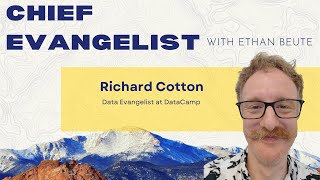
Richie Cotton, DataCamp's Data Evangelist, talks about moving from teaching into curriculum creation and hybrid evangelist work. He explains how evangelists help people overcome fear of data through relatable analogies, and describes the practical work: podcasts, webinars, cheat sheets, and tracking metrics like marketing-qualified leads.
Chapters
Welcome to Chief Evangelist. I'm your host, Ethan Butte. I'm on a mission to explore and understand the role of the Chief Evangelist and the movement behind it. How should founders, investors and C suites be thinking about it? How does it benefit the company? Which companies and markets need evangelism most? What does the work involve? What does success look like and who's a good fit as a chief evangelist? That's what we're exploring@chiefevangelist.com and in conversations like this one, which is brought to you by Ringmaster Conversational Marketing and their evangelist powered podcasting package. Learn more@ringmaster.com. Today we're learning from the Data Evangelist at Data Camp, a data science, data analytics and AI training platform for teams and businesses. He spent the past seven years with their team as a course creator, curriculum and quality lead, and curriculum and learning solutions architect. So I feel like curriculum and learning and training is going to be a thing. Richie Cotton, welcome to Chief Evangelist.
Thank you, Ethan. I'm really excited to be here.
Yeah, I was really glad to connect. I love what you all are up to. There's obviously a great need on earth for what you all are providing and I think it's so great that you've spent so much time with the team and have evolved your role into an evangelist role. That's kind of the story we're going to tell here, I hope. And I'll start, Richie, where we always start on the show, which is the most important job of an evangelist. What comes to mind when I offer that to you?
Sure. I think there's really two things. I mean, first of all, you need to make sure that you get people to care about your products or services. And I think within the data space especially, there are a lot of people who are just terrified of using data. So a lot of my role is just about making sure that people feel comfortable getting started and they get over that fear.
I really appreciate that. And it's obviously a human endeavor given the words that you use, like terrified. Like, that's a powerful kind of emotionally charged scene that comes to mind with a word like that. And I totally get it. Talk about the human to human quality of that. Like, it doesn't seem like I don't think you can knock down terror with a really good blog post or a customer service macro.
Absolutely. Yeah. There are obviously some people who just won't come anywhere near Data Camp because they are too afraid of it. But I think one thing that's changed, certainly over the course of my career and particularly in the last few years is that using data has gone from being a sort of nerd sport to being something that everyone has to do. So finding more and more people where they probably avoided using data or taking any kind of data training for as long as they could. And then suddenly they realized, well, in my work, I have to use data. And they're sort of forced into it. And at that point, it's just showing them. Well, actually, you know more than you think you do, because everybody does have to use data in real life. I mean, even if it's just, you know, consulting a weather forecast, there's data that you're then interpreting. And so people do have some data skills. And it's just giving them the confidence to know, well, okay, I can do something, and what's the next step? And actually, there are a lot of really simple steps you can take just to get started doing something productive at work with data. And it's just showing people that they are capable of this.
Yeah, I love it. So this idea of helping people care and making them feel comfortable, if not even confident, I appreciate what you just did there, which is brought it right down to earth. All of us have looked at a weather forecast on our phone or on our laptop or on a television screen or something, and. And that's exactly right. So talk about the role of, like, analogy or metaphor or even storytelling, like, because you just. That was just a great example of. It's like, oh, ye. I guess I have looked at, you know, 10 different numbers across the screen, highs and lows on the day, and figured out what that means for me and how likely is it to be true and how likely was it the last time I saw this number? Can I trust my intuition? And all these other things that triggers. Like, that was just a great example. I'd love for you to speak to the power of those techniques.
Absolutely. I think you really nailed it, that the idea of analogies and turning something that's maybe technical into something that people understand already. So we do a lot of things where if you're analyzing data sets, we'll analyze like a movie data set or maybe a sports data set, something like that, something that people have seen. Because once you get into, well, okay, I'm analyzing some marketing funnel or something like that. Well, some people care if your job is in marketing analytics, but most people, they're not going to instantly connect with that. And it's really about knowing your audience and saying, well, okay, how can we make this relevant to the people we're speaking to?
Yeah, really Good. How did you find Data Camp or how did they find you seven plus years ago?
Uh, yeah, I found Data Camp. Um, I. Before that. I mean, I've come into this role like a lot of people on your show through, starting with the, the technical side. So I've been a data scientist for coming up, 20 years now, since before it was called Data Science. Anyway. And back in 2016 I was actually working in Qatar at Wild Cornell Medicine. So this is the medical branch of Cornell University. So I was doing, I was helping biologists and chemists do scientific research and asking stupid questions like, oh, well, just remind me what a cell is again. And then because it was in Qatar, all the money came from gas and oil and the price crater and I was looking for another job and I'd heard about Data Camp because they were just starting to make courses and actually someone had mentioned to me, oh, Richie, you should go and make a course. So I'd heard from that way and yeah, there was an open role and I thought, you know what? Teach. Teaching sounds fun, so let's do it.
Awesome. Had you done any formal teaching like, or I guess what was your depth of familiarity with teaching and some, like, the real techniques behind it when you stepped into that role? Or was it. I'm an expert in this topic and I'll figure out how to connect it to people, like, talk about how that went, like right out of the gate. And ultimately what I'd love to do over the next several minutes is kind of get your progression that leads up to the doorstep of it makes sense for you and the company in the market to be an evangelist, but I'd love to take our time in it a little bit as well. So talk a little bit about stepping into that. It was an early curriculum role, correct?
It was, yeah. So actually my teaching story starts way back. One of the first jobs I had coming out of university, I was a secondary school teacher teaching mathematics. So I'd had no teacher training at all. I was a substitute teacher. And at least in the UK you don't need any qualification for that beyond having a degree. So actually the first school I went to, it was a failing school since been shut down. And it was like day one, I just got handed the keys to my classroom was like, this is your form class, go and teach. And that was a brutal trial by fire. So teaching courses is much easier by comparison. I think one thing that really helped me though, getting into the sort of teaching side of things, was writing books. I've written two books on R programming and the first book happened by accident. I was involved in the R community and this is pre GitHub day. So if you had a problem with an R package, you would email the maintainer and say, okay, I think I found a bug, blah, blah, blah. And so I'd been contacting a package maintainer back and forth a few times by email and he said, you know what? I've been asked to write a book. I don't want to do it on my own. Will you write this book with me? So we put in this proposal for a book together and it was like, you know what? Actually, I'm busy. Can you just write the book? So I ended up just writing a book and it turned out to be a huge career break. And it turned out that I enjoyed content creation. So that was how I got into it. And then a data camp. Going from writing a book to creating courses was a fairly small step.
Yeah, by the way, what a pro tip. Invite someone in to do part of the work with you and then just step all the way out completely. What a cool experience for you though, like at that point I'm sure. Well, I'm not sure of anything. Had you ever thought about writing a book before? And how did that process. And I asked primarily because a lot of folks that I'm talking with either have written books or want to write books. I'd love to learn a little bit about your experience, especially because you were, you know, it's not like you're like, I'm gonna write a book, and you went out for it like you kind of got welcomed into the process, kind of how did it go relative to your expectations?
So it turned out to be mostly easier than I expected, like, because it was something I'd not thought about before. So I hadn't really known how difficult it was going to be. I mean, it is a huge amount of time and the amount of money you get back from it is next to nothing. But writing that book then led to the next job because they're like, oh, wow, you've written a book. That's amazing. And, you know, it's opened so many doors career wise. Nowadays, I would say actually creating online courses is perhaps a more effective way to teach people just because it takes less time and you reach a much wider audience. Like, I think the course I've made on data camp have been taken by half a million or so people. And the books, I mean, I think have been read by a few tens of thousands of people at this point. So certainly the amount of impact Compared to effort, online courses are better than books at this point.
Yeah, super interesting. And I can totally see that. And I wonder. And you're right, like, even a good selling book like yours or mine, like, if you sell 50,000 books, it's like, that's amazing. But here you are at a half a million on your course and you're like, I think we get another half million.
Absolutely.
What was. I mean, when I think about it, I think about like, okay, what is the topic? What are the big chunks of it, in what order should they be sequenced? And some of these other kind of like basic logistical things. I can see that as organizing chapters of a book, and I can also see that as organizing, you know, modules of an online course or something. Talk about the parallel between a book and a course in terms of just structure and, like, how you're going to teach a topic. Because in general, you're like, okay, this is the topic. These are the top five takeaways that we need. Or, you know, whatever the goals you set in terms of people who interact with the material, you want something to happen with them. What are some of the main similarities or differences? Am I oversimplifying it to say that a table of contents is a bit like an outline for a course?
Yeah, it's kind of the same sort of thing. I think one thing at Datacamp that we've had to work on a lot is how you prepare for writing. So before you even get into creation, there's a lot of preparation goes into it, because we make hundreds of courses. And then a lot of the people who are creating courses don't have that sort of background in creating content. They're people with technical expertise. And so a lot of it's about thinking very carefully about who your audience is. And this goes the same for the evangelist role. You really have to know who you are speaking to. And then beyond that. Yeah, it's about trying to work out where people are beginning. Like, what do they know already before they start consuming your content? And what do you want to. What do you want them to know by the end of it? And then after that, the outline is really just sort of dreading that needle. Like, just going from start to finish and trying to put it in a sensible order.
Yeah, very good. Talk a little bit about your journey through Datacamp from that initial role that you were in. Talk about that like, how long did that last? What was next and why? And lead us up to the evangelist decision. And I'm just curious to break that decision down too. Is it yours? Was it theirs? Where did the language come from? Et cetera, et cetera. But like kind of walk us up to maybe a year and a half ago.
Absolutely, yeah. So my first few years at Data Camp were in the content team. So this is about making courses and projects, and some of them I made myself, and a lot of them were with external instructors who. It was really a people management process. Like getting. Persuading other people to create content people outside the organization. Exactly. People outside the organization. And then a few years ago, I switched to the Learning Solutions team. So I decided I wanted to be a little bit more commercially focused. And so the Learning Solutions team is very closely. They work very closely with sales and customer success. So it's the sort of educational equivalent of pre sales engineer or solution architect. It's those kind of roles. So it's really helping business customers who are generally learning and development admins. So they understand about learning and development, but they don't know about data. And it's just saying, well, this is how you run a data training program. And that worked very well for a few years. And then how I got into the evangelist role, basically we'd had this position, it was a new position, and we'd had it open for about eight months or so, and my boss finally said, you know what, Richie, you got a face for podcasting. Why don't you, why don't you apply for this? And so it wasn't a position that I'd really considered before. I hadn't. I didn't really know exactly what an evangelist involved at that point. I was like, okay, I applied and I guess because not Bell supplied, I got the job. So. But I'm very glad I did. It turned out to be a lot of fun. But yet again, I think there is this sort of lack of awareness about what does an evangelist actually do. And that's why I really love your show because it's, you know, helping spread the message.
Love it. So when you. So when you got approached, like, I know who we'll talk to about this. Let's go talk to Richie. So when you got approached, like, what was your gut reaction like to the title or even to the opportunity?
Yeah. So I had to have a. A good read of the job description, see what I was actually getting into. And it did seem to be a very natural fit once I understood what the job involved. Because I do love this app. This. I do love teaching people. I love content creation. And then just having the opportunity to interact with our users and potential users, you Know all these people who are sort of casually interested in data in Data Camp or in data in general. It's really amazing. Like, that's one thing I sort of missed when I was creating courses. You create the course, but there's not quite that natural sort of contact with the, with the people consuming it, especially with online learning. And so this role's amazing just because I do get to speak to our users, like several times a week.
Love it. What was. What were just the job. I. I don't. You don't need to read the job description to us all, but, like, what were some of the key elements of the job descri description as it was written? And which were you like, oh, heck yes, I'm all about this. And which ones were you maybe thinking, gosh, I wonder if I. I could. Should would be good at that? Or I'm going to need to kind of close that gap. Like, when you looked at that job description, what jumped out to you for like, oh my gosh, I could do this tomorrow and I could do this every day. And what jumped out to you as I need to figure that out.
Yeah. So a lot of my job does involve content creation. So some of the stuff that I was like, okay, yeah, I can do this in my sleep. Things like running webinars and I do creating cheat sheets or reference materials for data topics. So that was all pretty straightforward. The other thing I do is I'm one of the hosts for the Data Framed podcast. And I have to confess, like, before I got this job, I didn't really listen to podcasts that much. And so then I had to kind of do a blitz and just listen to a load of podcasts and be like, oh, yeah, this is what it's about. So, yeah, that, that was something I was a bit nervous about beforehand. The other side of thing, that of the job that's been completely new to me is working closely with marketing. So trying to understand what makes content popular, how is it distributed? How do you ensure that you get that repeatable machine of content that people will consume? And it's not just speaking to a nerdy data science audience, because it has to be a lot more broad than that.
Yeah, really interesting. How deep into is your, you know, who is the primary webinar audience? Is it existing course takers? Is it potential course makers? Is it teams and companies that haven't made a commitment to data camp? Like, who are you making the. Just because you mentioned audience and how important that is for courses? Just talk about the webinar Initiatives in general. Like, who are you reaching with those?
Sure, yeah. So we have sort of four key audience segments. So you have the existing data practitioners. So these are data analysts, data scientists, machine learning scientists. We've got a few data engineers as well. The second group is people who are more casually interested in data. So people are just getting started, trying to understand what's this all about. And then perhaps more on the business side, we also have data leaders. So these are people who are trying to work out how do I get better at using data across my whole team or across the whole organization. And then the fourth group is learning and development professionals. So people who are trying to work out how do I run an effective online data training program.
Super. In the podcast, was that existing, or did you have to start that as part of the. Was that, like, part of getting the evangelist position going?
No, the podcast been around for a few years. I think we started 2017, 2018. And yeah, we were already on the second sort of host when I took it over. So it's now me and my boss, Adele. So we sort of alternate episodes, and Adele and the previous host, Hugo, had done a great job in sort of building an audience. So I think we're sort of. We're one of the top data podcasts at the moment. I'm not sure exactly what number it is, but certainly top five. And so, yeah, I'm in a very cushy position of just kind of maintaining this thing and keeping it going and trying to find interesting new topics and guests.
Very good. Okay, what are some of the other, like, key activity zones? Like, when you look at your calendar for a week or a month? A, how consistent is it? Say, quarter to quarter, year to year? And B, how consistent is it like on A. In a. In a tighter timeframe than that? Like, what's it like? What are some of the main activity areas that you're spending time in beyond those two?
Yeah, sure. So, uh, the. The kind of the. The broad strokes. I mean, we have quarterly targets, and it doesn't change that much from one quarter to the next. You know, I've got to create a certain number of podcast episodes, a certain. Get a certain number of webinars out, create a certain number of cheat sheets. The one thing that takes up a lot of my time, which I. I guess I hadn't really anticipated. I spent so much time on LinkedIn just trying to find interesting people and persuading them to come and give a presentation on something or come and be interviewed. So I think that's one of the. I mean, it's a very enjoyable part of the job, but that's one thing that I didn't realize would take up so much time.
Really interesting. Are your success metrics again? I think. I think you just said it, but I wanted to be really clear. Like, are the success metrics the output? Essentially, yeah.
So my personal goals tend to be around the amount of content that's created. So I'll have.
Yeah.
Targets for number of podcasts, webinars, et cetera. On a team level, what we really care about is sort of the impact. So there will also be goals around the number of average number of attendees for webinars, number of listens for the podcast, and things like that. So you want to know that there are people actually consumed the content, so were then sort of forced to create high quality content that's popular and also distribute it well. So that's why it's a team goal rather than a personal goal, because it does rely on people who are running the social accounts, people who are running the email accounts, marketing people and things. So it is very much a team effort getting popular content out there.
Absolutely, it is. How are you that. That made me think about, like, talk about the team that you're in. Like, where do you live inside the organization. And. And then maybe on the heels of that, we'll get into like, how far out into the organization does your direct connection and communication spread? But, like, how are you structured inside the org? And how big is the org?
Sure, yeah. So datacamp is roughly 200 people or so at the moment. And I live within the media team, so there are currently four of us. So there's Adele, who's the boss. Can think of it like a band. So you know, Adele's lead singer. Then I'm on guitar doing all these sort of webinars and things. We got Matt on base. He. He's in charge of our tutorials. Reese's drums, so he's our operations expert. So he kind of makes sure everything runs smoothly. We are between product marketing people at the moment, so usually we have a product marketer as well. So I guess they're keyboards.
Yeah. Really good. And is that. Is media like. Like who. And we don't need to make a whole org structure, but, like, who does Adele report to? Is the team inside marketing or is it kind of a freestanding org that goes to like a operations person? How do. How. Where does this sit?
Okay, yeah, so Dell, he's the VP of media and he reports to our.
Chief operating officer now go to that other side. Like in terms of direct interaction and direct communication, are you engaging with the SAL team directly? Are you engaging with the customer service, customer support, account management teams? Like how do you interface inside the org? Or are you primarily just cranking out all this, all this work and trying to bring people in to teach others?
Yeah, so we are closest to the marketing team and that's because our sort of metrics feed into like what we really care about is getting the. Is how the sales cycle starts. So our metrics feed into metrics around the number of marketing qualified leads. So Basically, number of MQLs is the sort of the end goal for good media content. We do work a little bit with the sales and customer success team because we create a lot of B2B focused content. So if there's a webinar that is going to be interesting to some customers or prospects, then we'll tell the will tell sales and customer success in advance and they can send out emails saying, hey, you should come along to this webinar and that that's a slightly more direct way of getting people on the B2B side interested.
Yeah. How talk about this curriculum theme. I mean, I think it makes sense just looking at your background on LinkedIn and certainly what you shared in this conversation. When I think about the first four evangelists I interviewed and the 10 things I kind of outlined as the takeaways from those conversations. You check a number of those boxes, including, you know, been with the team for a long period of time, our expert in the topic, you know, like, you check a lot of the boxes and so talk about the importance of this curriculum background within the organization to the work that you're doing now. It seems obvious to me, but I'd love to hear you talk about, in my imagination, how smooth the transition was into the evangelist position, given your background.
Yeah, it certainly makes some things easier. For example, whenever we do a webinar, we'll then send links to the audience, say, okay, well now you want to go and take these courses that are related. And because I've got most of the curriculum sort of stored in my brain, that's a much easier task. And I think in general, when I'm talking about product features, that's all sort of, you know, I've been using this for years, that that's.
Yep.
It just comes naturally at this point. So I do think that your point about having had some experience with the company does make things a lot easier. And in terms of technical stuff, I think a lot of the webinars when I'm hosting them. I think most of the time I have more experience than necessary. So just, you know, introducing someone and then reading out audience questions at the end, it's not a difficult task, but occasionally things become difficult and this is where the experience helps. So recently I did a webinar and about 20 minutes beforehand the instructor was supposed to be doing a presentation and he said, well, you know, actually I don't really like the presentation I've created. Can we just do an interview instead? So then like it was an hour long session as had to just make up questions the whole time and just. You do need a strong technical background. Like you need to understand what you're talking about in order to be able to do that sort of improvisation.
Hey, thanks for listening to Chief Evangelist. For so many reasons, podcasting is a great opportunity and channel for evangelism. If you've been thinking about a podcast or you want to shift production and promotion to a team that's especially evangelist friendly, check out ringmaster.com their Connect Engage Scale program is designed for evangelist powered podcasting for software and tech companies in the growth stage. Again, you can learn more@ringmaster.com they're also the team behind this podcast. Speaking of Chief Evangelist, let's get back to it. Yeah, absolutely agree. And it also is a. I don't go in a little bit because, you know, you are. I think it'd be fair to describe you as a data science expert. You might qualify that even further because I don't know the field that well. I can't speak to it like in a more specific zone or pocket. But you know, just I'm thinking about the dynamism of just being able to flip, you know, 15, 20 minutes out from going live with an audience that's expecting something in particular. I'm also thinking again about knowing your audience well and trying to figure out how to get them to care off the top. I'm also thinking about whether it's any of those four audiences you described earlier. Everyone's terrified of something now and then. And so like, like given the richness of your mathematics background, your data science background, that all I think to a layperson who hasn't worked in those zones or studied in those zones, starts to sound perhaps a little bit cold and technical. And yet this is a very warm and human position that you're in that requires some adaptability in the moment. It requires some moving people from one emotional state to another, not just from one state of knowledge and understanding to another state of knowledge. And understanding those two things happen simultaneously. I'd love for you to talk about when. When did you become consciously aware of your maybe strengths in this area or even how do you, how do you think about the human side of this work? You know, it's not just imparting the information, it's also bringing people on some kind of a human emotional journey for their own transformation. When did you realize this was something that you were good at or could get good at or enjoy?
Oh, man, I still. No idea like how you get good at this stuff. I guess it's just empathy really. You know, you gotta try and put yourself in the position of who you're speaking to and just try and, you know, understand what they care about. In terms of deciding, like, when do I enjoy this? I think that's an easier question to answer. So I think a lot of my career I've been work, I've been doing sort of data analysis, data science support for people who don't have a data background. So I started my data career working at the Health and Safety Laboratory in the uk. This is a government laboratory. I was doing chemical health and safety. So I was working with chemists and chemists are sort of, you know, they're smart people, but they don't necessarily care about the data side of things. And yet all their experiments generate data and they're like, oh, got to analyze this now. So I think that was a fairly early sort of career point where I was like, okay, actually there are all these people that have to use data and they don't really care about it. So this is how I can help them out. And so I spent a lot of time chatting with these sorts of people and I guess at this point it just sort of comes naturally.
Really good. How so? As we record this, we're like, it's like Q4, 20, 23. I imagine that you and your team are looking at the year ahead. What does annual planning for the data evangelist at Data Camp look like? Are you, you know, do you have goals that you're setting for yourself? Is it. Are you anchoring up or laddering up to, you know, marketing's goals or the company's goals? Like how do you, what is, what is planning the role for the year ahead look like for you?
Oh, Matt. So we actually have a big planning session in two weeks time. So we're slightly early for this conversation.
Good.
Yeah. A lot of it is about thinking about how we can improve operational efficiency just because, you know, because we have to create so much content, we have to figure out how can we do this efficiently? How can we improve the quality of the experience for the audience? So it's sort of. It's one thing to run a webinar. It's just like a zoom call that I've seen some people do. And, you know, you start using, you know, fancier platforms and, you know, we actually, we switched to Restream recently. It's a very nice experience. And, you know, you have, like, the fancy graphics at the start of it and play a bit of music and all this other stuff. And then how do you follow up with the audience afterwards? Say, well, you know, did you have a good experience? So there's a lot of little things that you can do to make audience experience better. And then also the current thing is, like, we're trying to figure out, how do we get higher and higher profile guests without me begging everyone on LinkedIn?
Yeah. What have you found? What have you found? Definitely doesn't work in that zone. And what have you found that does work in that zone? Because you're sourcing people for both webinars and podcasts? Like, I've been on the receiving end of a lot of outreach for a variety of things in general. You know, if it feels like it's a little bit for me and about me and I. It doesn't feel like it's this kind of broad, generic swath, which the nature of the content that you're looking to produce, obviously you're not just, like, mass dumping this on lots of people. So I don't worry about that for you. But, like, what have you learned for the past year or two about, like, what, you know, what do people really respond to? What doesn't work, what does work?
So one thing that's worked really well is finding people who've spoken on something already. So that means going through lists of speakers at existing conferences, and they're like, okay, I know this person can speak, or at least has tried to speak once before. So that's. That's a good starting point. The other thing is, when I'm doing outreach, personalizing messages works really well. So, for example, if, you know, you search for their name and try and find, like, something they've written or something else they've done before, you can at least say, well, you know, you can first of all vet them to make sure that they can string a sentence together, and then you can say, oh, well, I saw this thing you did already. And then, would you like to do this as well? And that means that you at least, like, you have researched a little bit who they are, and I think people are a lot more amenable to respond then.
Yeah, certainly. So you are a data evangelist. You're not a guy on the marketing team who's a content producer like. And I think one of the differences there is obviously depth of subject matter expertise. But you know, one of the things we try to talk about a little bit on this show, because depending on who I'm talking with and the nature of their role and where they plug into the org and kind of how they landed in that role, and it's funny, so many of them are bespoke positions. This sounds like this job description description was written not necessarily with you in mind, but it became obvious that it fit you. You know, sometimes we're talking a little bit about, you know, it's sales, but it's not sales, or it's customer success, but it's not customer success. In this case, it fits into the bucket of it's marketing, but it's not marketing, it's market, it's content, but it's not just content. Like talk about to the degree that you can on behalf of the organization. Why an evangelist role? To kind of fill these gaps. Is it really that subject matter expertise or is there something more there?
Yeah, I think this really arose because in the early days of data camp, there was a sort of a very definite split between the people who understood data and people who didn't have a data background on the commercial side. So sales and customer success, like there was, there were no one or at least very few people who had any kind of data background. And so a few years ago, the Learning Solutions team has formed and it was myself and one other colleague who did have a data background and had in fact both previously been on the content team creating courses. And so they were or we were there to help sales and customer success have that sort of domain expertise. And that worked really well on the B2B side. But there was no sort of equivalent for people who weren't existing prospects or customers. So particularly on the B2C side, there was not there to tell individuals, okay, yeah, you should come and do this and have someone who can credibly talk about data to them. And this is why the media team was set up to provide that sort of awareness of, hey, this is what you can do with data. This is how you can make use of it. Well, with Datacam, just to a broader audience.
Yeah. And into the idea that you shared earlier that pretty much everyone interacts with data needs some Basic level of data literacy and let's even just call it confidence and comfort because we're all. Well, I know there are, there are people who are probably in some kind of an illiterate category with regard to this. What are some of the top, you know, when you think about, speak to a very mainstream audience, people that are interacting with data, but it's not their full time job and they could use more confidence and comfort. I'd love for you just to share some of your like, like evangelize a little bit about the basics of data literacy.
Sure. Well, one of the most useful skills that is pretty easy to get started with is understanding data visualizations. If you think about a lot of news reports, there's always a plot in there and just being able to look at that and not be terrified and go, okay, well I understand what this means. It's just, it's an essential life skill at this point. So it's something that doesn't take long to learn, but you will benefit definitely. Now I think from a business point of view as well, if you're not working with data, the sort of minimal level of data literacy you need is to be able to have a conversation with that data analyst or with that data scientist. So you need to understand a little bit about what's possible with data, what's not possible with data, and then also understand a little bit of the jargon. So just being able to have that conversation and not be intimidated by the words that they say back to you.
Yeah. And I think, I think a lot of just to, to, to knock down the kind of the terror component off the top. I don't mean to keep going back to it, but like, you know, I, I think and steer me, correct me or add something to this. I feel like meaningful and valuable use of data in a business context, very broadly speaking, is completely dependent on asking really, really good questions. And then the kind of the literacy gap there is, do we have the data? How far can the data take us in helping us answer this question? But really it's driven by questions, correct?
Absolutely. But one thing to note is like you don't need to be really good at asking the right questions straight up. I mean, I'm very keen on having a no stupid questions policy because in fact a lot of the questions I ask are incredibly dumb. And then once you say them out loud you're like, oh well that's not quite right. And then you can refine it into something that is a lot more sensible. But yeah, you shouldn't be you shouldn't feel pressured to ask good questions off the bat.
Yeah, yeah.
But, yeah, certainly. I think there are a lot of fairly standard questions you can ask about data. The hard part is often having those business questions. I feel like the, the variety of business questions is often more broad. And so having domain expertise is also incredibly sort of helpful. So if you're like a business focused person and you're like, well, I need to understand data, actually, like, the data questions are much easier than the business questions.
Yeah, I totally agree. I get that you actually restated the kind of the underlying aspect of what I was probing around, which is, you know, good business questions are what this is really all about. Right. And then the data is the means to the end and the data analysis is part of the means to the end. Where I thought you were going to go right off the top there as you, as you repositioned. What I had offered was kind of the iterative process that you can go back and forth with the data as well. It's not fixed. Like, I have a business problem, which I formulated into a business question which we're now going to, you know, engage with data in some way to get an answer to. There's also like a lot. You can have a back and forth kind of process there as well.
Absolutely. And I think that's the key to success in a lot of, well, solving a lot of business problems is that you have a conversation and, you know, you keep chatting until you get to something that's going to be useful.
Yeah. What do you wish you knew about the evangelist role before you said yes?
I think understanding a lot of that marketing jargon, that, that was the, the hardest part for me was, you know, just understanding like, what are the differences between, like, I didn't understand different marketing channels. Like, what's the difference between organic social and paid social? Or where do ads come into it? And what, what does search engine optimization actually mean apart from, oh, well, Google can. Google can find us sometimes. Um, so yeah, that part of it was, I think, the, the trickiest bit for me.
Yeah. How deep have you had to go into that zone and how terrifying was it off the bat?
Yeah, so I get used to like, not knowing things. I'm sort of comfortable in being ignorant for short periods of time. So I feel like I've learned a lot to the. Well, I wouldn't say I'm an expert, but I've got a little bit of marketing literacy. I know enough of the jargon that I can have a conversation with someone in marketing and we can sort of understand each other.
Yeah, very good. And I. I also appreciate what you shared. There's like a basic life skill, being comfortable being ignorant for some short period of time.
Oh, oh, this is so important. So I find a lot of the times, if we've got a new technical subject where we've got no content, I end up being the person to, like, create this content. So I have to create a lot of stuff where I'm like, I have not a clue. Like, next week I'm supposed to create a cheat sheet on kubernetes. I have never used kubernetes, so it's going to be like, well, okay, I don't know what I'm doing, but I'll figure it out. Create something in the end. And I think one thing that's incredibly important is to be patient with yourself, because quite often you're doing something like this, you will spend two hours reading documentation and going, okay, I've still not a clue what this is about. But eventually you get there and you just need to be okay with accepting you don't know stuff yet, but you will eventually.
Yeah, I appreciate that so much. How. What would you advise? Okay, I was going to ask for, like, general advice for people thinking about stepping into an evangelist role, but I think I'll reformulate it to ask as soon as your title changed, what did some of your colleagues ask you about it and how did you respond? And. Or what did, like, family members or friends? Like, what the heck does this mean? Like, talk a little bit about that.
Yeah, I think a lot of people like, well, what is it you do now? And I think the. The job title I've said, like, it works best is, oh, I'm a podcaster and people are, oh, podcasts. I've heard of those. And that works really well. And if they'll go. If they want to prove a bit detailed, I'll say, well, it's a sort of mix of data roles and marketing together.
Yeah, very good. And I guess I'll ask this too, then. Has anyone approached you? Like, that sounds really interesting. I might want to do that. Like, has that happened to you? And if so, kind of. What advice do you have for people that are saying, well, you know, kind of like marketing, but not marketing, kind of like sales, but not sales. I have a depth of expertise in this zone. How would you advise that person to think about an evangelist role?
You know, I've actually had no, oh, yeah, how can I become an evangelist? I think, yeah, a lot of people like, oh, Speaking to other people. That sounds terrible because certainly within the data data world there's still a lot of people who very much sort of identify as introverts. And the idea of speaking to lots of people is, is a bit scary for them. But I think for people who are interested in this, maybe the most important thing is just you've got to be okay having conversations with people and not be afraid to do public speaking. Because there is an awful lot of that. And so actually my first introduction to public speaking really was I'd lived in a small town in the countryside in England and there wasn't much to do there. But one thing, there was one pub had an open mic story night once a month. So I would go along there, I'd write a story, then I'd read my story out. Just like 5 minute thing to the pub audience. It was very friendly audience. And that's got used to, you know, speaking in public that way. It was a fun sort of way to do things. So I think if you do anything like that, I know other people, like if I do the colleagues who've done stand up comedy, who've done improv acting, just things like that, where you are doing something performative. I think that's a really great way to just get into this role where I mean. Yeah, essentially performing.
Yeah, I totally agree. It's interesting. Mine happened kind of by default. I was the first and only marketer in a very, very small company. I ended up doing a lot of the customer support like training videos and things. I developed like some of the training webinars and that expanded into more like strategic types of webinars where it wasn't just like click here, do this, go there, like that kind of webinar to like, hey, where does this fit in your day to day? Where does this fit in your week to week? And so when we finally got some traction in a particular industry is in the real estate space. We started going to real estate conferences and we ended up getting a breakout session. And it was like, all right, good news, we got a breakout session at this next. And it's a massive event. You know, like 20,000 people at this event. Of course not all of them were in the breakout session. Cause there are multiple going on at any given time. But we, you know, we were pretty excited about it. So like, hey, who's going to do that? Like Ethan, you go do that. Like, okay. And I was super nervous because I hadn't done anything like that. I had not done an open mic anything. I hadn't really done improv, I guess I had been on. Yeah, I guess I had done some stuff like that. In general, I would describe myself as introverted as well. So I think it's one of those things you can't force. I think the most interesting thing I heard from you about that was I was in a small town and it just seemed like something fun to do. Right. It wasn't like I need to develop this skill. So it's really interesting. Here you are this person who's written multiple books on the topic. It makes sense. Kind of even going back to your mathematics degree and teaching young kids mathematics and now here you are teaching people of a variety of ages how to be much more comfortable and confident in a data environment. But you're also the kind of person who was creatively writing stories and reading them on a stage. So it's like. And this is why I think so many of these roles are actually bespoke. Like you can't. That's why the job description was open, I think.
Yeah, it is definitely very hard to find someone with technical skills and who likes to do chit chatting about the topic rather than actually doing stuff. I mean, I think in data especially, like there are so many people who enjoy building things that talking about data is a very different prospect to, you know, going and writing some Python code.
Yeah, absolutely. Richie, this has been super fun. I love what you're up to. I hope you have a great year ahead. And before I let you go, I would love for you to share something that you evangelize in your own personal life.
Oh, man. I think I want to pick two, if that's all right. Please.
Yes.
You know what, I've had like a lot of colleagues who kind of burnt out over the years or got stressed or whatever. And I've got two long term hobbies which I think have provided me a modicum of protection against this. So the first one is that I've been doing yoga for nearly 20 years now and I'm kind of an uncoordinated person. So I do yoga after work and because it involves thinking about where all my limbs have to go at once, it requires complete focus and there's just no way of thinking about work. So that really helps. The other thing is I do hiking and I'm a strong believer in like having a hobby that involves a little bit of danger. So I used to do things like mountain biking and rock climbing, but you know, middle age now. So hiking is. And the scales really nicely, from gentle walk in the park to backpacking and the first time I went solo backpacking, it was in the Smoky Mountains in Tennessee. And I've been hiking all day. Get to the campsite. And it says, campsite shut due to aggressive bear activity. And I can see all these, like, bear footprints and bear that on the ground. And so I set off walking to the next campsite, and the heavens open, and, you know, it's torrential rain. The fog rolls in, and I. By the end of the day, it was, like, it was going dark. I hadn't seen another human in hours. And then on the trail in the distance, I'd see, like, this large animal run through the fog. And so at this point, I'm panicking. I'm like, hey, bear, come on. I will fight you. And I'm holding my hiking poles like swords. Anyway, I make it to campground, like, survive. But is that sort of, like, little bit of jeopardy experience in your hobby, which makes you realize that your quarterly targets are not that bad?
Yeah, really good. Yeah, I. I love hiking as well. I. In general, I draw the line. I'm in Colorado, so I have access to a lot of mountains. I draw the line at, like, if the. If the description recommends ropes and helmets, like, that's not that interesting to me. Um, and I'm definitely not a backpacker. I'm much more of a day hiker. But there is something that brings you to life about it besides just the physical exertion. It's the. And it sounds like you were out alone, which I like to do, too. I know that it's not recommended, but I really like that time and space to myself. In addition to some of those challenging moments of, like, you know, the trail is super faint here, or there's, like, a creek crossing, and you look like the trail goes straight up to the creek, and you know that there's a creek crossing coming. You look across the creek, and you're like, there's no obvious place. This trail picks up. Like, those are. For me, that's the kind of fun. Like, it's not danger per se, but it's still kind of the fun challenge where you have to kind of get through it yourself. And it brings you to life. And. And it does. It takes your attention off of things in a way that makes your return of attention to them, make them seem smaller or more manageable.
Absolutely. Agreed. Yes.
Yeah. Cool. I appreciate you, man. This was super fun. I hope you have a great rest of your afternoon. I wish you safe hikes, and maybe we'll. I don't know. I haven't been to the Smoky Mountains since I was a little, little kid. But maybe I'll see you on the trails up time.
Absolutely.
Yeah.
Thank you for having me. The time just flew by. That was really fun.
That wraps up this episode of Chief Evangelist. Thank you for joining us. And thanks to Ringmaster Conversations Marketing for helping bring these episodes to you. With any thoughts or questions about the Chief Evangelist role, Message me on LinkedIn. I'm Ethan Butte E T H A N B E U T E For show notes and more of these conversations, visit chiefevangelist.com.
More from Richie

#359 My Best Friend is AI with Valerie Tiberius, Professor of Philosophy at University of Minnesota







How AI Agents Will Work While You Sleep | Ruslan Salakhutdinov, Professor at Carnegie Mellon

#358 How AI Agents Will Work While You Sleep | Ruslan Salakhutdinov, Professor at Carnegie Mellon

