#109 How Data Leaders Can Build an Effective Talent Strategy (with Kyle Winterbottom)
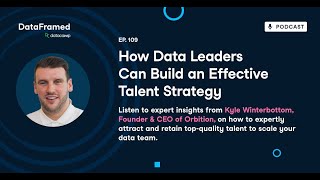
Kyle Winterbottom, founder of Orbition, talks with Adele about building data teams after the pandemic hiring boom proved unsustainable. He identifies the core problems: scarcity of mid-senior talent, reactive hiring, and weak employer narratives. The emerging Data Product Owner role bridges technical teams and business users, while retention depends on visible work, competitive pay, and remote flexibility.
Chapters
You're listening to Data Framed, a podcast by Data Camp. In this show, you'll hear all the latest trends and insights in data science. Whether you're just getting started in your data career or you're a data leader looking to scale data driven decisions in your organization, join us for in depth discussions with data and analytics leaders at the forefront of the data revolution. Let's dive right in.
Hello everyone. This is Adele, Data science educator and evangelist at Data Camp. Over the past year hosting Data Framed, I've had the privilege and honor of interviewing a lot of data leaders and practitioners on how to become data driven. One common theme is that it always boils down to the people side of things. Whether upskilling or hiring, becoming data driven is a talent strategy just as much as it is a technology strategy. This is why I'm excited to have Kyle Winterbottom on today's episod. Kyle is the host of the Driven by Data podcast and the founder and CEO of Orbition, a talent solutions provider for scaling data analytics in artificial intelligence teams across the uk, Europe and the us. Throughout the episode we touched upon a few themes that are really relevant to building a holistic talent strategy for data teams, including hiring and recruiting, improving retention for data teams and how to approach upskilling and more. If you enjoyed this episode, make sure to rate and subscribe to the show, but only if you liked it. Also make sure to check out the content we have in store this month on on building a data driven organization. It ties a lot to the themes we talk about on the show. And now onto today's episode. Kyle, it's great to have you on the show.
Thank you very much for having me. Looking forward to it.
I am very excited to discuss with you all things building effective data teams, how organizations should be approaching hiring, retaining recruiting, data talent and your work leading orbitrend and hosting the Driven by Data podcast. But before maybe can you give us a bit of a background about yourself?
So I've been in the data and analytics talent and recruitment space for the last 12 years. I guess Orbition is a boutique kind of talent solutions business that operates exclusively in this world. So we're headquartered here in the uk, but we have a presence out in the States and do quite a lot of work across the uk, Europe and America. And I guess really the bulk of what we do is done at the mid to senior level and often done at scale. So helping organizations typically to build out their data leadership and management teams and then the senior technical teams that fit beneath them so that could be, I don't know, working with a FTSE 100 or Fortune 100 as an example that want to hire 40, 50, 60 people over a 12 month period. It could be a smaller to mid size enterprise that wants to hire eight to 10 people over the next two to three months. It could be an organization looking to appoint a chief data analytics officer as an example. So there's three components to our business, really. And then yeah, as you mentioned, outside of the day to day, the business really is underpinned by the community element that we try to serve. So we have our podcast, we have our event series, we have our mentorship scheme, partnerships with universities to try and raise awareness and things like that. So yeah, roughly speaking, that's a little bit about me.
That's really great. And there's definitely a lot to cover. So I'd love to set the stage for today's conversation by first trying to understand what the hiring and retaining landscape looks like for Data talent in 2020. We're at the backdrop of a pandemic. The rise of remote work, the great reshuffle, the great resignation, and now a downturn in the economy. So maybe in your own words, how would you describe the landscape for hiring and retaining data talent in 2022 and how has it evolved over the past few years?
So, interesting question. I think the, the last 18 months have been, if you were to sum it up in one word, would be crazy, right? You know, so I think it's been interesting because I have conversations on a daily basis with people that might have not have been in the job market since before, before the pandemic. And normally one of the first questions I get asked is how is the market now after the pandemic? And it's interesting because I think really data and analytics was very fortunate. So a lot of the work that we were doing with organizations, even after the pandemic started, obviously there was a natural pause. So while people figured out what's going on, how long is this going to last, etc. But within a matter of months, recruitment in this space was back to normal levels. And then obviously start of 2021 and ever since it's been on a trajectory like, like that. So it's certainly been crazy. But also just the level of growth and the amount of hiring, we were always going to see a natural correction. So we talk about now the great resignation, we talk about a potential downturn in the economy. We've definitely seen a bit of a slowdown over the last couple of months. But I don't think that's necessarily related to the economic situation. I think that's more of a natural correction because just the scale and the pace of hiring in this space just wasn't sustainable to keep going the way it had been going for the last 18 months. And then I think anything outside of that, which I'm sure we're going to get into in a little bit more detail, but there's been a lot more focus, I'd say, over the last 12 months, especially around trying to maybe realign our focus on getting the foundations of data and analytics right as opposed to focusing on the shiny technical AI type stuff, which many businesses unfortunately got kind of distracted by had.
Yeah, definitely. I'd love to like talk about that trap at a later point in the conversation, but maybe on mentioning the crazy and unsustainable pace of hiring over the past 18 months, what were the drivers behind such high demands of hiring in the data space, especially over the past 18 months?
Well, I think if every business leader now knows that for them to continue to thrive and be fit for the future, as we starting to refer to it as that data is going to play an almighty important role in that. Unfortunately, that's easier said than done. Right. So the execution becomes really difficult. But I think what we found is that you're getting more organizations actually starting that data analytics journey, and then you're also getting organizations that are already in the midst of it, throwing even more money at it. So it was a combustion of two narratives coming together at the same time, which meant there was an awful lot of businesses looking to hire people and not just ones and twos, you know, multiples. So I don't think I've spoken to a business over the last, God, 18, 24 months that's saying we just want to hire one or two people. It's normally, you know, we need to hire 10 engineers and four data governance people and yada yada, yada. So that combustion of those two narratives, the demand and the lack of supply, I think all together just created this, this big kind of boom, really.
That's very exciting. So let's definitely go into the details about hiring and recruiting data talent. You've, as you mentioned, you've worked with quite a few organizations over the few years on filling their talent gap. Walk us through maybe some of the main challenges data leaders are facing in filling their talent gap. And how have you addressed these challenges?
I think there's a, there's a few key things and probably to frame and give you a bit of context around the Question. I've used the analogy that data leadership is almost coming like football, soccer management, or I guess management of any sports team, right? Where the demand for instant return is so high that a few months of instability or unsuccessful results and people's heads are on the chopping block, unfortunately. So what that created is this environment where organizations and their data leaders need to hire people that can come in who can hit the ground running because unfortunately they just don't have the time or usually the energy, the finance, the resource to bring on more junior people, more entry level people, and wait for them to be developed and trained, as unfortunate as that is. So at that mid to senior level, that's where every business is trying to recruit people from. And obviously, as I just mentioned before, the amount of businesses looking to hire, the fact that they're trying to hire in multiples, the fact that there isn't enough people that certain job disciplines more so than others, for sure. But that's led to this point now where there's just such a demand that there's, there's not enough people there. So that's been the challenge is that we're in a talent short market. But the really, the only way that data leaders can go and start to add value quickly is by hiring people that are of a certain level that know the job, that can come in and just hit the ground running, but there aren't enough of those people. So that's certainly a challenge. I think the second part of this challenge that most data leaders face and where we try to start to then take conversations is do you have a strategy around your talent and your talent attraction and your talent acquisition? Because what we find is that most businesses don't, unfortunately, you know, most are very reactive to their own needs. So hence why 9 out of 10 conversations we have and you say, okay, well when would you like this person or these people to start? It's a case of yesterday, right? And, and I always try to kind of use the analogy of if you were to ask a business or a data leader, how do you go about acquiring your customers? For example, if you talk about new customer acquisition, they'd be able to give you a pretty compelling answer around that. You know, well, we do this and we do this and the whole nurturing process and we multiple touch points and we try to engage them in all of that type of stuff. That's exactly what organizations should be doing with their, with their talent. But they're not. They only think about it when there's a big gaping hole and the reality is obviously dependent upon where you're located. But there's an interview process, length is a notice period to work. So often, especially here in the uk, right, you get organizations that they want to hire someone who they would love to have started yesterday, but the reality is they're not going to have anyone to see for probably five months, which obviously causes challenges. Right. So that whole talent strategy of well, when are you going to need skills, why do you need them, what should them skills look like? And then how do we start to go and engage those types of people so that legwork and groundwork has been done so that when the time comes for us to actually make a hire, we are much further along that process. So that's the thing where we usually start. And then I think that the next piece around that is do you have a compelling enough narrative, you're competing with hundreds if not thousands of other organizations for the very same talent at the very same level. It's not just about are you paying well, et cetera, are you using the shiniest and latest tech? So talk about compelling narrative. But why should someone join your organization over the other 10 to 15 options that they might have? Because we're talent short and there's high demand. So that whole compelling narrative and creating that narrative of what's important to that audience, that's something where we, we focus a lot of time and attention. And I think to bring that all together, there's really the landscape of data analytics talent has changed. Their wants and needs and desires have changed over the last few years, especially where many, unfortunately, many kind of went into organizations where they were told we're a data driven business in quotation marks. And they realized when they got in there actually that that wasn't the case. They felt like they were on a production line of projects where a project lands on their desk, it gets done, it goes off into the ether and they never see or hear about it ever again. So they don't know if it was good, whether it was bad, whether it was used, whether it had any value, whether it had any impact, etc. So we try to tie that compelling narrative back to how are you apart from how are you different and how is that compelling? But how can you make the day to day work of these people be visible, be valuable and be impactful across the organization? Because beyond just salary, location, technology, exciting projects, that's the other part of the equation that people are now starting to look at organizations and assess them in terms of the people looking to enter those businesses.
That's really great. I love the answer. And there's so many things to unpack here. I want to maybe start off with the talent strategy component. Right. And to go on a bit of a tangent, you mentioned here that very few organizations have a talent strategy similar to their, or at least a strategy that is as robust as their customer acquisition strategy. Maybe walk us through, what does a robust talent strategy look like for an organization in the data space?
Well, I think that the fact that so few organizations actually put any time and attention into this, it's kind of one of those things where anything is better than nothing. Right. Right at this stage. So I think it's just trying to get ahead of the curve on this. Right. Because as I said, most businesses are really reactive. So it's a case of based on that data strategy that hopefully is being compiled to operate in tandem with the business strategy and then the operating model around that. Okay, well, where are the current gaps in this team? Are those gaps causing us problems right now? And how do we prioritize which of those gaps are really important to us? That then gives you a list of prioritization and then it's often a case of whether you believe it or not. In fact, we do a lot of work around actually you think that you need this skill set, but you actually don't. Really. What you'd be better off with is this skill set. So, for example, data science being the sexiest job of the 21st century. Unfortunately, many organizations went out and thought they needed a data scientist if they were going to become data driven again in quotation marks. And I've spent many, many meetings trying to convince business leaders that you don't need to hire a data scientist at this point in time. All that is going to do is mean that you pay 20 to 30k more than you actually need to for the skill set that you really require at this time. And they're going to come in and get really bored and leave, which is a very expensive, higher and not a very efficient strategy. So I think it's about prioritizing the gaps that you have and therefore when you need to recruit them and then working backwards from that point. So if you know that in January 2023 you're going to need, I don't know, a data engineer, for example, to do X, Y and Z. Well, really, you should have already started that process last month. Right? Because by the time you factor in notice periods, the interview process, etc. Etc. Unfortunately, it doesn't work like that. There'll be hundreds of organizations that get to January and go, okay, we need a data engineer and they won't have one until May to June. So I think, I think that that talent strategy and then tie that in with how do we make our proposition compelling to the audience that we're trying to engage with.
It's really interesting because it's really similar to like a marketing department in some sense, where you need to build like a predictable pipeline of talent, create an entire marketing narrative around why you need to join this organization, and all of these pieces need to fall together to be able to create that predictable pipeline of talent.
Yeah, that's exactly what it is. Yeah, absolutely.
That's really great. So given your vantage point in the market, you know, what are the different data roles that organizations are currently hiring for? And maybe more importantly, how has the skill set or requirements of these roles have evolved over the past few years?
Yeah, so obviously I think we've seen a big shift in the last two years, especially around, around the market. And again, to go back to something that I said earlier, I think many organizations again, unfortunately jumped feet first into the wrong areas. So they made investments into areas like, you know, advanced analytics, data science, AI, ML, when they almost saw that, I guess as a bit of a silver bullet and they really didn't have their house in order. Right. They just weren't ready for that type of activity and initiatives. So we've seen, and probably just by again, natural correction, unfortunately, you know, many businesses have spent an awful lot of money and not got a lot of value out of what they were expecting in comparison to what they were expecting. So therefore, now I've had to trace their tails back and things like, okay, data engineering is really important and we hired a load of data scientists and we couldn't get data out of one system to the next and for them to do any data science on. So data engineering has been far and away alongside architecture, the biggest area of growth in terms of demand for sure. Same conversation goes for data governance and data management. Again, many businesses didn't have their foundations in place and therefore they didn't get the value they were expecting. So data governance and data management has certainly been an area of high investment and where there's been a lot of hiring. And I think the thing that's probably changed the most, if you look at transformation and innovation of our sector, we're starting to see now a real big drive towards a product mindset, our product thinking, to treat data as a product or data as a product or data products or whatever terminology we're using. Around that on the basis that, as we all know, the stats have shown us that many, many data analytics initiatives don't add the value they were expecting to add. And obviously then you trace that back to things like culture and adoption within organizations. The data product thinking and mindset seems to have driven better level of adoption and engagement from those business businesses and business users. So I think that's going to be something that is going to be really prevalent over the next 12 months or so. So we're getting to the point where there's a few key things I'd say that have really changed over the last. Over the last 12 months.
That's really awesome. And I love that last notion on approaching data as a product. Maybe walk us through what does that skill set look like in practicality for organizations? Right. And what are the roles that are usually reserve for this type of skill set?
Yeah, so it's interesting. So I personally think the title that most have adopted is Data Product Owner. And really we've heard the term coined the data translator. Right. That's being branded. And at one point in time that almost threatened to become an actual real job title, which would have been interesting. Right. So to kind of have that as an official title. But I think the data Product owner has effectively become that person. Right. They are the person that normally comes from a background where they at least understand the technical concepts so that they can sit between the business and the business users and the data analytics team, and they can ensure that the products that the data team are creating are actually being embedded and used properly within the business. I think it's more of a mindset thing than anything else, to be honest with you. I don't think there's any kind of huge revelations. In fact, you probably hear many conversations in the industry. This stuff almost already happens, but probably just with not the rigor around it. So you talk about data translators. They were often responsible for going out and just trying to make sure that the whole business was adopting whatever the data team were producing. I think this has become a little bit more focused. So you might have someone that's responsible for a single type of product as far as making data a product and really becoming an expert in that product and being known for that product in and around the business. So I'd say that's the key thing around that. It's the ability to translate technical lingo into, I don't know, someone that works in a marketing team or someone that works in an accounting team, for example, understands what's the premise of me Using this product, why should I do anything different? I think that's probably a good point to highlight, right. Many businesses have been operating very successfully forever without data being at the core of their business. Right. So effectively we're asking people to change and transform their behavior to suit what we're trying to do. So there needs to be that level of buy in. And I think historically speaking, the whole soft skills again in quotation marks, because the soft skills tend to be the hardest skills to master. I think they're the things that we're really starting to focus on. If we can get that right, then the rest of it takes care of itself. Because eight to nine times out out of 10, the thing that we struggle with is often the softer skills. It's not, it's not the building of the data lake or the dashboard or the model. We're pretty good at that, right. It's getting them to use it, getting it to be embedded into the culture, getting it to be adopted so that actually you can see some value out of the other side of that. Whereas what's often happened is we've built great solutions, these solutions, either it's trying to answer a problem that we don't have, or it's not the right problem to be addressing at this point in time and therefore it's not used and therefore it's been a big cost with little return.
I love how you define the data product owner as the next iteration of the analytics translator, because I do think that there is some specialization to be had in that field and more maturation of the processes and kind of the notions of what makes an embeddable machine learning or data science solution as our best practices are evolving. So given that, let's also talk about retention. I think retention has never been more important to think about today, especially given the great resignation, the great reshuffle that we experienced over the past year. How have you seen the great reshuffle effect data roles and how have you seen data leaders trying to address the retention problem?
So I think retention is probably one of, if not the biggest problem that a data leader faces, right? Because if you think about it really logically, every business is going to have some level of attrition that's just they've got to factor that in and most of them do factor that in. However, in a market where there's been such a shift, right? So just to give you a very plain example, part of the problem and challenge that most data leaders have now is that if they've had someone that's worked for them for three or four years, they'll be a certain level with a certain salary. For them to go externally to the market and bring the same person in at the same level, they're probably going to have to pay them £20,000 more because there's been a shift in the market which obviously causes a lot of problems internally politics, as I'm sure anyone would, if someone's working alongside a team member that's doing the same job and finds out that they're getting paid £20,000 more for doing the same job, probably isn't going to be happy about that. So in my eyes it makes absolute sense that rather than having to go to market for additional recruitment, why don't you focus your time and attention, first of all, on keeping the people that you've got happy and retaining them? Because the other side of the coin is that when they're not happy and there's not been a leveling up, let's say in terms of salary and remuneration to what the new market kind of standards are, those people are also sitting ducks. Right, because other organizations will just go and pluck them straight out because the individual knows that the market has shifted by £20,000 as an example. They're not getting that at their current organization and someone else is more than willing to, to pay them to do that. So the retention problem is very real. Often though, I think the unfortunate reality is that most people on an individual basis are better off by moving jobs in terms of they will get so bigger titles, more responsibility, bigger pay packets by moving roles than they will do by staying with an organization. Even if they get promoted, they might get a percentage uplift in salary, but. But it's never going to equate to what a move will get you. So I think there just needs to be some thought around that. Right. The reason why that happens is companies internally are dealing with politics, red tape, salary bandings, job title levels. It's a really difficult process to navigate, but unfortunately it's one that's happening and there's not really a right or wrong answer. I think it's something that most data leaders struggle with a lot of, to be honest with you.
Yeah, I can imagine. This is something that we've definitely seen over the past two years. What have you seen to be the differentiator between organizations suffering from retention issues versus those that are not?
So I think natural things like are they willing to have a conversation with us about leveling up salaries to new market conditions? I think that that's. That's a given. Obviously the whole move to having a more flexible workforce and work life balance, I think that's been something that's, you know, if there was something out there that has has dramatically changed since pre Covid to now, it's that I think most people are more aware than ever that they want to be in a place where they can add value so their work is visible, valuable, impactful, but they have a great work life balance and they're not needing to be on the road five days a week. So I think it's businesses that have really tried to cater to the needs of the market in regards to that kind of flexibility, I think is the differentiator between those that have retention issues and those those that don't and businesses that fundamentally at their core look at, okay, how do we make sure that the work of our team is being used, it's visible, it's valuable and it's impactful for them that they're having an impact on this organization and they're not just coming to work doing a job that they never see or feel or hear about. So I think that's, that's the key thing. We talked about the compelling narrative earlier from an attraction standpoint. That compelling narrative also plays out from a retention standpoint. Right. Because if an organization is able to articulate over and over again, look, this is why we feel that we're better as an employer in the data analytics industry over you going down the road and getting a 20,000 pound pay rise. But what you're doing here is actually going to be better for you longer term. It's going to look better on your cv. You're going to actually add some value to an organization which is going to help your growth and development and all of that type of stuff. I think it comes down to organization, organizations that are really forward thinking about this stuff and trying to think about actually what are our people fundamentally interested in and how do we cater to that as opposed to taking very hard lines on well, we want people back in the office three or four days a week and it needs to be prescribed on these three or four days a week because ultimately that's probably not flexibility either.
Yeah, I'm really looking forward to expand on that flexibility notion. But maybe let's pause a bit and discuss the making work visible, valuable, impactful. I think a lot of data leaders struggle with this and I think this gets easier, easier as you go along the data maturity curve and actually become a data driven organization. So maybe for those organizations at the beginning of that Spectrum. Right. That are still struggling and getting value out of data. How do you create a culture that makes the work of your data professionals visible, valuable and impactful?
It's a really good question because it's, it's. As we know as an industry, it's really difficult to actually be able to put quantifiable, tangible value to the data analytics initiatives. I often think this comes down to, if I'm being really kind, the ability of the data leader within that organization to spearhead the whole team and really put it in the midst of the business, to be seen and to be heard. I think there's a few very obvious ways that you can do that. One thing that I really like, which I don't think really gets as much airtime as it should, we speak off the cuff around communication. Right? And obviously communication in our industry is really important to be able to make sure that, that the business understands what we're doing and how are we translating it, and where do we get the value from and how do we articulate our role that we've played in that value. But often that's where it starts and ends. It's almost like a flippant comment that communication is important. And it is. What I've seen work really well is where organizations have put together a communication strategy. So with their internal PR team, for example, where they have a budget assigned to communications, it might be an internal podcast where they talk about what's going on with data. It might be where they've built a bit of a data academy. That's for the business users to come in and start to look at. Well, how can I get more involved in creating my own dashboards, for example? I think it's trying to bring awareness and literacy, if we want to use that term around. How do we bring all of that, that to the forefront? Because ultimately that just raises the profile of the data team within the organization. So I think that's one really useful example where I've seen it work quite.
Well and harping on that notion of dedicating a small budget for communications and public relations or internal er of the data team's work. One example I've seen that works really well comes from New York Life Insurance, actually, where we had on the podcast, Glenn Hoffman, the chief data analytics officer of New York Life Insurance. What they do there, for example, is that for each new project there is a dedicated landing page internally with like really high quality videos explaining the new project, what it's about, et cetera. And that is very effective at creating excitement within the organization and driving adoption and making sure that the work is visible, valuable and impactful. So another thing that I'd really love to discuss here that you mentioned is flexibility. Right. One thing that you mentioned here is on remote work and creating work life balance. Of course, remote work has been quite on the rise over the past two years and is one of the differentiators that we see more and more so on the market as to why candidates stay or leave an organization. A great example would be Apple's directorate of machine learning. Ian Goodfellow left Apple because of the return to office policy. Maybe walk us through how remote work and your perspective has impacted organizations ability to find and retain data talent.
Yeah, so I think this is a really, really interesting topic because obviously you've got two very clear distinct sides of the fence here. Right. You know, you've got the individual that naturally wants as much flexibility and work life balance as possible. And, and rightly so. I think if the pandemic has taught us anything, it's that we probably had an unhealthy obsession, most of us at work. So the whole work life balance thing has been a real positive that's come out of the pandemic. I think how businesses have kind of tackled this. So I think there's been this general misconception in the general employment market, right. Especially for people that do office based on roles, of course, that once the pandemic ended that everyone was going to just stay 100% remote. And I think that's obviously been proven to be a myth. Like we, we work with very few organizations that are willing to appoint people on fully remote contracts. Right. I think most organizations want people to be visible in some aspects that could be a day, a week, it could be four days, a week, whatever. Like each, each company obviously sets its own policy, but naturally that has a KN effect to how businesses can either retain or attract new talent. Right. Because if the work life balance and remote working aspects are really important, then obviously no one's going to be choosing to go and work for Apple. Right. As per your example. So I think that's been something that I think what it's done outside of that obviously it's quite interesting because I think most organizations operate within their own own kind of locational bubble. Right. Because that's how they've been used to thinking and operating. So I don't know if you're based in, in New York City, there's a radius, right. From a postcode perspective, let's say of really where someone would be willing to travel from and to. And you could pretty much hazard a guess as where that would be. That's obviously changed now. So in, in essence, the candidate pool is as great as you want it to be. Right. It's really up to your, the organization on what their party line is, on how willing they are to appoint people in fully remote roles or not. So that plays a part because therefore your candidate pool is greater equally on the other side of that coin that your competition is greater. I think that's something that a lot of organizations didn't really think about. I think they thought, okay, well, now we can appoint someone, I don't know if we're based in London, we can appoint someone based in Spain. Fine, our candidate pool has grown. But actually that same person in Spain could also be be employed by Google in San Francisco. So therefore your candidate pool, your competition has also grown despite the fact that the candidate pool has grown. So I think those things have been everything that plays into it. The attraction of talent is probably not as easy as most organizations thought it would be on that basis. The retention of talent all comes down to now how flexible is the organization actually willing to be? And then you tie because. Because let's be honest, most people don't make a decision solely based on if they can work remotely or not. There's a lot of other factors to it, but obviously it's a factor that still is very high up on most people's agenda.
Okay, that's really great. And I love that holistic perspective. I love how you show the other side as well. Given that we discuss as well how to make business users more engaged as well with the data analytics team's projects, how to get business users involved. I'd love to talk about as well hybrid roles. Right. And how organization have been filling them. To give a bit more context, earlier in the year we had Matt Siegelman on the podcast who is the chairman of Burning Glass Institute. And they do quite a lot of natural language processing on open job descriptions across the Internet. And one of the main insights that they have found is that there's a hybridization of roles where a lot of data skills are becoming standard as part of traditional business roles such as marketing operations, etc. For example, think of roles such as business operations analyst, marketing analysts, revenue operations analyst. Walk us through from vantage point of data leaders. How have they been filling up these roles as well?
This is really interesting because I think it shows that we are moving in the right direction. We're starting to think about there's roles in Our organization that don't have to be plugged by pure technical data people, which I think is a really good thing. I've become probably famous on LinkedIn for talking about how bad most job descriptions have been over the last several years. Even if you think about the Chief Data Officer Russia, normally the first requirement was to be able to code in Python. It's kind of like, well, yeah, shouldn't probably be the case. So I think it shows that we're moving in the right direction. It also shows that there's more awareness and literacy around the role that data is going to be playing within those individual domains. Now, naturally you will get areas that marketing and finance are probably two areas to pick on here a little bit because they are typically more data literate in the sense of they're used to using data to measure and manage performance. I think the reality of hiring those people is then quite different because whilst the notion and the concept of hiring people with hybrid skill sets, I think what it does, as I mentioned before, is the whole thing around soft skills and you know, the commercial skills and the persuasiveness and the influencing and the adoption and the communication, all of that stuff. That stuff that historically, not exclusively, but historically, you know, a lot of data teams have struggled with. So you can acquire a lot of skills from outside of the pure data analytics world that really works better in that space. But then obviously there's certain things that those people need to be, need to be upskilled in maybe from more of a data and analytics analytics space, for example. So I think it's definitely a step in the right direction. It's probably a lot easier in theory to say than it is to execute on because obviously that they've typically been in most businesses been two separate roles. Right. You would have maybe a data analyst that comes in and just sits within finance or just sits within operations or just sits within supply chain and then you would have someone from the business again in quotation marks that they almost become business partners to each other. I think we're starting to see that these business partners can learn some of the core fundamentals of you're getting data people that are becoming better communicators, influencers and then can start to act more as the business. So yeah, in theory it works. Finding those people is really difficult, I'd say.
Yeah, that's really great insight. And you mentioned here the importance of upskilling. Maybe where you see, expanding on that, where do you see the role of upskilling and internal promotion when filling these types of roles.
Most disciplines of data analytics, there's more demand than there is supply. Right. So theoretically here there's two options. We need to get more people into the industry from less conventional areas of study. So if you think about, I don't know, computer science is a great example. Just by the sheer demand and the growth trajectory of data analytics people, students that study in that area will just get sucked in to our industry just by the sheer demand and the amount of money that's being paid and all of that type of good stuff. There are an abundance of students out there that study things that might be seen as less conventional. So social sciences is a great one. Students that study criminology or sociology or psychology, students that study geography as an example. They're all used to using data to analyze what they're doing and often incorporate that into their studies. So in theory, they have the foundational skills to enter our industry, which makes absolute sense to look at those areas because we have a talent shortage across most areas. Right. Unfortunately that doesn't happen. So we need to get better at how do we get out and raise awareness. As an example, I do a lot of public speaking at certain universities. I speak at a social sciences faculty and these people are doing quantitative analysis as part of their social sciences degree, like they're using certain tools. Yet when I go in and do speaking, it's probably the most diverse room in terms of gender, religion, ethnicity, background, everything you can think of. And I'd say 95% of them don't even know that there's an industry in data analytics that they could go and get a job in. So that's problem number one that we need to address. Right. The second thing is definitely retraining. There are going back to a previous question about these hybrid roles now.
Right.
There's the data analytics industry as being guilty of the whole softer skills, maybe not being quite to the standard that we might expect or want or need. That's been a bit of a problem for us historically. And therefore there are people that work in the business that have an appetite to get more into the data analytics side that we can start to cross train or retrain from from other areas of the business. That's another way to try and plug the gap. But again, the problem often being is that that takes time, that's not a quick fix, it's just going to happen overnight. So there needs to be a real initiative around. Well, how are we going to do this? How are we going to execute it? Again, it's another idea that's great in theory, but the reality of actually implementing and seeing results is quite difficult. And because most data leaders don't have the time and resource and energy to develop these people, whichever side of that coin that you're looking on, it often gets neglected a little, really. And that's why you see these types of data academies that pop up mainly in big organizations. Right? Because they have the money to throw at this stuff and someone, you know, they'll be happy to pay someone to manage that. Right. So I think the whole upskilling piece is going to be absolutely critical for us as an industry to move forward, because we already know that there's a lack of talent at most areas, and there's probably a large portion of that talent that are approaching a certain area now. So we're going to start losing people at the other end of that funnel. So it's a big area. And I think obviously one of the reasons why businesses like yours do really well.
I completely agree. And yeah, the upscaling component, I completely agree on the notion that the transformational aspect of it is definitely something that needs patience. It's essentially a culture change project and should be treated as such. Now, of course, Kyle, as we reach the end of our podcast, I'd also be remiss, not to mention your podcast, Podcast driven by Data. I think any data leader listening to this conversation would benefit from subscribing. Maybe walk us through some of the learnings that you've had from hosting the podcast over the past. How long has it been running? A year now?
Two years? Yeah. Yeah. So we concluded season two a few weeks back. So we did 50 episodes in season one, 50 episodes in season two. We're about to launch season three soon. So a lot of interviewing and a lot of learning. I think the. There's a few key things that I've learned throughout all of these conversations, and that's typically that most organizations suffer with the same problems and challenges just on different scale in terms of their business and their size, which is really interesting, actually. I think the second thing is, despite all of the talk and the press around the importance of data, I think there's only really a few organizations that have mastered how to actually drive value out of data. I think everyone else is still very much on that maturity journey and trying to figure this out as they go. And I think beyond all of that, I see there's almost this chasm that's being created, to be honest with you, between the ability of the data leader and their team and then the business. So I think it's been quite broadly reported that the data community often struggles to articulate and quantify the role that they've played in creating and realizing value for the business. Business. Right. There's a lot of factors around that, but allocation might be a problem. If a data analytics team helps the sales team to generate $10 million more in sales, then, well, naturally the sales team wants the credit for that. Right? So it's about how do we get front and center as a team to create relationships, to say, well, look, if it wasn't for us, that number wouldn't have been that, it wouldn't have been that big, or that wouldn't have happened. So I think we need to, as a data community, get better at how do we articulate the role that we've played in that kind of value realization. But the flip side of that is that organizations and business leaders that have made the decision about investing into data analytics often don't know a what they're trying to do. Therefore, they don't know what type of person they should hire to run that function with them and often jump feet first into some kind of technical initiative. So the amount of times that I've sign rooms where it's almost a notion of, well, the business leader knows there's value in here somewhere, so why don't we just start to build a data lake? Because we're going to need a data lake at some point in time. So they'll build a data lake and then they try to piece it as they go, which becomes really problematic because there's no strategic direction that ties back the data initiative and strategy to what the business is trying to achieve. And that's, I think, why we end up in this place where a lot of money's being spent, but it's not being spent spent strategically to help the business, it's being spent just building infrastructure. And their data becomes seen as a cost center. So because they aren't starting from a place of strategy and tying it back to the business, they don't know who to appoint for that data leadership role. They don't really know what that role should be, why they want it, what that person should be delivering. So they often appoint the wrong person. It's almost like they're being set up to fail. So there's this big gap, right? Data leaders can't articulate the value well enough, but business leaders aren't setting them up to do that, if that makes sense. So I think that's been the thing out of all these conversations and all the events that we've run, I often just end up back at that place wondering, well, how do we bridge that gap? To be honest with you, it becomes a bit of a vicious cycle.
Yeah, that's really something interesting and I think definitely something that the industry needs to tackle in the next few years in order to reach that stability point for the data and alternative industry. So given this perspective of you interviewing data leaders, what do you think are top trends that will affect the data space in the next few years? And how are data leaders approaching hiring and building data teams?
Yeah, so as I said earlier, I think the data product thing will be a real key component to driving adoption and changing culture, which is really the thing that needs to happen if we're going to continue on this journey to get value from it. I think back to the kind of attraction and retention piece. It's about having well balanced teams. I think we've been guilty of building very highly technical teams and that's fine. But I think we've realized now that there needs to be a balance around that and not just diversity in the traditional sense, but diversity of thought and experience and perspective. So people are bringing people in from different backgrounds that have come from different places that look at challenges and problems in different ways and have just a different breadth of skills. So I think we're in a place now where not everyone needs to be a Python wizard. There might be someone within a team that whose job is actually to go and translate technicalities into business and I think that's fine. So yeah, I think those are going to be the key things. And then getting to the point of the overarching thing for me is I think we need to figure out a way of how does the data analytics community start to articulate the value that it's creating. Once we tackle that and we figure out, okay, what's the correct starting point for this and there's enough use cases out there where other organizations can almost lean on past experiences to make decisions in terms of where do they start with data analytics, what's the right place, who's the right type of people, how big does the team need to be, what skills do you need, what tech do you buy? Etc, etc, etc, I think we'll be in a much better place. So I think the whole treating data as an asset and the value and how you value that, I think that's going to be one of the big trends over the next 12 to 24 months.
That's really great. I love this perspectives. Now Kyle, as we wrap up our podcast. Do you have any final call to action before we wrap up today's episode?
Call to action? No, I don't think so. I think all I'd encourage anyone, if they're in the process of trying to build data analytics teams, I would say just touch back on the points of create well balanced teams around diversity of thought and experience. Create that compelling narrative around Someone should join your organization over someone else. Because I think that's the thing where most businesses in my experience fail. When I ask them that question straight up, I often get very blank stares back. Right. Which is a problem. It is. And it's something so simple to do, yet so few organizations actually sit and think about what that message and narrative should be. So that's something that businesses definitely should be doing. And then articulating how the work of that team is visible, valuable, impactful within the organization because that's become a real driver for the individuals that they'll be targeting.
That's all really great. Thank you so much, Kyle, for coming on Data Framed.
No problem at all. Thanks for having me.
You've been listening to Data Framed, a podcast by Data Camp. Keep connected with us by subscribing to the show in your favorite podcast player. Please give us a rating, leave a comment, and share episodes you love that helps us keep delivering insights into all things data. Thanks for listening. Until next time.
More from Richie

#359 My Best Friend is AI with Valerie Tiberius, Professor of Philosophy at University of Minnesota







How AI Agents Will Work While You Sleep | Ruslan Salakhutdinov, Professor at Carnegie Mellon

#358 How AI Agents Will Work While You Sleep | Ruslan Salakhutdinov, Professor at Carnegie Mellon

