#139 How Data Scientists Can Thrive in the FMCG Industry (with Anastasia Zygmantovich)
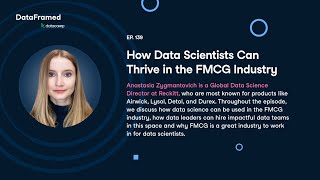
Anastasia Zygmantovich, Global Data Science Director at ReKit (Vanish, Airwick), explains how data science drives value in FMCG through pricing optimization, demand planning, and shelf-image recognition. She outlines ReKit's shift to a hybrid team structure combining product squads with functional chapters, and emphasizes that robust data governance and executive alignment must come before any analytics work.
Chapters
Sometimes it's very difficult to sell value of data if there is no kind of exciting things happening around it. Sometimes it's difficult to sell, let's say dashboard. Sometimes it is exciting, sometimes it's not really. But when you talk about AI or ChatGPT, something which everybody touched, I think that's the biggest impact of ChatGPT, that everybody has access, they can see that it's really working and it's almost a magic for many people who are not technical in this sense. I think it creates a huge buy in for data, but also for AI.
Anastasia Zigmantovic it's great to have you on the show.
Great to be here. Thanks for inviting me. I'm actually quite frequent listener to the podcast. I'm very happy to be here.
That's really awesome to hear. It's really a huge honor to have to hear that. So you are the Global Data Science Director at ReKit. I'm very excited to speak with you on what it means to drive value with data in the FMCG space. But maybe to set this stage, walk us through a bit about your role at REKT and maybe for listeners who may not be aware, what does REKIT do? Some of the products that Rekkit produces that listeners may be using that are not aware of.
Sure, happy to do that. So as you mentioned, I'm Global Data Science director, so I'm responsible for AI, machine learning and all technologies related to data science. But also I think it's good to set the stage about FMCG in general and REKIT too. So probably most of the listeners, you do not know the name of Racket, but I'm quite confident that most of you have some of our products in your bathrooms or kitchens because what we produce is Finnish Zurix Vanish Airwig, So those are quite well known brands and I think that's what makes FMCG so relatable because you really know the products and you happy with them.
That's really great. So I want to really set the stage for our conversation by really focusing on what it means to drive value with data in the FMCG space. Kind of the key components of driving value in this space. You mentioned here, a lot of the products are relatable. This is a relatable space and that's really the beauty of the FMCG space and kind of working in data science here in this space. So we've all consumed REKT products at one point in time in our lifetime. So with that said, what do you think are key components for Driving value with data in the FMCG space.
Maybe I'll start with some foundations because what we have to get before you drive some value is data itself. And it means that you have to have proper data governance. And the way we approach data is some of the listeners might know it already. So that's fair principle, which means that we want our data to be findable, accessible, interoperable and reusable. So that's very important for us to make sure that we have proper data structures so later data scientists and the rest of IT community can use those data. And what's also important to drive value with data is strategic alignment. So we have to make sure that very senior leaders also support our strategy and that we create buy in. So that's important aspect and maybe the last mile to actually bring it to life is to embed it into business processes.
Okay, that's really great and I'm excited to unpack a lot of this, a lot of these components, you know, from data governance to getting buy in from leaders and making sure that, you know, data is embedded in decision making and business processes. But first maybe to get a better lay of the land, you know, there's a lot of business challenges in the FMCG space that can be solved with data because it's such a relatable space and a lot of relatable data sets. Maybe. Can you provide some examples of the data science use cases that unlock a lot of value in FMCG and how you've seen that play out at organizations such as Rekkit?
Sure, let me touch some of the most common use cases for FMCG but also some a bit less common for FMCG and more specific for ReKit. And that might be quite interesting for your listeners. So the biggest use case is definitely on revenue growth because again we are business, we have to show that our revenue grows year to year. And to make it happen we look at the pricing. So we want to make sure that we are able to do price ups in effectively. That's a big topic actually this year for whole FMCG with inflation and you have to make it quite often and in effective way. And the second part of revenue growth is actually promotions. So basically how we execute discounts in the stores to decide which store we should do which kind of discount, what is more effective, what is less. And this way we can actually execute more effectively with less amount of money. So that's the biggest use case usually FMCG has on revenue growth. Another one is definitely on demand planning. And if you think about fmcg, we actually very big manufacturers, so we have dozens of factories to produce our products and they are located in different regions. So it's a huge exercise first to purchase all the materials to produce those products in enough quantity to actually deliver what we're going to sell. But also we have to predict how much we're going to sell and make sure that all of that aligns to what we're going to produce and later how we're going to ship it. So this is where data science plays huge role and that's one of the biggest optimization cases actually. It's not just prediction, it's about how to make whole value chain work. So that's a second big use case, maybe a bit different use case on shelf image recognition. So we want to understand how we execute in stores and I think that's very relatable. When you go to buy, let's say finish and you look at the shelf. We want to make sure that for example our share of shelf represents our actual share in the category and to track it, you don't want to basically send people to the stores to write down and measure amount of shelves that we have because that's a lot of work. What we do is we take pictures and we try to see automatically using image recognition what is actually share of shelf. And this case is quite interesting because in some countries like Brazil, shelves alleys can be quite narrow. So it's very difficult to take a head picture and it means that it goes on the angle and it's very difficult for analyzing this data set to see what actual share when picture is kind of getting smaller on the corners. So that's quite interesting use case we have on that.
That's awesome. And definitely we're going to unpack a lot of these use cases in a bit more detail. But maybe let's start off with the key components of data science successful in the FMCG space. You know, you mentioned here the proper data governance, strategic alignment and making sure that data science is embedded in the decision making process. So maybe start off with data governance and you know, making sure that data is accessible, findable, usable. Walk us through how you approach that as a data leader and maybe some of the best practices that you can share in making sure that data science data is usable and accessible and findable.
So that's one of the most difficult actually parts. It's not part of my regular job because it's part of data governance team and those are the basics we were missing in REKT and those are basics many fast growing companies are facing. And the way we try to approach it is by data mesh concept. So we want to make sure that we have some big enterprise data sets which we have responsibility of global teams. So those will be for example, sales, material, marketing, those big data sets. But then on top of that we have smaller data sets in different layers for which different people are responsible. So we do have the structure for the data governance to make sure that for example, definition of even share of shells which we were talking is the same in multiple countries. And basically the way to do that is to do two things. First, create this huge buy in from the top leaders to make sure that there is a, a big data driven push to actually get it happen. And the second part is actually to put people responsible for that on every stage where we touch the data.
That's great. And you mentioned here you approach the data governance component through a data mesh framework or concept. Right. In a lot of ways data mesh is still a nascent idea and a lot of companies are trying to implement it. Maybe what were some of the challenges when trying to implement the data mesh and how have you approached that when trying to solve for it? What are some of the best practices you can share about implementing a data mesh with listeners?
To be frank, we also, at the beginning of this journey and the biggest barrier I think we face, but I believe many companies also face, is to build this understanding of people. What is the value of data mesh? Why do we do that? And the easiest analogy, I think it's microservices. That's the way we usually explain it, to say that you split basically big component to the smaller to make the modules which you can basically mix and match. And that's the same as with any transformation. You have to create buy in, you have to educate people, you have to make sure that you spend a lot of time on change management. And I think this part is actually quite complicated. And if you look at it together with data governance, that's actually whole foundation. You need to have successful data strategy.
Okay, that's great. And this ties into, you know, the second component that you mentioned, which is, you know, really strategic alignment leadership buy in on data initiatives. Walk us through maybe kind of the journey of getting executive buy in here. What are some of the, you know, key components of getting executive buy in? What are some of the challenges that you face? I'd love to understand the story here of getting executive buy in that you've had throughout your journey at reit.
So far, I think the easiest way to create any kind of executive buy in is to prove the value. So this is basically the start of the conversation. So it's two things, what value you deliver, but what is the cost of not doing that. So that's the second thing. So the way we talk about, for example, responsible AI, that's the second option that we have to do that because the cost of not doing is very high. In case of data governance or a proper data structure, data quality, all these things, they are a bit less understandable in sense of value. So the easiest is actually to talk about specific cases, like for example, we're speaking about the revenue growth, but actually to make it happen, you have to get the proper data set. You have to get the data from 50 different customers, which means you have to have proper structure for data governance to get it done. Then you need to have proper data quality. And if you don't have that, it means that you might produce some results, but they might be actually harmful if you interpret something which is not a good quality. So I think what speaks the best is actual cases and conversation based on the value.
Okay, and maybe in a lot of ways early in the journey, there's maybe some resistance or maybe there's a need to prove value of data. What is a good framework to approaching proving quick value with data? If a data leader is starting off within an organization, what is a good framework for quick wins? Maybe a data leader can get when driving value data and when trying to showcase the value of data within an organization.
So I think what works in our case is actually using AI as quick wins, because this is the area where there is a lot of interest, a lot of hype as well. And what we did is to create some kind of lightweight framework to actually collect those cases and deliver as fast as possible to see where the value is. And that really speaks because then to actually make it happen long term, you need all these foundations. I think then it comes to the place where we see huge value. But actually to unlock it, you have to approach data analytics as a whole big space with all the foundational parts.
Okay, that's really great. Now I wanted to switch gears here because we mentioned and talk about data structures and data governance and leadership and buy in and making sure that data science is embedded within the business processes. I'm going to want to talk about how to embed data science and business processes in a bit more detail. But what I want to discuss a bit is really how to build a high functioning data team as well. Because in order to deliver that value to put data science in a business process, you need to be able to have a high functioning team, right? And that starts with the type of people that you hire, the type of talent, the type of skills within a team. So I'd love to get first from you what you think is a high impact data team in the FMCG space.
So maybe I can start with organizational part of it and later go to talent part of it, because I think it takes both to actually get it happen. So on the first part in the organization, it really depends on maturity of the company because sometimes it really works when you embed data scientists into business teams and then they really understand the domain and they can deliver the value. In our case, it actually didn't work. And what happened is people quickly realized that they don't have career path because if you are the only data scientist in the whole region, that's clear, there is no second step. And what we decided to do is actually to build a hybrid model to integrate data scientists into the chapters. So this way they have access to various business problems generally. And I think that's important to expose people to different business problems, not just technical ones. So that's one of that aspect of that. And second on the talent specifically, you need to build a team which can do various things. And right now, because the space of AI is going so fast, it's very difficult actually to hire a person who can do everything. So I don't think anymore it's possible to have a person who understands statistics and can write perfect code in python, can do MLOps and everything. So we don't expect that anymore. And it also means that you have to think which part of data science skill can be outsourced to different organizations. So in our case we think about MLOps this way. So we have a separate team to create a framework for us to execute those data science projects as fast as possible. But we do not expect data scientists to have the skill to do whole mlops themselves. So basically you have to vary the skills and divide teams in such way that you can execute as fast as possible. Because as we mentioned in the previous point, to prove the value you have to execute a lot of cases and to actually show and find actually these cases which bring you a lot of value, which means that you'll have to try tens of pilots before you deliver one, which is a great impact.
Yeah, and let's break that down a bit. I want to really deep dive into that organizational part of things. I think a lot of organizations are still trying to identify what is the best organizational makeup or kind of structure of a data team we've seen? You mentioned here an embedded data scientist model that not necessarily work at rekt. Other organizations tend to have like a purely centralized model. You opted for a hybrid model, maybe walk me through the journey of making that determination. And also you mentioned that really key component of creating, you know, growth pathways for data scientists. Walk me how that looks like right now at ReKit. How do data scientists grow within ReKit and how did you create that laddering journey?
Sure. So actually two transformation happened for us last year and the first one is on the product organization. So whole IT community transformed into this product way of working, which I think is industry standard. And again, this is a proper way to give people right careers. And the expectation for the product manager is that they're kind of CIO of their business capability, which works in a great way because then they also track value adoption, they establish contact with the business. What also productmanship has is a team, which we call squad to actually deliver those capabilities. And we see data scientists as one of the members or a couple members in the squad we usually have. If it's a data related squad, there will be data engineers, there might be some visualization specialists, could be some DevOps. So it really depends on the project. And this way data scientist has basically first family inside of the squad. Those are people, they work every day and the second family is actually chapter. So in case they want to progress in different way, they want to learn different domain, they can still do that because they are part of global data science team. So that offers this flexibility in a.
Lot of ways as well. We talked about the skills component and the talent component. We mentioned that you don't opt for a one size fits all data scientists. There's a lot of different, different roles that occupy different parts of the data value chain within rekit. I'd love to understand from your perspective what are the essential roles that make up a high functioning data team and how do they play together in terms of a collaboration in terms of the data value chain as well.
So I think it really depends on the company. I can only explain how we work or how I worked in my previous companies as well. So you definitely like what works for us is this chapter approach where we have in this case three chapters. One is data science, but we also have data engineering and data visualization and this is specifically for the career path. So that was the main reason to make sure that people have this second family and we could determine how they work. We also Try to make sure the fair concept. And for that we actually have specific roles. We call them data product managers. So the main goal of this person is to make sure that data is fair. So that's exactly the role which is responsible for that. But also we have data governance teams. So these data product managers, they work very closely with data governance. So if you look at foundations, so those are the two roles which ensure that we have right quality of data, but to actually have data in the right place. We also have the platform team to make sure that it's in the right cloud. We have certain operations, we have DevOps, all these things. And of course we have data architect which oversees all data products with a team of architects responsible for specific business domains. Which again in data mesh concept makes sense to have responsibility per data domain, but then to split it into smaller pieces. So yeah, so that's solution architect for data, specifically platform team, Data governance team, data product managers and then the chapters which is engineering, visualization and data science. Pretty much like that.
And when thinking about the makeup of a team and the impact of a team, I think a big challenge data leaders face, especially in 2023, because you mentioned here it's an inflationary period, a lot of organizations are looking at the ROI of different initiatives that they're trying to put in is trying to understand what the ROI of the data team is and trying to quantify it. Right. How have you approached kind of the ROI question from the data team and maybe share some best practices with data leaders on the call here that could benefit from trying to understand how to calculate the ROI from their data teams.
First thing is to make sure that you do that so that you embed it into the process that the first pretty much step you do when you discuss business case actually to think about this value and then it really depends on the product. So the easiest way to explain it is to go back to the use cases. So when I was talking about revenue growth, so that's obvious when you look at the price ups, it's a question how fast and how high you can do the price up so you can actually earn more. So it's simple like that in case of promotions is that you do not overspend for discounts where you don't have to. So again it's certain saving of money. So it's either you earn more or you spend less. In case of demand planning, for example, that would be rather the cost of failure to actually deliver those products to the customer. So it's a bit more tricky in case of this shelf image recognition. That's quite interesting case because this one is related to the technology cost because we have choice to buy something enterprise level, which is quite pricey, especially for small countries where we don't sell for millions of pounds. In this case, we actually tried to see if we can build something in house using standard components which will be much cheaper for those smaller markets. So in this case, it's kind of technology saving, but also possibility to bring these tools to the markets which otherwise cannot afford them. So in this case, I think it really depends on the use case.
Okay, so that's really great. And maybe let's focus in on one use case. Right. I was really interested in the demand planning use case because not only does it require, you know, really strong kind of data science jobs, but it's also a very strong optimization problem. Right. Maybe walk us through the different data sources that you need to think about when trying to create this type of use case and how do you approach embedding it in a business process and what type of insights does it inform the remainder of teams at Rekit, to.
Be frank, this optimization issue is actually the business problem. It's not the data problem in the sense that it really has to align between different teams where some of them local and some global. Plus it goes across multiple organizations in this sense. First thing to do is actually to establish the business process to understand who is playing which role where, and then for each actor in the business process to identify how they do that and what kind of data they use. So once you have all the data sets which you already have, obviously you have to check if the data quality is right, if there is ownership, all these parts. Another thing which you could do is actually to look a bit wider because again, if you have proper ownership for the data domain, in many cases business owners, they're not even aware of some data sets and it makes sense to actually expand the data sets you're using to what is available and then to think how to build this use case end to end. But again, going back to our value discussion, this is a huge optimization case and if you wanted to crack it end to end, from the beginning to the end, it will take you years probably. So it's important actually to decide which part brings the most value. Because if the biggest business problem is that we don't produce enough products and that our, let's say, demand predictions are low quality, then that's the space you have to address it. If the problem is we cannot buy chemical components for those products, that's somewhere else. And actually we have a separate product for specifically that. So you really have to put it into smaller pieces. But where actually these big corporations either win or lose is actually to build these connections to make sure that you don't stay in silos and you think about the future also to integrate it back.
That's really fascinating insight and really connects to the aspect of embedding a data science solution in a business process. Right? Especially for a use case such as demand optimization, this demand planning. Sorry, and optimizing demand. There's a lot of different teams that play into this, from supply to the planners to a lot of people who work with retailers, support products into market. Maybe walk us through the process of embedding a data science solution such as demand planning into a business process. Who do you need to work with? How do you approach these conversations and what are some of the best practices that you can share here as well?
Again, you always start from the beginning. So like personally in data science we have a checklist of things which have to happen before we start. And I will just talk about the value, but second is actually how do we embed it into the business process and that's actually responsibility of business. So when they come to us with a business case, first thing we told them, great case, but let's decide together before we start where in business process is going to land. Maybe a good example again is demand planning. So there was a case when supply team came to us, we want to improve quality of forecast prediction. And first question was like, in which meeting you're going to use the tool we're going to build? And first was like, oh, I'm not really sure, maybe somebody will use it. And I was like, no, that's not good enough. We have to really define from the beginning how often this meeting is happening. If it exists, you can just reuse the meeting, but in that case it actually didn't. So it means that you have to build new business process to embed it into what you're trying to achieve. So that's important part. Sometimes these processes are very big and often we actually have choice as data science, either to run it as a side project somewhere or to embed it into something bigger. But then we have to wait and my choice is always to embed it into something bigger because then it becomes a part of the business so we can run some pilot. But with this thinking that at the end it has to land in the same space for supply we use a system which I will not name here, but it's company wide system and recommendation is obviously to try to put some additional arguments inside of it. Because this is one space where people go, they open the system and they do everything there. Every time you try to give person additional system, your adoption drops. And it actually drops for both tools for the main one, which we spent millions actually to deliver, but also for the tool you're trying to develop. So user experience aspect is extremely important. And this is I think, where a lot of companies are missing. You have to really understand who your end user and what will be the experience for them.
And in a lot of ways that initial conversation when you're trying to understand from your business partner, how are you going to use the tool that I'm going to develop, does that inform the actual development cycle and how that tool looks like? Because it's going. Because user experience, as you mentioned, is extremely crucial aspect of making sure that there's strong adoption.
Definitely yes. And also I feel how you deliver data science, it's a life cycle which repeats itself, right? Hopefully that should be this way in sense that you never just frame the case and you develop it till the end and then you tell the user there it is, user it. So what is expected is that you do multiple iterations with both and you just explore the features and you consult with business. Does it make sense for you? And if the answer is that they're going to use it in completely different way, then you have to adjust to that. Because the end goal is not to actually just develop some tool, it's to make sure that there is adoption and value and if there is no adoption, there is no value. So in this sense we try to also embed this process of talking to the business constantly into any data science project.
You know, related to this is you relate to these conversations, right? Like adoption of data science, making sure business stakeholders use data tools. I think that requires, you know, some level of data culture within the organization, right? Not just buy in from leaders who are strategically aligned with the importance of becoming data driven, but also middle managers, individual contributors, you know, who may have, you know, years under their belt developing their own gut feeling and their own, you know, gut instinct when it comes to like how to approach business problems. How do you approach that buy in component with your business stakeholders, right. And what do you think is the most critical factor data leaders need to look at when trying to develop a data culture and their business counterparts?
So I think currently what helps a lot is this fast development of AI because in this case it's much easier to convince that if we don't do anything in 10 years, we might simply not exist. So I think that that's a very strong argument we have. And obviously to approach any kind of data literacy effort is two ways and actually you have to do both. It's like top down and bottom up. So top down, that's very important because otherwise it's very difficult to do role modeling inside of organizations. But the bottom up actually requires much more work in the sense that you have much bigger user base to actually train. And the easiest way to do that is to define Personas which you're going to train. Because not everybody needs the same knowledge of data science or even data data in general. So I think basically we just need like the way to do that is to define those Personas and to actually create learning paths for them and expectations, but also embed it into evaluation process. So we have like yearly reviews of performance, for example, and some of the skills are solved. So data is actually a perfect skill to put into this performance review. And it's important that you make it measurable in some way. So I think that that's a key component because just to run the training, it's never good enough. You have to make sure that people really feel it, they have some experience, hands on. And one of the things which works for us is we have AI, NML community of practice. And we basically allow people to go to kind of show and tell sessions where we actually explain how we do things. Sometimes it's quite in depth, so not everybody would understand, but it's quite exciting for them and we encourage people to come to us with ideas. So in this way we create a lot of buzz and we call it like FOMO in different organizations. So they want to do these things and mainly if we do it again with AI, because it's much easier to solve. But after they come to us, we always of course convince them that we have to get foundations and basics. And it's not just AI, it's a lot of other things.
That's really great. And definitely you mentioned here kind of riding the wave of AI, right, of the AI hype that we see right now, especially with large language models and tools like ChatGPT maybe. How do you think that there has been a culture shift recently within organizations when trying to think about data science and AI because of the recent boom that we've seen on AI? How have you seen that play out? Have you seen that there has been a difference, for example, in how people think about data and AI recently?
It's actually Funny that you ask right now because next week I'm going to our general executive committee. So this is the team of our CEO basically to talk about it. And one of the slides I have is actually about how ChatGPT hype accelerated investments into AI. So actually it's a huge impact everywhere also on the senior executives because if you have hype, you feel that you have to invest more. So we feel that everybody feels it. And I found some market research about it. It's actually quite a proven situation and I think this is great because again, sometimes it's very difficult to sell value of data if there is no kind of exciting things happening around it. Sometimes it's difficult to sell, let's say dashboard. Sometimes it is exciting, sometimes it's not really. But when you talk about AI or ChatGPT, something which everybody touched, I think that's the biggest impact of ChatGPT, that everybody has access, they can see that it's really working. And it almost a magic for many people who are not technical in this sense. I think it creates a huge buy in for data, but also for AI.
Yeah, in a lot of ways, you know, ChatGPT is maybe the first consumer application that has put AI in the hands of, you know, millions and millions of people, like really strong AI. And this is what's really fascinating about it. One additional question here on that is that we see a lot of additional investment in AI right now because of the ChatGPT hype. Right. But do you think that, do you think that could take away maybe attention from, you know, executives and leaders on, you know, low hanging fruit, simple use cases that can really improve data driven decision making in the organization? Because we want to start developing, you know, more advanced AI systems within a specific team or company rather than really focusing on descriptive and diagnostic analytics. Have you seen that there is a trade off here when thinking about prioritization of data science and AI use cases?
I think you're very right. And even the way we approach it in two things, one is innovation boost, of course those small pilots which in many cases they come from generative AI. But the second part is strategic big initiatives which actually delivering the impact. And I think it's important to balance it actually we do not struggle with that. But I can see that because there is so much hype, some of the executives might actually concentrate on low hanging fruits. And I think it's important to balance the way we do that is we centralize the intake of those ideas. So the way we do that is we have a form where we collect and we meet literally with every single person who submitted this idea. Also to do some education to explain it's not maybe even generative, maybe it's actually automation. It's not a data science. Cases like that come in, in most cases their eyes are not framed well enough or they do not bring that much value. So that's also important, but also you can centralize. So one of the biggest use cases we have is a content generation. But if you think about fmcg, we have content everywhere. We have it in our websites, in our D2C websites, we have it on Amazon, on Ecom, we have it on the packaging of the products, we have it everywhere. So it's much better to actually centralize this effort to make sure that it plays together well rather than to have five different teams trying to figure out. So in this sense what really helps is to centralize innovation pipelines. And that's one of the advices I can give.
So, you know, as we near the end of our conversation, Asazo, what I want to focus on as well is maybe the skills needed to succeed as a data scientist in the FMCG space. You know, we discussed how this space has a lot of relatable data sets and relatable, you know, products that data scientists can really understand intuitively. But you mentioned as well that, you know, a lot of projects also require stakeholder management. A lot of, you know, mix between hard skills and soft skills. So I'd like to understand if you can elaborate a bit more on what is the perfect skillset maybe of a data scientist in this space, what type of balance there is between technical skills and non technical skills to excel in the FMCG industry. And how does that differ from any other sector that you've worked in?
So I think fmcg, but also other companies which are more like business related and less maybe digital native or technology companies. What we share in common is definitely this requirement on the skill set of data sciences that they understand the business actually. And for example, there is always a choice, you can take some vendor to do data science for you, but we try not to do that for data science specifically for the reason that techche bring huge impact, especially like supply chain. I think it's so complicated that you need to retain this knowledge, you really need to get someone who understands it. And in many cases those people don't even come from directly data science. They actually had experience in supply chain and after that we also had technical skills. So I think very important skill is actually understanding of domain knowledge and In FMCG we have many domains. We even have interesting case where we did predictive stability of chemical components. And for that we were lucky to have a person who was a chemist actually. So in this sense you really need to have a good mix of people because if you operate as a chapter, different cases are coming to you and you have to be able to handle those. So this kind of various knowledge in different business domains is very important.
And what advice would you give maybe data scientists joining a company like Rekka to develop that business domain who may not have had that business domain and supply chain or you know, understanding the FMCG space necessarily, what are the type of challenges that you think junior data scientists can overcome here in this situation?
So the way we approach it is we make sure that they have as much contact with business as possible. So sometimes they basically even do store checks with people. Or we try to do onboarding or marketing the same way as you would onboard brand managers, for example. So we try to make sure that we basically expose them. But also if they work on specific business case, we expect business owner to spend some time to onboard this person. And it's win win for both because in many cases they want to understand data science better and we want to make sure that our people understand business better. But generally for data scientists who are just starting career, I honestly believe that FMCG is a great start again because it's very relatable. So many of the use cases, they're not that complicated that you always need a senior data scientist to do that. And it's also a good combination when two data scientists are working together, senior and the junior. So that's usually how we approach that. And I do believe that it's a great start.
And maybe to cap off here our discussion on the skills of data scientists, maybe what would be your advice for aspiring data scientists looking to get into the FMCG industry? How do they get started?
I think if a person already has some skill sets in data science, then basically that they can try to go for specific domains in data science if they want to learn about specific domains. So for example, digital marketing tend to be one of the areas you can obviously upskill yourself in different ways to go there. But what I usually appreciate during my interviews is this enthusiasm. That person really wants to learn about specific domain and there is a clear reason why it's not just to get any kind of job, but there is actually a lot of intention to make it happen. So in this sense I think that's when it really works.
So Anastasia, as we wrap up our conversation, I'd be remiss not to talk about some of the trends that you're excited about to see. We talked about ChatGPT, a lot of the hype in AI right now. I'd love to see from your perspective what are some of the trends in this space that you're looking at currently that especially are exciting for you at ReKit and FMCG in general.
I think the one I keep the closest isis, is still generative AI. But also what I'm interested is how it's going to change future of work. So for example, Microsoft announced the Copilot and I think that's something which will really change how people operate. So in this sense I'm really interested also in hybrid intelligence to see how basically AI can work together with humans. I don't believe that anytime soon we're going to replace people with AI, I think very successful leaders, not just in IT actually those who will be able to use AI in wise way and understand it. So I think that that's, that's very important and I'm preparing myself to more and more things happening because right now, every week something new is, is coming out. So I think it's extremely exciting.
It is indeed extremely exciting. And you mentioned here earlier in our conversation the importance of embedding responsible AI into the process, developing use cases. Maybe share your view a bit on how the responsible AI conversation will maybe change within a year or so as you know these generative AI tools become more and more embedded in business processes. I'd love to get your perspective as well on you know, tools like Microsoft Copilot and what that looks like from a responsible AI perspective.
So I think this topic becomes more and more important for two reasons. First one is more like on regulatory side because there is more and more legislation which is actually happening also across Europe in us. But the second part is we are in situation where there is AI everywhere. So it's much more difficult to control it. And it means that if you don't control it now, it will be much more difficult to control it later. And the complexity of responsible AI is the fact that you really need cross disciplinary teams to actually make it happen. Plus it is responsibility of pretty much everybody in the company. So I think that's hugely important to start as soon as possible and to create also buy in with the leaders where the biggest value is actually avoiding the cost of mistake. I think that that's how you measure that. But many people, especially young generation, which I'm super happy to hear they are very interested in that. They are really value driven. They want to do right thing and that brings a lot of hope.
That is really awesome. Now Anastasia, as you wrap up our discussion today, do you have any final call to action before we end today's chat?
Maybe to data scientists, especially those who just starting their careers. I just wanted to make sure that you think about any use case you work in as something which is related to real life. You can even think about some of FMCG products like Durex or Vanish, how they got into your hands, where did you buy them? Is it like online channel? Why did you buy that, how content look like if you bought it from the shelf, how shelf look like all these things. Just to understand that many steps which happened in the middle before you got the product into your hands to actually AI data science or IT related and to actually feel what kind of impact you might have as a data scientist that it's not just like small piece of code, it's actually making whole process happening. So I think it's quite important.
I couldn't agree more. That's a very inspiring message. Now Anastasia, I really enjoyed our conversation today on Data Frame. Thank you so much for joining us for the show.
Thank you though Sam.
More from Richie

#359 My Best Friend is AI with Valerie Tiberius, Professor of Philosophy at University of Minnesota







How AI Agents Will Work While You Sleep | Ruslan Salakhutdinov, Professor at Carnegie Mellon

#358 How AI Agents Will Work While You Sleep | Ruslan Salakhutdinov, Professor at Carnegie Mellon

