#164 Driving Data Democratization with Lilac Schoenbeck, VP of Strategic INIT at Rocket Software
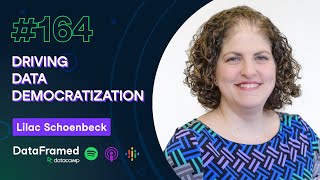
Lilac Schoenbeck, VP of Strategic INIT at Rocket Software, says the biggest barrier to data democratization is culture, not technology. Start with a map of critical data flows and a shared glossary. Most people think data is only for specialists, but the solution is incremental, transparent, and collaborative.
Chapters
The companies that I've seen be successful with this are not actually trying to overhaul the world on day one because it's a fruitless effort. New systems are going to come in every three months and six months and we'll be chasing our tails the whole time. Like, let's, let's build a practice of incorporating data into our view of the world and have that continue to expand incrementally. And if you do it that way, you also get the buy in of the business. The people sort of clamoring for more. And when people clamor for more, you typically get the budget and typically get the focus. And creating that demand within your organization is going to help move the ball forward.
Hi Lilac, thank you for joining me on the show.
Hi Richie, nice to see you.
I think to begin with, let's make sure that everyone understands what we're talking about. So what does data democratization mean to you?
Data democratization is an interesting word. I love that it feels like it's bringing freedom to the data within an organization. I think the biggest piece for me is that it means that what we're providing is broader access to data within a company to a number of people who could use it to make different kinds of decisions. And I think all of us have been inside organizations where decisions are made on basis of a lot of things, sometimes just good hunches, sometimes an understanding or a perceived understanding of truth. Having the ability to access the company's data will enable far better decision making. And I think democratizing it means that it's not just the senior executives who are privy to the data, but actually anybody within the organization that should have access to it can make a data driven set of decisions.
Excellent. So it really is about bringing things to the whole company. And so I think in some organizations there is this perception that data should be something that the data team does and it's not necessarily a concern of anyone else. So what do you think the advantages are of having this widespread access and knowledge about data?
You know, it's an interesting question. I think the reason people say that is that data feels tricky or complicated. And we all took stats class in college and we remember that three standard deviations is something that we actually couldn't define at a cocktail party if we tried. Then there's this concern, right, that actually data is often misunderstood or misread. So when I say a certain field implies, I don't know, total revenue or customer count. And you'll tell me, well, actually it's customer count on alternate Thursdays and you didn't know the asterisk associated with that, so maybe you'd misinterpret it. So this sort of persistent belief that it requires a specialized set of knowledge, if not skills, in order to understand the data, I think the key is actually transparency there. Right. The key is to build a framework for the data that allows, let's call it lay people, normal humans, to query that data and get a sense for the answers. I think the second piece, though, that also harkens back to, I think perhaps all of the trauma we had from college physics. Number of significant digits is actually a really reasonable concept in this construct. Right. So there's a difference between saying precisely 47.35% of our customers live in Idaho versus saying the majority of our customers are in the Northwest. And I think that the notion of democratizing data and allowing people who aren't the data scientists to have access to broader swaths of data also comes with a certain understanding or access to the education of how to draw conclusions from information and what a degree of significance would be in the variability they're seeing in data. Right. So there's an education process there, but I think it's one that's sort of congruent with the way that people are approaching business more broadly in less hunches, less feelings, more what pieces of data can we bring to bear to validate our hypotheses? And at the highest level, those broad trend lines and basic understandings being distributed across an organization leads to better decisioning.
Okay, so you're not just writing some extensive thesis every time you make a decision with data. It's just about like, get some sensible numbers and use them to inform your decisions.
That's right. I mean, most companies will tell you, most enterprise software companies, and this is sort of the domain I've been in for 25 years, will tell you most of our customers are in financial services, healthcare, or government. We'll say that every time. It says that on every single prospectus for every software company ever. How many of us actually know, when we say most, do we mean 50%? Do we mean 95%? And it really depends on the company. But then the downstream decision you're going to make, for example, to advertise in something as simple, am I advertising in the Wall Street Journal, or am I going to advertise in grocery stores today? Right. Those are the distinctions that actually a vague sense of that number will change your answer. And it doesn't need precision and it doesn't need a lot of deep Data understanding. It just needs a high level understanding of what's vaguely going on.
Yeah, that does seem pretty sensible. Like have a vague idea of what's going on in your company and you can use data for that. Excellent. So I'd like to hear about some success stories. So do you have any examples of companies that have sort of gone all in on data democratization and they've seen some sort of benefit?
Yeah, and I think all in is interesting because I feel like it's very much an evolution. But some organizations that we've worked with, large financial services firms, shockingly enough, have gone really far in the idea of providing basically a data catalog, a data library, and also in addition, a set of very talented and collaborative data scientists on their teams that support the business in their data queries. And I think the, the benefits of it are that they are able to anchor the whole organization on a shared understanding of truth. That's the first big step. Because what often happens, and I think in any organization any of us has been in, is that one department says something is true and another department says another thing is true. And you could actually waste the entire meeting debating which one is true. Which isn't a good use of anybody's time. And often, by the way, stems from a misunderstanding of definitions or a misalignment of what XYZ might mean. Or is it revenue in this period or revenue in the last quarter, revenue in the last 12 months or revenue in the last fiscal year? Right. These distinctions actually would make different versions of the truth. And so what these organizations that have been successful have done have been first and foremost to create a truth of the data that can be agreed upon. And the benefit of that is that actually what we want from our senior leaders, from the people making decisions across the organization, is not to debate truth, but to leverage truth in order to make other decisions. And that's the level that they have made very successful. They can decide, am I going to switch a system or change an approach to a database or do these other things? Because I understand the impact of that across my entire data fabric and footprint. That's a data driven decision. I don't need to sit there and debate whether or not the hip bone is connected to the leg bone or whether I've misunderstood the whole skeleton.
Absolutely. It does seem that these sort of inter team or interdepartmental conflicts about the different perceptions of how, what the company's doing or how the world works, they just seem to happen far too frequently. I do like that idea that data is this sort of mediating force where it's going to help different companies agree and not have stupid arguments.
I mean, let's not pretend we're going to eliminate them completely. That feels really intrinsic to our humanity.
Fighting with other teams is often fun anyway, so yeah, maybe it needs to continue a little bit. All right, so can you tell me about what some of the most common data problems are that you've seen businesses face and then having the idea of data democratization is going to help this?
Yeah, I think one of the biggest things, and this is funny because I'm thinking back to, I grew up in the Pacific Northwest and there was a, there's obviously a large airplane manufacturer out there. And I just remember as a young computer science student, I couldn't have fathomed when they came and spoke, I don't remember the, and said how many applications they had running. And the number was something like 10,000 applications running within their walls. Now I haven't, that's 25 year old data. So I'm going to say I have no idea if that's grown or shrunk, but it really impressed upon me the number of different systems within a large organization. And each one of those systems is creating and generating data. Back in the day we printed it out on those like really loud printers that might, you know, with a little piece of paper on the edges that we tore off and used to make small figure puppets. But the situation now is that we still have largely in a large bank, in a large multinational corporation, a thousand or more applications running often in the multi thousands, each one of them creating their own data and each one of them with a set of dependencies that normal human brains cannot possibly fathom. Right. It's just too complex a system. We have built something of a house of cards within these organizations. And then the challenge is, is that we also want to continue to evolve these applications, modernize these applications. What we hear is I'd like to move some percentage of my footprint to a SaaS based alternative and not an on premise homegrown thing. Right. That's a daily conversation for CIOs around the world. How do you even know what the impact would be of removing that one piece from the system? And that impact actually could be cataclysmic. Right. Or what you could decide is I'm going to understand the top three impacts and let the next hundred just come as they may, but the Jenga Tower that we've built in this situation is actually quite terrifying. And so one key piece that organizations benefit from is an actual topology of how data and data dependency works within all of those organizations so that you can make an intelligent decision about the order even in which you make changes. Right. And so that's a piece that we've found is really, really productive for an organization is to just have a map of you. How does the data flow through my organization? And we all know that your name is spelled right in one of the systems and wrong in the other, that your address got updated in one place and not the other. And if you can extrapolate that to all the internal pieces of data that an organization might have, it's just, it's truly. It's a stew, it's a mess. And that's not a bad thing. I don't actually believe that this is an addict that needs to be tidied. I believe that this is the chaos is the state of the system. But having the tools to be able to navigate that chaos, to understand the impact analysis of making changes, to understand what has to happen in order to remove or excise somebody from a GDPR type situation or event that's invaluable to a company. And it actually frees you up to make different kinds of business decisions because there isn't that latent and wholly legitimate terror that something is going to go horribly wrong.
It does sound like understanding what data you have and who's using it and how it all connects together seems like a really good sort of starting point for any kind of program. And yeah, you sort of think that that ought to be the case everywhere. But now I'm thinking about it. I'm sure it's probably the case absolutely nowhere, very rarely.
And it's further complicated by the fact that we have systems in again, in larger enterprises, large organizations that have been around sometimes for 100 years. Some of the systems are antiquated. Some of the systems are barely running. Some of them are robust and lively mainframes that are still very much running the transactions of the world. Some of them are distributed systems on premise. Some are SaaS systems in the cloud, some are distributed systems the cloud. Some are homegrown, some are commercial, some have been bought, some have been acquired. There's actually no reason to expect an organization to have a view of this. Right? That's not a rational expectation for a company that's more than 10 years old, honestly. And so I actually, one of my major rants that I like to pull out on podcasts is I think it is not productive to shame our IT team for some of the emergent problems, properties of the IT estate and footprint. I think it's not fair, it's not productive. They have been working decades to try to build something that supports their business and evolves and changes at a pace that almost no other part of the business evolves. So I think accepting what we have and working with it, but then providing the tools and using the greatest and latest technology in order to mitigate some of those emerging properties is the right approach.
Excellent. Yeah. I'm sure the IT people listening to this will be like, oh, yeah, it's good, we shouldn't get the blame for this. And no, because it is very easy to just be like, okay, well, yeah, the software's not working as IT should do. I'm going to blame the IT department.
They should have had it tidied. Really? Really? I don't think so. No. No.
All right, so suppose management have decided this is a good idea and your CEO makes this big pronouncement about, okay, we're going to become a data driven company. Where do you start? Like, what's step one?
I think the first, there's a few pieces that are really helpful right up front. Right. I think that map or view of the entire organization's data and entire is an incremental thing. Right. Maybe we start initially with the databases and some critical systems and we slowly, slowly add additional visibility. Right. I think the piece to think about is where are the critical flows of data, the critical transaction points? And so that often requires an understanding of some of those legacy systems, right? The mainframe systems or the other ones that are really at the core of a company, but also extending all the way out to the edge. Because what we'll also hear is that data flows into your AWS snowflake implementation. Right? And so what you want is to be able to broadly span the organization. The second piece sort of harkens back to what we started with earlier. Right. The notion of a glossary or a shared understanding of what a word means is actually critical. Right. And I think, finally, I've never met data people who actually, really want to be the possessive, insular hoarders of the data. Most of the time they are delighted to tell you all about it and explain to you the nuances of it and actually educate the rest of the organization. They will typically love this. Right. You don't enter the data field without really loving to talk about data. And so I think any such program really should have an evangelical or educational component from the data team to the rest of the organization in order again, to Sort of overcome that false need for precision in places where it might not be necessary. Right. Or some of the fear that perhaps might be pervasive in an organization amongst people who don't usually have these tools. Right. So how do we help people get over the hump and understand what they're looking at and in doing so create some basic dashboards maybe that they can, that they feel are approachable and then the mechanisms for follow up analysis, if that's what's called for. Okay.
I think it is generally true that data people do actually quite like talking about data, for sure. Certainly I like talking about data is why I'm here. All right, so once you've sort of got going along these first steps, what are the sort of the goals you need to set in terms of improving data capabilities?
Yeah, I think that's really an interesting question. I think part of it is cultural. Right. Part of what you're looking for is the motivation to ask the question, well, on what are we basing this hypothesis or how do we test this hypothesis? How do we test this assumption? Is there data that we presently have in the organization that would help validate which course to take on these various courses? That is essentially a cultural thing, a thing that is affected by the leadership as they choose to pivot the way in which decisioning is made? And then I think some of the other pieces, again, there's access, Right. If you look 10 years ago, the people who had access to the data dashboards, if they even existed, the tableaus or whatever of the world were a limited, limited group. I think we have to come to a place where we recognize that at least the data that we feel comfortable broadly sharing in the organization is actually shared across the organization. So we need to give people that visibility. Partly because as you start playing with the tool, you become more facile with it and you sort of begin to take it on a little bit more as something that's part of your life. We did this a lot. This is a strange analog, but I think it actually applies in the long ago times when we rolled out like a Slack or a teams or an instant messenger within a company. Now, I don't know about you, but I've been using some version of Instant messenger since AIM back in the day when it was beeping across my screen. But corporate America was not using a ton of instant messenger a decade ago. And as we rolled it out, I remember that it was not pervasively rolled out. There was often like this sort of have and have nots of instant Messenger. And then eventually we got to a place where when something is rolled out, everybody sort of understands the rules of the game and understands how to behave properly in this context and what it means to send a message to the entire channel.
Bob.
So maybe stop. And the same thing sort of has to roll out with data. Right. I think you give a bunch of more people access and then slowly ratchet up the literacy that is happening within the organization and so that the rules of the game and the rules of engagement become more democratized.
I really do like your point about Becky Wilson messaging the entire channel on whatever. Messaging programming. Yeah, that's terrible. It's like the same people are probably still doing like reply all and send to the whole company on.
That's right.
So yeah, there is a. I think it's also appropriate in the data space. Right. Because you need to learn to talk about data. And that just seems like an important part of data democratization. So do you have any advice on this? Like what's a good way to communicate around data with your colleagues?
You know, I think that's a really. It's interesting because I think my feeling is that a lot of people don't have the latent training in this or that there's. There's huge swaths of an organization that might even say that they didn't have a ton of maths education or I didn't take statistics. I was more of a creative type. People will say things like that. Which I actually think is kind of. I would encourage people not to take that approach. It's unnecessarily creating a barrier in your mind to something that doesn't have to be unapproachable. Most of us are quite capable of going to the store and determining which is the cheaper item to buy. And this is not any more complicated than that. It doesn't have to be. So I think the first thing is to use language that doesn't elevate the fear levels across an organization around what this might mean. And then I actually think that your data team is probably your best ambassador for education and wanting to elevate the nature of the discourse across a company. And so to the extent that they're interested in becoming sort of data business partners, maybe in the model like you often get an HR business partner or you get a finance business partner, a data business partner is an interesting idea of somebody that might be able to support a group. Right. And provide that sort of low grade understanding and education as people get their feet wet and move into it. I would be Remiss, sort of not to note that one of the big sensitivities around all of this is the fact that not all data actually should run free. Right. Contrary to 1999, Google's manifesto, all data does not actually want to be free. Some data has to be very much bound by compliance requirements and by corporate security requirements. And, and, and you don't take an organization of 50,000 employees and tell them, live and be, well, here's all your data go crazy. Right. Because there's a number of reasons why that would be a bad idea. And so I think all of this sort of requires us to build the kind of boundaries on the data that keep the organization safe and the individual safe. Right. And I think that that's a piece that the degree to which that can be transparent, clear, understandable, so that people don't feel like there's danger associated with playing with this stuff and so that the organization doesn't incur any risk. Right. Because all you need is a compliance violation in a system like this. But so having the right kind of boundaries in your system that provides the right kind of role based access is absolutely paramount.
Okay. Yeah. So you probably don't want the HR data being available to absolutely everyone. I can say that. Okay, so if you're setting up a data democratization program, then who needs to be involved in this? Are there any particular teams or roles that need to take part?
Yeah, I think obviously like a chief data officer or CIO are the obvious leaders of this type of action. But when I think through who else has a role in this, it becomes sort of some of everybody. Right. The financial data is often led by the FP and a team. They're the people that are the stewards of that information. On the other hand, if you thought about pipeline and sales data, right, that's sales ops and marketing that want access to that. What? We don't see that often. How do I put this? I think every person has a hand in a subset of the organization's data. Right. And every leader probably has some thoughts. You could even talk about the data associated with the actual work of a business unit, the investments of a financial services company, or the quality of a piece of software. All of that usually feeds into the data footprint of a company. I think when we really think about it, that there's huge value in those different organizations understanding each other. And so first we get to the point that everybody is kind of anting up their publicly consumable views of the world. And then the second step, I think is to engage with the data of your friends and colleagues because that's actually going to give you a better holistic understanding of the business. And that's often where we get things wrong or where they stagnate. Right. Is that it's easy for finance to focus on finance data and marketing to focus on marketing data. But if we take a big step back, we realize that those pieces coming together actually is the strategy of the business.
That seems interesting because you're always going to have an adjacent team, like maybe the team that you work with a little bit. And understanding their data as well as your own, at least casually, does seem like a good way to sort of gel. And I guess again, it's coming back to not having fights with your colleagues as often.
Yeah. And empathy for what they're dealing with or their challenges. Right. Because it's so easy. One of the places where we make a lot of not data driven assumptions are around what the other team could or should do. Right. And so if you look at their. Well, they should be, you're like, well, okay, but they're starting at a much different position than perhaps you're giving them credit for. Right. And so having an access to the baseline and the data that they're working with, it provides a better basis for negotiation and understanding.
Okay, so I'd like to talk a little bit about tooling and so improving access to data. Part of the story is going to be about having the right tools for this. And can you talk about like, what are the sort of the components of a data stack that are going to assist with democratizing access to data?
Yeah, I think that's an interesting question. So I think there's elements. So we talked a little bit about the element of lineage and understanding the lineage between all the systems and how data flows. We also sort of talked a little bit about a data catalog and a glossary, which sort of work hand in hand to make sure that we know what we've got in there and which are the pieces that matter and which are the ones that are. Right. There's a data quality component to that. Right. Where the backend system of the bank that keeps track of your account is probably the better source for your address than whatever you entered into the web form when you were sitting in a bar trying to get a coupon. Right. And so these distinctions and being able to guide people as they move through the data, there's obviously the front end interface to the whole thing with a BI tool, whichever one is your preference. There are so many these days on the market. I think all of these things are critical components and differingly critical at different points in your evolution. The thing that I'm not thinking saying and intentionally not saying is that I don't think you have to wait until some sort of idyllic, platonic world where you have got all of your data in one streamlined, beautiful data lake and everything is tidy and then we can start doing this. Right. I think that's perhaps just a fruitless approach. Right. And so while I appreciate that and have seen tremendous results from people working with data lakes in order to get just a lot of flexibility in their data environment, the notion that that has to be done and dusted as step one fully before we move on to step two, I think is a mistake. I think the best way is to actually accept the systems that you have, accept who you are, IT organization and work with that and find the connectors, find the scanners, find the pieces, find the even the change data capture tools and the other pieces that help you bring pieces together right incrementally over time. The companies that I've seen be successful with this are not actually trying to overhaul the world on day one because it's a fruitless effort. New systems are going to come in every three months and six months and we'll be chasing our tails the whole time. Let's build a practice of incorporating data into our view of the world and have that continue to expand incrementally. And if you do it that way, you also get the buy in of the business, the people sort of clamoring for more. And when people clamor for more, you typically get the budget and typically get the focus right. And creating that demand within your organization is going to help move the ball forward.
That's interesting. And the idea that you need to have some sort of little success story in order to drive excitement and make more things happen, that seems really important. Do you have any ideas for what can give you a quick win here? Can you make that a bit more concrete?
Well, I think I probably have a non technical answer for that. I'm going to give you a non technical answer for that. I think a quick win is actually on the cultural side. I think a quick win is for senior leaders within the organization to commit to leveraging data more heavily in their communications. And when we see, and I've seen this repeatedly in organizations, when we see data being presented in an all hands meeting or a town hall meeting, it is universally adored. Right. And when we can take the time to explain that so that every individual in the organization knows what revenue means or bookings means or right. All of these things that might seem commonplace to those of us who deal in these pieces of data, but maybe a little more esoteric to those of us who don't. It is universally loved. And the degree to which we can increase the clip of that, the types of data, the regularity of that, that's actually going to change the entire culture of the organization so that people want more. One of the things we talk about with data is that the minute you're presented with a bunch of it, you have five follow up questions. That's actually what's going to propel you forward is those five follow up questions. When people say, well, that's interesting, but how does it vary by region? Now you've got them, that's what we need to catalyze. And I think it's actually incumbent on the leadership of an organization to make that happen.
I do like the idea that it's sort of question driven development then, isn't it? It's like, well, these are the things that your actual end users are asking about the data and that's going to give you some inspiration in terms of like what you need to do next in terms of your data processes and stack. Excellent. So I'd like to talk a little bit about data siloing because it seems like this is like maybe one of the biggest, almost common problems that organizations face with respect to data. So how do you overcome this idea that some people in the organization have access to some data sets but not everyone does and things aren't joined together?
Yeah, I think that's interesting because sometimes, as we said, it's necessary. Right. Your HR data is not going to be democratized outside of HR anytime soon. And that is good and Right. And so there's some. I think the word silo has a slightly negative connotation because it does feel a little obstructionist. Right. But let's admit that there are places where the silo is actually good and Right. There's other places where the word silo sort of is meant to perhaps imply a little bit of protectionism or hoarding or gatekeeping by the people who have that information. The thing about it is, I think long term that approach does not win within an organization because then what you're stuck with is a situation where people either have to come to you every single time that becomes tedious and then your data becomes less relevant. If you were a gatekeeper to that, then eventually people are going to say, I'm not going to work with Janice. It's not worth it. I'm going to find a way to get my answer by going around that. And in doing so, you actually starve yourself out. You starve yourself out of the conversation. That's not a productive stance. On the other hand, if you do engage and you do break down that silo and sort of give willingly of your data, then people start saying, well, Janice has all the answers. Why don't we just ask Janice? She's got all of this. Right. And what I have found again is I think that's an old school philosophy to build a silo, an unnecessary silo. It's a protect my job old school philosophy. And increasingly we're in work environments where people move around regularly. Like, I just think the culture of the whole thing is far, far less. I will build my dominion and no one will enter my castle walls. That's not how we operate as humans and companies anymore. Because your dominion is probably fickle anyway. It'll come, it'll go. And so I think what we're seeing is a generational shift of more collaboration, in part because in that collaboration you actually gain power. Right. And if that's ultimately where you're going with your silo. Right. That's going to be helpful. And so the people that are most collaborative on the data front are the ones that are turned to most that are valued most that are part of conversations that they wouldn't otherwise perhaps be part of. That feels like a reinforcing cycle.
That's really interesting. I haven't really heard the idea that collaboration is a good career move in some sense with respect to data, but actually, yeah, if you're talking about data to other people, you're going to do some networking, get involved in those great conversations, and it probably is a good career move. Excellent. All right, so I'd like to talk a bit about skills. And so you mentioned that maybe one of the things you can do in terms of tooling to improve the data situation, you get your new business intelligence tool. But then often if there's no point in just buying this business intelligence tool unless people know how to use it, and often people don't feel confident working with data or creating reports, thoughts or whatever. So what can you do to make sure that these new tools are adopted and they're being used effectively?
Yeah, that's a good question. Right. And I think always seeding the initial dashboards, always creating a set of a view of the world. Right. That people don't have to go in and create for Themselves from scratch. There's the sort of analogy of like when you buy the LEGO set, right, it comes with the instructions to build a Death Star or whatever. Now any LEGO master, if you've seen them on tv, can build anything. They can build the Earth, they can build Saturn, they can build whatever. Me, I'd be lucky to build a Death Star. And I'm probably just going to build a small hut. That's probably as far as I'm going to get. But having the instructions and having the kit makes it much, much more approachable as you're fiddling with this bag of tiny bricks. And that's very much the way that it works with data. What we're seeing is that organizations put up a set of very purpose built dashboards, often for their constituent customer base within the company. And then as I said, like the questions spawn the greater granularity. And sometimes that's visualization. I prefer to see this as a stacked bar chart. And then there's sometimes there's follow up questions. Can we cut the data by, I don't know, region or by industry or whatever? It's those follow up questions and it's that challenge that is actually what gets you to engage. Right. But you do have to start with something. A big box of weird shaped bricks. Often people can't actually imagine what they could build with that.
Yeah, it's amazing how like the small children get the idea of Lego. They'll build anything from their imagination. Grownups are a bit less good at that.
That's right.
And so related to the imagination problem, there's also like a more general confidence problem. And so do you have any tips to make data seem less scary and a bit more approachable?
Everybody puts them in pie charts. And I have seen so many completely borked up pie charts in my life, I can't even talk about it. I don't believe the pie chart is more approachable than the bar graph. I'm just going to start with that. I think there's an element. Again, I think the average data scientist is a delightful human that actually doesn't want to make this impenetrable. They don't actually want to talk in terms of statistical language. They actually want to talk about their findings. Findings and what they've learned. So firstly, I would just say that I believe that this is sort of some latent stem PTSD that we have in the culture that actually has nothing to do with the individuals in the field today. The other piece that I would just say is less is more, particularly as we're starting. Right. Also, I have data scientists I know and love, and my God, would they love to give me a spreadsheet that barely loads on my laptop. And that is lovely. But the truth is that I consume as not a data scientist. Consuming something that is a little bit more streamlined, a little bit more focused is easier for me to sort of read what's going on. I think that's true for anybody entering this domain. Right. And so I think from the perspective of the data team, how do I present a limited set of actionable pieces of data and then let people sort of dig deeper as they want to? The inclination is to be like, look at all this great stuff I found. And I get that. But as people are sort of stepping into something, how do we make it not feel overwhelming in its sheer mass as well?
Yeah, there's definitely something to be said for appendices and sort of burying the detail a bit later on in an optional manner. Okay, so are there any data skills that you think ought to be universal? Like, what does everyone need to know about data?
Oh, gosh. I mean, I think there's basic math skills that we wish were a little bit more universal. Right. Because there's so many times when you're thinking to yourself, that's not how you divide fractions. Right. And it sort of triggers those of us who do have that background, I think that the primary piece is just a little bit around language. Right. What does it mean to be a percent? What does it mean to understand the denominator? I feel like I say that like a hundred times a month. Like, what's the denominator on that number? Because if I don't understand the words next to the number, I don't actually understand the number. Right. And that happens over and over again where somebody will say, it's like 83% of what? And so I think having the tools actually to ask the word questions around the numbers is probably more important than being able to math the numbers yourself. You've got an excellent team and excellent software that helps with a lot of understanding the. The actual. With doing the math and doing the numbers. And I think that's what we think when we think of data literacy. We think, I should be able to do all the math. I don't think you actually need to be able to do all the math first. I think you need to be able to understand the words around the numbers and what they actually mean first and then work with somebody or work with a piece of software to get at the math.
That's interesting. It's like natural language. Data science. I like it. Okay, so what sort of training do people who don't have data in their job title need around data?
I think, you know, sometimes there's online. It's been so long since I've taken an online course. I won't pretend that I sort of knowing what these are, but I think that whatever makes you feel more comfortable understanding what's being placed in front of you is the right thing. Right, like understanding basic maths, understanding how to read bar charts, understanding how to, how to understand the elements of data. Revenue bookings, customers, churn whatever pieces are relevant to your business and that could be understanding the stocks and bonds. Whatever it happens to be the piece for me is to lower the fear level, lower the impenetrability level and whatever it takes. And for some of us that's we're delighted to take an online course and learn. For others of us, reading is the right approach. For others of us it's a conversation with somebody who might be an expert. And what I find largely in organizations and among people is that if you turn to them with that little bit of vulnerability that says, hey, I'd really like to better understand bond math, you know, they'll probably sit down with you and give you a basic primer. And also you've built a relationship, you've built a place to ask the follow up questions. I think that actually has such value so that you're not feeling like you're alone in these corners of frankly often esoteric and very industry specific and very function specific pieces of data.
Yeah, I think that's kind of key that although people are worried that they're going to say something stupid around data, no one's going to laugh at you because you don't understand some data concept. They're just going to explain it to you in general unless you speak to someone very horrible. But that seems like data, aren't they? I think it's a rarity, yeah. All right, so are there any specific requirements around like data skills you think that executives have? Like what do senior management need to know about data?
I mean, I would like them to be very facile with understanding the data. I don't know that that's a universal truth. I think we're coming to that. Right. And I think it probably industry probably matters and function probably matters to the degree to which that individual had to learn these skills during their experiences getting to that role in that position. When we finally look at CEOs of public companies, they have to be facile with the stuff, just because that's the sort of job requirement. But along the way, there's a lot of variability. I think it's evolving, though. I think in 20 years you're going to see a different kind of facility across the board.
Okay, so it's good news. You think that in general, the skill levels are getting better across management? You think that there's more understanding at that level?
I think there is, and I think there will continue to be. That's my experience, is that there's more than there was 10 years ago and it'll continue to grow.
Excellent. That's very good news, I think. Okay, so you mentioned data culture a few times earlier, so I'd like to dig into that a bit more. What do you think constitutes a good data culture? How would you describe it?
I think open, collaborative. I think those are the big pieces. It doesn't. Like I said, there's data that has to stay confined, but I think a posture of openness, collaboration, respect. I think that one of the biggest barriers to collaboration in organizations, particularly when one group has a set of very specialized and unique skills, is that there could be a. You can build a culture of innate superiority that is really detrimental to the entire business. Understanding that the people that you're working with on the other side of the wall have their own specialized skills in a domain that perhaps you don't and have that kind of trust and respect between organizations is going to be the most important thing. I also think that there's an element worth considering as you structure a data team of expediency, because a lot of times when senior leaders are looking for additional data, they don't really feel they have three weeks for it. Right. They actually would if they could get the answer today. That's great. If they can get it this week. Okay. Right. Understanding. And if they understand why they can't, that's also important. Right. But understanding that a data request doesn't go into a queue and at some point we'll call your number. That oftentimes for data to be relevant, it has to be available, it has to be fairly responsive, because the business decisions that happen don't typically wait weeks and months. Actually, we feel like we talk about things forever, but it's amazing how quickly we pivot and put a pin in something and say, this is truth. So having a very responsive data team that understands that that isn't a fickle choice on the part of leadership, but rather that emergent question in that meeting that says, well, actually how many of our customers have X? And if you could answer that for me today, I can make a different choice tomorrow. And I really am going to make that choice by Thursday.
Yeah, I think the lack between asking questions in an organization and having them answered is such a huge issue. And ideally you want the answer immediately, but that's a tricky place to get to sometimes. Okay, so are there any just simple changes or fixes you think an organization can make in terms of being more consistent or more effective in data driven decision making?
I think real clarity around how you communicate data so that everybody knows exactly what's being talked about. The words again around the data are really important and also real clarity when you don't have data. One of the things we don't label is the absence of data very well. And it's okay not to have all the data. It's actually fine. What's not okay is pretending it exists when it doesn't. Right. Or pretending it is unknowable when it is knowable. Right? It is. There is a real intellectual honesty to saying we would love to know what industry our customers are in. We don't have that data right now and this is or is not what we're going to invest in fixing that. Right. You get to choose as a company where you put your investment and where you put where you decide to fix things in the data footprint. I have seen too many times when people have just sort of glossed over a gap or lamented a gap when nothing was actually going to be done to fix that. And that's okay. Right? Not everything will be fixed, but acknowledging it removes some of the weird shame and weight upon all the people in the system. Right. We recognize we will never know what industry our customers are in because of a series of foibles or the nature of our CRM or the phase of the moon. And that's okay for us right now. We're going to move forward without it and make decisions without that information. Right. And that kind of clarity and transparency I think actually lowers the temperature of these sorts of questions and the fear associated with engaging with the data.
That's interesting. So like at the start we were talking about how you need to know what data you have and how you're using it. So actually it's equally important to know what data you don't have and you know, sometimes be okay with. We're not going to get this interesting.
Okay.
And are there any processes you can put place or changes to processes you can make in order to encourage good data usage?
I mean, I think just like we, like I said, I feel like I'm being a little repetitive, but I think labeling clarity. Right. Let's not let any piece of communication go out without what does this actually mean? Right. And I've actually seen the marketing slides that say 85% of what. Right. And having a rigor around the clarity of the data that is presented, I think is absolutely one of the biggest pieces here. Because to our first point, right when we started at the start, the debate about what truth is is really hampered by the idea that we actually don't even know what we're talking about. And so having that clarity consistently within an organization and not allowing that to go out in the same way that every PowerPoint slide says confidential on the bottom. Right. Even if it's not, I think that there's a, that is a rigorous practice within an organization that will help just check and balance on the whole thing.
Excellent. Definitely have seen that confidential PowerPoint slide thing far too often. It's like, yeah, really? I'm not sure that's very confidential.
That's our public ad campaign. I feel like not.
All right, super. So before we wrap up, is there anything exciting that you're working on at Rocket?
Yeah. So Rocket, we work very closely on the working with data and with content. And in particular we have a data intelligence solution that helps with some of the problems we've described today. The problem of understanding where data lives within your organization and how it travels throughout your organization. And I think it's just such an interesting technology to have built because what it requires is two very disparate pieces. It requires a really strong understanding of the backend systems, a lot of different applications, homegrown applications, languages even. Right. Because the homegrown ones don't have an API necessarily. So you've got to actually be able to understand how data moves within an application from a mainframe to a cloud system. That is a highly technical and esoteric topic. But then at the same time, everything else we've talked about data democratization, I don't want to present that in a way that's hairy and unpleasant. So what I need to do is present a view of Lineage and a view of the data in your organization that's actually accessible to people beyond the most technical IT team that would really appreciate the exact part of the database where you pulled that feel. Right. And so being able to span that deep, deep back end knowledge with a very easy to use tool that allows you to sort of fly through the data in your org like you'd fly through a Google Map is something that we just recently released. We've had the backend for a long time, but we recognize that need for data democratization and that need for non technical users to be able to engage with the flow of data in their organization. And I'm just super excited about it. The piece, honestly that's wonderful for me is that I could use it. Right. I'm not a data scientist. I wouldn't pretend to know where in the database. I really want to find this field. I can use this and say, oh, I see, the customer number gets transferred over here and. And then it gets obscured and then it comes out the other side. And if I want to change something, these are the places where I'd have to fix and patch. That feels really empowering to me and really exciting. Right.
So this really comes back to the idea of understanding what data you have and where it is and how it relates to all your other bits of data that just seem incredibly useful. All right, so just finally, do you have any last advice for organizations wanting to improve their data usage?
I think start small and try to set aside the fear. I don't think it's that scary. I think little bits of willing, engaged pockets of applications and people start with where the enthusiasm is and where the demand is and incrementally grow from there. I think that's the best approach because like you said, you get some early wins, you get some demand, you get some enthusiasm, and from there that can really motivate an organization.
All right. Yeah. A few steps in the right direction is going to get you a long way. Excellent. All right, thank you very much for your time, Lilac.
Thank you so much, Richie. It's been fun.
More from Richie

#359 My Best Friend is AI with Valerie Tiberius, Professor of Philosophy at University of Minnesota







How AI Agents Will Work While You Sleep | Ruslan Salakhutdinov, Professor at Carnegie Mellon

#358 How AI Agents Will Work While You Sleep | Ruslan Salakhutdinov, Professor at Carnegie Mellon

