#206 The Venture Mindset | Ilya Strebulaev, Professor at Stanford School of Business
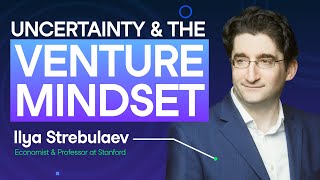
Stanford professor Ilya Strebulaev outlines nine principles for the venture mindset, a framework for decision-making in uncertain environments. Home runs matter more than strikeouts, bet on the team not the idea, and say no to 100 ideas before saying yes to one. He uses examples from Dropbox and Airbnb to show how this approach works in practice.
Chapters
As an investor, the last thing you want is to throw good money after bad money. And of course the same with all of us. So just ask yourself a how often do you continue incurring a lot of effort, putting a lot of time into the project that in fact you kind of already know is not working out?
Hi Elia, welcome to the show.
Richie, thanks so much for having me.
Excellent. So just to begin with, what is the venture mindset?
The venture mindset is a new mental model, how to make better, smarter decisions in an innovation driven world. In a world where there's a lot of uncertainty, unpredictability, I call it unknown unknowns, disruption and so on, where the traditional way of making decisions both quantitatively and qualitatively does not work very well. So that is the idea behind the venture mindset.
Okay, so you talked about unknown unknowns and it seems like there's a traditional way of doing business that's worked very well for a long time. Has something changed in the world that means that it's no longer relevant and you need this new venture mindset?
A lot of things have changed in the world. I'm not saying that the traditional way of making decisions is not completely irrelevant. It's still relevant, but not all the time. So when I say unknown unknowns is that in the past, when we think about businesses, when I think about data analysts, for example, then we can predict the future much better because we knew, for example, that if we think about companies, the business models will be the same. If we think about various data trends, data trends would kind of be on the continuous path. And nowadays there is so much disruption in academics. We talked about caste theory. So there's so much new chaos that is very difficult to predict. And it's not just generically, but with specific individual decisions. You know, I'm teaching at Stanford, I have hundreds of students who are taking my class who become either investors or the founders of venture backed companies. And I'm helping a lot of them and I stay in touch with them after graduation. And you know, just yesterday I talked to four of my former students and I'm helping them to raise money. So three out of four are now raising funding for generative AI startups. Okay, well, I guess not a big surprise, Rich, either for you or for our audience. But the whole point about this is that if you think about this, it's a lot of unknown unknowns. So unlike many of my students in the past, what is the business model of this generous BI startups, very often they don't know what is going to be the technology? Very often we don't know how large is the market, it's very difficult to predict, and so on and so forth. And so that is the idea behind the venture mindset. And by the way, the reason I call it the Venture is because really for the past 50 years, venture capitalists were making bets on startups and they were facing all these unknown unknowns all the time. It's just that now we are far away from Silicon Valley, far away from venture capital, it is facing the same, I would say, hostile environment where we make decisions.
Okay? So I think this is going to be quite terrifying for a lot of people in the audience who are data analysts or data scientists saying that actually your ability to predict things is decreasing because there is more chaos in the world and more unexpected things going on.
So I agree with this Richie, but you know what, you should not get pessimistic. So that's the whole idea about the venture mindset is that it's a different mental model so that you still can make decisions, you still can make, I think very high quality decisions, even though it's much more difficult to predict. And let me tell you right away, I think what is really important for data guys is that if you think about what is really most important for venture capitalists and identified in my research at Stanford over the last 20 years, what I call nine principles of the venture mindset. But if you have to rank them, by far the most important one is the following. And I'm going to use a sports analogy. Home runs matter, strikeouts don't. So if you are in something that you don't expect a lot of changes, you actually do not want strikeouts. You want every single line of code work perfectly. Ideally you would like every single data point, tell you something and so on. Every single mini project to succeed, the venture mindset thinks completely differently. Home runs matter, which means that it's okay to fail. It's okay if a lot of mini projects do not work as long as you experiment, try them quickly, scale fast, and then abandon them if they do not work. But some projects, some of the analysis is going to be truly impactful. And the whole idea is to use the venture mindset to identify and scale and put all your effort on those projects that will become a home run. So that is the whole idea, okay?
So you're having, or you're allowing for some failures to be built into your business model, then you think that some things are going to go wrong, but you just got to concentrate on getting those wins as well.
I think built in is a very good word, Richie, because failures in the venture mindset that don't happen just because they have to happen, they are built in, which means we expect a lot of failures to happen over time.
Okay, so if you think about home runs and strikeouts, how big do your home runs need to be in order to compensate for these strikeouts?
That is a great question. So because we're talking to the audience of data geeks, right, Let me tell you the numbers. And the numbers based on my research at Stanford, I'm the founder of the Venture Capital Initiative and we have perhaps the best data set of all the venture capital investments, investors, founders, startups and so on. Okay, so here are statistics for you. If you take on average typical 20 early stage venture capital investments, so 20 typical startups, about 15 of them, we expect to fail. Think about this, okay, so 75%, 15 out of 20 we expect to fail. Investors expect to lose money on them. Then there's going to be a couple of starts, maybe three, maybe four, that will be kind of successful or semi successful. As VC is used to say, we'll get 2x, 3x or 4x of our money, meaning that you invest $1 and you'll get back $2, $3, $4. If you're a banker like investment commercial bank, you'll be extremely happy with this result. VCs are unhappy. Why? Because if they get 3x, it will not allow them to return the money on their losses to cover their losses. And so those outcomes are considered to be mediocre. And then there is one and perhaps two investments that will return you 100x. So that is a home run. So home run really starts at, people say 10x. The reality is it starts at much higher than 10x. So I just talked to a friend of mine, capitalist, and he's an early stage investor. His typical check size is between 1 million and 3 million dollars. Okay. And just one of his startup that he invested in about three years ago was sold and so he put in 1.5 million. It's actually a data startup, 1.5 million. And it just got sold and he got 120 million back. So that's about a little bit less than 100x. So that was a successful investment. Here's the way to think about this, by the way, about a home run. The venture capitalists think, and I always tell the founders about this because that's critical. The way venture capitalists think is if I reach a consider whether to invest in you, in your startup, okay, I will ask myself the following question. If everything goes according to the plan, in fact, if everything goes better than the plan, then will my investment in you allow me to return my entire fund, which is the entire pool of money that I'm really managing? And that would be an amazing investment. So a fund returner is a true home run because effectively, if I have one fund returner, everything else is a cherry on top. So that's how they think about the venture, the home runs. And I really think in today's unpredictable, disruptive scenario, when you think about your data projects, when you prioritize what you do, I think you should really use the same home run approach.
Okay, so that sort of investing, one and a half million, getting 120 million back, that seems like a dream scenario. And I'm sure everyone would love that. Sort of 80 times, 100 times sort of win. But there are also sort of methodologies for thinking about decisions. So things like the Toyota Way Six Sigma, which are about incremental improvements to what you have already. So when might you want incremental improvements and when might you want to go for this venture mindset situation where it's like you just want a few big wins?
Thank you, Richie. First of all, I think that is a great comparison. There is a Toyota Way movement, there is a Six Sigma movement, and I hope that we're going to launch, with your help, the venture mindset movement. Now, those are not really contradictory. They're very different, but they're not contradictory approaches. Because I believe the Six Sigma, the Toyota Way approaches are very useful. And they're very useful when you don't expect big changes, when your improvements are incremental. Let me give you an example. So every single year, Gillette produces, releases a new razor blade. Now that is an innovation. And they of course then try to push so that we, Richie, you and I use all those new fantastic blades.
Okay, I'm not doing very well on that.
Maybe they lost you as a customer, but they have not yet lost me. But first, it's an innovation. And I think that likely using Toyota approach there makes sense. By the way, it is an innovation. Do you know that Procter and Gamble is the parent of Juliet? Do you know that Procter and Gamble employs more PhDs? That's Stanford, MIT and Caltech combined. So it's a big R and D heavy organization. Now that is an incremental approach. But let's consider a situation where suddenly a competitor appears that offers a completely different business model. So for example, you actually don't. I need Gillette blades. But you order a blade and every single week blade comes to you and it's like a subscription model. So that's very different. Okay? And in fact, venture capital is back to startup like this. And that is a completely different setup. And that will require the venture mindset. So the moment there's a disruption in the way how technology works, in the way how business model works, or the disruption how really you do business, by the way, professionally or personally, then Toyota Way is not only helpful, it's hampering you because it doesn't allow you to go outside your cage that you built for yourself. And this is exactly where the venture mindset should be used.
Okay? So if you want to make incremental improvements, it needs to be something like a continuous business case where you've got this discontinuities. That's where you need the venture minds. All right, so principle one, that was the home runs matter, strikeouts don't. What's the second principle?
So another principle that I really think is important and in particular maybe Richie for our audience today, is the one that I call get outside the four walls. What I mean by that is that again, I'm doing this research and venture capitalist, okay? I met thousands of them. And one thing I noticed about them is that you cannot find them in their office. Now, they typically are on their office once a week to meet with their partners, their colleagues. The rest of the time they're traveling or you can find them in a coffee shop talking to some other people trying to find out the new stuff. Again, the moment you are incremental in the incremental life, you don't mean the serendipity, you don't mean to meet people that will tell you something unusual. But once you are in the disruption, in this unpredictable stage, you really do not know what's going to be important tomorrow. So you would like to open up to new ideas and new people. And it's interesting because I've done research and I showed that venture capitalists have dramatically bigger LinkedIn networks than the LinkedIn networks of corporate innovators. Think about Chief Innovation Officer, for example, Chief R and D officer and so on. But more importantly, I think their LinkedIn network are much more diverse. Different industries, different backgrounds, different education, different geographies. While if you are, let's say a corporate innovator, you tend to, well, like 20% of all the LinkedIn connections are going to be from your present company, 15% are going to be from your previous employer, and then the rest will be from your High school and your college, okay? And that is not a great idea. Whenever you would like to achieve something unusual. So get outside the four walls, meaning that try to get outside the cage, try to open yourself up. And I think, especially when we think about new data opportunities, new unusual patterns, new connections, that is particularly important principle. Let me give you my personal example first. One thing is being a professor who is studying stuff. Another one is being somebody who says, you know what, that actually has an impact on me personally. So I've been studying venture capital for 20 years and I've discovered this kind of principles and I tested them, et cetera. And then I realized that for many of the principles, I'm actually going to use them in my life. So here's my own example that I'm pretty sure data geeks will appreciate. So I've been at Stanford for 20 years and I've been traveling a lot for academic conferences, to speak, whatever. So what do I do when I travel? Well, I come to the airport and I have my earbuds on because I'm listening to something because I kind of don't like noise very much. And then when I wait for the plane, what do I do? Well, I open my academic article or maybe my laptop and work on my data very intently. What do I do in the plane? Well, the same when I don't drink, I open my laptop or I read something. Okay? Now that is not getting outside your four walls. Because in fact, amazingly enough, when you travel, that is a good opportunity to meet somebody whom you don't know who is definitely outside your network. You never know what's going to happen. So after I decided to apply this principle to myself every time I travel, and nowadays I travel even more, I have a goal. Every single plane ride I take, I must speak to at least five people whom I don't know. It could be a person sitting next to me in the plane, it could be a person standing in front or behind me in the passport queue, etc. And you know what it's like. Home runs, meta strikeouts, don't. It is true that a lot of conversations, you know, hello, hello, where are you from, what do you do, et cetera, et cetera. There's no connection. And suddenly, wow. Let me tell a story. I was just returning from New York recently from Newark Airport and my flight was delayed. Big surprise. So I was waiting there and waiting and I started talking to the guy again. I would have never ever talked to him had I not had this petri minded principle in me. And by the Way you have to force yourself sometimes because there's a person standing next to you, he does not know you. I don't know you. He's actually kind of reading something. But there's always a way to start a conversation. It turned out that he's a journalist. He was coming from Dubai, from the Dubai World cup horse racing because he was covering horse races for the major US publication. And we start conversation. Then I told him, do you know that I study venture capitalist? And venture capitalist is all about what is important. Jockey meaning the founder of the team and the horse meaning everything else, product, market, business model, et cetera. And we spent like 40 minutes in the debates about jockey versus horse in startups versus horse races. And I think he's now going to write an article for his publication about, you know, horse raises and the, and the, and the venture capital and startups and the venture mindset. And I've learned a lot from this conversation as well. So you never know. So my suggestion, Richard, to you and to all the listeners, get outside your four walls.
As you can imagine from my job, I'm very enthusiastic about talking to strangers. So I'm fully on board with you on, on that point. Okay, so we've got home runs matter outside your four walls. What's point number three?
So point number three is, I think, very important. And it is called say no 100 times. What do I mean by that? Again, first of all, coming from my research, I'm a data guy, okay? For every single deal that venture capitalists consummate, like they give you a check and you accept the check, okay? The they consider hundreds, in fact, even more than 100 opportunities. Just think about this now, if you're a founder, that has huge implication for you because effectively you know what the odds are against you statistically. So you have to do something to increase them. But I think that goes way beyond. You need to learn to say no to many deals, to many opportunities in life, too many projects. And here is the trick how to do it. And the trick how to do it is what I found out is that venture capitalists ask a very different question when they start considering their potential investments initially. And I call this fast lane. There's a fast lane and there's slow lane. Firstly, they ask the following question, why should I not want to pursue this opportunity? Not is critically important. Instead of asking yourself a question that I observe, for example, in a corporate setting is a typical question, so why do you want to approve budget for this project? A better question might have been why we do not want to approve a budget, budget for this project. And I think that when we ask ourselves about whether we would like to pursue A or B, like whether we would like to accept a job offer, whether we would like to actually seek that job offer, you know, so our audience is doing a lot of data projects. I'm doing a lot of research projects. And before I discovered this myself, I was asking, do I want to pursue this research project? Like, is it promising enough? I have changed to the fast lane to, oh, why do I not want to pursue this research project? And I found this so efficient, so amazingly different. And I call this, so that you can remember this better. I call this the red flag approach. So you're trying to identify red flags that will make the project is not interesting enough. Note, by the way, that the venture mindset, the venture capitalists, they don't make a final decision at this point. So the idea is to put a filter on if the project, the startup, the idea doesn't meet the red flags, okay? Then they will not consider it. And then they will put all the effort, all their time, a lot of time, on doing much more detailed due diligence on the project that passed the first filter. Then they switch to slowlane and will ask a question, well, okay, why are we anxious to pursue this? And so the challenge is, I think that in the traditional mindset, we're too often asking ourselves effectively an inefficient question for every single project, why do we want to do it? And again, if it's incremental, that's okay. But the moment there are potential for home runs, you do not want to, for every single project to ask, why do you want to do it? You will not be able to consider a lot of opportunities then. So therefore, remember this principle, say no 100 times.
Okay, so this actually reminds me a lot of like a project manager mindset where you get hundreds and hundreds of tickets being filed with ideas for things to do with the project, and you just have to reject most of them. You've not got enough time.
Exactly. And again, the point is to find a very efficient way to do it. And I think the venture mindset will tell you do it by asking a different type of question. And what I found out in my research is that when you change the nature of the question, your approach dramatically changes.
And so it seems this is an implicit assumption here. So the first stages saying no to lots of things very rapidly, and then you can spend a lot more time concentrating on the few that remain. The assumption is that You've got lots of different things to choose from, like how many sort of different projects you have to choose between in order for this to start making sense as an approach.
Well, that of course depends. You know, for early stage range catalysts, it's at least 100. Okay. In fact, it's interesting that for software VCs so those who invest in IT projects, it's impact more. It's like 130, 140 on average. Perish deal done. If you're in healthcare VC, it's fewer. It's still a lot, but less. And I think the reason behind this is that typically software startups are much more uncertain, much more unpredictable than healthcare ones. So in healthcare ones, let's say very often we know the market, the market is there. There's technology and pharma risk that let's say the drug will not work or the medical device will not work. But if it works, we know the market is there for IT projects, for a lot of data projects, we don't know if the market is there. And so therefore you actually consider even more opportunities.
Okay, so we're looking at at least 100 different opportunities. And that's the point where you really do need to filter on reducing that number.
That's right, Rich. And for this you of course need to increase the number of opportunities. And this is where, going back to the previous principle, getting outside the four walls is really important.
So the example you mentioned before about this conversation with the person from Dubai was about should you bet on the horse or the jockey? Do you want to tell me a bit more about that? Like where did you land on this?
Well, that's another principle of the venture mindset. And the principle is very simple. Bet on the jockey, not just the horse. And that is first a critical principle for venture, the venture mindset. So venture capitalists will not invest in a startup if they do not think that the team behind this idea can execute the idea. And the truth is, and I've seen this again and again, you know, the world of ideas is overrated. There are too many ideas. And I know we talked about intellectual property and copyright, but the truth is that there are so many ideas that especially when we don't know how good they are, the ideas are less important than the people behind them. I can come up with a great idea, but I'm unable to implement it. And for each great idea there will be so many teams who would like to try it out. Let me give you, Rich, an example. So I hope that not everybody in Our audience is so young that nobody remembers the day when the first iPhone was released back in 2007. But if I take you for a second back to that period, at the time, there was no possibility to share files. Or rather you would use a. Do you remember USB sticks? Well, you remember maybe salmon, but USB sticks. And even if you're a little bit older, I still remember the diskettes. Okay. Kind of the disks, the floppy disks. Okay. So that was the way to share files. But the idea that the future of file sharing is going to be disrupted was there was out there. And of course, iPhone obviously supercharged that. Okay. So 2007, in fact, there was a popular tech blog called Mashable and it posted the list of, I think more than 80 startups that were pursuing this kind of file sharing, file hosting stuff. Okay. Now, many VCs looked at that, and one VC in particular, his name is Sameer Gandhi. He was a partner at Sequoia Venture Capital firm and he thought file sharing is really cool. It's going to be big. By the way, again, the market did not exist at all. The technology was not there yet, but he thought, it's actually coming up, it's coming out, it's a huge vertical. I would love to make an investment. Okay, how he approached that? Well, he went out and met with dozens of these startups that Mashable listed that he met. He learned a lot about this technology. He did not invest in any of them. And then one day, serendipitously, he was introduced to these two guys who didn't have any money. In fact, I think he needed to take a Greyhound bus from Boston to the Bay Area because they didn't have money to fly and they didn't have a prototype because obviously they couldn't do anything and they were kind of outside this community. But in several minutes he invited them for pizza. And I think very quickly he said, I would love to invest in them. Why? And that is because the jockey, remember the horse, was the same for all those teams. The file sharing idea was exactly the same. The market was the same. Nobody really knew about how technology is going to evolve. What he realized in that really first five minutes, I think, is that these two guys and their names were Drew Houston and Arch Verdousy. They knew much more than everybody else he talked to. They in fact thought deeper about many issues that he thought. And by the way, venture capitalists love investing and founders who know more than them about the stuff that they think they're experts in. And so he realized those Guys can execute, if anybody can, they will execute. And so he of course proposed and Sequoia invested. And I think that investment turned out to be one of the better investments. Dollar per dollar, that company was renamed and became known as Dropbox. And maybe some of us still using Dropbox every day, but, but that is the point. So the point is that There were like 80 startups perhaps doing exactly the same, but really only two plus survived. There was a Dropbox, there was a Box, and of course there was a Google Drive, which is a startup inside Google. And I'm not really sure whether you can name any other successful file sharing companies. Okay, so that's about the jockey. So I think venture capitalists will not invest unless they believe in the jockey. And I think that also holds a lesson for everybody, for all of us. I'm often asked, being a professor, I'm often asked, so what is the purpose of education? One of the purposes is to ensure that you improve your jockey skills. Now, I don't mean horse racing skills, I mean that when you talk, like when I talk to you, and I think of myself as an expert in your field, I'm still impressed by what you do. And so I think that is a skill, but I don't think there's too much luck involved. So my suggestion is to think about your jockey skills as a result of that.
So that is fascinating. Of course, Dropbox, incredibly successful in the face of, like you said, about 80 of the different startups trying to compete for this space. So you said one of the things that the venture capitalists appreciated about the founders was that they knew more than they did. So beyond domain knowledge, are there any personality traits that make for a good leader or a good founder?
A great question, and the answer is yes. And you can see it both quantitatively and qualitatively. And there's no one single personality trait, but there are many. One is difficult to define but easy to see when you encounter it is charisma. Let me give you another example. Again, I've been very lucky. At Stanford, I met so many students of mine who had this charisma. And again, all of them are different. And so if you ask me, can I define charisma? Not really, but I can give you an example. Okay, let me give a specific example. And in fact we give this example in my book, the Venture Mindset. So I had this student, his name is Rene Kassi, he is originally a doctor, a surgeon from Canada. He came to Stanford to study business. And the idea was because he really wanted to Find he didn't have really an idea. He wanted to find an idea that would merge know, business, data, technology and medicine because he, he really cared about healthcare, okay. And he came up with the idea this, the exact idea kind of is irrelevant here. Actually the idea is amazing. It's a platform to match the patients who have rare diseases, okay, Those that maybe a few hundreds patients have in the, in, in the country with the hospitals and the providers. So that's actually not the point. The point is that I have hundreds of students come to my office and talk to me about their aspirations. And a lot of them are amazing, but when some of them come and I'm a professor, I'm sitting in my comfortable chair and I'm 10 years, I don't need to go anywhere. And I talk to some of them and my heart starts beating faster because I say, gosh, I actually would love to join this guy, okay? And so that's what happened with Rene. He came and talked to me and the way he talks and the way he looks at you, et cetera, that's what I call charisma. And he convinced when he didn't have money, when he didn't have prototype, when he didn't have any success of any kind, he succeeded in getting some, some students join him full time. He succeeded some top person who worked at a well known large company drop everything and join him. And so when as a founder you succeed in making people follow you, when you don't have success, when you don't have millions of dollars to show, I think that is very, very, very impressive. Okay, that's one. So charisma is one, two is passion. And that is because the reality of the venture mindset is that the real home runs are likely to be long term endeavors. Venture capitalists joke, however, they laugh every single time I tell them that One of my research insights, which I would say may be one of the least important but the most cool research insights, is that if you look at the average period of time that startup spends before it kind of becomes public, if it's successful startup, and it's now 8, 9, 10, 11, 12 years, depending on exactly how you count, is actually longer along some metrics than the median marriage in the United States. Okay? So you have to be very patient and for this you need to be passionate. And for example, if the founder tells a venture capitalist, you know, I'm here for a quick buck, I have this great idea, I'm great, I'll be in a couple of years, I'll sell it like for 100 million bucks, venture capitalist, immediately it will be immediate red flag, immediate turn off the end of the conversation. And the final feature, which I think is really important, is resilience. And resilience means, in my experience, every single startup, even the ones that became amazingly successful, amazing home runs, they're on the verge of going bust so many times, and it's tough. And you have to make as the founder, as a team member, you have to make a lot of tough decisions. I think resilience is something that venture capitalists are very, very curious about when they evaluate founders and also builds to work on a team. So I'm getting calls all the time from venture capitalists who are doing reference calls on my former students who would like to raise money from them. Okay? And you know what? I had maybe 500 calls this year. And you know what? Not a single time. They asked me about the grade. Nobody cares about the grades in my class. Okay. They asked me about, so how this do remember this person, did that person stand out? They asked me about, so was that person a captain of the team? Because we have a lot of case study teams. How did that person interact with other group members? How was the resilience if there was some disagreements among the groups and so on. So those sort of type of questions that I think the venture mindset really, really cares about.
Okay, so we've got charisma, patience, and resilience. These all seem like good qualities in people to have, regardless whether you want to be a founder or not. So, yeah, certainly useful thing to know. So you mentioned just then, like, what happens when you have disagreements and it feels like you're getting a lot of cases where it's like, well, I won't do this one project. Someone else says, I want to do something else. Do you have any advice on how to resolve these sort of disputes?
Yeah, that's really fascinating because it's amazing because I often work with the leaders of large organizations, like large global companies, and I go with them through every single principle of the venture mindset. And they're surprised by a lot. They're taken aback by a lot. But I think this stuff about disagreements is the one that they're really kind of shocked. Okay. And that's why also the reason why we, in fact, in this, the venture mindset book that I mentioned, we call a chapter agree to disagree. And this is the chapter where I just met the CEO of a large organization and he said, oh, wow. And also it's a while because in fact, you can make changes, right? Away, like some stuff, it's very difficult, it's very difficult to make myself charismatic if I'm not. But some stuff you can actually implement right away, right there. Okay, so what does agree to disagree mean and why you should use it in the venture mindset situations, not in the traditional mindset situations. So typical, typical decision making in groups work like this. Like, think about meetings you had when you actually had to make a decision. So there could be a lot of debates. But at the end of the day, people try to come to consensus. And many organizations in fact either require consensus or they require unanimity. So everybody says, yes, let's go forward. And that could be done for culture, for politics. The truth is it's human psychology and there's a lot of research, including mine, shows that if we don't design the system, then trying to reach consensus is something that is innate to us, okay, to human beings, amazingly enough. And I don't have time to go into the detail, but one of the most amazing examples is not from my research, because I'm doing research on humans, I'm not doing research on monkeys. But one of the most amazing stuff about monkeys and consensus is from Professor Erica de Waal, who's professor at the University of Lausanne and she's been studying vervet monkeys in Africa. And she showed that conformity, desire for consensus, monkey unanimity kind of, okay, is really so widespread. So maybe not surprising that we're also. Human beings are also similar. And by the way, it makes sense again, if we live in the world of incremental innovation or incremental changes, it actually makes sense because we make small step and we kind of would like to ensure, because there's not that much uncertainty, that we take everybody's view into the account and everybody's okay with that. But the moment you are trying to catch an outlier to secure a home run, the whole point is that the future is unpredictable. And you know what? Most of the amazing ideas will seem stupid, at least to somebody. Let me give you an example that I give in the book, which I find fascinating, but let me preface it by saying reach is important. I give a lot of examples here. They're all typical. I give examples, I try to give examples so people know the names, but it's typical example. Okay, so here's a typical example. In 2008, I believe, a venture capitalist, his name is Reid Hoffman and he's in fact known as one of the co founders of LinkedIn. But by then he was a partner at a venture capital firm called Greylock. He met those kind of two scrappy guys who created this kind of weird startup where strangers could sleep on a mattress in your living room. Okay? And he came to his partnership and he said, this is actually a really cool idea. I met these founders. They're really into something. They're charismatic, passionate, resilient, and et cetera, et cetera. And by the way, I think that's potentially a huge market. Of course, the market didn't exist at all. Okay? And Greylock partnership said, how stupid idea. In fact, one of his partners said, you know, Reid, every single venture capitalist has a right to. To make deals that. That fail, and let this deal called Airbnb be your failure. Okay? But here is a very important point, Richie, and this is something that makes the venture mindset different from the traditional mindset in the traditional mindset organization. That would have been the end of the conversation. So I have an idea. I bring it, Richie. You say, what stupid idea Ilya, you brought to me today? And I try to convince you, and you say, no, and then we will end it. Especially if maybe somebody else says, yeah, I agree with Richard. That's stupid. And so therefore, we would not make an investment. And yet, despite the fact that his partners disagreed, Rid Hoppen proceeded making an investment. And I'm sure that that became one of the most successful of Greylock investments. Okay? So, and here is the point that's critical, and I really would love everybody to pause and listen to me carefully, because I think that is something that shocks people, is that disagreements and dissent is very important in these situations where there's uncertainty, unpredictability, and so on. You have to design it. It will not happen by itself. And what I found out by studying venture capital firms, by studying the venture mindset, that there are many ways to design it, and venture capital firms design it in a different way, but they are thoughtful, they are purposeful about that. So if you don't do anything, that will not happen. So let me give you some examples. In one example, the venture capital firm called Venrock, every single partner comes in and brings a deal. And then everybody debates. They write investment memos, due diligence and so on. And then after the meeting, that partner who brought the deal leaves the room and has to make their own decision. They don't have an investment committee. They don't vote. Very unusual. It will not work. In many organizations that pursue an incremental approach, that should not work. But the moment you trust an individual, make an outlier decision, that's the way to proceed. Or another example in another venture capital firm called Founders Fund for a smaller deal, it's enough for a partner to convince just one another partner. So Richie and I, if we're partners, it's enough for me to. It's my deal. I'm excited about this. It's enough for me to convince you, Richie, even if everybody else kind of thinks like it's bizarre, will proceed. So there are many, many. I won't describe all of those methods. So that is at the decision making stage. There's also something that is really important at the, what I call information exchange stage. So you and I get together and we discuss couple of points. For those of our audience who actually make decisions in groups or discuss stuff in groups, let me give you two actions to implement. One I think is very intuitive for most people, one I find amazingly unintuitive. Okay, let's start with an intuitive one. In every single meeting, my recommendation is juniors should speak first. For example, in our recruiting meetings at Stanford, when we try to hire best professors to come to us, we always have junior professors speak first. And there are great reasons for this. In fact, very often they know younger faculty members who are trying to join us better, and they know the most recent trends better. But more importantly, when a very, very senior professor speaks up and you think that I disagree with that, it's much more difficult to go against it. So my suggestion is that, and again, be purposeful about this. This is a rule. A rule is if I'm joining to you, Richie, in terms of the number of years or whatever title, I always speak first. It's kind of intuitive. Well, at least I find it intuitive. One is counterintuitive. Okay? So make sure that everybody, the entire audience must sit down at this point because that's what generates a lot of debates. Experts should speak last. Now, again, in the situation where there's an incremental change, I don't think experts should speak last. If we know a lot of stuff, I'm the experts, I should speak, and then what is there to discuss? But if we're trying to catch outliers, the whole idea of an outlier is perhaps there are no experts. In fact, maybe experts are in their own golden cages. Okay? And I think the idea is that when experts speak last is that you do not try to remove the freshness from the debate or from the information exchange. So whenever you are thinking about, well, really trying to find this home run, let those who are far away from the field speak first. Because once the experts spoke or the Perceived experts, rather, and you disagree, it kind of would be difficult for you to speak up and for everybody else to listen to you attentively. So this is my specific recommendations for how to change the decision making process within groups.
This seems incredibly important. For example, running meetings. I think that's when in most organizations, that's where a lot of decisions get made. And just that simple change of getting the most junior person to speak first seems like it could be an incredible sort of change to innovation across the company. Now, you mentioned the idea of Airbnb and Greylock almost sort of didn't invest. So making mistakes seems like it's going to happen. Like if you invest in something or if you start a project, at some point you're going to hit roadblocks. Things are going to go horribly wrong. Do you have any advice for what to do when things go a bit south?
Thank you. Richie, you are bringing up another venture mindset principle that I call double down or quit. Let me first of all step back. In the venture capital world, startups fundraise again and again and again. Okay? And that makes sense, which is if you're growing fast, you would like to raise money. The challenge is that if you're about to fail, you also need money. If you would like to continue as an investor, the last thing you want is to throw good money after bad money. And of course, the same with all of us. So just ask yourself a question. How often do you continue incurring a lot of effort, putting a lot of time into the project that in fact you kind of already know is not working out? Okay. And by the way, you can always find justification why you would like to continue this. And it's called academically, in the world of psychology, it's called escalation of commitment. Okay. And what my research finds out is that venture capitalists who succeeded in managing this, who succeed in being kind of more ruthless and concentrating on their best startups with the highest potential, are those that are more successful. Now, how to do it? Okay, so here are specific tricks. One is that doing this decision, making this decision yourself is very difficult. If you're engaged in this like Richie, you've spent six months on a project, it's maybe not going anywhere, but you can think, well, let me spend another six months and then maybe it will go somewhere. So the first that venture cappers do, and what I recommend you is ask somebody else who has not been engaged in the project but you kind of trust or you consider that they are experts or they can advise you. So come to them. And I think so in the world of venture capital, that means they're partners, okay? Partners of the venture capital firm. You can go even further. You can say, you know what? I would like to get commitment from somebody else. Like if I, if I cannot find somebody who is excited enough to join me, then maybe I should not continue. By the way, this happens very often to my students. They've been working on some startup and then at some point I tell them, look, guys, it seems like you are unable to attract another person to join you. Now if you cannot attract a team, you're unlikely to succeed alone. Okay? And by the way, here's a deadline for you. Eight weeks. So you have eight weeks to convince at least two people to join you part time. If you cannot do it, I think you should do something else with your life. And venture capitalists do it. In fact, many venture capitalists will invest in the same startup again only if they find another venture capital firm, a reputable one, that will also put in the money. And I think that this is something that all of us can do. Let me give you my own example. So when I'm doing research, and I started so many research projects in my life that failed, luckily I also caught home runs that succeeded. But the trick is that had I spent more time on projects that failed, likely I would not have been able to catch those home run. And so early on in my career, I think I spent too much time on projects that really were not going anywhere because I felt, you know, the question I was asked myself, like, look, I'm a young assistant professor at Stanford. I'm doing this project that I kind of know is, you know, like deep inside me, I kind of know this is like not going anywhere, but maybe I'm working with the PhD students and I actually even feel commitment and, and I feel maybe I'm going to spend more time on this. Maybe something will come out of it. And I think that was a mistake and that was a disservice not only to myself, but also to that PhD student. Now what I do is I very often seek outside feedback much early on. So I go to somebody whom I trust and say, look, here's the idea, here's what I've done. Do you think it makes sense? And then we debate and then I try to put the hat of that person on me. And very often these days, very often I stop the project much earlier. And had I done this, I think 15 years ago, maybe I would have been even more successful. So I advise everybody to Avoid this collection of commitment. And this is why I call the principle double down or quit. Because you have to make purposeful timeline, like a milestone, where you say, either I quit or I double down. Double down meaning really kind of double my effort on my resources, my time, whatever. But you can't double down on everything you do in your life. Okay? There's only 24 hours a day, and therefore, you have to quit some projects as well. Now, a typical venture capital statistics is that in every single round of fundraising, VCs drop about 50% of their startups. So every second project. And again, that kind of depends on. I found out in my research. Yeah, I drop every second project at various stages, and I think it works. So, again, think about this, especially if you pursue many projects at the same time. Okay.
Yeah, certainly, I can see how psychologically, it can be very difficult for a lot of people to just completely abandon things that they've started. You know, they want to get to the end. But in terms of. Yeah, you've only got so many hours in the day. You're gonna have to drop some of the losers. All right, so I'd like to talk a little bit about productivity and how you can incentivize employees. Like, are there any ways that you can change employee compensation or what they're doing in order to make them work harder or more productively?
Thank you, Rishi. And I think incentives drive behavior. That's kind of very simple. Okay. And the principle that I keep in mind that all the time that venture capitalists use, and the principle is very simple to state, difficult to implement, is called make the pie bigger. Make the pie bigger. So you're making the pie bigger by ensuring that everybody's incentivized. Now, by the way, when I say the word incentives, it doesn't mean you just pay them more money, because different people are incentivized by different things. So finding out what really drives people is important. But these incentives drive behavior. You would like the people with whom you work to. Well, you would like yourself to be driven by incentives. A bit of history is going to help here. So if any of our audience works in maybe tech companies or in startups, et cetera, they might have shares, they might own shares of those startups, they might have options, they might have RSUs, restricted stock units that are vesting over time. Okay. And amazingly enough, it's a new development. Well, relative development. And it was kind of invented or maybe rediscovered really by venture capitalists back in the 1970s. So prior to that, that was something that nobody was doing. And financially I think it makes sense, especially if you are in this unusual, unpredictable environment where the outcome is unclear, to incentivize people by giving them even a small fraction of the pie rather than paying them a fixed salary. So if I pay you, Richie, even a lot of money, like million bucks a year, but it does not depend on how you perform what you do, okay, you have to appear at your work from nine to five or whatever, okay? And you have to appear as you work. But if it's a fixed salary, however excited you're initially, this excitement will over time disappear. But if my goal, let's say I'm the owner of this project and your goals are the same, which means that you in fact benefit from this project being successful, then our incentives will be aligned for longer. That is also why I think in many large companies they create what is known as shadow stocks. Shadow meaning for stocks for a specific project like say Google is doing that. Let's say you work in a Google group that is not involved in search engine, then whatever you do really doesn't impact the Alphabet stock price, okay? But whatever you do really impacts your group. And so if your group is like a separate startup within a company, you can get a shadow stock where the shadow stock price will really depend not on the entire company's value or success, but on your group's success. And so another point about making the pie bigger is try to make the pie also very specific if you can. And I think that my advice to our audience first is whenever they join a company or negotiate a deal, try to think about long term incentives. Try to negotiate for yourself long term incentives. If somebody wants just to pay you money, but you will not participate in success, that's okay, but you will not be able to catch a home run. And likely you will not participate in the big success if it comes. And by the way, more likely the success will not come. And then on the contrary, or not the contrary, on the reverse, if you're hiring somebody or you're trying to convince somebody to join you, try to find out those who care about incentives, who care about the success, the success of the whole enterprise. And by the way, there is an important word in science called self selection, which means that if I, Richie, let's say offer you 1000 bucks a day if you're going to work for me, or I'm going to offer you only 500 bucks a day, still seems a lot, okay, but half of that, but also 1% of the profits in the future, it turns out to be that some people will say oh no, I would like a thousand bucks a day. And some people will say yeah, I would love a smaller compensation now, but I believe in the success. And sometimes you actually want those people who do not want all the compensation now. And so you would like to people self select. And I think that's very important. By the way, that is I think one of the major reasons and that's why VCS really care about this. They know that by structuring these incentives, right, to ensure that there's a long term incentives, people who are going to join the startups, who are going to base, who are going to leave apples of the world and join them are those who becoming less risk averse, who are more adventurous perhaps who are ready to incur more effort, who are ready to become more resilient. And I think that is very important, especially if you initiate a project.
Absolutely. So I think that idea of shadow stocks in particular was especially interesting. So there are a lot of parts of business, particularly as business gets bigger, where you aren't tied directly to revenue or like major business impact. So having that sort of startup like feel is going to be incredibly important there. Okay, so before we wrap up, it'd be nice to know how you get started with this. Like, do you have any advice for like what's the first step you need to take in order to adopt this venture mindset?
Well, first of all we, we had time to cover only some principles. So obviously these principles are interconnected, work together. So of course my first advice would be to read the entire thing and to understand all the principles. But I have specific advice for this. And what I find out is that by teaching, you learn. Now I'm a teacher, I'm a professional teacher, so I've, I'm very proud that I had more than 5,000 staffer students graduate from my classes, talks, sessions, et cetera. And you know what? Every single time I come into the classroom, well, by virtue of being a professor, I know more. The truth is I learn every single time. And so what I suggest is for everybody in our audience, I encourage them to learn more about the venture mindset, but then to talk about all these principles and provide all these examples and encourage debate and dissent and disagreements with their friends, their colleagues, their families, during dinner time, during lunchtime. I actually think a lot of examples, like we're given a book, for example, I think a lot of examples are cool enough that you can discuss at a party and that generates, I do this all the time whenever I Attend a party. And that generates a lot of debates. And I love debates, both statistical debates, so people cite data facts, but also a lot of anecdotal debates where people say, well, let's think about this, let's think about that. So here's my encouragement to you is just do not learn yourself. Okay? And finally, Richie, I mentioned some examples where I myself changed my behavior. So I truly believe in any mindset working only if you try to change your behavior. Don't be too ambitious right away, which is, oh, this is great, I'm going to change everything. Do it step by step and try to evaluate yourself. And you know, it's interesting that every single principle that I talked about and more principles we didn't have time to talk about, every single one of them, I changed as a result of those. I changed my own behavior as a result. So I believe in specific actions that people take and those actions could be different. It depends on, are you a data geek working all the time alone, Are you working in a group, Are you the leader of the group, Are you the boss of a large organization? So those actions are going to be different and you will find something that in fact you would like to implement yourself. And then when you do it, talk about that. Talk about that to everybody. If you're present on social media, say, here's what I've done and whether it worked or it didn't work and why.
I love the idea of just communicating more, talking about what you're doing and sharing these ideas. Maybe a bit hesitant on the idea of talking about this at parties. You've got to be very careful about, like the kind of party you start discussing this sort of thing at. But yeah, that's brilliant advice. So. All right. Yeah, thank you so much for your time, Elliot. Like, so many great tips there.
I think, Rishi, it's great having you. Great having you. And I hope that everybody in our audience became just a little bit more venture minded as a result of our conversation today.
Absolutely. Super. Thank you.
More from Richie

#359 My Best Friend is AI with Valerie Tiberius, Professor of Philosophy at University of Minnesota







How AI Agents Will Work While You Sleep | Ruslan Salakhutdinov, Professor at Carnegie Mellon

#358 How AI Agents Will Work While You Sleep | Ruslan Salakhutdinov, Professor at Carnegie Mellon

