#90 How Data Science is Transforming the Healthcare Industry (with Curren Katz)
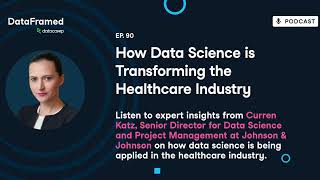
Karin Katz, Senior Director of Data Science at Johnson & Johnson, discusses how data science is moving from pilot projects to real-world healthcare deployment. She shares three concrete examples: using predictive models to find COVID-19 vaccine trial sites, detecting pulmonary hypertension early through multimodal data, and accelerating drug development with real-world data. The biggest challenges are data quality, bias, and getting clinicians to trust and use these tools.
Chapters
You're listening to Data Framed, a podcast by Data Camp. In this show, you'll hear all the latest trends and insights in data science. Whether you're just getting started in your data career or you're a data leader looking to scale data driven decisions in your organization, join us for in depth discussions with data and analytics leaders at the forefront of the data revolution. Let's dive right in.
Hello everyone. This is Adele, Data science educator and evangelist at datacamp. Two years into the pandemic, the potential for data science and machine learning in healthcare has never been more apparent. Whether it's drug discovery, acceleration, operational innovation, virtual assistants, and disease prevention, the margin of opportunity for data science in healthcare is massive. However, that doesn't come without its own set of unique challenges and risks that require unique solutions. This is why I'm excited to have Karin Katz on today's episode of Data Framed. Curran is a Senior Director for Data Science Portfolio Management at Johnson and Johnson. She has decades of experience at the intersection of healthcare and data science and is deeply attuned to the state of data science and healthcare today. Throughout our conversation we discuss where the landscape of data science and healthcare is today, the unique challenges of applying data science in healthcare, the importance of ethical AI when working on healthcare use cases, how to solve some of the data challenges of the healthcare industry use cases. She's been excited about how data science was used to tackle COVID 19 and much more. If you enjoyed this podcast, make sure to rate us and subscribe and add a comment, but only if you enjoyed it. Now let's dive right in. Karin, it's great to have you on the show.
Yeah, great to be here. Thank you for having me.
I'm excited to talk to you about data science and machine learning and healthcare, your experience leading data teams and complex organizations, and how you've led R and D at Johnson and Johnson. But before, I'd love to learn more about your background and what got you into the data space.
Yeah, absolutely. So I guess like most people, I've always loved data and my first statistics courses I started to think, oh, this could be really, really fun. And especially when I started applying it to data I had collected as a research assistant, it was pretty addictive. And then as I moved along in my career, I'm a cognitive neuroscientist by training but did FMRI research as well as looking at some like epidemiology data sets and 20 years ago wrote a paper on predictors of suicide attempts. Not exactly an AI ML approach to it, but that interest in like how can we predict some event? And then I being in neuroscience, studying neural networks, all of these things, and applying actually machine learning techniques to FMRI images, which are images while someone's doing something. So it's a fairly complex, although clean data set got me really excited. And then I've always been passionate about healthcare and solving problems in healthcare. And my first corporate data science job was at Highmark Health. So I started on the payer side building a bunch of models and seeing how those models impacted care and was hooked. And then moved to the parent company. It's an integrated healthcare system, second largest integrated payer provider system in the US and started a data science department at that parent company, looking at the payer, the insurance side, the provider side and a few other diversified healthcare businesses. And then came to Johnson and Johnson where I am now. And it's been a really exciting career where I get to see a lot of impact from data science.
To start off our conversation, I'd love to understand the current state of data science machine learning in healthcare. Early in my career, about five years ago, and that's not too long ago, healthcare was often and still is talked about as an industry with a large margin of opportunity for data science. But it comes with its own unique sets of challenges which makes it slower in comparison to other industries. Given your experience as a data leader in healthcare, I'd love to first start off our conversation by understanding how you would describe what the current landscape of data science and healthcare looks like today. And how has it evolved in the past few years?
Oh yeah, that's an exciting question. And it has evolved and different parts of healthcare, I'll say, are probably at different places and evolving and at different paces out of sometimes necessity. And you say there's a lot of opportunity in healthcare. There is, and I think it's one of those industries where you have to take a bit of a careful approach to anything new there practically there are regulations and there's a lot of risk for something going wrong, but huge benefits. But what I've seen over the last few years is really a couple things that we're seeing in a lot of industries, but in healthcare as well, scale as we're moving into, hey, data science can be very, very useful for solving real problems. In healthcare, there's a focus on deploying these models and not just having proof of concepts, but really using them to drive core business decisions and core insights. And that requires data science at scale. Where at first it was a little more experimental, a little more, well, let's just see how this goes alongside what we do today. But we're not going to go all in and really use this to drive our business. But we're moving towards that. The other change, I guess, are the problems that we can solve or just we're realizing them. Right. We're expanding the scope of what data science can do in healthcare. And of course there's diagnostics, there's also operations, there's clinical trials and how those are run, how patients are. There's so many things we can do. And then a third really important, I wouldn't say change, but something that's just continues to mature and we think about and I think has helped accelerate data science and healthcare is just thinking about the ethics of what we're doing, considering it's impacting people and the care they receive. And it can be life or death, or it can either help or hurt disparities we're seeing in care. So really have thinking about ethics, which is important in healthcare, and having tools and ways to address that at scale has really evolved over the past few years.
That's really great. And I'm excited to unpack these with you even more. So you mentioned at the beginning some of the areas of impact that data science and machine learning have in healthcare. Do you mind expanding on these main areas of value where you've seen data science and machine learning push the envelope forward within the healthcare space?
It's hard to pick a few, but one I love to talk about, and this is something my former team did and I really love the way they approached this and I saw it impact patients, was looking at operations. So sometimes in health care we go at the we're going to cure this disease, we're going to diagnose this disease. And of course, how do we not say we're going to put every data science tool we have towards cancer and we should. But a safer way in and a way in that makes a huge impact can be the operations of healthcare itself or the operations of a clinical trial. So I'll give you an example. When I was at Highmark Health, we built a tool to help schedule patients receiving chemotherapy. And a big thing for me is start with the problem we heard about. Hey, we're scheduling patients for chemotherapy. They have long wait times, which seemed not great. We noticed we're really busy in the mornings and then things are empty in the afternoon. So our clinicians are either overwhelmed or don't have a lot of patience. And we dug in. That was two things. They didn't know how long a treatment could take and there could be side effects. And clinicians want to care for their patients and make sure they have plenty of time. So they're blind to how long each patient might need staying there in that location. So if we're able to predict that, we can start efficiently scheduling and then just optimizing the scheduling, optimizing the operations. Where in the calendar can this go? Where location wise, can this go? And we had this tool ready when the pandemic started and it became even more important to space vulnerable patients out. It started with an operational challenge though, scheduling, very practical thing to solve and it made a huge difference. I've heard stories from patients and saying, hey, I can get on and back to my life and not wait. I can come at times convenient to me. Another area that I've seen an impact in a lot of promise is diagnosis or detection. Early diagnosis, early detection, to give clinicians some time to intervene. We heard about this in things like sepsis, acute diseases. We're talking about early detection of things like pulmonary hypertension, which is frequently diagnosed late. And I know that's something where we're doing now. These are big, big areas of opportunity where we can treat patients because we can detect these diseases and diagnose them. And then the third is patient's own experience, like with the operational, of course, that had a patient experience piece, but just understanding patients, their journeys, where they're facing challenges, how they're experiencing the healthcare system and where we're not maybe delivering care in the way we should. Data can help us see that and help us deliver a better experience, deliver a more personalized, tailored experience on a biological level, as well as just the individual level, preferences, ways of interacting and ways of receiving care.
I love how you frame the operations component here because whenever we talk about data science and machine learning in healthcare, we always talk about aspirational use. Cases that I think we're all in agreement are extremely important. For example, I'm very excited to see the impacts of DeepMind's alphafold and drug discovery. But that doesn't mean we cannot create impact on people's lives right now with data science just by solving operational challenges. When talking about data science and healthcare, we often talk about challenges unique to the healthcare space, such as access to relevant interoperable data, ethics of AI and a host of other challenges. I'd love it if you can break down what are the main data challenges you think that the healthcare industry is facing.
Today I talk to my colleagues across industries, everything manufacturing, automotive, just very different industries. And no one Tells me our data is perfect, clean, haven't really had a problem there, thought about it. Of course, you're not surprised to hear this. And in healthcare, we face that as well. And interoperability and different formats of data, we're facing the same things. But I think we're realizing that A, other industries have faced this and B, you know, there are solutions that will work here as well. It's the whole topic. The ethics of AI is, is huge, a huge one here and really, really important. So this becomes crucial in healthcare. I'm not saying if you're selling a consumer good, of course you don't want to make a mistake. But if I get a recommendation to buy a toaster oven, and I just bought a toaster oven, so I'm probably not going to buy a second one, and this just happened to me, it's not a big deal. It didn't really affect my life. You can experiment with those algorithms, get them out there and get them out there quickly. And in healthcare, we've obviously had to think, and other industries face this as well. There's risk. So you have to really think through what you're doing and what could happen and how this algorithm is going to work, what, how you're going to build this process and get it right. That's not to say there aren't things we can do. There's a lot, because there are a lot of problems and things we're not doing really well today. So as long as we're not making it worse, we should try some things. But that's always going to be a pretty big challenge and an important challenge that we should take on relative to other industries. Just talking about the data, obviously the sensitivity of the data itself makes it maybe a little harder to get access to data or think about how to use it, share it, what kinds of environments that data can be in and it should be. I mean, that's a challenge we should take on as a good challenge and the one we say we were never good enough because this is the most sensitive data in people's lives. So we should be continuously improving and thinking about how we protect this data, how we use it, how we make sure we're using it in a way that decreases inequalities in how we deliver care, which I think it can. But we have to use the data responsibly and consider it is very, very sensitive data, maybe more so than if there's a leak of that. I bought a toaster oven, not that exciting. I bought a coffee maker, not that Exciting, but this is a pretty big one.
I completely agree here. And let's spark the chat a bit and talk about the ethics of AI in healthcare. When we talk about using machine learning and AI in health care, there's this aversion that whatever we develop will end up creating harmful outcomes or that it could be used irresponsibly. And oftentimes the response is not to leverage machine learning and AI. So I'd love to understand how you evaluate the risk of harmful outcomes of machine learning and AI in healthcare and how do you go about minimizing it?
Well, great question. One big thing. To understand the potential harmful outcomes, you have to understand the problem that you're solving. Be working collaboratively with a cross functional team, with clinicians, with whoever is using and implementing and acting on your model, with patients. You have to have everyone in the room and involved in this process and understand that end to end, because that's the only way you're going to find where the risks might lie. You have to understand how they're going to use this information and make a decision. What mitigations can you build in, where are the risks at every point in the system? And that is sometimes something data scientists, especially when they get started, they're excited to build models and they skip over this piece of it unintentionally. And when I read about, you know, resumes from the HR world, like the algorithm is going to learn what you feed it. And historically data reflects our human biases. So the algorithm, if you don't think about it and you don't account for that, is going to learn to do exactly what people have done, which is not really necessarily ethical. But with data and with an algorithm, we have an ability to fix that and to control that a bit more than we do in people. But I always think about the end to end, how the decision's being made. It can't just be about the algorithm. And another part is it sounds kind of simple, but empathy and the human centered design thinking approach is very valuable for data science because you start putting yourself in the shoes of the person who's affected by this, the patient, all of the things they may be facing and all of the things that may happen based on the algorithm. So you've got to really think about it from that angle. And then it's of course the technology, the data itself, what biases are there, the algorithms you're choosing, the ways you can mitigate and correct it. Can you? And that's job a technical expertise, a data scientist has to have and it's essential now, especially in health care. But everywhere we want to think about that. The other obvious one is really going way back and saying did we pick the right use case? And like the operations example, there is a lot of problems to solve in health care. We should be thinking about all of them. But maybe the easier, quick wins are ones where there's a little less opportunity for harm. If it's maybe we're just randomly, we're communicating with everyone in the same way today and maybe if we try to figure out some preferences and try to customize a bit and learn from there, that may be lower risk than detecting a disease or changing the course of care. And in medicine and healthcare, this doesn't replace a clinician. We want this to enhance a clinician's decision making.
That's awesome. And I love how you draw inspiration from other fields like human centered design. Given that, do you think also healthcare can draw from risk management, risk analysis to create AI governance for.
I think that is a great question and absolutely there is no industry we can't learn from. We have to be looking outside of healthcare all the time and looking across healthcare to different parts of healthcare, but definitely looking outside. That's why I very intentionally hired people from other industries on my teams. I've wanted people from manufacturing and it has worked. They've come in and looked at things and said this is not an easy but a pretty easy problem to solve. We deal with this all the time. And something that somewhat my background is mainly in healthcare. I would think scheduling, certainly movement of chemotherapy drugs around at different locations that I thought as though that's a pretty big challenge. But I knew that other industries had solved it. And so I look to people from those industries to come in and bring some of that thinking to healthcare risk management. Of course that is something we do. We have risk mitigation plans for everything. We do think through everything early. Every industry. We need to be looking outside all the time. In healthcare.
When thinking about some of the other obstacles that are unique to healthcare, such as data access, interoperability and collection, what needs to change so that data science, healthcare innovation accelerates? Here is it regulatory innovation, industry standards that need to evolve.
The regulatory component is there. It's important. There's collaborative work and discussions going on across healthcare to make sure the regulatory environment meets the needs of data science. That's an ongoing process. Another one though that maybe is every industry, but I see it a lot in healthcare. The systems are very complex. We have different EMR systems. Those have A lot of steps and pieces. Data scientists don't always understand how a clinician interacts with that system. Yet that's, that may be the place where their solution is delivered and acted on, where the value is realized. But they're very complicated systems and to get them all to connect, maybe we want to use multimodal data from multiple sources, imaging devices, everything, to really get a full picture of the patient at different timescales. To really scale that solution and implement it, we need those systems connected. You can do it once, grab all the data, put it together, build a model. But how do you then deploy that model? Seen some simplification of these systems and some consideration of, hey, it's very important to use this data to deploy solutions and to seamlessly connect and simplify things. Would be great to see. And I think we're probably going to see that. And as I said, it probably exists in other industries as well. The other one is experience with data science, data literacy or AI literacy. We don't need clinicians and hospital administrators, they don't need to be experts in data science. But I think as we all bring up that level of understanding and understanding how data science works, how some of this stuff can be used and be able to speak a bit of the same language, that would help. And we're seeing that again in every industry but one. I think we have a good chance of solving in medicine. A lot of people have a scientific background and data science has the science, so it should be a good place. And I've seen a lot of engaged clinicians and a lot coming with a lot of knowledge, experimental design, and that's moving along. But we could be better there and we need to keep pushing.
And that data literacy component is huge from a data quality perspective because a lot of healthcare professionals are the ones who are inputting this data in, into these systems. And if they do not recognize the role the data plays in the value chain of data science, then that value chain will end up breaking because no one is paying attention to the data quality.
Right, That's a great point. And it actually that data literacy, then it's going both ways. It's a business literacy on the data scientist part of understanding how a clinician is inputting data and how they're interacting with an EMR system or how on, you know, the insurance side, maybe a care manager is identifying and reaching out to members of an insurance plan to help them coordinate their care and manage a chronic disease, but we have to understand how that data comes in. And conversely, if we show the value of data science. The people delivering care and part of that healthcare ecosystem are going to be able to work with us and say, okay, I can see the value of this distinction. As long as we don't take time away from their interactions with patients and make it harder. Don't want to do that.
That's awesome. And given we're discussing the value of data science in healthcare, I'd like to pivot to discuss your experience as a data and AI leader at Johnson and Johnson. I'd love to understand and dig through some of the most exciting use cases you've seen data teams working on, especially in healthcare at Johnson Johnson. Especially given what must have been a very interesting time for R and D teams with the release of the JJ COVID 19 vaccine.
Yeah, there are three that really come to mind and one, we all are so deep in it, it's always a great examp. So this is something I think is an excellent example of using data science to solve a real problem and make an impact. When clinical trials are planned, as you can imagine, they're complex. There's a lot of planning and you need to decide where to have those trials. In the case of the vaccine, we needed to find places where Covid was spreading so that we could see whether this worked quickly and get it out to people. And what the teams are able to do using data science was predict where these future hotspots would be and plan the clinical trials in those places. Then it was effective and it allowed us to accelerate that and be really targeted in where we were doing clinical trials and where we were seeing high levels of COVID So I think that's just a very great example and it shows data science can rise to the challenge and really solve big problems under pressure when it counts. Where there is no bigger really pressure in recent times than the whole world's in this pandemic. And we need to do something about data science. So I'm really proud of that. The other I think I mentioned the pulmonary hypertension example, but just one example of how we can bring data together and use AI to diagnose a condition earlier. And that's something we're doing and working on. That's very, very exciting. This is an under diagnosed disease or it's not diagnosed early, when and when we could treat it and make an impact. So if we can bring together diverse data sources and predict that diagnosis, we can really make a difference in people's lives. And then the third is just generally using data to accelerate what we're doing and how we're doing it at every part of the process. We could talk about that all day, but using digital data and digital endpoints to better measure outcomes, using real world data, claims data, EHR data to really make sure we understand the patients, we understand their needs, we're developing, developing drugs that are going to make a difference and we're doing it efficiently and quickly because it always strikes me that every day that this is not out there, a patient's not getting this treatment. So I love that we are always focused on how do we get medicines to patients faster because this matters and we all either have been know someone or will be affected by this.
I absolutely love the COVID 19 use case here and it's really exemplary of a data science use case that requires relatively simple data science that can provide value now for patients and healthcare providers. So I'd love it if you can unpack that use case even more and maybe discuss the methodology used here.
I think it's a general process that really is important for solving any data science problem and at a high level. And I've done this at every multiple companies, it starts with identifying a clear problem in this case, right. It was clearly we don't know where to plan to have these clinical trials and it's not something we can spin up in a day. It takes some time. So how could we know earlier? It's finding that problem that can be solved with data science. That's one piece that was crucial here. And then it's collaborating, working together with the business clinical areas to design and implement that solution in time. Sometimes data science, if it gets too exploratory or just experimental, we're not thinking about the urgency and the timelines where we need to deliver and working closely as a core member across the team and to make something like this happen, you have to do that. Those are just two key things that have to happen in any high impact data science use case and I think ones that have served well. And then the third, a piece of advice I got very early and I've always used and I've seen as a component of successful projects is really understanding how the solution you're building is going to be used and making sure the people who are going to use it are involved in the planning and have bought into this because you, if you don't have adoption, you're, you're not going to solve the problem that, that you wanted to solve.
So I think one thing that's evident is that there's a lot of different data teams at JJ Doing different work. It's one challenge to do this data science and healthcare, but it's another challenge to work in a large matrix organization where there are tons of stakeholders and a lot of different teams working on different problems. I'd love to know how you ensure that you're staying effective despite this complexity and some of the best practices you can share in managing and working with data teams and large matrix organizations with other data leaders.
I think a big one is coming back to the shared mission, vision, what you're trying to do. Because in a healthcare organization or any organization, but definitely in healthcare and at Johnson and Johnson, it is very clear we are getting medicines to patients, we're saving people's lives. At the end of the day, that cuts the matrix. The complexity of a large company, sure, it's there, but the culture and the focus on the patient and what we're doing unifies and brings us all together and breaks down those silos. And I think if at any company, if you find and focus on that, the problem and what you all care about, how everyone's benefiting, it really helps. The other is something I think is just crucial. Bring people in early from across your company. It becomes more complex when data science happens in the silo and then you show up with a solution and different parts of the business are thinking, oh no, we needed to be involved earlier. This is slightly off here and it can be harder than it needs to be. Which is brings me to the good part of a large matrix organization and why I keep working for them. And I love to be at one. I love to be a leader. In a large matrix organization, you have incredible resources, you have experts, you have legal teams, you have supply chain. There's so many experts in the area where you're developing solutions that it is a luxury to have when you're a startup. I talk to companies, people that have great ideas and they have to work so hard to just get access to, hey, can you just tell me about some of the problems you have or how this works? And they don't have all of these resources surrounding them. At a large company you have so much support and you can never reach out too much or too early and think about, hey, you know what I'm struggling a bit with maybe how do you think about marketing? Oh, we have a marketing team. They, everybody loves to get involved and they love to help. And most companies, I think you'll find this. So reach out and use those resources that make a large company great because otherwise you're going to have all the bad parts of a big company and none of the good parts. And that why do that?
That's great. And it must be especially rewarding to have access to healthcare subject matter experts across the value chain because this will help you develop this empathy to create human centered data science solutions.
Exactly. No, absolutely. And we have that easily just phone call or quick message away like we are. People are happy to talk and using that is key. Yes, it's wonderful to have and great to use.
Awesome. So I'm sure these conversations with subject matter experts also influence your roadmap. Given the importance of R and D in the healthcare space, how do you ensure an adequate with split between long term research and short term wins that can help you move the needle?
Yep, absolutely. And right now I'm in this R and D environment developing medicines and it's a long term view which is really interesting to see and to have. That said, there's a lot of short pieces and wins along the way to get to that end goal. So if you're working with, with the clinical teams and as we do we really work together or in any company you're working with the business area in talking about what is that end to end, what's the ultimate like kind of long term outcomes and then work backwards, what are the short pieces and those quick wins as you say a lot to get you there, you get that mix. And then I think it's important to look at the portfolio you have for data science and go through and see how many of these are really it's going to be years before we see the value. And that's something in data science you need to know because you have to be careful not to let that timeline and that pace of technology and changes conflict. You've got to think about it early. But yeah, looking at how many long term projects do I have, how many short quick wins do I have? And then also it's okay to have purely exploratory. I'm going to play around with this data, see if I can develop this model that's great to have too. It's just looking across the portfolio and making sure that the percentage of work that's in all of these buckets is where you want it to be and need it to be.
And how do you determine which areas to research in your R and D agenda?
The good thing is in an R and D organization that happens at such a high, high level. But to bring it back to one simple concept, it's unmet need and what do patients need And I think it's something that applies everywhere that where is there an unmet need where we can bring data science in but of course that goes into the planning of what do we develop. And it's a pharmaceutical R and D organization. It's a big process, it's the core of the business. And then there's the data science component. How does data science support and accelerate and enhance that that portfolio and that that R and D process. And as we mature and talk to each other and data science grows which we're doing at Johnson Johnson Janssen R and D which is pharmaceutical companies of Johnson and Johnson the data science team and capabilities are just exceptional. Jack Kahn is our chief data science officer has built just a really incredibly advanced capability and the company is putting a lot of investment into data science in R and D and commercial and across the company. It's great to see and that shows me that there is right we've had the discussion about this can impact the R and D portfolio. This can help you meet your goals and we've had that conversation been successful and that's why we're able to grow and really use data science now.
Karen, as we close out I'd love to have a look into the future and what you think are the data trends and innovations that you're particularly looking forward to see within healthcare.
One that is very important and I'm very excited about is the concept of fairness. So we talked about the risks and reasons people don't want to use AI in healthcare and this one comes up a lot and it really any kind of high stakes industry, it, it affects that industry. But I'm really excited about the capabilities and the thinking that is evolving around fairness. Both being able to detect bias and unfair pieces of the algorithm and then even fix that on the fly at scale make corrections. I think that has the ability to allow us to really use data science, AI and machine learning in healthcare. But it really brings a ton of value to people, to patients and make sure they're getting care that is fair that we're considering things that maybe we haven't been great at in the past and maybe this can make medicine a bit better or any field a bit better. So fairness is a huge one for me. Future trends of course I think we're going to continue to see scale. We're going to continue to see a bit of a, I don't want to say a catch up but we're in a nice position to leapfrog other industries that are of really perfected or made a huge a lot of advancement in embedding AI into every part of their business. We can take the technical learnings and platforms and pieces and start from there in healthcare. And I think we're going to see that continue to grow because as we start making an impact, we're going to need to consider how this becomes a core part of healthcare.
Karin, it was great to have you on the show. Do you have any final call to action before we wrap up?
You know, it is to focus on the impact. Like I just always encourage data science and data science leaders to think through how is this data science solution solving a business problem? How is it making an impact and how is it doing so in the right way? So focus on impact, understand the context, be fair, but really go all in, make a difference. Because data science, we're ready for that.
Thanks for being on Data Framed.
No, thank you. Thanks for having me.
You've been listening to Data Framed, a podcast by Data Camp. Keep connected with us by subscribing to the show in your favorite podcast player. Please give us a rating, leave a comment and share episodes you love. That helps us keep delivering, delivering insights into all things data. Thanks for listening. Until next time.
More from Richie

#359 My Best Friend is AI with Valerie Tiberius, Professor of Philosophy at University of Minnesota







How AI Agents Will Work While You Sleep | Ruslan Salakhutdinov, Professor at Carnegie Mellon

#358 How AI Agents Will Work While You Sleep | Ruslan Salakhutdinov, Professor at Carnegie Mellon

