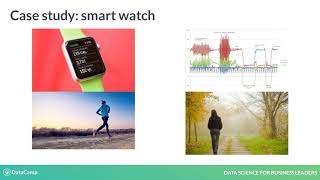
Three real-world applications show how data science works in practice: a bank uses transaction history to flag fraud, a smartwatch recognizes walking versus running from accelerometer data, and self-driving cars use deep learning to detect pedestrians in video. Each requires different tools and data sources, but all follow the same workflow: define the question, gather data, train a model, make predictions.
Chapters
Previously, you learned the definition of data science and the steps in a data science workflow. In this lesson, you'll learn how to apply data science to real business problems. Let's take a deep dive into three exciting areas of data traditional machine learning, the Internet of Things and deep learning. Suppose you work in fraud detection at a large bank. You'd like to use data to determine the probability that the transaction is fake. To answer this question, you might start by gathering information about each purchase such as the amount, date, location, purchase type and cardholder's address. You'll need many examples of transactions including this information, as well as a label that tells you whether each transaction is valid or fraudulent. Luckily, you probably have this information in a database. These records are called training data and are used to build an algorithm. Each time a new transaction occurs, you'll give your algorithm information like amount and date and it will answer the original question, what is the probability that this transaction is fraudulent? Before we can answer that question, let's walk through our example and highlight what we need for machine learning to work its magic. First, a data science problem begins with a well defined question. Our question was what is the probability that this transaction is fraudulent? Next, we need some data to analyze. We had months of old credit card transactions and associated metadata that had already been identified as either fraudulent, fraudulent or valid. Finally, we need additional data every time we want to make a new prediction. We needed to have the same type of information on every new purchase so that we could label it as fraudulent or valid. Now, suppose you're trying to build a smartwatch to monitor physical activity. You want to be able to auto detect different activities such as walking or running. Your smartwatch is equipped with a special sensor called an accelerometer that monitors motion in three dimensions. The data generated by this sensor is the basis of your machine learning problem. You could ask several volunteers to wear your watch and record when they are running or walking. You could then develop an algorithm that recognizes accelerometer data as representing one of those two states. Walking or running. Your smartwatch is part of a fast growing field called the Internet of Things, also known as IoT, which is often combined with data science. IoT refers to gadgets that are not standard computers but still have the ability to transmit data. This includes smartwatches, Internet connected home security systems, electronic toll collection systems, building energy management systems, and much, much more. IoT data is a great resource for data science projects. Let's tackle another example. A key task for self driving cars is identifying when an image contains a human what would the data set be for this problem? We could express the picture as a matrix of numbers where each number represents a pixel. However, this approach would probably fail if we fed the matrix into a traditional machine learning model. There's simply too much input data. We need a more advanced algorithm known as deep learning. In deep learning, multiple layers of mini algorithms called neurons work together to draw complex conclusions. Deep learning takes much, much more training data than a traditional machine learning model, but is also able to learn relationships that traditional models cannot. Deep learning is used to solve data intensive problems such as image classification or language understanding. You're now familiar with several different applications of data science.