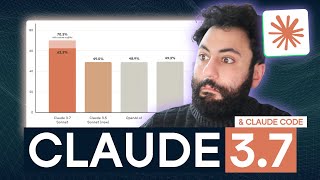
Claude 3.7 Sonnet scores 62% on software engineering benchmarks and 85% on graduate reasoning tests, outperforming DeepSeep-R1 and OpenAI-o1. Claude Code, a new command-line agent, can refactor code, generate docs, and build design systems from the terminal. Programming isn't ending, it's shifting to chat-based tools that will expand demand for skilled developers.
Chapters
One of the best essays I've read this year comes from Tim O'Reilly, in which he describes the end of programming as we know it. In his essay, O'Reilly discusses how what we know as programming has evolved throughout every stage of the computing revolution. Connecting physical circuits to perform calculations led to binary code, which led to assembly languages, ultimately leading to higher level languages like Fortran and C. Eventually, interpreted languages like Python and JavaScript made programming more accessible than ever, shifting the focus away from low level control to higher level abstraction. Today we are on the cusp of a similarly transformative transition, one that is called chat based programming. And I think with the release of Claude 3.7 Sonnet and Claude Code, we're one big step closer to that programming paradigm. So in this video I'll go over how Claude 3.7 Sonic compares to other models when it comes to coding benchmarks, what Claude 3.7 and Claude code mean for coding at large, and if Anthropic's claims are correct, what it means to have a collaborator on par with a human expert right in your command line. Despite the version number suggesting an incremental Update, I think Claude 3.7 sonnet represents a pretty big step forward compared to Claude 3.5 sonnet. For starters, Claude 3.7 is a reasoning model and as you'll see shortly, is definitely a strong competitor to Deepseek R1, OpenAI03, and Grok3. Moreover, it seems especially optimized for code coding and reasoning workflows. This should come as no surprise as according to anthropic, around 37% of all of the prompts used on CLAUDE today are related to coding and math. So looking at the benchmarks, Claude 3.7 Sonnet scored around 62% when it comes to a software engineering benchmark, and when using structure prompts jumped to around 70%, making it without a doubt the best coding model on the planet today, especially if you Compare it with O1, O3 mini and Grok 3. On the GPQA Graduate level reasoning benchmark, it scored around 85% in extended thinking mode, outperforming OpenAI's 01 and DeepSeq R1. Similarly, it's also in the top shelf models when it comes to agent use. So it's no surprise to see Claude 3.7 Sonnet perform exceptionally well in the wild, with folks already sharing examples of them, building full on games with a one shot prompt or designing really beautiful HTML files, and a lot more to illustrate the difference in quality between Claude 3.7 Sonnet and other reasoning models here's the output of Claude 3.7 to Ethan Mollick's prompt on creating a control panel of a starship in P5Js versus how other models performed. Judge for yourself so the main headlines so far Here are number one Claude 3.7 Sonnet is really good. Two people are already building really cool software with it the even bigger piece of news that Anthropic released this week was the release of Claude Code and Research Preview. In a nutshell, Claude Code is a command line coding agent that has access to your repositories and can create, improve, refactor, and debug code for you directly from the command line. Now, of course, Claude Code uses Claude 3.7 sonnet behind the scenes, and that makes it one of the best AI coding agents, bar none. Some examples of people using it included creating an entire new design system for a website directly from the terminal. Others essentially created documentation for an entire code base in under 40 minutes. Others essentially changed and transformed documentation on their entire code base in just a few minutes. And Anthropic shared how they've been using Claude Code internally and how tasks that used to take up to 45 minutes are now handed off to Claude Code in their entirety. I will cover how to use CLAUDE code and the Claude 3.7 Sony API in future videos, but I want to come back to what we discussed early in the video and ask the following questions. What does programming even mean today? And what will the future of programming look like? Anthropic laid out its vision for CLAUDE in an infographic it shared online, and while yes, this is probably the machination of a Frontier Labs market marketing department, the trend over the past two years has been that of commoditization and intelligence, which means that models will become cheaper and more intelligent over time. So while the Claude 3.7 Sonet models of today are impressive but expensive to use, I think it's safe to say that a year from now, In February of 2026, a Claude 3.7 Sonnet model will be incredibly cheap and easy to use. And that means the changes that programming is experiencing today will only accelerate. So does that mean programming jobs will disappear? Not quite. You see, in the same O'Reilly essay I mentioned earlier, O'Reilly discussed how previous computing revolutions led to more democratization of programming and computer use, but also led to more demand for programming. The web interface made working with computers more accessible than ever, but that only increased the demand for programmers who can develop web interfaces. Similarly, the API revolution made difficult enterprise ready tasks like taking in payments easy and that only increase the demand for developers that know how to work with APIs. As such, AI will not replace programmers, but it will radically transform their job. This does not mean that the road ahead is all good and dandy. There will be disruption and the dynamics of innovation are slow and oftentimes weird. But over time, as our workforce becomes more AI literate and as programmers adapt more to chat based programming, we could see a new golden age of programming, especially when the ecosystems, services, tools and new roles surrounding that paradigm fully mature. The bottom line here is programming is going to change and models like 3.7 Sonnet prove this. So how will you adapt? Will you be a stubborn developer as Steve Yuga describes, or will you jump headfirst into this paradigm and try to thrive in chat based programming? Either way, programmers will have to adapt. And as O'Reilly ends with his essay, this is not the end of programming, it is the beginning of its latest reinvention. Thanks again for watching. Stick around for more content. Sam.