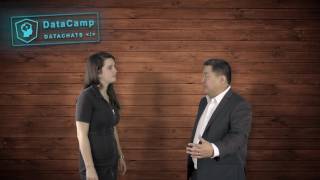
Clifford Ang, VP at Compass Lexicon, talks about building a bond valuation course with DataCamp and his financial modeling textbook. He switched to R around 2012 for its flexibility and emphasizes that aspiring modelers should understand concepts and intuition, not just mechanically apply formulas.
Chapters
Hey, everyone. I'm Laura. I'm a data scientist at Data Camp, and we're in a recording studio today with Cliff Ang. We just recorded a video on bond valuation analysis in R. So, Cliff, welcome and thank you, obviously, for having me. I think it will be a great video. So it's a new course for the finance curriculum. So. So maybe we can start off with. For the people that don't know you, maybe you can tell a little bit about yourself, what you do.
So my name is Cliff Ang. I'm vice president at a firm called Compass Lexicon. We do economic consulting. I specialize in the areas of business valuation and securities, and we primarily do work in litigation.
Okay, nice. So probably the most important question to ask for me as I'm in charge of the finance curriculum and promoting finance, I guess, in a way. So how did you end up in the field of finance?
So way back in college, I just did better in finance classes and I thought, I guess that's the way to go, and just fell in love with it. And now almost all my coursework after that is in finance, and it's just I just have interest in a lot of areas in finance, in particular financial economics.
Okay. Okay. Nice. Yeah. Well, so then I guess this is a related question as well. So why did you decide to build a course for Data Camp in the first place? And why did you choose this particular topic on bond valuation and bond analysis?
You know, I've always been interested seeing these online courses, and I thought datacamp had a very good platform. And, you know, the structure and everything looked really, really good to me. It's very attractive. And I mean, this course, bond Valuation Analysis, I think, is one of the most fundamental concepts that every serious student of finance should know. It's also probably one of the most practical things.
Yeah, that's right. No, definitely. I think it will be great. Definitely. So how. Well, I mean, you're obviously in finance, so why did you decide to use R? So how did you start using R?
So I started using R. This was in 2012 or thereabouts. A colleague of mine and I, we decided that we wanted to present in the R in Finance conference.
Okay.
Yeah, he knew R, and I had to force myself to learn R. So that was it.
Okay, so what other languages, or did you know any other? I guess you didn't know other languages before. So what were other languages that you used before?
So I used SAS a lot. So especially at work. Some matlab, vba. Those helped a lot, especially in learning a new language like R. Yeah, yeah, true.
Certainly knowing other languages does help. I guess. So I mean you work in finance, you have experience in R, you recently finished a book analyzing financial data and implementing financial models in R. So why did you decide to write that book and what's. Maybe our user are interested in hearing what it's about.
So there are I think maybe three things. So I also taught finance investments and a lot of times I see students the harder parts in terms. So first it's a financial modeling textbook. And so when you see these financial modeling textbooks, some of the problem is that they don't take the student from the beginning all the way to the end. So that's one. So I wanted to write a book that essentially handholds the student through the whole process. And secondly, when they do, even when they show something like that, they kind of only do the start the end and you're kind of left guessing. If you have a multi step problem or model that you're creating, the students may get lost in the middle. So in my book it's every step the intermediate output is generated and R is a really good tool for this because you could output intermediate data and so they can see, okay, this is the spot where I made a mistake. So you don't have to wait till the end and then try to figure out for yourself how to debug all this. Then the last reason is I want to write a book where all the data is free. Right. Publicly available data. Some of the books they require you, especially in university or college. It would be a database that once a student leaves, they're not going to have access to. In my book it's either Yahoo Finance data, data from the Federal Reserve. So all of these you can access, you know, for free at home or wherever and you can implement every single model from start to finish.
That's a very valuable contribution. Yes, because I know most finance data, it's not easy to get. There's non disclosure agreements that need to be signed. So not everything and most of it is not publicly available.
Exactly. And for most of the things that people want to do, like you want to study stock prices or create portfolios with publicly traded stocks, it's fairly easy to get free data online. And so how you integrate that with R. And so that was one of the things that I wanted to share with other people.
Yeah, that's great. I'm sure this is very valuable for many people. It's very interesting. I think the last question I would like to ask you, I think our users would be interested in too is what would you advise people who aspire to be working in the field of financial modeling?
So my advice is that building the financial models isn't really a mechanical exercise. A lot of people treat it that way. So just because you can do it doesn't mean it's the right I know the 10 steps and this is what I'm going to do. I would say probably the biggest advice is learn the concepts, learn the fundamentals, learn the intuition behind the models and that way you know how to apply the models properly because the last thing you want to do is just you know implement random models because some guy 10 years ago figured out this is how you're supposed to do it but without really understanding why and is it really appropriate for the situation that you're working on.
Okay yeah I couldn't agree more. I think, I think it's very useful advice. Okay well thank you again for being here.