How Specsavers Upskilled Their Data Teams
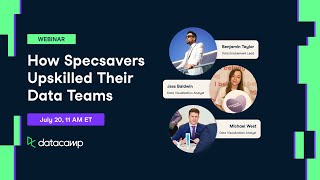
Specsavers built a Zero-to-Hero data training program through DataCamp that upskilled teams across the company. Junior analysts Jess Baldwin and Michael West learned SQL, Python, and Power BI through bite-size courses, while competitions and hackathons kept engagement high. The program improved decision-making and cross-department collaboration across global regions.
Chapters
It.
Hello everyone and thank you for joining today's webinar. My name is Rhys and I'll be your moderator today. We're going to kick off today's session in a couple of minutes. We're just waiting so everyone has a chance to join. In the meanwhile though, we'd love to hear from you. So let us know where you're joining from using the chat or the comments, depending on where you're watching from. And yeah, tell us something that you'd like to get out of today's webinar. I'll be back to repeat these messages for any new joiners shortly, but until then, enjoy the background music.
Sam. Foreign.
And thank you for joining today's webinar. My name is Rhys and I'm going to be your moderator for today's session. We're going to kick off in a couple of minutes. We're just waiting so everyone has a chance to join. In the meanwhile though, we'd love to hear from you. So let us know where you're joining from. And yeah, tell us something that you'd like to get out of today's webinar. Lots of people already in. We seeing lots of people from Egypt, India, Pakistan, uk, Poland, Germany. So yeah, loads of people. Oh, Brazil, Nigeria.
Nice to see you.
Emmanuel Philippe, Dian Sak, Prince and u. Nice to see you all.
Sam.
Hello everyone and thank you for joining today's webinar. My name is Rhys and I'm going to be your moderator for today's session. We're going to kick off in about 25 seconds or so. We've just been waiting so everyone has a chance to join. Let us know where you're joining from using the chat or the comments, depending.
On what platform you're watching from.
And yeah, tell us something that you'd like to learn from today's webinar. Just to note as well, we are going to have a Q and A throughout today's session. So if you have any questions for for any of our panelists, please let us know using the chat or the comments and we will save them for the Q and A. I think that's everything from me, so I'll hand you over to your host for today's session, Richie. Richie, please take it away.
Hi everyone, this is Richie. So today we're going to be talking about upskilling for data at Specsavers, that's a multinational optical retail chain and using Datawell is essential in all areas of retail. And Specsavers has a particularly impressive training program to ensure that all their data practitioners have the skills they need to succeed. So I'm very excited to hear the details of what they've been doing. I've got three speakers for you today. So the first speaker is Benji Taylor. He's the Data Enablement lead, and that means he's responsible for upskilling his data colleagues. And as a datacamp administrator, Benji runs the datacamp based Zero to Hero data training program at specsavers. And then we have Jess Baldwin and Michael west, who are data visualization analysts, and they specialize in creating dashboards and communicating data across their company. And they're both graduates of the Zero to Hero program and share their experiences. So with that, I'm going to hand you over to Benji. I believe you're going first.
Yep. I'm just going to share my screen. I'll share the deck. One second. Can you all see my screen? Fine.
We can, yeah.
Yep. So. Hey, Richie, and hello to everyone watching today. I'm going to briefly be discussing the specsavers data strategy, how this ties in with Data Camp. I'm going to give a quick intro to myself on the next slide and then I'm going to let the other guys introduce themselves before their parts of the deck. So as the slide says, I'm Benji Taylor, Data Enablement Lead for SPEC Servers. As a data enablement lead here at specs, I'm responsible for creating a data culture within the organization and ensuring that data is accessible for everyone who needs it, with a keen focus on ensuring teams are enabled to maximize the value of their data and make informed decisions using their data. Also, with an eye on our tooling strategy and adoption of these tools within the data community, and a big part of this for everyone at specsavers is everyone having their own data story. Such a hot topic right now at specsavers is data stories and enabling everyone to be able to tell their own data stories. Data storytelling is the ability to effectively communicate insights from a data set using narratives and visualizations. It could be used to put data insights into context and inspire actions from your audience. And this is heavily independent by free data calls recently set out by SPEC servers. So these goals are to enable departments to tell their own data stories, meaning that departments can use data storytelling to communicate insights from a data set to the wider organization, enable anyone to answer a data question in minutes, meaning that anyone can get answers to the data questions quickly. And this is made possible by the availability of the tools and the platforms that we give to our users to access the data. And this is without Any need for any advanced technical skills to be able to give everyone create tangible value from the data. Generally this means that everyone should be able to use data to create something that has measurable impact or value for the business. This could be anything from creating products or services to improving existing ones or even making better decisions based on the data insights. And now I'm going to take you a bit further back all the way to 2019 and long before my time at Spec Servers, the organization set out three core goals to enable everyone to use data and these were to establish a data culture, empowering teams and creating a data community, enabling through self service, pushing heavily on sharing the knowledge, giving users the tools and the platform to help other users to share success stories and ideas with other areas of the business and finally to deliver prioritized projects. Being clear with our users what projects are being pushed and using forums and pods to be super clear. I just wanted to share now how datacamp is being used as a foundation to support with all of these objectives. So back in 2021 we identified DataCamp as our data learning platform of choice and we've already doubled our seats. 156 members strong and probably even more right now as I created this slide a few weeks back, we're in multiple areas and regions. The uk, Canada, Australia, New Zealand, Supply chain, marketing, finance, global data database, Data science, data. DataCamp really is for everyone. We have total beginners who are looking to make a career shift or just curious about the data all the way through to senior data engineers and scientists who use the platform as a refresher. Plus to stay on top of the recent tech changes. Similar to myself, all new data starters are offering a Data Camp license to kick off their data journey here at Specsavers, which is really supporting us growing the data community here. More skilled people at Specs is allowing us to devolve into new areas, reducing manual workloads and discovering new insights. The admin features on datacamp are excellent and working with the lovely Maz, our customer success manager and Rich, our account manager, we've been able to pick out the courses we love and add these to specsavers. Custom tracks Custom tracks are a great way of creating a learning path for different audiences in your organization and to track enrollment and completion rates. For example, we have a track which covers data literacy, so less coding morph area. But then we also have the complete opposite, a track for our more complicated, our more experienced databricks users more focused towards SQL and Python. In fact, we're now starting to see data champions emerge in departments such as Finance and marketing, which are typically very data dependent areas. We're empowering them to manage their own teams as they're better able to know the individual capabilities and how best to support people in their roles. They'll manage teams and we're working with them to create appropriate custom tracks to support them. Datacamp has some great publications and in this case the datacamp Industry Specific Learning Recommendations Guide has been super useful. Another great part about datacamp is that when a user is ready to go beyond the courses, datacamp offers certifications for both data scientists and analysts and the abilities of the candidates are measured through timed exams and a take home case study based on the scenarios you're likely to find in the workplace. This really solidifies learning and improves the confidence of the user, helping as users move the newly found skills from Data Camp into the day to day roles at Spec servers. And who doesn't want a brand new badge on LinkedIn? Something else which I'm super proud to talk about and again that Data Camp is heavily involved in. We've recently won the best place to Work in Data at the British Beta Awards and we've also been nominated for six Data IQ Awards in the in the coming award ceremony and datacamp heavily being involved in the Becoming Data Literate and a few more I'm now going to hand you over to Jess who's a massive success story at specsavers and she's going to take you through her experience using Data Camp. So over to you Jess.
Thanks Benji. Hi everyone. So as Benji mentioned, I'm one of the junior data visualization analysts here at specsavers. Just a bit of background about me. I've been at specsavers for just over two years now, but I've been in this role since last September and my role focuses on looking at using visualization techniques to tell data stories and deliver insight to the business for various stakeholders. And now for my section of the webinar, I'm just going to go over some of the things that I've used datacamp for and how the platform has helped me in my career so far. So I mainly use datacamp for the bite sized courses as it's so easy for me to fit them in around my workday. Nowadays I tend to do the lessons and courses at the end of the day as it's like a nice wind down to the workday. But in the beginning, like at the start of my role, I use datacamp all the time to help me get up to scratch with using Power BI within Spec Savers. I personally actually hadn't used Power BI before coming into my role and only had experience with Tableau. So datacamp really helped me understand how to navigate Power BI and get me up to scratch ready to create the dashboards within the company. I also really enjoy the assignments that we have in our data community too. So for example, we've had the Right Royal SQL Challenge and the June Marathon Challenge last month, and it helps us to check in with our data skills and gives us a little bit of competition. It's so, so easy for us to get looped in with work projects and other commitments that we all have. So having that little bit of competition and possibly having bragging rights if we win it can really help us get into the frame of mind for learning. And as you can see, the challenges help push up our engagement each time. So now specsavers is in the excellent engagement benchmark, which is fabulous. Another good thing that we've used datacamp for is the certifications. So as Benji said, I've got the badge on LinkedIn, which is great, but I wanted to do the certification to understand where my skill level was after doing all the tracks and the other courses on datacamp. And it's really helped me test my skills with practical examples which I can then take further into my role here at specsavers. And the certification is valid for two years, so I'll be able to do it again when it expires to ensure that I'm up to date. And I do have my eye on doing the Data Analyst professional one at some point, which is also on datacamp. But finally, I just wanted to mention something that's on a slight tangent. So I do a lot of work within specsavers for our diversity and inclusion ambitions, and this was through setting up a women's network. When I started at the company, one of my passions is to get more women into STEM subjects, as it's such a valuable and rewarding field to work in. Now datacamp has been a really good tool and a starting point to help encourage people from a wide range of backgrounds to gain the skills and knowledge to become data literate. And even some people have started their career in data. I actively encourage people I talk to across the business to start thinking about data as a career option, and datacamp really helps make it less scary for people to look into data and start to understand it. Personally, I think it's really important to ensure that data literacy is accessible for all. And as I say, Data Camp is just the perfect Starting point for that. That's it from me. I'm going to hand over to Michael.
Hello everyone, my name is Michael West, I'm the same as Jess, I'm a junior data visualization analyst as well. I did not come from a typical data background as you had expected. I started off with getting a degree in business management and it wasn't 100% all my life. So I had various hospitality roles after university as the majority of my experience were part time roles. And then I fell into an analyst position at a renewable energy company and then I became a pricing analyst for a tyre manufacturer. Both these companies promptly used Excel for all their analysis. They did have a couple of people that used SQL, but they were in other areas of the business so I didn't get the opportunity to learn and shadow of them. But during these roles I became interested in macros and Python in a way to automate my weekly reports and that's when I became really interested in coding. So I set my eyes on specsavers as they had won some awards and best place to work in data and they have intensive training for someone new to data with an aspiration to learn and as I was keen to be surrounded by data professionals to excel in my career. So on my first day at specsavers, one of the first things I was set up with was a Data Camp license to get me started. To this day I've learned Power BI, SQL, Python, including PySpark. I've developed my skills in data literacy, storytelling and making more data driven decisions. Achieved Data analyst certificate and I can practice my skills whenever I have spare time. So I could just log on if I have a spare 10, 20 minutes and get a bit done. Datacamp has really propelled my career in data and has got me to the point where I can start working on large projects for the company. I do like the fact that datacamp has various career pathways, not coming from a data background. It helps me understand each position with the company and now I'm working with data roles, other data roles in the company. It has enhanced my ability to collaborate, work better together with other teams. The pathways would also make it easier for people to progress into other roles such as data scientist, data analyst, data engineer. I know progression was a big issue in my last role, so this opens up lots of opportunities if you want to start moving sideways or upwards within the company. Understanding other data roles in the business helped me with my first project where I had to create a dashboard to monitor machine learning models to make sure they do not drop out of production and they're performing as they should do. But this came with a few obstacles and when I first started I did not know an awful lot about machine learning. I tried to look on YouTube and there was almost too much information and I didn't know where to start. But luckily datacamp had a machine learning operation track which gave me an overview and a taster of each step in the machine learning process. This vastly improved my dashboard as I got I found out about data and concept drift and I could include these in my report. I could understand what the secondary stakeholders would be interested in and include the extra features that would be useful. And it's nice to know that now it's productionized, it has been used by both data engineers and data scientists for their projects. Three days after I joined my Data Science team three days after I first joined the Data Science team, we're hosting a Data Science hackathon for the company where data teams could attend to take part in the event. I really enjoyed this event as I got to meet lots of people across the company face to face as this is not common with work from home and I got a flavor of Data Science working for a project step by step with the team. We were assigned modules on Data Camp to complete before the event and use datacamp workspace for the machine learning project on the day. And now the data visualization team is doing our very own version of the Hackathon for Power Bi and inviting all of the Power BI professionals in the company and people who want to learn Power Bi to come and join our version of the hackathon called Dash and a Flash. When I started 10 months ago, I was assigned modules to complete for the Hackathon and now I'm helping assign modules for people for Dash and Flash. I've gone from a beginner and now I'm enabler and I'd like to open up to everyone if there's any questions.
So we don't have any questions from the audience yet. So if you do want to ask Benji or Jess or Michael any questions, then please do write them in the chat. Before we get to that, I do have a few questions for you all. So in particular I guess maybe this one is for Benji. I'm curious as to how the Zero2Hero training program got started. Like who's involved in setting up the training program.
Global Data? All of our training programs I guess are fed out from Global Data and then like we said already, we use Data Camp as kind of that base for all the various things. So the hackathon the training camps and stuff like that all really fit nicely within the workspaces. Then just send out various comms and things like that, and people can, can sign up and go through the procedures that we've set up for the training.
And another. Thank you for that. Another thing is that it does seem like, well, particularly Jess and Michael, you both like, in very sort of technical roles, how do people who are not, who like, don't have data in their job title, how do they learn about data at Specsavers?
I mean, I can go. Michael, I was going to say a lot of people, as I said through the network, come to me asking me specifically how to get started. It's all about incorporating little bits into their day job, I find. So specifically, if people don't have like data or analyst or anything in their job title, it's. It's always a really good way to try and find ways in, within the current scope of your role, how you can visualize that. It doesn't have to be a massive data set. It doesn't have to be anything huge. It can just be a month's worth of data from, from something that you do already and then you can build on your knowledge from there. That's. That's kind of what I go for.
Okay, so the work that you've created, like when you're trying to communicate what you've done to people who maybe aren't data professionals. Yeah, yeah. Okay, you're saying that. Yeah. So you create the dashboard and then you can sort of communicate with them afterwards. All right, so we have a couple of questions from the audience, so I'm gonna, I'm gonna dip over to those. So this comes from an anonymous LinkedIn user. So it's asking from an organizational point of view, have you measured the success of your unskilled workforce? I'm not exactly sure how to interpret that, so I'm gonna leave it to your own interpretation.
Yeah, no worries. Measuring success, especially around Data camp, other than like the reports that are great coming out of the admin panel and things like that, I think it's something that you see in the departments and we always go out to managers and things like that asking for the feedback. Are you seeing, you know, change within, you know, the people which are identifying themselves as less technical after they've gone through the Data camp courses. And just to add what Jess said earlier, I don't think we're really seeing anyone as a non data person now. As I mentioned during the slides, we really want everyone to be someone that is comfortable to tell. Work with the data, tell a data story, work with the tools. The tool set we have here, we do try and target everyone as well. So if you are comfortable doing all the code and things like that, we have drag and drop tools. We really want everyone to feel comfortable. And the whole idea of Global Data is supporting everyone on the different levels as well, all the way from basic all the way through to expert.
That's excellent. I do like the idea that just everyone is a data person now. It's not just you got data in your job title. You actually. Yeah, everyone has to work with data. Michael, did you want to add anything to that?
Yeah, I was just going to say about. I've technically come from an unskilled background. So what's been really helpful with the Data Camp is there's been some sort of, like, competition. I guess when you're sort of learning through Data Camp, there is like XP you can gather so you can see across, like the whole organization that everyone's working through their pathways or courses and tracks and you see like. So I know Jess is in my team along with another guy and we're all started at the same time, so we've almost like competing about, like having a certain amount of XP or if we achieve the Data Analyst certificate, we will try and achieve it. So it's been like a healthy bit of competition and we're all doing the same path together.
I like it. So you're really competing against each other. Do you want to tell me a bit more about that? Like what sort of competitions do you run to have you, like to encourage you to, like, get better and compete with each other?
I guess it hasn't been sort of like a verbal competition. It might just be like, oh, they've done a bit more learning than I have. And then you just sort of go, I need to catch up with them. But we have done some competitions then Benji, the Enablement team, has done these competitions. One was called. No, it was the Data Camp Marathon and it was basically achieved 10,000 XP over the month. So it's to encourage the whole company to get some more XP and work and learn as much as they could.
Yeah, we go for a different range of competitions and loads of different prizes. We get got some great swag across from you guys. You know, I've got a hoodie that I wear all the time that's got data come written on the back of it. We love that. I think, you know, the competitions of the prizes is, you know, overall part of that trying to Keep people engaged. I think we're on for the third back to back increased usage of Data Camp. So every single month we're seeing increase. Now it's only gaining momentum on our end. And with the upcoming hackathon, it's just gonna go through the roof, really. We're going to be coming back for you asking for more licenses, things like that, which is only good news, right? So, yeah, we're over the moon with the platform, really.
I'm really glad to hear that. And yeah, speak to your account manager if you want more licenses. That's excellent.
Yeah, we already have, we already have.
But I'd love to hear a bit more about these sort of ideas for engagement because I know this is often like a challenge in learning development. It's just making sure that everyone is actually making use of the tools you provide. And these competitions sound like a great idea. Do you have any other tips around making sure all the learners are engaged?
Yeah, 100%. I can't take much credit for this. I have a lovely person that worked with Lorraine who gets all the comms. It's comms, comms, comms. You know, you need to be on top of your things. You need to make it look great. It's advertising the new courses that release. I think even you guys agree on your side. You guys are constantly funneling through all the new course courses. I'd say Data Camp are not only reactive, but you're proactive. Right. We're talking about doing an AI challenge. That's going to be the next one we're going to be doing on our end. Sorry to spoil that, Jess and Michael, but you, you've already released all the, all, all the courses. You know, you're already proactive, you're already on there. I can go onto the Trello. I can see the upcoming releases as well. So that's great. But then also in another sense, recently we've been mentoring around Excel courses and you know, a few days later, a few weeks later, there's an introduction to Excel course that's been released. So, you know, we're really happy with that. But yeah, to keep engagement, it's just a lot, a lot of comms. I think in that initial message, when you're assigning out that license as well, it's just pushing on someone and being like, nothing seen as mandatory here, but being able to book out an hour in your calendar or even if it's 15 minutes a week. I myself start most of my days on the app. I'll hop onto the Data Camp app do my, you know, daily learning. I think I'm 110 days deep without missing a single day on Data Camp. So, you know, there's lots of different options. And that's another good thing about Data Camp, really, all the different options and ways that you can learn on the platform.
That's pretty. You say you're on a 110 day streak. That's very impressive. You're probably one of our top users at this point. So I like that you said that you're sort of keeping on top of the latest courses coming out. And Michael, since you talked about like the, the recent mlops courses that you've taken, do you maybe want to talk me through how that's been useful to you? What motivated you to get into mlops?
So I, I got given a project to do with machine learning. So it was all the data scientists have their own machine learning model and basically I had to make a dashboard to monitor five or six machine learning models at the same time. And it was just basically to see if they were working and performing correctly. So when I first went into the project, I didn't really know what that almost meant. I thought they just meant, are we getting data? Yes, no, and we're good to go. But when I'd done the mlops track, I learned about data drift and concept drift. So that's when sort of data can change over time. So say the same data today and the same data in two years time could be the exact same, but the state of the economy could be completely different. And so that means the machine learning model will need to be retrained. And that's not something I've known prior. So when I'd done the mlops track, I was like, oh, I've got to take into account that. And I made a few visuals to be able to track that as well. So that made such a big difference because then I can understand what the data scientists actually want to get from this dashboard and then also looking at duplicates and stuff like that for the engineers, like what they want to see. So realistically. Yeah, it's just those sorts of those things that helped me a lot with the dashboard.
That's brilliant. I like the idea that a project came up, you had some, you, you had some skill gaps there because it was stuff you didn't know how to do and then you took the courses and that enabled you to get straight on with the project. So I really like that kind of flow of how like you learned something and that just enabled you to be Productive in a completely new area. All right, so we got some great questions just coming from the audience, so I'm going to switch to some of those. So this one comes from Michael and Michael wants to know, like with the tracks that you had set up. So I know you mentioned custom tracks. So basically did you come up with these tracks yourself or were they pre created by Data Camp?
We come up with the tracks themselves as the admin panel. You have full access to create a as many attracts I've been able to create so far and which is fair few. So yeah, but we, like I said in the presentation, we have full support of the Data Camp guys. I'll often put a track together. I'll reach out to Mars, who's our, you know, success manager over at Data Camp and he'll give me, you know, advice, tips, you know, maybe you add this in or rearrange things. So yeah, it's not pre written, it's all done by us. Well supported by Datacom.
Yeah.
So I just want so these custom tracks that are available on the enterprise plan and you can create whatever tracks you want, but you will get support from an expert at Datacamp to help you decide what courses go together in a sensible order.
Spot on. Yeah.
All right, next question comes from Alex. So Alex says, I've got some Flintstones customers that are reluctant to change. From your point of view, what's the right pitch? Convince them. All right, Jess, you've not told anything for a while. Do you have any ideas on how you can get people excited about learning new data skills?
Well, personally, I think the data is kind of everywhere. It's kind of talked about a lot in the news. It's kind of, you know, everywhere. And I think that most organizations need to kind of adapt or sort of fail if you like. I know it sounds a bit of a drastic phrase, but it's, it's technology and things are moving so quickly now. In my opinion, if you don't change and do things quicker, then it's kind of, it's going to be too late. I know it sounds really bleak, but. Yeah, that's just my opinion.
Yeah, I think, you know, a lot of my jobs, in many presentations, I give a lot of introductions and things like that. If I was paid a pound for every single time after someone asked the question, I said there's no silly questions here. I think there's a lot of element around fear, around the tools and data and stuff like that. So the right pitch is just ensuring that it's a safe space for Everyone to access the data, to ask the right questions that they feel comfortable with and you know, putting them in a group of their peers who are potentially, you know, on a similar level, who they can bounce ideas off and things like that. And I also think Data Camp's great in the sense of people, especially in my world, in my experience, they're reluctant to use systems. So for the example, the Data Lake at Spec servers, if I write a wrong query at Spec Servers, that's going to be expensive and potentially costs make someone else's query run a lot slower. Right. But with Data Camp you've got refined area, right, which isn't going to damage anything that anyone else is doing. At Spec Savers you can't cause any issues or anything like that. So again, I think that's going to be part of the pictures. Data Camp creates a safe environment for you to test things out and to get get things wrong.
That's really nice. I like the idea of a safe environment. So you also mentioned connecting people with their peers and so I find that really interesting. So I mean with Data Camp you can just sit down, take a course on your own and have it be a sort of single player experience. But for a lot of people, they learn better in a social setting. So I'm curious as to what sort of social systems you have set up so learners can communicate with each other. So either Michael or Jess, do you want to talk about like how you interact with it with other people, learning things when you were doing this zero to hero training program, I mean for.
Us specifically, we all started within, I think within the same week actually. So we obviously had each other within our team to sort of bounce off. But Benji and Lorraine have set up quite a few teams channels as well. So if there's any questions or anything that we needed, we could jump in those different channels for support or advice or anything like that. And just the whole of the global data team really has just been super supportive all the way through using datacamp.
So that's wonderful.
Oh, sorry, go on, I'll jump in after when you're ready.
No, it's really nice that you have these sort of like you say Slack channel set or like basically like forums where people can communicate electronically. I'm curious if there were any sort of in person like social events or meetup type things. Do you ever do face to face learning?
Well, we've had the Data Science hackathon as well, which was over a whole day and that allowed time for like face to face kind of networking and meeting People and things. And then obviously we're planning our 14 in August, in a few weeks. So yeah, we, we sort of like to create space in the physical world as well, to network with people.
Yeah, it's all about giving everyone their way that they want to learn really. I think, you know, with the way that the world's going, we're generally going more to more. More remote and I think, you know, with the idea of the global data team, you know, I've been on with Canada and things like that recently, the idea of offering something local which then we're then cutting off from part of our. What's essentially our global offering, you know, it's not great for some of the users, so we generally mirror. Mirror things as well. So we'll do the hackathon in person whilst I'll do a virtual event for the Canadian users as well. So everyone gets a bit of something.
Fantastic. And Michael, did you want to add anything on there?
Yeah, on the previous question I was just sort of like elaborate on what Benji just said about the safe space. I think quite a few people can be a bit scared to sort of fail, like, because quite a lot of data is just failing. So you do something, it doesn't work, try again and then you almost just carry on it's rating through. So not being scared to fail is probably quite a big one. And I know for me I didn't come from a data background but I got into it because I wanted to make things easier for myself. So making a macro to do the report for me and stuff like that, or making a dashboard. So then you like. We know people in the company that have a big Excel spreadsheet that they have to pre populate every day, whereas we can make a dashboard in Power Bi and it will do it automatically and refresh for you. So for me it's making things easier and I think most people in the world want their life to be easier. So that's a big sales pitch. And then with the speaking with other people in the team, with the channels, we also have these like sort of Power Bi beginner sessions and show and tells you. So if we learn anything new, we think it's useful. For the rest of the Power BI community, we'll do a show and tell for an hour and explain it and go step by step and do a Q and A after as well. An internal spec Savers thing. It's really useful.
That's brilliant. I love this idea of the show and tell. So basically you're learning something and then you're sharing with your colleagues? Maybe. Can you give me an example of what one of these involved? Like what, what was the topic?
So I'm doing one tomorrow actually and so I'm currently learning a thing called Deneb and I thought it would be useful for the rest of the team to understanding though. So I've tried to understand it as much as I can and then I've only just learned it, but I want to be able to share what I've learned to the rest of the team. So tomorrow I'm going to do sort of like a 20 minute presentation and then do a step by step how to do it yourself. So yeah, that'll be really exciting because Denev's not completely out there at the moment. It's not really easy to learn. They've got the documentation but not many people have shown how to teach it.
Okay, so that's cool. It's like new technology and yeah, straight in there. Everyone on the team can know what it's about once you've sort of shared your wisdom. All right, so we got a comment in here from Lorraine, one of your colleagues. So I believe Lorraine is also on the learning and development team. So same team as Benji. So Lorraine says thank you. And for think about internal comments, you need to make things fun. No heavy stuff, no rating. So I think this really speaks to the idea of having this sort of safe space where people can learn. Do any of you have any more tips for ideas where you can make it sort of safe, friendly environment where people actually enjoy, enjoy learning? What sort of helped you be enthusiastic about learning at work? Oh, sorry, maybe that's a tricky question.
Yeah, yeah, I think like I've already said, I think it's just staying on top of things. I myself always offer my support to other users. I think, you know, identifying those SMEs, putting, putting yourself out there, I think it makes myself a better developer. Answering, you know, the tricky questions that other people pitch. So making sure that people have the support there, whether it's on teams or it's another way. Like people often like a call and I'll take them through it that way as well. So whatever works for them really.
From my side of things, I know specsavers, they're like company values, one of them is collaboration. But I know with other companies I've been with, the company values are just sort of there. But what I like about spec savers, everyone sort of lives and breathes them. So as I know some companies, I'll learn something new and you wouldn't want to tell anyone because you want to progress in the company and you don't want someone else to then get that promotion before you because you've told them something. But in specsavers, everyone, as soon as they find something out, they all collaborate and they teach each other just like show and tells. And I think that's amazing because if you do it, then everyone else does it and everyone's bought into the same idea and that's what makes it a safe place.
That's wonderful. That also seems like a really weird culture where you like wouldn't want to share.
Yeah, I know some companies like that.
So worked with a few developers in my time. Yeah, yeah, yeah.
All right, so this next question comes from Becky. So Becky explain asks, can you explain how the data training program impacted decision making processes?
Well, like I spoke about earlier, we kind of review things with the leaders in these areas. So once people, once effectively a beginner or something similar has gone through one of these training programs, we then go out to the leaders to talk about, talk with them, how they're seeing, how that's seeing the trends reflected during their sessions and things like that. So I guess everywhere really we're really pushing heavily on devolution so we don't want to be kind of bogged down by having loads of repeated requests come into centralized teams want teams to feel like they're comfortable and you know, happy to get on with data themselves. So in all different areas we've seen it impact the decision making processes.
So this is really helping you move towards self service analytics then. So 100 people having to wait for some data analysts to say, well this is the answer and you have the back and forth. It's like, oh, well, people can just, you know, solve the question themselves.
Yeah, don't get me wrong, there's still some business critical things that are going to always have to go through centralized teams and things like that. But yeah, we're really looking to empower the various teams out there in spec service at the moment.
Excellent. All right, and next question. This comes from a LinkedIn user. So did you identify a skills gap before you created the pathways? And what advice do you have for a team trying to upskill their workforce for data literacy? I would say maybe take the first one first.
All the pathways are created to fit skills gaps. That's exactly why we've created them. That is the purpose we've identified that. For example, we want to upscale on data bricks and that's why we've created the specific pathway for databricks on there. What would I advise a team trying to upskill there? So I would advise to go into Data Camp and filter for data literacy. There is plenty of options for data literacy. Often when you go on these other learning platforms, I won't name any of the names, but they are often very technical. What I found with Data Camp is it doesn't have to be that way at all. It certainly suits the less technical people more theory based. Like I said during my presentation as well, we have the exact flip side. So we have theory based and then we have all the way through decoding as well as well with the, the way it's set out as well with the multiple choice. It kind of fits both ways as well with the theory and, and the coding. Because you've got your coding environment that loads up so you can do your sample coding as well.
Yeah, I mean that is absolutely true that the needs of someone who isn't a data professional are very different to the needs of someone who has technical data skills already. So yeah, certainly we do have plenty of content on data literacy if you, if that's what you need. I just want to push you a bit more on the first point about skills gaps because you sort of mentioned that you'd identified skill gaps and then those learning pathways were designed to fill those gaps. Taking it like one step previously, how do you go about identifying and sort of quantifying that? What are these skill gaps that you have? How do you know what you don't know?
I guess it comes from the users. Right. Similar to what Michael just said with the new technology. You know, I'm already hearing that if we get more appetite around that, that's when we'll try and, you know, fill that skills gap. So it comes from the users. You know, we're very open at Spec savers to getting feedback from everyone that's using the platform, constantly firing out questionnaires, what do you want to see and things like that. So yeah, definitely coming from the users.
That's good to know that it's not just like having some dictat. Okay, we're going to learn about these things and everyone has default it. It's like it is coming from the people who.
Exactly. Yeah.
I have a question around scaling. So you mentioned you doubled the size of like you doubled the number of licenses and you sort of considering buying more. What challenges have you faced as you've increased the, the number of people involved in this? How do you scale things?
So I guess the challenge is, is once you're approaching the 150 people and 50 things like that, it's much harder than, say, staying on top of 10 people using the licenses. Right. I want to be allocating licenses out to people that are using it daily, weekly and things like that. And. And not really any any less frequent than that, really. So I guess it's just about making sure that you've got that information to begin with.
Okay, it sounds like it's been a fairly smooth process then just, you know, maybe a little bit more work just. But I presume it's not doubling the number of people you.
No, no. We have, you know, very, very good licensing and pass stuff like that using ServiceNow. So it's very easy for a user to go on there, request the license and then the rain, who I've already mentioned, goes out to that user. We give them a bit of an introduction course. We also offer a session going through, you know, the courses that we've picked out, the custom tracks and things like that. But again, with all these sessions that see things as being crazy mandatory, some users, you know, are happy to stay a bit more siloed and just jump onto the platform themselves. And with the way data camps set out, it's very intuitive. So you don't really need that intro session for everyone.
That is good to know. All right, so we've got one more question from the audience and last call for anyone else who wants to ask a question. But this one comes from Sheenam saying, how do you decide which analysis tools to use? For example, Power bi, Tableau, Alteryx. Is the data team involved in these procurement processes or is this come from somewhere else?
Yeah, I guess we're heavily involved in that and it's kind of story of my spec server's life really which tool to go with. I think Power bi. We are Power BI over tableau. And I think when you look at the difference between Power BI and Alteryx or Tri Factor, the web version, you're looking more towards do you want something that's more visual or do you need something that's more of a drag and drop? I can manipulate some Excel files and pop out another Excel file at the end, really. So that's the difference between those two tools. But if you're looking at it from the point of view of how do we offer that out to users, I guess it's down to us as a department to take in what technical skills that user has got. If they've got a desire to learn SQL and things like that, then we'd show them down more of an analytical tool type route. But if there's no desire to learn SQL, then we have more drag and drop tools similar to Alteryx. Then if they want to learn to love the graphs and things like that, then it's found to Power Bi. I guess also the project decides it. Some projects are going to need a lovely dashboard at the end, some just need an Excel output to an Outlook box, which is going to be morale to express Power Bi.
Excellent. And so you mentioned projects and of course Data Camp is more than just the courses. We've got the projects for applying things. And I know you've also been making use of the certifications. So do you want to maybe talk me through, like, what are the non core space bits of Data Camp that you've made use of?
Yeah, I can go again.
Yes, for me I can jump in if you want.
Michael Jonathan.
One of the sort of, it's quite a small area but quite a useful bit is the practice bits. So you might do a course, might do a pathway, but you can practice it every day. Just keep your knowledge ticking over and you get real life questions of like, what might actually happen and then multiple choice and you can get, you get different questions every day and it just sort of gets you taken over. And I think it only takes five minutes to complete so you can do your full day of work, log on today at camp, five minutes, do the practice questions. And it makes such a big difference because they're real life questions and it makes sure that it's all fresh in your mind because sometimes when you learn something new, maybe like next, the week after, you might forget it or it's not as in your head. So yeah, doing these practice questions really like sort of solidifies your knowledge on that area.
Yeah, 100%. I've moved away from like being a consultant and coding in the dark all day, you know, and things like that, into more of a leadership role that I'm doing now. And I think, you know, having the practice sessions, the courses and things like that is key for me because it allows me to. Even though I'm not coding 24 7, I still feel like I'm able to support people with coding. There might be large periods of time where I'm just, you know, speaking, doing PowerPoints, but I've still got that practice session that I've done on the morning. I've still got a little bit of. Oh, I've been still able to kind of itch that scratch that I love for coding.
Nice. And Jess, what else you've been using.
I was gonna say, I think Michael kind of stole my answer there. I use the, I use the practice bits as well quite a lot because as Michael said, it's like really good for keeping it fresh in your mind. But also when you log into Data camp, they kind of pop up. Like try these three today, like until, you know, keep your streak up kind of thing. So it recommends it based off of like, like areas that you, you might need to work on.
So yeah, but we have worked through all the projects as well, so not all of them, but in our. We've done mostly the sequel ones. But what was nice about them that you can work through like real life projects from start to finish so that you've got like 10 points and there is some sort of guidance. So you work through the first bit and if you can't solve it, there is some sort of hint. But you do try your best not to take any tips and hints. You want to be able to solve it all yourself. But the project's been really helpful.
That's brilliant. I do like that you both said practice because it's just one of those sort of curses of like learning is that you do forget things that you learned first time. So just being able to practice things every day does really help solidify things in your memory. And I do really think that the projects are incredibly useful for just being able to string together longer analyses. You can go from start to finish.
Finish.
So yeah, that's good that you've been making use of all these tools. We've got one more question from the audience and then I've got another question for you and I think we'll wrap up after that. So I'm going to ask a sort of similar question around decision making. So of the upskilling efforts in data literacy enabled more effective decision making particularly. Oh so among different departments, particularly in the case of conflicting interests. So I don't know, do different teams, different departments argue with each other about things and has data helped them?
I wouldn't say we have many arguments between teams here at Spec Servers. We all work quite nicely together. But I would say the data definitely helps that we're moving more towards using a common data model. Here at Spec Servers we definitely have the supply chain know their data really well and it's a bit hard for them to understand finances, things like that. Once moving towards a common data model, that's going to remove that because everyone can easily understand the common data model without needing all the supply chain or finance things that go with it.
That's Good that you're all getting on well across different teams. I was hoping Fairyear to dish the dirt, but I guess no chance. No, I mean, at Data camp certainly we have like, there's lots of arguments across departments about, like, how to define different metrics because everyone wants a slightly different definition of something. But certainly, yeah, data is helpful for resolving a lot of issues. All right, so last question from me is what are you most excited about learning at the moment? Michael, do you want to go first?
I've already sort of mentioned at the moment it's called Deneb. So it's Custom Visual Editor, Wind, Power Bi and it uses the language Vega Lite or Vega, and it uses the JSON syntax. But I'm really excited to learn it because I can really customize the Power BI visuals. If you obviously look into it, you can really customize over the top. The card visuals are not just a basic number. They can have a graph within the card visual and there are lots of extras. I'm really excited to do that and also pass my knowledge on as soon as I learn it.
Some new Power Bi tools. That sounds fun. Jess, do you want to tell us what you're most excited about learning?
I've actually bookmarked my next course that I want to do on Data Camp. It's the Large Language Models one. Because I've been assigned a project with the data scientist here at Specsavers. I need to get up to scratch for that before the project starts. I'll be doing that one next.
Absolutely. Some cutting edge AI. I like it.
And you guess who are, Michael, gonna steal my answer? I'm a big AI fan, as if you've noticed. I've released an AI blog on the datacamp platform and going to be releasing one on our side as well. I think, you know, for me, the reason why I got into all this coding in general is automation. That's something that I've been interested in since I was given the first Excel sheet. Very many, many moves among to go now and I think, you know, AI is really that next step. I'm really a big fan of all the tools. Even when we look at supporting users, I find that, you know, Bing AI is super helpful or Chat GPT is super helpful, even in the way we're supporting SQL and things like that. So everything in the world of AI I'm very interested in at the moment. Yeah, very keen to see where that goes.
Okay, so tons more AI content being launched over the summer and the the second half this year. So yeah, hope we'll give you enough content that you can keep your streak going through.
Sounds good to me. Sounds good to me.
Excellent. All right. Thank you, Benji. Just Michael, brilliant having you here. Thank you to Reese for moderating. Thank you to everyone who asked a question. Thank you to everyone who showed up today. We have some more webinars coming up, so tomorrow there is a session on using ChatGPT, uh, the code interpreter tool for data science. So for those of you who are AI fans, please do come along to that tomorrow. Then on Tuesday, there is a session on building AI skills with data camps. You can learn more about how to up your AI skills. All right, so thank you, everyone. Hope to see you in future webinars. Goodbye.
Cheers, guys.
More from Richie

#359 My Best Friend is AI with Valerie Tiberius, Professor of Philosophy at University of Minnesota







How AI Agents Will Work While You Sleep | Ruslan Salakhutdinov, Professor at Carnegie Mellon

#358 How AI Agents Will Work While You Sleep | Ruslan Salakhutdinov, Professor at Carnegie Mellon

