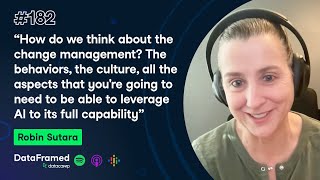
Ari Kaplan and Robin Sutara from Databricks argue that organizations should start with low-risk internal automation like spreadsheet rationalization and workflow improvement, not flashy chatbots. They emphasize that successful AI adoption requires attention to people, processes, and change management alongside the technology itself.
I really like that idea that you're getting these applications that are going to improve the customer experience or improve society in general. So I think that the tricky part you mentioned there was like, how do you prioritize it? What's the most important thing to build? Ari, do you have any opinions on this?
Yeah. This question holds true no matter what it is. Whether it's been traditional projects and data, whether it's, you know, machine learning, artificial intelligence and data science, which are typically, how can you predict something into the future based on past evidence, or whether it's the newish, like about a year now on gen AI. And typically the types of priorities they have are, you know, the. The common one is like ChatGPT, like things which is kind of like a chatbot or text. But other really fascinating use cases are coming out, like internally at Databricks we have this, the whole data intelligence platform. But Databricks Assistant, for example, you're writing Python code. People may not realize that this is like a whole thing. It's going to change the way software development's made. But you can automatically document your code, put in comments, you can troubleshoot. My own daughter does this in college. Like, there's a bug, you just hit the AI button and it'll give you advice and feedback on what's wrong with the syntax. If you want to use AI to search for your assets, not the traditional keyword search, but in addition to that, like context, like, what is churn? Churn may not have the exact letter C, H, U, R, N, but it may have a different context. So those are like ways that AI is being embedded in, in applications, the way it's being embedded in code. But then, you know, the chatbots. But then another big one is just like summarization. Like you have a bunch of documentation, just summarize what's the main points and, you know, five bullet points. So that's another like, great suite of use cases. And every single company that we're talking to is at least like curious. They want to know what's possible. Most of them are actively working towards it. We're still at the phase where it's not like not every company has a whole buzzing full of LLMs out there working. But this is the year I think it's going to take a huge step to many, many companies getting to that maturity stage.
I think the only thing I would add maybe is that, right, that this transformation isn't unique. Right. AI has been around there for a long time. I think it is the accessibility that everybody sort of saw the power of ChatGPT when it came out and now organizations are really starting to think what can that uncover? But we've talked a lot about platform and technology, but there's also the people, process and platform, right? So what I tell organizations when I'm talking to them is what are those use cases that you're going to actually be able to manage the people and process change management to execute? Because we have great technology with databricks that's going to unlock a lot of capabilities and capacity across your organization. But how can we bring people along on that journey? How do we think about the change management, the behaviors, the culture, all of those other aspects that you're going to need to be able to leverage AI to its full capability within the organization. And oftentimes those early use cases aren't the big ones that are going to make the New York Times headlines. Right? They're going to be the ones where you're solving some of your internal process things where people look at it and say what the heck, like why am I investing so much time into rationalizing these spreadsheets or synthesizing this knowledge base, et cetera. Those are the great use cases to start with. Because you have more control over the data. You can really leverage open models, which databricks has foundationally sort of built the precipice of what we, we want to make sure that we're not locking your data in into a proprietary ecosystem. So what are the things that you can actually control the data, control the ip? You're not exposing yourself to the risk while we wait for legislation to continue to be decided. So there's lots of opportunities. As you look at all those use cases, it doesn't have to be the big one that's going to suddenly make headlines across newspapers. Could be the ones where you're really going to save your employees a lot of time, you're going to be able to deliver your services faster for your customers. There's lots of back office internal process that you really should target I think as your first early use cases, because so many others have already created that you can just leverage. Like Ari was talking about, these solution accelerator type of things where you can just implement relatively quickly, you minimize your risk so that you know you and you protect your intellectual property, your iPad.