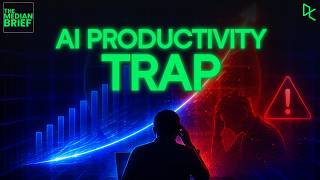
Anthropic surveyed 81,000 Claude users and found that as AI productivity gains rise, so does job threat perception. Each 10-point increase in AI task share raises threat perception by 1.3 points, with early-career workers and software engineers most anxious. Users report 5.1/7 average productivity gain, but 10% say employers demand more output.
Chapters
Deepseek open sources its new V4 models. OpenAI launches GPT-5.5 and ChatGPT Images 2.0. The WEF drops an agentic AI playbook for governments. And Anthropic surveys 81,000 workers, finding AI saves them time but sparks job anxiety. Welcome to The Median Brief, based on The Median by DataCamp.
Deepseek released V4, a fully open-source model series with a 1 million token context window. There are There are two versions: V4 Pro, which rivals top closed-source models on reasoning, math, and coding, and V4 Flash, a faster and cheaper option for everyday tasks. Both are live today via API and the web interface, with open weights available on Hugging Face. It's one of the most capable open-source releases of the year.
OpenAI had a big week! Shipping two models. First, GPT-5.5, a more autonomous model that debugs code, analyzes data, and conducts research with fewer prompts and fewer retries. It's available now to paid ChatGPT and Codex users. Second, ChatGPT Images 2.0, capable of generating text-heavy infographics, accurate multilingual typography, and flexible aspect ratios, with world knowledge updated through December 2025.
The World Economic Forum is warning governments to slow down on agentic AI. Its new Readiness Framework, co-authored with Capgemini and Berlin's GovTech Center, says without an evidence-based approach, public sector pilots will misallocate money, undermine public trust, and fail to scale.
This week, Anthropic published a study of 81,000 Claude users to measure how AI is actually affecting their work lives. The data tells a consistent story. Productivity is real. But so is anxiety, and the two rise together. The core finding is near-linear. For every 10-point rise in how much of a job Claude handles, perceived job threat climbs 1.3 points. Workers in the top quartile of AI exposure mention displacement worries 3 times as often as those in the bottom quartile. Software engineers are significantly more worried than elementary school teachers. And early-career respondents express far greater concern than their senior counterparts. The people whose work AI touches most are also the ones just starting out. Productivity is real. The average user rates their gain at 5.1 on a 7-point scale. 48% say AI lets them do new tasks. 40% say it just makes them faster. Most workers keep those gains. But 10% say employers simply demanded more output. The faster AI lets users work, the more they fear displacement. A U-shaped relationship between speed and panic. The more value AI creates for them, the less secure they feel about keeping their job. Last year's worry was that AI couldn't deliver. This year's is that it can, and that's the harder problem.
And this was the Median Brief, based on The Median by DataCamp. For the full breakdown and the deeper analysis behind this week's stories, subscribe to the newsletter using the link in the description. Thank you for watching, and I'll see you next week.