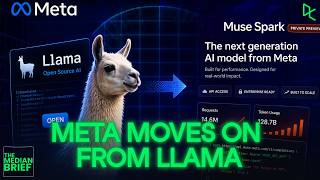
TSMC's AI chip revenue jumped over 35% year-over-year with orders booked through 2028. Anthropic launched Claude Mythos, a model that finds software vulnerabilities, restricted to defensive work through Project Glasswing. Meta abandoned its open-source strategy to launch Muse Spark, a closed commercial model built for profit and efficiency.
Chapters
Meta abandons open source with MuseSpark. TSMC posts record revenue on AI chip demand. Anthropic warns about a dangerous unreleased cybermodel. And OpenAI adds a new $100 ChatGPT tier for Codex users. Welcome to the Median Brief, based on the median by DataCamp. TSMC reported record first-quarter revenue, up more than 35% year over year. The main driver was AI chip demand. Especially for its most advanced 3nm and 2nm process nodes. Those lines are reportedly booked through 2028. That tells you almost everything about where the AI infrastructure race stands right now. Demand is still intense, and the bottleneck is still supply.
Anthropic had a big week on two fronts. First, it revealed an unreleased model called Claude Mythos Preview, which showed advanced ability to discover and explore exploit software vulnerabilities. Anthropic says the model is being restricted to defensive work through a new initiative called Project Glasswing alongside companies like Amazon, Apple, Microsoft, and Google. Second, the company launched Managed Agents, a new enterprise service designed to make long-running AI workflows faster, safer, and easier to control. Together, those two announcements point in the same direction. Anthropic is pushing harder into high-trust enterprise infrastructure while drawing sharper lines around dangerous frontier capabilities.
OpenAI introduced a new $100 ChatGPT tier aimed at heavy Codex users. It sits between the $20 Plus plan and the $200 Pro plan, giving developers more room for sustained coding use. Without jumping to the highest tier. This is another sign that coding is becoming one of the most commercially important AI workflows. But the biggest story this week is Meta. For years, Meta was the company making the case for open-source AI through the Llama family. Now it has launched Muse Spark, a closed commercial model. And that is a real shift, not just in product strategy, but in how Meta seems to think the frontier AI business now works. The most obvious reason is cost. Staying competitive at the very top of the AI market is getting incredibly expensive, and Meta's spending has exploded right along with it. At that point, open-source leadership becomes much harder to justify on its own. A closed model gives Meta something much more direct: a path to monetization. And that seems to be the key change here. Muse Spark does not look like a model designed mainly to strengthen an ecosystem. It looks like a model designed to support products, APIs, and a business that can actually pay for frontier-scale development. Meta also seems to be thinking more seriously about efficiency. Muse Spark is built around the idea that high-end models cannot just be smart; they also have to be deployable. They have to be cheaper to serve, faster to run, and easier to turn into products people will actually use. So this is not just Meta moving on from Llama; it is Meta adapting to a new reality. Meta may not be giving up on open source entirely, but MuseSpark suggests the company is no longer treating openness as the center of its AI strategy. Now the priority seems to be control, monetization, and deployment at scale. And this has been the Median Brief. Based on the median, by DataCamp. If you want the full analysis behind these stories, subscribe to the newsletter through the link in description. Thanks for watching, and I'll see you next week.