Python Tutorial: Statistical Thinking in Python I (Part 3)
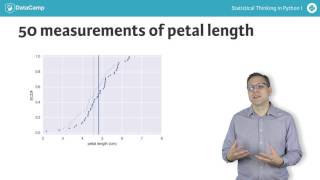
In this segment of the tutorial, the instructor uses an empirical cumulative distribution function (ECDF) of 50 flower petal‑length measurements to illustrate core ideas of statistical inference. He shows how the sample mean can be computed and marked on the ECDF, then explains that this single statistic does not reveal the true mean of the entire population of flowers. By invoking probabilistic reasoning, he describes the uncertainty surrounding the population mean and the expected variation of sample means if the measurement process were repeated many times. The speaker emphasizes that probability provides a language to express how future samples are likely to behave—specifically, that future sample means will tend to cluster near the observed mean rather than being arbitrarily far away. This probabilistic viewpoint is presented as the foundation of statistical inference, converting raw data into statements about what we might expect in repeated experiments. The segment concludes with a promise of exercises to practice these ideas and a preview of learning to “speak” the probabilistic language.
Chapters
More from Richie

#359 My Best Friend is AI with Valerie Tiberius, Professor of Philosophy at University of Minnesota







How AI Agents Will Work While You Sleep | Ruslan Salakhutdinov, Professor at Carnegie Mellon

#358 How AI Agents Will Work While You Sleep | Ruslan Salakhutdinov, Professor at Carnegie Mellon

