Justin Boyce from Caltech teaches statistical thinking in Python for biology students. You'll learn exploratory data analysis, data visualization, probability distributions, and hacker statistics. A sequel covers parameter estimation, regression, and hypothesis testing using Darwin's finch data.
Chapters
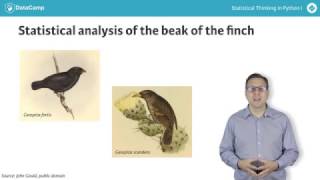
This is the first course on statistical thinking in Python. You will learn powerful concepts and tools to help you get the most out of your data. My name is Justin Boyce and I am a Lecturer in the Division of Biology and Biological Engineering at the California Institute of Technology. I am dedicated to empowering students and researchers in the biological sciences with quantitative tools, particularly data analysis skills. The end goal of the analysis of a data set is to be able to draw conclusion to make judgments based on the data. This is the realm of statistical inference. Thus any data scientist must have a strong statistical grounding to get the most out of their data. They also must have a computational framework to do the statistics. Ours is Python based. In this course and its SQL you will learn the relevant conceptual and computational tools to have that grounding. You will learn the basics of exploratory data analysis, also called eda. You will learn to plot your data in instructive ways using Python and how to interpret such plots. You will also learn how to use a variety of summary statistics to make sense of and communicate meaningful information about your data. We will wrap up by working with probability distributions, how they arise from stories that occur in the real world and you will come out being able to simulate stories and their distributions using hacker statistics. In the sequel to this course, you will apply all of these new techniques to parameter estimation, linear regression and hypothesis testing. The sequel culminates with you using your newly learned Python based tools to do your own analysis on a real data set of scientific pertinence. You will analyze actual measurements of the beaks of Darwin's finches from the Galapagos. I'll see you in the course.