Unleash the Power and Profit of a Data + People Strategy
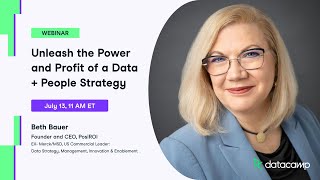
In this DataCamp live webinar, host Adele (VP of Media) introduces Beth Bower, founder and CEO of POZI ROI, who shares three decades of experience helping Fortune‑300 firms generate billions in ROI through integrated data and people strategies. Beth frames data initiatives as an "Insights Factory" that mirrors product development, emphasizing that data is a means to business profit, not an end in itself. She presents a "Flexible Master Plan" metaphor—akin to city planning or modular web architecture—where organizations build interoperable, evolving data modules, continuously reprioritizing based on learning ("relentless prioritization"). The talk introduces the "Adept Innovation" framework (people, process, technology) and stresses the need for data literacy that progresses to fluency (20‑30% fluency threshold). Stakeholder delight is positioned as a continuous, partnership‑based accountability model, with dashboards described as the "Wikipedia of work" that must evolve with metrics. Beth warns against "data vomiting"—over‑communicating low‑value insights—and advocates disciplined insight flow through stakeholder mapping and micro‑habits. Trust is identified as the anchor of any data initiative, built via relationships, judgment, and consistency. She outlines a "fail‑to‑sale" learning loop where rapid prototyping, piloting, and feedback synthesis turn failures into actionable insights. The webinar also covers practical sustainability concepts—reducing, reusing, recycling data—to curb digital waste and free resources for innovation. Audience Q&A explores data literacy start‑points, stakeholder delight frameworks, managing assumptions, and inclusive practices for introverts, with Beth recommending varied connection structures (speed‑dating, coffee chats) and vulnerability to elicit feedback. The session concludes with a call to action for upskilling teams and future webinars.
Chapters
Foreign. Hello. Hello everyone. I think we are live. I see quite a few people joining us from all over the world. Do let us know where you're joining from. I see here Jennifer from America. How's it going? Antenor from Haiti, Jose from Nigeria, Roseanne from California. Awesome. Quite. Really great to see people from all over the world. Do let us know where you're joining from, what you're looking to get out of today's live stream. Do make sure to ask as many questions as you can. We have here John. Hi, Beth. It's been a while. Beth will join us shortly. Hello. Hello everyone. My name is Adele. I am VP of Media Data Camp. It's really a privilege to be able to host these live streams. A bit of housekeeping before we get started. This session is being recorded. The recording will be sent to you at the end of the week or early next week at the latest. It will also be live on YouTube directly after this live stream concludes. And also you can revisit it back on LinkedIn in case you need it. The discussion will be followed by a Q and A. So Beth will start off with a bit of a presentation, then we'll have a bit of a chat and then you can ask your questions along the way. If you have any non webinar related questions or if you encounter any technical issues, please do ping us in the questions panel and we'll try to assist you as soon as possible. Quite a lot more people have joined us since. Always nice to see Shru Ki from Thailand. I really hope I'm pronouncing your name correctly. Nicholas from Argentina. People from all over the world. Maya from Ireland, Ahmed from Egypt, Marhaba Ahmed. It's great to see you. David from the uk. Always great to see everyone joining in from all over the world. Brings us so much happiness. Now I think we're able to kick us to start off officially. I'm going to invite Beth on screen. Hey Beth, how's it going? Thank you so much for joining us. It's really exciting for you to be here. So good morning, good afternoon, good evening everyone. I'm very delighted to welcome you all to our latest webinar on unleashing the power and profit of the data and people strategy. You know, in today's increasingly digitized economy, harnessing the power of data and human expertise is no longer a luxury. It is essential to secure a competitive advantage. But there's often a problem. As many of you may know, there is a cultural dividend that exists between business teams and data teams. Often leading to confusion, miscommunication, and hindrances to the strategic planning of the organization. Bridging this gap is crucial for building ROI from data initiatives and part of a cohesive data strategy that puts value at the center. So how do we approach this cultural divide? How can we ensure that data becomes a common language across the entire business? Here to answer these questions is Beth Bower, founder and CEO of POZI roi. Beth. Beth Bower is an innovative big data expert with over 30 years of experience. She has successfully helped 26 Fortune 300 companies, generating billions of dollars in returns. As the CEO of Posi Roi, Beth shares her valuable insights on maximizing return through strategic data utilization, covering various aspects of the data life cycle, including business consulting, statistics, coding, contracting, privacy, and governance. Her specialty lies in rapidly synthesizing and solving problems at the intersection of data, people, and technology. And this is what we're going to be talking about today. Now, before we delve into our discussion, just a bit of housekeeping. This session is being recorded. I'll say this again. You can revisit the insights shared today at your convenience. We also highly encourage everyone for asking questions. We will make sure to ask questions at the end. So Beth will start us off with the presentation. So I will go off camera and let Beth share her screen. Then we're gonna join back in, have a bit of a discussion about the presentation, and take audience Q and A. So, Beth, I'll let you take it away.
Excellent. Did I just stop sharing my screen or am I sharing my screen?
You can share. You need to share your screen again. Yeah.
Are we good now?
We're good now.
Excellent. Thank you, everyone. I'm so excited to be here, and I'm very grateful to Adele and datacamp for this opportunity. It's amazing to hear how much frustration there is in being able to move forward with data innovations. And I'm going to share 30 years of insights into how unleashing the power of a data plus people strategy can help get us there. So some of the basics of the key elements that we'll be covering today is remembering that we're all doing this to prioritize the business. Data is not the actual product, unless that is your business. And that means that we need to be setting up the data and people strategy in a way that we actually help the organization to make money and put their goals at the forefront. And if we can begin to think about the insights that we're creating as a factory process which most businesses are used to understanding, how do they build their product, we can begin to actually understand why some of the foundational components in an Insights factory will help us to get there. That means that we have to be more adept and I like to call that adding aid to the people and process and technology for innovations, being able to move that forward through knowledge systems and of course show me the money and how do I get started. So first off, prioritizing the business. When we're looking at this from the data perspective, what it comes down to is we're looking more holistically at how the business is functioning. Businesses have really gone off and we've all honed our expertise by going off into silos. And that can mean that we have conflicting goals. And there's a lot of conflicting goals. This could be short versus long within the same business. This could be brand versus brand within a franchise or franchise to franchise or business to business unit to business unit. There's opportunities, but there's always risks associated with those. You have vertical issues and horizontal issues. You have business unit to enterprise. You have the costs associated with these opportunities for versus the resources you have available today. With democratization of that data, there also comes governance issues again related to risks. All of this gets down to we have multiple types of demands. Some of that is demand management. How do I handle my day to day issues, what I have to answer immediately, and then how can we be more strategic not only about the data, but that we're handling, but clearly about how we're handling our business and utilizing a data informed culture that actually gets us there. Because at the end of the day, data isn't going to get us there alone. People have to adopt it. And we're going to talk about how getting people to adopt that can help us reap significantly better and faster accelerated profits because we'll get those profits when we bring it together on a common purpose. And we all have passion and motivation to get there. So one of the first things I hear a lot of people talking about data as a product. I've been blessed for a large part of my career to actually have data as a product. And I thought about translating this back to how we all do our business when we do our standard business as a business person, we think about how we take our products, how we create them, how we identify our customers needs, the raw materials that we need to be able to bring that in, how we create strategic partnerships that we actually have sales and marketing who help us with a product launch, that we then have manufacturing and scaling process because the faster and better we can do it the more profit we'll be able to make. We need to future proof that factory. We need to be able to have principal consulting so our customers know how to use it. We need to be able to have product development and prototyping. We need to have business development. We need to have customer service that meets those customers needs. We need quality. We need to be able to track that quality both as inputs and the raw materials, through the manufacturing process, through the product distribution and delivery. That needs to have financial strategy and operations. And we need to treat it as a lifecycle management of our product with strategic planning. And of course there needs to be concerns for privacy, security, compliance and regulations. Your customers in your large businesses have choices. You want it to be that their choice is to work with you in order to have that happen. By treating it really as an insight factory, you can begin to understand the synergies across your business. Ways that you can begin to build foundations through both your contracting and your technology to be able to get you to a point where you can scale more easily and have the flexibility to handle the future. So how do we do that? Right? You're going to need to be able to align goals, people and the data. The easiest way to get there is really through something I call the flexible master plan. Someone had described this years ago. I was at a conference on quality. They mentioned the start of the web. And if we start and think about that, the web largely as a whole does not go down. And it doesn't go down because it's in every place. And when it was started, we started in a way to say, I don't know what this is totally going to look like in the future, but I want to make sure that I build little modules that can talk to each other and and make sure that they sustain on each other. That's what we mean by a master plan. We can also think about that like a city planning. All the different components that you would need in your city of the future. You need to be able to define what the data and actions would be in that future state. If you were designing that master plan. And then you don't say, I'm going after all of this at once. You tackle it strategically and you allow what you learn as you go through that process to evolve what your next component on that master plan will be. That means that you need to take in and listen to all of the pain points. But then you don't just do what people ask you to do. You have to synthesize that together. You have to hear These different points make connections, talk to people, so that you can really understand what's at the heart of those needs. If you can build a three to five year vision of that future world that has some swag returns, and swag returns for those who are unaware with that term, you can look it up on Wikipedia. It is a scientific wild, a guess. And what that means is that you've actually done some work to be able to understand what that future will bring. But when we're in innovation, we can never be 100% certain. That's why it has to be a swag. But as you learn that SWAG should evolve into concrete steps where you can actually identify what new capabilities will bring and what returns those capabilities will have and be able to talk about how long it will take to get there. That means you have to have thought through those steps. In order to think through those steps, you have to talk to the people who will take those actions, who will benefit from these advancements that you create with this data. Are their actions aligned? Their actions not only need to be aligned, they need to get on board with you. That means that you need to be able to have them begin to actually become sponsors for what you're creating and, and share their successes. Because it's not just your successes, it's their successes. They're taking risks with you because it's their actions that are bringing the value. So we also need to think about how at each point, with every dollar that we get in investments, what else can we do? So when you have that master plan, you can take a look at, I got this amount of money. What if I can accomplish this piece and maybe I can fit in this other set of actions too and unlock additional opportunity. This allows you to be able to exceed expectations over and over again and to be able to build for today and tomorrow, especially planning for those inevitable needs. This means that we need to relentlessly prioritize. I hear this all the time. But relentlessly prioritizing does not mean sticking to the first plan, because sticking to the first plan means I'm going to put blinders on, I'm not going to pay attention to what I've learned along the way. So relentlessly prioritizing means taking what I'm learning, using that to change my prioritization. To do that, you have to pay attention to how the world has changed. All of the different components about the technologies, the data, your customers, the world, your competition. You have to then regularly recheck these assumptions, because as the world changes so quickly, it's quite possible that you're going to need to change the strategies to get there. Again, a lot of our companies are used to doing a product launch. They have marketing campaigns, they have sales campaigns. But innovation internally is also a product launch. You need to treat it like one. That means that if you're doing something completely innovative, you need to begin to create awareness campaigns far ahead of your launch. You need to be able to get key opinion leaders within your organization who are going to help you to take that forward. So how can we begin to get there? Specifically, I bring this down to something I call adept at innovation. And again, it's aiding the people, process and technology. So analytics and acuity. Acuity is a word for insights that starts with a. So it fits in nicely to the framework. But what this means is that as the world changes, how we look at it needs to change too. We need to broaden our focus in order to accelerate. If we only look through a tiny lens, we come to certain conclusions. But I guarantee you, as soon as you broaden that lens, you'll find that there's more to the world that you needed to incorporate. That needs to obviously be balanced with timing, because there's never enough time to know everything. And we certainly can't allow perfection to get in the way of getting it done. But we certainly also need to recognize that potentially we had blind spots and we need to be honest about those blind spots. So 10 years ago, before cloud infrastructure was here largely, a lot of analytics spaces had certain job and functions where they did certain analytics. The analytics are evolving continuously. That doesn't mean that all the ones that we did before are bad. They're not at all. They're still completely relevant. But that also means that we need to think about not only the analytics, but the metrics that we're taking a look at. So as we begin to move into this new world of let's add all these analytics, we have to think more intentionally, create a strategy about that, this, because if we allow that change, that constant demand to drive what we're doing, we'll. We'll end up in chaos. Strategy allows us to be more focused on that reprioritization. But while we're focused on that, there needs to be this separate component that's actually twisting, turning, exploring, looking at where are my blind spots so that I can understand what's driving and changing, to know what is happening, why is it happening and do I care? Do I really care? The insights that we learn from that, in order for them to become acuity, that really becomes a part of our organization. We have to push those insights out to as many stakeholders as possible. And then we need to get them to push it out further. Because as these insights infiltrate our organizations, they begin to communicate. And this communication of those insights across the various stakeholder spaces is what actually creates the insights that lead to evolution and actions. People that need to be positively incented to be able to talk together. And that doesn't mean mandating in a way that they are forced. It needs to become a part of the culture because everyone plays a part in that insights and innovation sweepstakes. So that leads us to the data and decisions. We need to really become aware of the decisions that are being made. We don't realize that every day we end up making decisions that really impact our lives. Some of these are large decisions, but a lot of them are small. And you need to ensure that the data that you're using actually fits the purpose that you're intending. So with everyone looking to monetize data, we've got data coming out the wazoo. A friend of mine who may or may not be on today, we used to call this data vomiting. We don't want that. Data vomiting means that people are overwhelmed and grossed out. It means that we need to be able to think about how can we turn this data into something that actually is usable for our business to take advantage of so we can accelerate value? And now, more than ever, garbage in is garbage out. Only it's a lot harder to recognize garbage. We all know this from the concept of disinformation that's out there. It's rampant. And it's rampant not only in how people are talking to each other, but even in the varieties of data. And in some cases, even the people who are creating that data may be unaware of that situation. That means that you need to be keeping track of the decisions. You need to be able to get ahead of those decisions. This also means that you need to be able to have an understanding of how much precision is needed, how timely that needs to be, how relevant the information is, and how much cost that's going to be. And all of these are in conflict. So part of that decision process is which one of these is actually going to lead the prioritization, how do I weight these different components based on the decision at this time? So what that also means is if you can identify a variety of decisions that are going to be utilizing one asset, that's an incredibly powerful way to take advantage of data that you already have access to, particularly if you can think about that at the forefront as you're signing up for your contracting. How are the different ways and organizations that I can have buy into this? Not just so that they share in the cost, but so that your organization as a whole gets as much value as it can and actually asks for information in a way that it will meet multiple needs. This also means that you need to be practicing really good data and financial hygiene. What do I mean by that? That means that again, if we think about it as a product life cycle that you need to be paying attention to, well, who's buying my product? Should I turn this product off? Should I still be? Do I still need this raw material? Has this raw material changed? Do I need a material that's been transformed in some way instead of raw? And again, all of the assumptions about this, including the quality and the models and AI ML that we create for this, we need to be reevaluating and testing them and set thresholds so, so that we retest to check if the world is still the way we thought it was. Oops, sorry, went too far. And that leads me to enablement and engagement. So what does that mean? People have to use it, right? And they have to be able to have the resources to be able to use it. We need to talk to them up front as we're creating these data products. How will this actually come into your workflow? If we can be more intentional and strategic and empathetic about how hard it may be, the bigger the innovation we create for them, the more change is going to happen. So again, instead of thinking about change management as something that happens after launch, we need to think about how can we actually understand their workflow to fit it in at the beginning. That means that a part of the visioning of our data product is that we have internal marketing from our data technology side that says, how will you actually use this? Is it going to be easy? And in our prototyping and pilots, which we really need to get better at, that they begin to try and use it in their day to day. Where do they struggle to be able to use this? What works, what doesn't work? How do we need to transform that? Did we fill our blind spots? We need to be able to see if we have really missed the mark. So process and people, these are at the key of pretty much everything that we do. But if we want data innovation to take hold, that means that our process and people innovation needs to take hold too. They're going to have evolved with us and they need to be prepared for that new normal, scaling means not just scaling the data, but scaling it to the people. They're going to need to want these innovations. They're going to want to put that into their workflow. We need to then leverage people's strengths and our technology strengths and our process strengths, and be aware of those blind spots so that we can leverage strengths but build for those weaknesses. In order to do that, we really have to motivate people to want to have continuous innovation. Because in continuous innovation, it's absolutely terrifying. I've been in continuous innovation, data innovations, and actually business innovations through data for 30 years. It's very uncomfortable. In fact, it's terrifying. It's terrifying because you are always changing. But in that new normal, that always changing is with us forever, and it's accelerating. We all know that that curve is accelerating. We have to take a look at our old processes and really ask the question, does this still give me joy? Does this still do what I want it to do so that we can understand what our real barriers to innovation are? Sometimes it's not in our technology. In fact, most of the time it's not in our technology. It's in our habits of how we work together. Changing some of those microhabits in our daily way that we talk to each other, work together, and facilitate sharing and partnership in those common goals are what's going to help our data innovations. That takes me to the anchors in this, which is technology and trust. And trust is really the anchor in all of it. We all know that technology is an incredible enabler, and it's changing the world so fast that we're losing trust. We're losing trust even with each other. So with so many possibilities out there, we often only hear about the negatives. So we need to start pointing people to the realm of the positive possible. We need to get them to be bound together in a future that's good for all of us in a common purpose. So if you're within your company, that is. How are we going to work together on this problem? Instead of me against you and my resources against your resources, how about if we bring our resources together so we can accomplish more? Because my success is your success. Because it's our success. Thinking back to the enablement components we need to think about when we're creating these new technologies. Will this matter to the organization? Will they actually love it and feel like it becomes a part of who they are? This leads me to some of the parts about dashboarding. And I know there's a lot of different discussions on this, and this is probably very controversial, what I'll say, but I think dashboarding is a critical component, but how we use it and what we use it for potentially has shifted. So I think about the main purpose of dashboarding now as the Wikipedia of our work, it has to be able to show different points in time, different customer bases, scenarios, where I can look up the state of affairs, I can look up and learn about what's happening in that space. But I need other mechanisms to be able to get me to be able to think about how this will evolve, what are going to be my key metrics that I focus on. But if I do it really well and I hit the mark, those key metrics will change and evolve very quickly. So if I pause and think about, well, how will that change? And I can do that in advance again, build an awareness campaign about how this will evolve, the organization can move a lot more smoothly and we'll have more trust. So that means we have to promise a little bit less, deliver more, be willing to go that extra mile and obviously delight your stakeholders over and over and over again, because that's how you're going to build trust. And treating them like customers, like your next dollar depends on your relationship with them, is how to begin to move that forward. That means that we have to get data into more people's hands. And having been a data expert pretty much for 30 years, that was really hard for me, putting data into people's hands and letting them analyze it without them knowing every nuance. Terrifying. So what's the easiest way to get that to happen? Create a relationship where that actually you can provide sandboxes of space so that they actually begin to learn their experience, experiences as they go. That means that they will make mistakes, but if you've created that relationship, they'll come back to you, or you create structures where they do come back to you before they have them go out. This means that actually they will create a relationship with you where they understand what their limitations are. Because none of us have expertise in everything, that means we need to rely on each other. That's what trust means. And in order for that to happen, we have to really put our compliance and regulatory first. We need to be compliant by design, but that means that you then need to be able to leverage this. Because if you really have a good handle on your compliance and your governance in this space, that means you also have a really good understanding of your holes because you have a section where there are people who have needs that aren't met. That means that when you take in new information, you can actually then say, huh, I took in this new information. That person over here needs that. Let me let them know. I laugh again. Did I mention piloting and prototyping? Allowing people to really touch, feel and make it a part of of their world is what allows them to say, hey, this is amazing. I want to share this. I want to stand on a soapbox and scream how great this is to my organization. But you're not going to get there unless you can actually begin to build some of the structures and tiny habits that create relationships sustainable within your organization. And hopefully you build them where they're not just personal relationships, they're actually organization to organization relationships. There's an article that HBR published actually several years back at this point called the three Elements of Trust. When I read this article, I was really taken aback. It talks about that there are three components to trust. It's relationships, judgment and consistency. Three main drivers. And I thought, judgment and consistency, well, isn't that data? Yay, go data. But it turns out when they analyzed it, even when you put judgment and consistency together, relationships is, is the highest, strongest factor in adoption and trust. And that means that no matter what data we create, if we don't spend the time on those relationships and create the that trust, we're not going to get adoption so quickly. I'm going to take us into knowledge systems, which is another space, because our institutional knowledge in any organization is really their competitive advantage and that comes from a combination of people and data. So there are new technologies and database structures that have really progressed to a point where we can connect dots faster than ever. So we've applied those often to the outside world, but we're not necessarily applying them into how we work. So if we can begin to actually collect our own information, we can begin to have better business agility. What do you do in your processes? How do you do it? Keeping track of some of this and identifying some of the key components can lead you to how you do that better. There are ecosystem insights. We are all learning that these overlapping ecosystems have influences in our world. The butterfly effect. What are the key drivers in your world's butterfly effect? This allows you to recommend how your GPS may need to change and allows you to begin doing scenario playing, being able to do opportunity and risk assessments. It also allows you to open up those blue oceans. How can you learn to identify and then create customers out of people who previously were not your customers or not completely engaged with you who really want your products? This can obviously lead to increased sales and reduced competition. And again, relentless prioritization does not mean put your blinders on. It means be aware and reprioritize. Know what your opportunities and risks are because those most critical decisions, they aren't scheduled. So show me the money that means we need to be talking about innovation horizons. How long will it take to get investments back? How can you begin to actually go from a swag of the of the long term future to, to estimates of what you're impacting today? And being able to calculate return on investments, you'll be able to look at that through a variety of mechanisms, including blue ocean growth ways that you can scale. One of the key things in, particularly in some of the largest companies, is that when looking only at roi, we think that the largest brands often end up providing the highest return on investment. But what I can tell you from a true scaling scenario is that you start with prioritizing on those largest brands. But if you can think about how that can be applied to all the others, they still spend money. They spend a lot of money to be able. They still have work to do. They have to get their job done too. So if you can leverage what you spend on your highest brands and scale out to the rest of your company, wow, there will be huge power and returns in that. But of course that means that you need to align and agree on the actions that will be taken. Not only the actions that lead to value directly in the business, but in your actions that will happen through scenario planning, keeping an eye on reducing, reusing and recycling your raw materials in your data business, and being able to have agility through that relentless reprioritization. But that means that you have to have something you can tie back to your strategy and foundations. Thinking about that like a city master plan, how do we need to take our next steps? So lastly, I had a blessing to be in a webinar about a year ago with Stephen M R Covey, who wrote the book Trust and Inspire, the son of Stephen Covey, who wrote the seven Habits of Effective People. And we were talking about how trust and inspire and data informed. They go together because data brings transparency. This also means it changes some of the power structures. So you are going to struggle with that because when power structures are at play, they can certainly be nasty and you may not be the most popular person in the room. But when I asked him, so how should we start with this? Do you go from top down or bottom up? His answer was, you have to start where you are. And that's where data needs to start. You need to start where you are and as you have successes and collaborate and create relationships and build trust and you're more intentional about that through strategy by chunking it out, learning, putting that back in. I call this going from fail to sale. We all talk about celebrating failures. Well, no one actually wants to celebrate failures. Nobody wants to do that. But those failures aren't failures if you learned something and learning something isn't putting it on a list and putting it in a file somewhere. Learning something is an insight and that insight needs to be brought back to the organization to create new actions. I call those shared actions in learning, which allows us to go from failure to sail. If we can do that, then we promote a culture where we all feel safe and people begin to engage and be informed with data transforming for all of us. Thanks very much.
That was so great, Beth. I love that presentation and there's definitely a lot of comments that we've gotten so far. I'm going to share a couple of them. First here, friend of the show, Vijay, excellent points on trust. Could not agree more. Vijayanav, great to see you joining us. Vijay. Kim Barzello mentioned here. Love the idea of a safe container to explore and value individuality and with the community. Completely agree. Very wonderful insights. Do make sure to ask your questions. We have quite a few questions that we've already pinned. We're going to ask Beth shortly. Do make sure everyone to ask your questions. I have one question maybe for you, Beth, before we get started. In a lot of ways a connective tissue or layer between the organization, between different people within the organization. When trying to think about data is that common data language, that data literacy. And you mentioned a lot the importance of enablement right at data camp we care a lot about creating that common data language, that common data literacy. Maybe. How do you start that journey of data literacy if you're a data leader? You know, you mentioned starting where you are. How do you start with data literacy?
So I'm going to start with a tiny little story. I actually saw a physician post an econometrics test of his nephew on LinkedIn and it showed questions in math language. Being a statistician myself, I could read all of this and he says, oh my God, if I had to take statistics today or understand it today, I would fail. I wouldn't be able to be a doctor. Well then as I look through what the questions were, they were really simple and they were things that doctors deal with every day, but they were written in math language and oh, by the way if that question had been asked in doctor language, the statistician probably wouldn't be able to answer because they'd start hearing medical terminology and get completely flustered. We have, we, we are saying the same things, oftentimes coming from different lenses. And so it's not just a question of data literacy, it's communication between the two sides. So I think, Adele, you and I have even talked about that the literacy really translates to fluency. And you really only I hear that the number repeated somewhere between 20 and 30% fluency. Fluency in any language is enough to be able to communicate well and get your points across. And so that's really the type of goal that we need to be moving toward. But in each group who has this issue, there's going to be a different translation that's needed because it depends on who you're supporting. Right? So are you supporting business people? Are you supporting doctors? Are you supporting manufacturing, what language you have to translate the data into and come from both sides on fluency? Because that's the other piece, right? It's not just data literacy, it's our customers literacy back. We need to be able to resonate those messages to communicate together.
I couldn't agree more. This is really wonderful insight. Beth. Maybe another thing that you hinted at is the importance of delighting your stakeholder. And I think a lot of folks here, especially data folks, are trying to think about the value that they're trying to create for their stakeholders, their partners within the business, the customers. And I think that's such an important aspect of gaining trust, as you said. I even have here a comment from Rosanna. This was such great content. Could agree more? Number one takeaway, delight the stakeholder over and over. Maybe walk us through a framework that you have in mind when data leaders are trying to create solutions for the organization. How can you always consistently put the stakeholder first and how can you prioritize delighting your stakeholder?
So it's easy to think about this going not only across my work life, but I do a lot of volunteerism. And so being able to, I have to get people engaged in things where perhaps there had been no engagement before. And if we think again about our businesses, we have to get our customers to engage, right? We're always trying to get customers to engage. And the more that you can get your customer to engage and own it with you, the more they're going to go on that journey with you and they're going to feel accountable with you and they're going to want to see you have that success. Right. So that means that you end up creating a partnership in accountability on this. Now the, the blessings and the curses, the go whippus is in that joint accountability. That means that if, if it doesn't succeed, you go together on the hook for that and if it does succeed, you both share in the success of that. But that means that you need to be able to stand together and not point fingers to say it's your fault, it's our fault, if we didn't make that succeed. And the more that you can get them to own pieces of those, the more that they're going to feel a part of it and want to make you highly successful because it makes them successful.
It's creating that journey, that partnership with a lot of the different stakeholders and co owning a lot of the different outcomes. I'm going to start taking some audience questions here given how many that we've had. First one that I found very fascinating from Jeremy here. You say we need to communicate insights to as many stakeholders as possible, but also that we need to avoid data vomiting. Right. Curious to hear your thoughts on how the flow of insights should be managed. I love this term data vomiting. I'm going to start using it as well, but yeah, maybe let us know. I think this is a lot of things, especially more junior data practitioners fall into this trap of over communicating data insights that don't necessarily have a lot of value. How do you approach that trade off necessarily?
So one of the key components in this of data vomiting is people are asking for data all the time, Data, data, data, data, data. And then what's fascinating is sometimes you get it and then you say okay, I have it, what are you going to do? Yeah, and they, they, they can't answer this question at all. So you need to start walking through the baby steps together and, and this is where those microhabits of creating really come into play because there is no one answer to this question. Right? It's from wherever you are you need to begin, you need to identify who your different stakeholders are, who's in your ecosystem, what goals do you have associated with that. And just start talking to people, finding that common ground. And as you communicate what you may have found in your day to day work is meaningful to them, it usually is. And then they put that into a context that actually turns data into an insight. And it's a combination of insights that connect the dots that lead us to major transformative moments. But that can't happen if we don't talk. I know a lot of organizations are bringing everyone back to the office and creating. We need everyone back at the water cooler. I have to tell you, I have never, I've worked from home for 20 years. 20 years, not three, 20. And I've never had a conversation at the water cooler that led to anything. However, I call as many people as I can. I put myself out there and make new relationships. I see something that was interesting to me and I connect with those people. And these are the spaces where we need to not be afraid to connect with each other. We need to be able to share what we're learning and say, hey, I found out this thing. Does that have any interest to you or do you know anyone who would have interest in that? And that's actually how we begin to have these new structures and habits within our organization. A comfort level to talk to each other about how our work relates to one another. And it can't be only in giant forums that are terrifying for people. It has to be in our day to day.
And you know, you mentioned here how you, you know, putting yourself out there and creating these relationships and speaking to people. I think in a lot of ways what hinders, you know, both business people and data people putting themselves out there is there's a lot of assumptions that are being made around how data could be used or should be used. And a lot of time these assumptions or wrong assumptions tend to have negative consequences on trust maybe walk us through from your experience, what are the common assumptions either business or data people may have about how data should be used or can be used that create this type of friction within the organization.
I think a lot of those happen when a you didn't focus on the relationships with those people first and what their actions would be. And there hasn't been sufficient that prototyping and piloting because it's not until you begin to get into like okay, I'm ready to go do something with this. And it can be with fake data, completely fake data. You just pretend to get this started. You really begin to realize, oh my gosh, I built this in a way that like nobody can do anything right? And so if you can create those early on fail scenarios which turn into sale because now you learned what doesn't work. That's what piloting and prototyping and test learning evolving is all about. You need to create rapid ways to fail and have as many people as you can provide feedback. But that feedback again doesn't need to come in the form of an after action review that goes in a file. It needs to be synthesized back into. Okay, so what really went wrong here? And it's not a list of bullet points that people gave, it's what does that mean? Does that mean that we actually created more work than solving problems? Does that mean that we actually.
We.
Didn'T put enough quality up front or we didn't include, we didn't know our blind spots? I see this happen all the time in data innovation and digital innovation is that we move forward. We move forward so fast on an agile pathway, looking to hit certain checkpoints that we're unaware that there was another capability needed that actually enabled our entire process. So then we look at our process and say, oh, we failed. But in reality, if we had talked to more people or walked through how this would be used and engaged with, we would realize, oh, if I brought those people in, it would completely flip this whole thing around. Another space where some of those failures are happening, particularly in the healthcare space, is, is with compliance and regulatory. Right. And what's fascinating in there is they need to be brought on the journey too. Right? We are not talking to them about how the world is evolving and for them to have trust to evolve policies in that space, we have to bring them on the journey. And that's going to take a little bit of time. So put the time up front instead of after.
And maybe to kind of expand on that. You know, you mentioned, you know, getting people along, right. And making sure that they are part of the journey. What are ways, you know, I think what's really important here is to really clarify that what's in it for you about any form of transformation, digital data, you know, any form of change management is really important to that. What have you seen as something that is very successful when trying to communicate that what's in it for you? For any type of stakeholder, first you.
Have to understand what's important to them. Right? And oftentimes we make assumptions about what's important for people rather than hearing their voice. That also means that we need to be able to have them own a part of it. Because if we ask them to be a part of this success and, and say, we need your feedback. Actually, a question that came to me just yesterday was, well, what if people don't want to give me feedback? They say, I don't, I don't like to give feedback. One of the things that I've learned, not only in the business area, but in talking with people in general, is if you can provide little insights about yourself, be vulnerable first. They will easily give you the next Step of feedback. So that may be. Here's what I was trying to achieve with this data product. Here's what I was trying to achieve in your workflow. Did I succeed? Does it do that for you? I then shared with you what my hopes and dreams were for this data product, which enables you to open up about what feedback you can provide back. And then no matter what feedback we get from those people, instead of saying, well, that's not true and that's terrible feedback, say thank you. Thank you for that feedback. That's really important to me. So we have to remember that no matter what we hear, we may or may not use that feedback, but we need to take it in as a data point. So just like we're asking our stakeholders to take in all these insights to drive their decisions, we need to take in all of their insights back to us to drive our decisions in what we do with our data products.
That's really great. And I'm going to start taking a bit more questions as well from the audience. One question that we have here from Hiao, I hope I'm pronouncing your name correctly. Can you maybe expand on what you mean by reducing, reusing and recycling, which is a bit more of a waste management concept. Can you give me an example of how this applies in the people and data strategy worlds? Greetings from Myanmar.
Wow, great question. So yes, it is waste management. Oh, and by the way, I think about data in the waste management space as well. So as cloud technologies have come about and storage is so cheap, we are creating a lot of digital garbage. And oh, by the way, the world is suffering from that perspective, both monetarily because you have to pay to store the garbage. But our planet too, because all of this data that we're storing around takes power and energy and that means that we're paying people to ruin the planet. And oh by the way, we probably don't need it either. So if I go way, way, way back to mainframe days, there were a series of processes built into mainframe systems that allowed people to say, how long am I going to need this data data to stay around for this little interim step of data, which technically is duplicative data if we think about it, and building in ways that actually our day to day people can put some form of time horizon on work that they're creating. There may be some that I'm going to need this forever. Tag it like that. There may be other forms of data that, you know, I really only need this while I'm working for say the next 30 days, 60 days, 90 days, maybe a year. But it will go away. It can go into a place where we actually manage the data that we're creating in a way that we are not wasteful with the resources, because the resources that you can free up in those spaces lead to you being able to spend that on other innovations. Right. But on a bigger scale, that also means reusing those raw materials in your factory. Right. The more that you can use those raw materials and use them over and over again in a factory process, the more waste reduction you have in your insight factory, which gives you more dollars to be able to spend on new innovations. And so if you can reduce, reuse and recycle what you're creating, both literally and figuratively, that actually puts dollars in your pocket that you can use to move onto new horizons.
That's brilliant. And maybe one final question that I think is a very important question that we just caught from Clevinson. Remy, I'm going to put it here on stage. Really enjoyed the presentation. Thank you very much. My question is about relationships and human resources. You talked about the importance of connection, having a good network, putting yourself out there. But what about a person who has difficulty connecting with others? I can complete the question here because it's getting cut off because of introversion. What if someone is, you know, naturally inclined as an introvert? They have difficulty connecting with others. This is a point that I see overlooked quite a bit when talking about organizational culture. So I'd love your perspective, Beth, here as well. On what approach? What advice would you give someone who's naturally an introvert? Or how can the organization adopt. Adapt to introverse within the organization?
That's a big question I'm going to start with. As we all become more fluent in what diversity really means and the various parts to that, we need to recognize that we all have different strengths and weaknesses. And we need to build on the strengths that we have and then provide supplemental capability for our weaknesses. The days where we all need to be able to do everything are completely over. Right. It is teamwork. Teamwork makes the dream work, as they say. And so being able to have various people who can assist in these areas is going to be key. We all need to have a little bit of self awareness and self accountability in these spaces. So if you believe that your introversion is keeping you from connecting with other people, you're going to have to find some mechanisms that actually work for you, because not everything is ever going to work for everyone. So organizations as a whole need to have a means again for people to connect in different ways. And again, having mechanisms, structures in place where people are. You don't have to be the one to say, let me connect with you. You have and build little structures where people get together. They have coffee, chats, they connect for two minutes. An interesting thing that happened during the pandemic was like speed dating within the company. I thought that was phenomenal because now you had that water cooler conversation, which actually happened in a way where you're forced to talk. Because sometimes at the water cooler you, you meet someone big and you still don't talk. But now you were forced to talk, but you only had three minutes to do it. But you could end up connecting in a personal way that actually enables the next conversation. Right. And so we're all going to have different pathways and organizations need to create easy structures for people. Listen to their people, ask their people how they'd like to meet with each other and then begin to implement and test, learn, evolve on that too.
I couldn't agree more. And I think we can end on a very inspirational message as well from Kim here. As an introvert. Introvert myself, practice and know that your voice is of value. I couldn't agree more. Everyone's voices of value. Thank you, Beth, so much for joining us for today's webinar. Everyone who's interested in upskilling their team, check out the QR code that we have on the top left in case you're interested to speak with us. Beth, it was a massive pleasure to host you on this webinar. We'd love to do it again. A lot of insights to be shared, a lot more to unpack. And thank you so much for joining us today.
Thank you. I'm so grateful to you and everyone who joined today.
Thank you. Thank you so much. And thank you everyone who joined us today for the webinar as well. We appreciate got people from all over the world, different time zones especially, so really appreciative for everyone, especially for those who are joining us later in the night or really early in the morning, thank you all so much. And we'll come back to you with another set of webinars next week. And thank you all so much. Talk soon.
More from Richie

#359 My Best Friend is AI with Valerie Tiberius, Professor of Philosophy at University of Minnesota







How AI Agents Will Work While You Sleep | Ruslan Salakhutdinov, Professor at Carnegie Mellon

#358 How AI Agents Will Work While You Sleep | Ruslan Salakhutdinov, Professor at Carnegie Mellon

