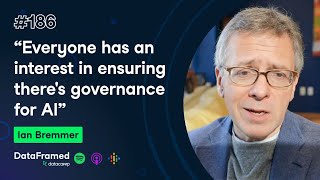
Ian Bremmer argues that AI's borderless nature and rapid proliferation demand global governance, not fragmented national rules. He cites an IMF report predicting 40% of jobs will be significantly affected, and proposes a UN observatory to coordinate responses, similar to the climate body.
Chapters
It seems like some kind of global governance is in order. Why do you think global governance has an advantage over country based rules? You said you don't think industry based rules are going to work very well because it needs to be governance to do the governing. But what makes a global guideline better than individual country based guidelines?
The Senate is just fragmented, it's dispersed as we see it already now. You know, it's first of all, it's only global north regions, countries that are kind of setting their norms, but they're also in terms of jurisdiction and applicability, it's only limited territorially, whilst the technology is not bound territorially, it's very transboundary. And again, all of this fragmentation of actors can happen obviously across countries, across continents. So it's very inefficient to have one country regulating something whilst they can just, you know, very well just move. Not even physically, just like the VPN and that's it, you know, and so that's the problem and why we need this international governance so that it's, you know, it can permeate everywhere so that everyone starts from the same kind of boundary rules. You know, what are the red lines? As long as we have that, you know, all the details could be specified. Obviously, you know, states have their own sovereignty and so on, but we do need to adapt to a global governance regime because otherwise it's just, it's just not going to be effective at all. It's going to be absolutely useless.
Yeah, I'll add to that. Look, I think that there are some areas that global governance are absolutely indispensable. I mean, for example, this technology is going to be massively proliferated in a short period of time. It's not like nuclear weapons where it's really expensive and really hard for any government actor to get a hold or handle on them. Never mind non government actors that have proven incapable so far. No, I mean this is, first of all, a lot of things are being published open source that are very high tech and, and you've got a lot of people that will use these technologies and tweak them in ways that are either tinkering or nefarious. And so when there are literally millions of potential actors that are engaged in behaviors to support malware, or develop new viruses or develop new weapons, I mean, that of course requires global governance to respond to. Otherwise you'll have rogue elements outside the reach of the law that will be deeply problematic for everyone. And the Americans, the Chinese, the Europeans, everyone has an interest in ensuring there's Governance for that thing. Also there are challenges that come from AI, like the disruption of labor forces that we will see all over the world. The IMF just wrote a report that said 40% of all jobs will be significantly disrupted by AI, 60% in advanced industrial economies. Well, we want to make sure that when that happens that, that the resources that are deployed to respond to it are done so efficiently. Well, the best way to ensure they're efficient are if you have a single global observatory, a single global institution that acts analytically to assess how those jobs in those sectors, in those geographies are actually being disrupted like the United nations does around climate change. A global challenge. Now that doesn't mean that all AI governance needs to be global. And I mean, for example the Brussels effect is really important. The EU was the first out of the gate with meaningful AI regulation, the EU AI act. And it's not going to be implemented until 2026. But just the fact that they're already floating it, given how important the EU is as the world's largest common market, means companies that dominate AI are already planning to orient their AI practices towards it. They don't want to wait until it's too late, until the last minute. They need to like got to get ready for it. And, and, and individual governments that are big, that drive significant AI governance themselves can have knock on implications for corporations and other, other governments around the world. So just because it isn't global or isn't global when it starts, doesn't mean we throw it out.
Okay, so if the EU says one thing and then the US has another set of rules and it's going to be kind of, it's going to be conflicting, it's going to be harder for corporations to comply with. So maybe having that global synchronization is going to help. So it does seem that there are a lot of guidelines and frameworks for doing AI responsibly already. I'm just wondering what's different about the UN's efforts here.
That it is global, that it is universal, that we have the legitimacy of the United nations and everything it stands for, the membership of 193 countries. And again, just the authority of the Secretary General, the moral authority in leadership in this matter, the fact that he created this body directly to advise him is quite an indication of the level of interest he has in on this, on this advancement of the global governance, because it is that important. As we, Ian and I just mentioned.
Again, there are a lot of regulations on climate too. But it's utterly critical that the world comes together and accepts that we've already put 442 parts per million of carbon in the atmosphere. It's essential that we understand methane, deforestation, plastics in the ocean. It's essential that we all agree that, that we've already warmed the atmosphere by 1.2 degrees centigrade and we're heading towards 2 or 2.5. You cannot get global responses to global challenges unless you have global agreements on what the problem is. So the first and foremost thing the United nations has to do is get people together to understand and agree on the nature of the challenge. Even if the regulations are very different. Understanding the nature of the challenge together allows the deployment of resources to be more efficient. There's never enough resources to take care of the poorest people. You really don't want them wasted, right? That it's real, and especially when something's moving this fast. I can't tell you how important it is that you have the United nations trying to get everyone together to agree on the nature of the challenges.