Eric Xing argues that AGI requires world models that simulate physical and social reality, not just predict text. He's building the Pan World Model, a multimodal simulator trained on text and images, and released K2Think V2, described as the most powerful fully open-source language model. The main challenge: getting models to plan consistently over long horizons.
Chapters
It is the first time that you see a frontier model which is able to be open sourced both in model weights but also the data, the training recipe, and so forth, so that people can really take it away and reproduce it.
Large language models have revolutionized many industries already, but there's a growing sense that in order to make the next leap in intelligence, AI needs to gain an understanding of the world. Consequently, World models are being hyped as the next big thing. I want to know what the use cases are and where you can benefit from using them.
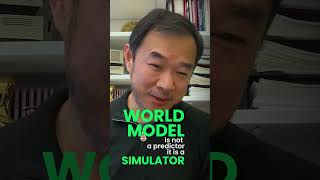
So world model is trained on more than textual data, but also image data and other sensory data. It's actually a simulator of the real world, of the physical and social world where agents can learn autonomously and perpetually. We are not building a predictor. World model is not a predictor. World model is a simulator.
Our guest is AI research royalty. Eric Xing is president at Mohammed bin Zayed University of Artificial Intelligence. He's also a professor at Carnegie Mellon University. Previously, Eric's had visiting professorships at Stanford University and Facebook. Eric's AI research focuses on three strands. Firstly, his team has created the Pan World Model. Secondly, he's been a prominent open-source contributor, having created K2Think V2, the world's most powerful completely open-source LLM. And thirdly, Eric's latest work involves creating digital organisms. Naturally, I want to learn about all three things.
Data right now is a commodity. You actually sell data. The real problem is the technical limitation of long horizon consistency and long horizon planning.