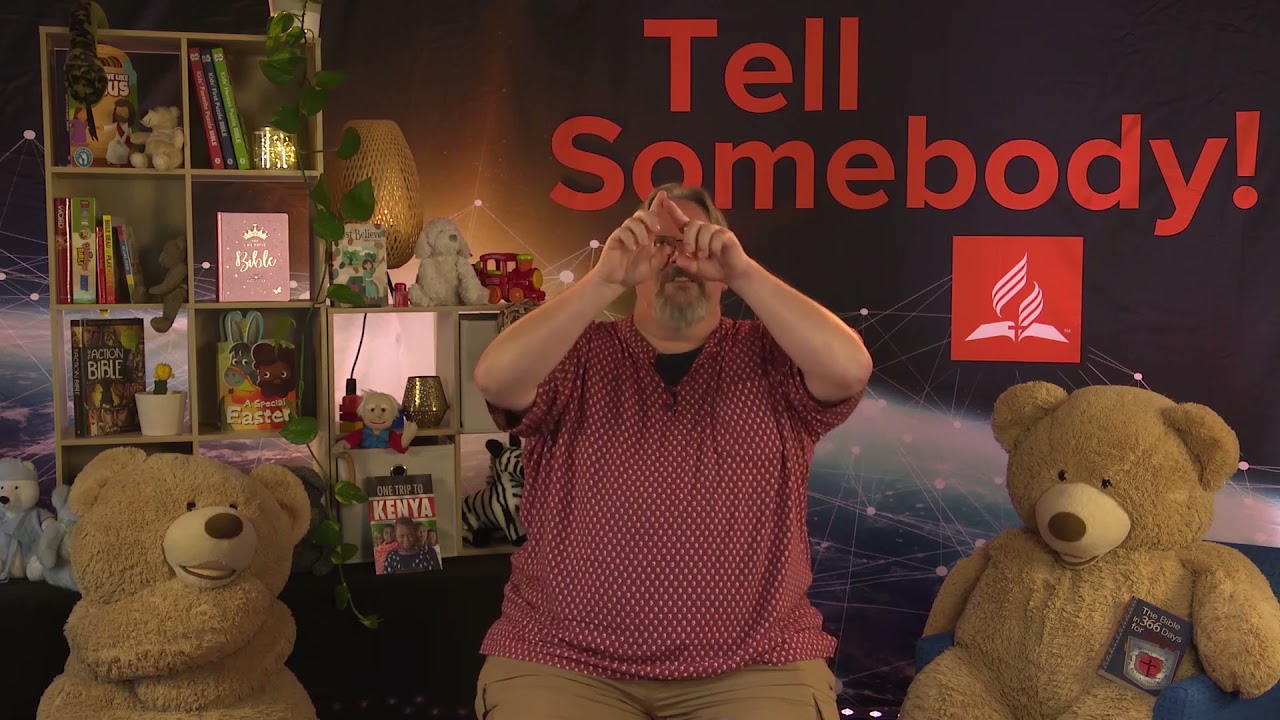
A missionary recalls a rock climber's friend who burned his hands saving the climber's life. The speaker uses this story to explain why Jesus kept His scars after the crucifixion: to show us His love was real, and that He chose to stay marked by what He did for us.
Chapters
Hey kids, welcome back to Family Worship Big Camp 2021, where we're talking about telling somebody. Today I want to encourage you to tell somebody that Jesus has their story written on his hands. Did you know that Jesus has your story written on his hands? He does. When I was in university, I took a year off and went as a student missionary to a tiny island, it was actually an atoll called Majuro. And Majuro was 32 kilometers long at the top of a dormant volcano, and the coral had grown up and there was this sliver that looked like a giant toenail in the middle of the ocean. It was only a quarter of a mile wide and 32 miles long to get from one end to the other. And the school that I worked at was in the busy end of the island. Believe it or not, there were 10,000 people that lived on that island. One of the things that was quite prevalent on that island was the weather. Because the island was flat and the ocean was right next to the island, the highest place on the island was a bridge that connected two bits of the atoll together, and it was 17 feet off the ground. So there was nothing very high on this island. And so when the wind blew, it blew right across the island. And when the storms came, they really showed up. And we lived in the school housing that was right next to the school where we taught every day. And I was teaching kids about maths and about geometry, I think, or geography. I can't remember now. I just remember the stories of what happened while I was on that island. And one night, as my roommate and I were trying to sleep, I was on the bottom bunk and he was on the top bunk, and the roof started to bang. The roof was made out of corrugated metal and it wasn't nailed down well enough. And so when the wind would come up, it would get under that roof and it would lift it, and then bang, it would drop and go bang, bang, bang. Bang! And it was so loud you just couldn't sleep. And so one night as we were laying there— I'm down on my bed and Brian's up there above me on his bed, my roommate— I said to him, "Brian?" And he said, "Yes." I said, "Can you sleep?" He said no. Then I said, "Brian, would you tell me a story?" And he started laughing and he goes, "Yeah okay, I'll tell you a story. Let's get up." And so we got up and we sat and we got some nice glasses of cold water because it's just hot there all the time. And we went out and we sat at and watched the wind blowing across the sea. And he told me this story about one of his friends. Brian was a rock climber. He loved— he was Canadian, and he loved going climbing in the Canadian Rockies. And he loved climbing anywhere and everywhere that he was. Even on the island, he found things to climb. Brian had a wingspan. He was really tall, and his arms were so wide that if I put my hands out and he put his hands out, I could only touch his wrists because his hands were so wide. And that's one of the best things for a rock climber, because then they can reach really good purchases and make good climbs. Brian told me that one time he was out climbing with the friend who taught him how to climb. And he said this friend, he was really good at climbing, and he said, "I've got a new route that I want to take you on, and I'll climb up it first, and then when I get to the top, I'll tie off and I will belay you up." So that as you get closer, he pulls in some rope, and basically if you fall, you don't fall very far. He said there's just one thing, about halfway up, there's a a bit of a crevice and you can't reach across. You might be able to with your large wingspan, but you're going to have to reach right out and probably, well, I have to actually jump. I have to jump across and grab on, but there's really good holds on the other side. You just have to jump to them. So you got to be brave, Brian. He said, "I can do it. I can do it." Brian, his friend climbs up and he watches him jump across and then he's clipping in his belay rope the whole way up so that if he falls and Ryan's belaying him from the bottom. But when his friend finally gets to the top, And Brian sees him do the jump and he's like, okay, I think I could do that. And his friend gets to the top and he ties off to a tree, himself to a tree, and then he's ready to belay Brian. And he says, okay buddy, everything's good, come on up. And Brian starts climbing up. And as he's climbing, his friend's pulling in the rope and making sure it's— the rope goes through basically like a figure 8 that's on a special tool on the chest of the person who's doing the climbing or on their hip. And the rope goes through it really slow and you have to kind of pull the rope through so that if the person falls and the rope yanks, it tightens like a knot and it lets them fall but only a little ways, and then they swing in and they hit against the wall and then they can start climbing again. And that's why climbers trust each other so much, is because if you're belaying someone up, you're taking good care of them and making sure that there's not too much rope for them if they do fall, because you've been pulling the rope in. So as Brian's climbing and he's doing the— and he's seeing his feet, fingers are getting sore, and he's climbing and he gets to that crevice and he thinks, "I probably can reach," and he can see the handhold on the other side. And so he reaches across. Oh, and it's just too far. He can't reach it. So he leans right out off his hand. Ah, just can't reach. And he thinks, "Okay, I've got to jump." And so he yells up at his friend, "Okay, I'm going to do the jump." And his friend says, "Okay, I'm ready." And so Brian gets his bravery up and he leaps and he grabs on, but his fingers are too slippery, and he tries and he can't— oh, but he can't hold on. Oh, he falls. And so as he's falling, he's waiting for the rope to kind of pull against him, and it hurts, you know, it's a bit of a sudden jolt. And when it comes to its end, it's not a sudden jolt, it's just like kind of goes tight but not super tight. And then Brian just keeps going down, keeps falling, but he's not falling at full speed. He's falling like half speed. And he's like, what's going on here? How come— it's my— what's going on? Am I going to die when I hit the ground? And he's falling, and it's about 30 meters to the ground. And he falls all the way down, and he lands on a pile of shale at the bottom and knocks the wind out of him. But he didn't fall full speed. And so when he hits the bottom, he catches his breath, and he sits up, and he realizes, I'm okay. But I wonder what happened. Some other people there saw what happened. They were seeing from a distance. They were watching it. And when they saw Brian start falling, somebody knew what was happening, and they called the ambulance. But they were a long ways out in the middle of nowhere, and so it was a helicopter when it came. And when the helicopter came and the paramedics got off, they didn't land down in the valley where Brian was. They landed up on the top where his friend was. And they took his friend to the hospital. Because what had actually happened is— and his friend wasn't sure what he'd done wrong, but he hadn't put the rope through the figure-eight knot holder tight enough, or the right way, or something. And when it started going, it just kept going. And he realized, "If I don't stop this rope, Brian's gonna die." And so his friend grabbed onto the rope with both hands, and he squeezed it. You ever held rope when it's moving fast? It hurts. It burns. But his friend held on, and he realized, "I'm not slowing it down enough." And so he leaned backwards and he did everything he could to push the backs of his hand, like to pull it away from the edge of the cliff so that it would slow the rope down. And he gripped it as hard as he could. And when Brian hit the bottom, his friend was the one who was hurt. His hands were stuck to the rope. It had burned away all the flesh on his hands, and it had burned away most of the muscle and some of the tendons out of the back of his fingers. His hands were destroyed. His hands were destroyed. And when the ambulance came, the ambulance helicopter, it landed and it took his friend, and it took him to hospital. Brian got back in their car and he drove to hospital, and he found out once he got there where his friend was. And he went in and he, he visited his friend every day because his friend had to go through lots of different surgeries to reconstruct his hands and to get them just so that he could open them most of the way. He never got back to where he could do go like that because there was so much scar tissue in his hands. And he was never able to fully be a rock climber again either because of what had happened to his hands. But his friend told Brian, mate, it's worth it, don't worry about it, because Brian was really upset that it had happened. And he said, well, what— look what I've done to your hands. And he said, no, you didn't do it, Brian, I did it. I did it on purpose because I didn't want you to get killed. And so it was worth it. It's just my hands. I can still do things with them. I just can't rock climb anymore and that kind of stuff. But don't worry about it. And Brian says, so man, Dave, if that guy called me right now and said, Brian, I need you back in Canada, I'd be on the next plane back to Canada. I would do anything for him. And I said, so he's your best friend? He said, well, he's my best friend forever. He said, but there is one thing that really, it kind of makes me ashamed to say it, but one thing that really is hard for me. I said, what's that? He said, well, when we're eating and he's talking, he's gesturing, I see his hands. And when I come and see him and I reach out to greet him and he puts his hand, I grab it and I feel his hands. And he said, and every time I'm with him, I'm reminded that he gave up his hands for me. And the story of what he did for me is right there in his hands. All the time. And it's hard, but it's also wonderful because I'm alive and he will always be my best friend. And then Brian actually said to me, and I heard him preach this in sermons a couple times to people on the island, Jesus has our story written in his hands. Do you know the Bible says that he kept the scars? He could have been healed and his body made whole after the resurrection or during, you know, in the resurrection, but instead he chose to keep the scars in his hands and in his side and in his his feet, so that when we see his hands, we're reminded of what he did for us. So that forever throughout eternity, when we come up to Jesus and we see his hands as he's talking, or we feel his hand when he shakes ours, we can say, Jesus, tell me again the story about what happened to your hands. And he'll tell us the story about how he saved us by grabbing the rope for us. By putting his hands on the cross, he stopped our death. We have a wonderful Savior who has scars to prove how much he loves us, and he will always have those scars. I want to invite you to tell somebody, tell somebody about the God who loves you so much that he would give up his life to save you. Let's bow our heads in prayer. Dear Lord, we thank you for your hands. We thank you for your willingness to allow your hands, the hands of God, to be nailed to the cross to save us from sin. Help us, Lord, as we go through our days to remember your hands, to remember that they're always open to us, and that you keep your scars not because you want to be reminded of the pain, but because you want us to be reminded of your love for eternity. In your name, amen.
More from Dave

Thor is four months old and already mastering AI! #thor #puppy #jackrussell #cat #mythology #war


Better to have gloved and lost... #puppy #jackrussellterrier #thor #doglife #dog #gloves #wrestling




