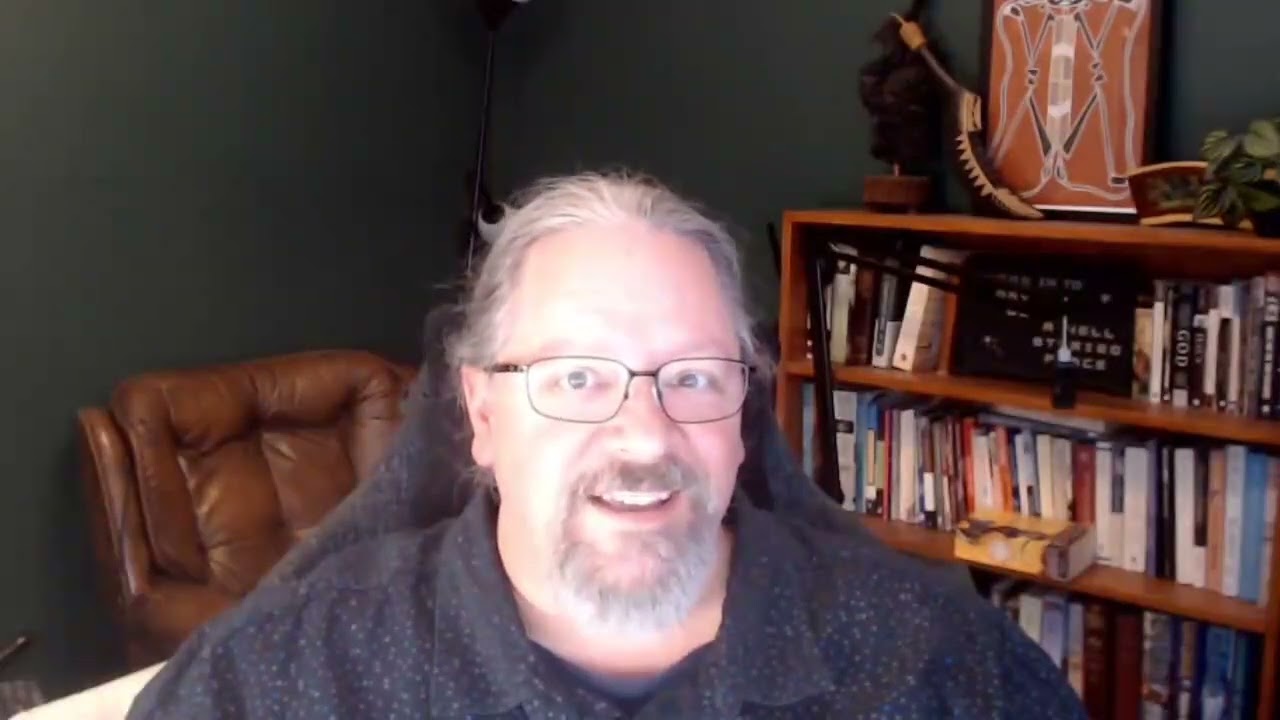
Dave Edgren examines Mark's account of Jesus calling his first disciples and proclaiming that the kingdom of God is near. The Greek word paradidomi, meaning "handed over," appears throughout Mark to connect John's arrest, Jesus' arrest, and his passion. Edgren argues the kingdom is both present reality and future promise, centered on Jesus' teachings and resurrection.
Chapters
I'm Dave Edgren, and this is the Jesus Journey. Uh, today we're going to explore the next bit of Mark. This is our second session doing this, and we're beginning at Mark chapter 1, verse 14. Um, you might remember last time we started with Jesus's cousin John and his mission to prepare the way for Jesus. Then we moved into the baptism of Jesus, and finally we followed Jesus into the desert where he was tempted by Satan. And that's where we left off last week. That was Mark 1:1-13. So today we start at verse 14. Our passage begins with John the Baptist's arrest and the proclamation of the gospel of Jesus, um, or the gospel by Jesus. If you actually want to hear the gospel in a nutshell, the way Jesus said it, it's right there at the beginning of Mark. We're going to look at that today. It's significant to note that Mark, unlike Matthew and Luke, does not provide any detailed narrative about Jesus' birth or his early life. Instead, Mark just plunges straight in. He takes his readers right into the public ministry of Jesus. The direct and even abrupt style of Mark has led many scholars to believe that Mark's Gospel was the earliest among the three first Gospels. They're called the Synoptic Gospels: Matthew, Mark, and Luke. John's very different, and so John stands on its own. It's still a Gospel because it's a retelling of the life of Jesus, but it's done very differently. And I'm sure many of you have studied that and seen the divine nature of John. Written around AD 70, they reckon, the Book of Mark, and The Romans had just destroyed Jerusalem and its temple, and then evidently all of the gospel writers started feeling like, "Ooh, this is a story we need to put to paper because people are spreading." And that is what caused Christianity to spread, was that unfortunate occurrence in Jerusalem where the Roman Empire just destroyed the place. But by destroying it, they drove out the early Christians and they took that story with them. And spread it around the world. So Mark 1:14-15, it sets up Jesus's earthly ministry trajectory and his mission statement. It's so fascinating with Mark, he packs so many things in, into little— the way he says things, he doesn't just say something, he means something more. And he kind of sets up a paradigm in the beginning of Mark. He's setting up paradigm for how the book of Mark is going to flow. And he does this with, um, just this, this simple, uh, John is arrested, Jesus gives his message, the message goes like this. And then he follows that model and shows that Jesus also is going to be arrested, and Jesus's message is going to go out. And it's, it's kind of like a foreshadowing of what's going to happen. So Jesus followed John the Baptist, he went to Galilee, he preached the kingdom. He called disciples. We follow Jesus, we go to others, we tell them the kingdom story, and they call others, and it repeats, and it continues this model that Jesus, um, that Jesus followed after the handing over of John. So after the handing over of Jesus, um, and, uh, and the death of Jesus and the death of John— John dies, then Jesus died. It's a, it's a fascinating kind of, um paradigm. Um, so have a look with me in Mark chapter 1, verses 14 and 15. Starting with verse 14: After John was put in prison, Jesus went into Galilee proclaiming the good news of God. The time has come, he said. The kingdom of God has come near. Repent and believe the good news. So he literally— it literally says proclaiming the good news of God. Jesus came Lord Jesus went into Galilee proclaiming the good news of God. And then here it is, here's what his message was: the time has come. So that's like a precursor to the message. The kingdom of God has come near. There it is. And then on the other end, repent and believe this good news. That's the whole thing as far as Jesus is concerned, the way that he presents it. The kingdom of God has come near. It's interesting, that phrase, um, John was, uh, put in prison. The, the Greek word behind that is paradidomi, and paradidomi literally means handed over. And it's fascinating because when you see it in the Greek and then you look for that word again, paradidomi, it comes up again in Mark. And the next time it comes up is he was handed over by Well, it says literally, the one who handed him over— Judas. Judas betrayed him is the way it's translated. Those— that phrase or word paradidomi gets translated in so many ways, but it literally means handed him over. And when it appears, it appears multiple times after that in the book of Mark. But the first time is here, um, when John was arrested. The next time is when Jesus was arrested. And then it comes again In 9:31, 10:33, 14:10-44, so kind of the rest of 14, it happens 1, 2, 3, 4, 5, 6 times, um, paradidomi. And then 15 verses 1 and 2. So it's like John arrested, and then it goes all the way down to chapter 9, and then there's the word again, another one arrested, or handed over, and it's Jesus this time. So from John to Jesus, and then, um, It talks about all the different, um, the ways that what happened when he was handed over, and it becomes, uh, the kind of the key word for what happens to Jesus at the end of his life. If the reader already knows the story of Mark, or if you're reading Mark again, the connection between the two becomes clearer. John the Baptist is more than a town crier who precedes Jesus. He is Jesus's forerunner. In his ministry to Israel, in his fateful conflict with earthly authorities, and in his brutal death. All of those things happen to John as well. He has a ministry to Israel, he's, um, in fateful conflict with earthly authorities, and he has a brutal death. Happens to Jesus as well. Uh, Jesus's gospel mission statement, right there in the heart of that, was the kingdom of God has come near. Jesus spent 40 days in the desert and came out with one sentence, with a mission statement. It's his gospel anthem: the kingdom of God has come near. When? Now. He says the time is now. The kingdom of God has come near, so repent, believe. The kingdom of God has come near. Now repent, believe.
Believe.
He spent the rest of his ministry saying, the kingdom of God is like. So he kind of— he said, here I am, I've brought the kingdom with me. The kingdom of God is so near that if you listen to me as, as yet you watch me as I live my life, and then you listen to the words that come out of my mouth, not only will I show you what the kingdom is like, but I will tell you in as many stories as I can. If you're a farmer, I'll tell farming stories. If you're a doctor, I'll tell doctor stories. If you're, you know, a lawyer, if you're a Pharisee, if you're Whoever you are, I will tell stories that help you to see what the kingdom of God looks like through your lenses, through your eyes. Repent. The word where it says repent and believe, the word for repent literally means changing direction. We often think of repentance saying, I'm so sorry, I'm so sorry, I'm so sorry, but it's actually an action word. It's not just that feeling of giving yourself up to I've done the wrong thing. It's saying, I'm changing my direction. I'm turning back. I'm— I've changed my mind. And it means all of those things. It's a, it's a package deal. Repentance equals, uh, change. But it's, it's often not doing something new. It's going back to doing what you know you were supposed to do. So repent is very much a word for you and a word for me. Um, it's to remind us that God is always, always willing. The kingdom of God is always near, and we can always repent. We can always turn around and go back. We can change our direction and, and walk along with God the direction he's going again. And then believe is also similar in that it's not just about a thought that I, I think this. It's in a nutshell, it's basically you commit and then you comment. If you believe something, you commit to it. You say, this is now what I believe. It's what I take on board. It's what I think is reality. And I, I choose to make this my driving force. But then you talk about it, you comment on it. And Revelation talks about this where it says, um, these are they who have the blood of Jesus, or the, the who have the blood of the Lamb and the testimony. Because it's basically, you, you can't have the blood of Jesus over your life and not talk about it. The testimony is, it's the comment. The, the commitment comes from believing what Jesus did for you. The comment comes from living after the belief, um, because it's, it's real for you. So the kingdom of God is the primary theme in the biblical book of Mark, uh, revealed in Jesus's teachings. It symbolizes God's plan on earth, serving as a pivotal element in his divine blueprint. This kingdom plan is fundamentally rooted in the establishment of a community specifically the church, comprised and devoted followers— sorry, yeah, comprised and devoted, uh, of devoted followers of Jesus. So the church is not just a nice idea that happened after Jesus went because they wanted to get together and talk about him. It was literally his plan. He was bringing people together. The kingdom of God, it's a kingdom. It's not just, um, a belief system. It's a group of people who all have the same king, and so they live a different way. They have a different citizenship. And we talked about that in a previous one, that where— what our citizenship means. So when we become part of the kingdom of God, we, we want to be, as much as the opportunity avails itself, with other people who have the same repent and believe pattern to their life, with that core message of the kingdom of God has come near, is coming near, is— it's, it's with us, it's, it's before us, it's behind us. The kingdom of God is near. So, this community serves as the embodiment of God's kingdom on earth, reflecting his divine intentions and purposes. The Gospel of Mark presents the kingdom of God as both a present reality and a future promise, characterized by righteousness, peace, and joy. It is often explained through parables and associated with teachings, miracles, death and resurrection of Jesus Christ. The recipients of the Kingdom of God are expected to live according to Jesus' teachings. The intended readers of the book of Mark, likely early Christians and Gentile converts, would have viewed the Kingdom of God as a central theme in their faith, seeing it as a call to live out its values and to participate in the spreading of Jesus' message: "The Kingdom of God is near." When did it arrive? At what point in the ministry of Jesus was the Kingdom fully realized? Theologian John Stott wrote this: In the New Testament as a whole, the conception of the Kingdom is not a static one. There was no one moment in the triumphant progress of our saving Lord from his cradle in Bethlehem to his final glory at the Father's right hand at which it may be said the Kingdom of God is right there, or the kingdom will come then. The kingdom was coming all the time, and in fact it is still growing. You may have heard the adage that Christianity is caught rather than taught. The kingdom of God is both caught and taught. The entire book of Mark is an example of it being both caught and taught. It's a record of those caught up in Jesus and the kingdom that he commissioned, but it is also a story that must be shared. In fact, it cannot be truly taken in without being passed on. That is the way of compelling stories. The 4 keywords of Jesus' good news—time, kingdom, repent, believe—are all examples of teaching. But they are also the beginning of the kingdom's story. We are caught up in. The kingdom is yours, the kingdom is mine, and the kingdom is still growing. Let's look back at the passage. We'll go on to the next 4 verses. It's interesting, um, the NIV, the subtitles that they put in, has here Jesus calls his first disciples, and, uh, others just say, um the first disciples. But here we go, verse 16. As Jesus walked beside the Sea of Galilee, he saw Simon and his brother Andrew casting a net into the lake, for they were fishermen. Come, follow me, Jesus said, and I will send you out to fish for people. At once they left their nets and followed him. When Jesus had gone a little farther, he saw James son of Zebedee and his brother John in a boat preparing their nets. Without delay he called them, and they left their father Zebedee in a boat with hired men and followed him. It's interesting that there's the same word twice here, and in most versions of the Bible it just translates it immediately. Immediately. Mark is the immediate gospel. He uses the word immediately like, I think it's 17 times or something, might be more than that, but he uses it a lot. In fact, there's twice just here in this one little passage because It literally says, uh, at once— instead of at once they left their nets, immediately they left their nets. And down at the bottom, when it says that, uh, that James and John came, it says, um, without delay. It says in the New International, but it's immediately again. Immediately he called them. So this time it's Jesus doing it immediately. He sees them and he's like, yep, fishermen, I know what to do with them. Calls them and they follow him. Mark 1:16-20 narrates the calling of the first disciples. They leave their nets immediately to follow Jesus, signifying the urgency of the Kingdom of God. This urgency is a recurring theme in Mark's Gospel, reflected in his frequent use of the word "immediately." So I have a question for you. What is your passion? Is it art? Is it building things? Is it crafting? Is it music? Driving? Reading: Travel? When Jesus saw Simon and Andrew casting a net into the sea, he knew what to say: "Follow me, and I will make you fish for people." Would that work on you? Me neither. Why not? Because I'm not a fisherman. So what would Jesus say to you? I love to think like that. I love to think, "So if Jesus walked upon me right now and saw me doing the things I love to do most, What words would he use to say, "Follow me," and make it compelling so that I immediately picked up everything and just left, or left everything, picked myself up and just left? My son Mike is a musician. He loves learning new instruments. He plays a bunch of them and he sings as well. We asked him— his birthday's next week— and we asked him what he wants for his birthday. And he's at Avondale. He's 23. And he said, "Oh, I Any woodwind instrument that I don't have would be great. So I start looking around and doing some research because woodwind instruments could be pretty expensive. And I found this little thing called a venola. And if you don't know what a venola is, Google it and have a look. It looks like a great teaching instrument and learning instrument, which is what Mikey's training to be is to be a high school music teacher and math teacher. But this would be a great instrument to teach his students. So anyway, we ordered one to be delivered to him at Avondale. And if Jesus walked up to Mike and he saw him learning the vinola, Jesus would say, "Follow me and I'll make you play the hearts of people." And Mike would follow. Personally, I love change. I know I'm weird. I really do. Anything new, I try it. Any adventure, I love going, I love doing, I love trying new things. And I like new things, new places, new jobs, new people. I think if Jesus walked up on me and, and as I tried something new in some new place, he would say, "Follow me and I will change you, and together we will change the world." Wherever you are, whatever your passion is, Jesus starts there and then he brings his kingdom alive in you. That's how close the kingdom is. It really is near. Jesus says the kingdom of God is near, and he means it. God's love is not far from any of us. So I'm going to stop here today. You may remember last time I said I was going to go all the way to the— through the next chapter, chapter 2, and into a little bit of chapter 3, because that's what I decided to do in the study plan back when I broke the Mark down and put it— put this series together. But guess what? I changed! I changed my mind! And so I changed the study. And now you get what has been given to change-loving me. Welcome to the Kingdom. What will you do this week to bring the Kingdom near to someone you know? What have you been given? Start there. Start with that. Where will you meet them? What will you say to them? A little advice from Jesus: Start where they are. Invite them to fish for people, if that's what they're into. Most likely it will be coffee and a chat, and two hearts willing to take time to draw near to the Kingdom, to turn toward Jesus and believe in His love. A little bit more day after day, and watch as God's kingdom grows in you and around you, just like it did for Jesus. Let's have a prayer together. Lord, we thank you for your scripture. We thank you that the men who loved you and lived with you wrote down what they remembered of you and took us on the journey through the story. We ask that you would bless us this next month as we put into practice these few verses from the book of Mark, and as we, um, are called to follow you as disciples, may we also be disciple-makers who call others to come and see the one that we have found, to follow us as we follow him. In your name, amen.
Let's bow our heads and have a prayer together. Dear Lord, I thank you for loving us. I thank you for just being with us and sending your Son to be with us and show us through the way you loved him how much he loves us. And then in our lives, how much we should love one another. Help us to put that into practice, Lord. Love the Lord your God with all your heart, your mind, your soul, and love your neighbor as yourself. Help us to love so much that people say, what's going on here? And then they realize that It's you that's going and growing through the world as your kingdom changes heart by heart, person by person. In your name, amen. Blessings. See you next time.
More from Dave

Thor is four months old and already mastering AI! #thor #puppy #jackrussell #cat #mythology #war


Better to have gloved and lost... #puppy #jackrussellterrier #thor #doglife #dog #gloves #wrestling




