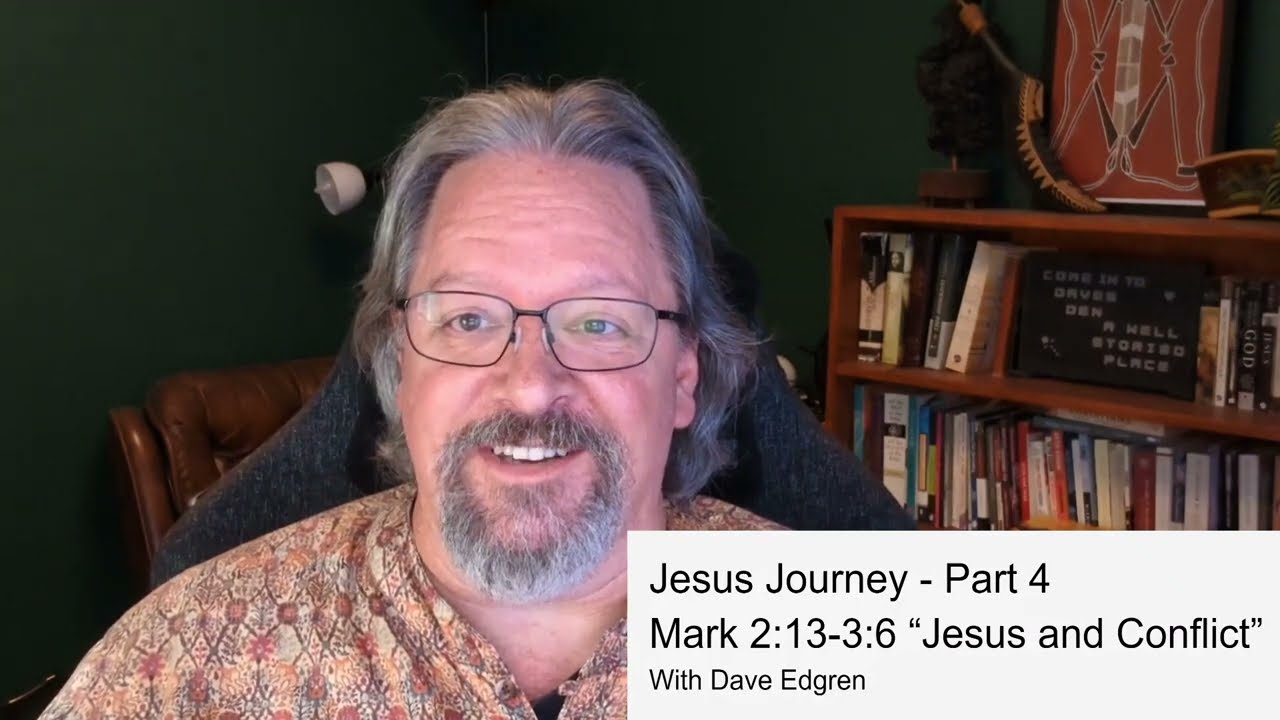
Dave Edgren walks through Mark 2:13-3:6, where Jesus clashes with Pharisees over who deserves his company, how to fast, and what the Sabbath is for. Jesus says he came for sinners, not the self-righteous. His teaching can't fit into old religious frameworks.
Chapters
Today in the Jesus Journey, we're looking at part 4, which is Mark 2:13 to Mark 3:6. So we're gonna bite off a chunk today, but it's a chunk that all fits together because it's really about conflict stories. How does Jesus deal with conflict? And we see that in a few stories and a few parables and a few illustrations that Jesus actually performs. And, uh, we're going to dig into it now. So let's start, and we'll read a passage and we'll talk about it, and then we'll read the next passage and talk about it. Um, the first part, if you have your Bibles and you want to turn to Mark chapter 2, uh, verses 3 to 17. So starting Mark 2, uh, verses 13 to 17, this one, uh, this section I've titled Tax Collectors and Sinners Versus Scribes and Pharisees. Jesus went out again beside the sea. The whole crowd was coming to him, and he was teaching them. Then passing by, he saw Levi the son of Alphaeus sitting at the tax office, and he said to him, "Follow me." And he got up and he followed him. While he was reclining at the table in Levi's house, many tax collectors and sinners were eating with Jesus and his disciples. For there were many who were following him. When the scribes who were Pharisees saw that he was eating with sinners and tax collectors, they asked his disciples, "Why? Why does he eat with tax collectors and sinners?" When Jesus heard this, he told them, "It is not those who are well who need a doctor, but those who are sick. I didn't come to call the righteous, but sinners." So in this passage, we have two groups that are kind of conflicting with each other, and Jesus is in the middle. Well, he really is siding with one of them, but Jesus is in the middle in the sense that he is arbitrating between the two of them, like, which one— why are you with them and not us? The unholy group is the tax collectors and sinners, and they're unholy because they don't maintain all the holiness laws. That the Pharisees maintain. But the other group is an interesting one because it doesn't just say Pharisees. Some versions of the Bible say scribes and Pharisees, but the literal translation is scribes who were Pharisees. So we know who tax collectors are, we know who sinners are, but it's been a long time since we've had people call themselves scribes and Pharisees in our world. So who are they? Who are these people? Pharisees were conservative laity—not rabbis, not clergy, just everyday people, synagogue members like you and I, but better. Pharisees were people with jobs like you and me, but they studied the Bible as much as they possibly could, and they obeyed the biblical laws as closely as they possibly could. They were legalists and perfectionists. So we do have them around us. You probably know a few. They don't just call— they just don't call themselves Pharisees anymore. Scribes were interpreters of the scriptures. They read the Law and the Prophets, and then they reinterpreted for the time and the culture in which they lived. Jeremiah is the first place in the Bible where scribes and Pharisees— or where scribes are mentioned, and Jeremiah didn't like them very much at all. He wrote this about them in Jeremiah 8:8: "How can you claim, 'We are wise, the law of the Lord is with us'? In fact, the lying pen of the scribes has produced falsehood." What the scribes were doing in Jeremiah's time is they were writing down the oral tradition. And when you write it down, what does it do? It locks it in time and place. And there would have been just even maybe 20 kilometers from where you lived, there might be a different telling of when Moses came down from the mountain, just a little bit different. But the way that Uncle So-and-so always said it, the way that Rabbi So-and-so always said it, that would be passed down. And now the scribes are going around and they were capturing these stories and they were putting them into print. And Jeremiah and other Pharisees— I mean, other prophets and other people, other religious people— read them and went That's not the way I've told it. That's not the way I've heard it told. And so sometimes they would just say, "Oh, that's just a matter of how you're telling it." But other times, like Jeremiah here says, "In fact, the lying pen of the scribes," because the scribes would take those stories and make them mean things different than what they had been taught that they meant in the past. So sometimes the scribes came up with retellings that didn't ring true. Sometimes their interpretations didn't satisfy the Pharisees. In their defense, they didn't need to believe it or to put it into practice. Scribes just liked playing with new ideas based on old texts. They didn't apply all that they wrote. They were more interested in the process of reading the text and coming up with something new. You probably know some scribes too. Mark says literally, "The scribes who were Pharisees." this is a select group— that they saw that he was eating with sinners and tax collectors. So these are the best of the best. These are scribes who were Pharisees, Pharisees who were scribes. These legalistic scribes wanted answers so they could write Jesus's reasoning down, and then hidden behind their pens in private, they could argue. Do you know anyone like that? Why are you eating that? Ooh, look who you're eating with. I can't wait to get back to Facebook and tell everyone. Question: the holy group that they're asking, the question they're asking is why eat with them, not us. Holy goes with holy. You're defiling yourself by your chosen crowd. Who you socialize with declares who you are. You may have said this as parents. Jesus has an interesting comeback to it. Jesus' answer is, "A doctor socializes with the sick and feeds the hungry." A Pharisee's food needed to be washed in a certain way. So did their hands. The food needed to be clean meat, as approved by their scriptures. It was— if it was self-grown food, the Pharisees needed to tithe it properly. Untithed food was ungodly because 10% hadn't been offered to God at the temple as an act of worship. And if it was purchased food, a Pharisee's food needed to come from proper sources, not places of idolatry. Eating with non-Pharisees was risky. You could be sinning without even knowing it. Every bite could be an act of worship to a foreign deity, and thus blasphemy to Yahweh, the one true God. Therefore, it is a sin just to eat with outsiders. Jesus shows that living for others is a better way than living for yourself. Identity comes from internal places, not external appearances. Elsewhere Jesus said, What goes in the mouth does not make a man unclean, but what comes out of his mouth. It's like saying, I can't eat with you because you're a sinner. That makes you unclean to say that. Jesus called the oppressed to come out from under the thumb of their oppressors. In fact, he demonstrated this with Matthew, who's Levi in this passage. Calls him Matthew. Mark calls him Matthew Levi. Jesus gives him the name Matthew in just a few verses, but Matthew was working for Rome, which, that's the oppressor of the Jewish people. So he's working for Rome as a tax collector. He's collecting fees of oppression from the hands of his own people. So poor Matthew, he was despised by both Jews and Romans. Jesus came to seek and save the lost. He loved all because God is love. Jesus became one with us, joining the oppressed in recreation, in eating and in conversation. He also healed them freely. Matthew was not a lonely, friendless reject, as some would have you imagine. Look around the room. Look at the many faces at the table. Yes, Jesus and his disciples are there. They're new. But also seated at the table are many tax collectors, Matthew's friends and workmates. He's a fun guy. People like him. He's got friends. His workmates come to his house when they're not at work. They came to eat with Matthew and to meet his new friends. Jesus said, "I didn't come to call the righteous, but sinners." Jesus calls his followers sinners. Evidently this is no barrier for Jesus, or else he would have called them "people called away from sin" or "needy people." Instead, he just calls them sinners. Jesus is comfortable just calling us sinners. He calls us as we are. Follow me, he says, as you are. Jesus didn't come for seekers. Jesus came for tweakers. Jesus came to save those lost in sin, not those lost in religion. For the religious to access what Jesus brought No matter how righteous they believe they are, they first must realize they are lost. Lost without Jesus. Just like the rest of us. Jesus said the healthy will never call for a doctor. Even if they're dead and rotting on the inside, only the sick know their need for a doctor. And so Jesus stands at the knocks. The Savior is waiting to enter your heart. Why don't you let him come in? The Expositor's Bible Commentary says about this passage: It would be true to say that this word of Jesus strikes the keynote of the gospel. The new thing in Christianity is not the doctrine that God saves sinners, but No Jew would have denied that. It is the assertion that God loves and saves them as sinners. This doesn't imply that righteous do not need Jesus. Rather, like the sick call for a doctor, only those who recognize that they are sinners can receive a Savior. The scribes and the Pharisees—and the scribes who were Pharisees—need a Savior too. Just as pride goeth before a fall, so self-inflated righteousness is distinctly difficult place from which to admit your own sinfulness. Humble yourself before the Lord and he will lift you up. That is why Jesus came. Let's turn back to our passage, Mark chapter 2 now, verses 18 to 22. 18-22 of Mark chapter 2. Now John's disciples and the Pharisees were fasting. People came and asked him, 'Why do John's disciples and the Pharisees' disciples fast, but your disciples do not fast?' Jesus said to them, 'The wedding guests cannot fast while the groom is with them, can they? As long as they have the groom with them, they cannot fast.' But the time will come when the groom will be taken away from them, and then they will fast on that day. No one sews a patch of unshrunk cloth on an old garment, otherwise the new patch pulls away from the old cloth and a worse tear is made. And no one puts new wine in old wineskins, otherwise the wine will burst the skins and the wine is lost as well as the skins. No, new wine is put into fresh wineskins. So this is Jesus's first parables in the book of Mark: new wine and patching old cloth or old clothes. And here we get another conflict story, scribes versus the Savior. The scribes, they're there with their pen and their paper, and they're looking at the Old Testament, and they're— and they're looking at Jesus, and And they're saying, how do we rewrite this? Or do we rewrite this? What's he on about? Scribes took the Old Testament and changed it to save it, to make it applicable for today. Jesus took sinners and saved them just the way they were. Verse 18, it says, people came and asked him. To the common people, Jesus looked just like any other religious leader. He taught like a rabbi, but he was different. Who was he? Was he a prophet like John the Baptizer? Was he a good Jew like the Pharisees? Who was Jesus? People like you and me want to know. If he was like John or like the religious leaders, why didn't his disciples fast like the Jews? Torah says that you should fast. That's the Old Testament. Says, um, that you should fast on one day a year, the Day of Atonement. That's in Leviticus 23:27. But the Pharisees fasted twice a week, just to make sure that they didn't miss any opportunities or any need. So they fasted every Monday and every Thursday. John the Baptist's disciples, disciples, evidently they were fasting too, because it's in this passage. And it's most likely because John's in prison. And so another reason that people fasted, often you can't eat when you're suffering, when you're mourning the loss of a loved one. And there they sometimes back then would fast on purpose when they were mourning. And so it's probably that they're mourning John's incarceration. Jesus' disciples, not fasting at all. I don't know about the Day of Atonement, but certainly not on Tuesday, on Mondays and Thursdays, and not with John's disciples. They were eating whenever and wherever with whomever they wished. Why? The people asked, why don't your disciples fast? In his answer, Jesus foreshadows the cross for the first time in the book of Mark. He's headed somewhere. The time will come, he says. Jesus said the disciples ate freely because their bridegroom was with them. They will fast when they are suffering, when the groom will be taken away from them, he says. Then they will fast. Can you feel the tightening of Jesus' heartstrings? I can. Jesus can see the day, but it isn't today. Not yet. Then Jesus gives a couple of parables about himself and his teaching. Jesus and his teaching were not a patch to be applied to the Jewish tradition, like the scribes would do with their pens. Jesus' way would tear away from tradition. Jesus and his teaching could not be stored in the wineskins of legalism, like the Pharisees believed the Messiah would. Jesus' way would burst the seams of self-righteousness. Neither legalism nor reinterpretation is fitting for the work Jesus came to do. In this short montage and the next section, Mark lists the the things that could not contain Jesus: fasting, eating with sinners, eating untithed, unwashed, and unclean food with unclean hands. Jesus pulls the rug from under much of their law-keeping and Torah abuse. So far in Mark: demons, healing, diet, fasting, tithing, purity, Sabbath. Jesus shouts, "New wine is put in new wineskins!" Why didn't his disciples fast? Jesus answers, "I didn't come to patch up the Torah like the scribes and Pharisees, or to patch your spiritual garments like John's baptism. Fasting? Ridiculous! I didn't come to introduce a new diet fad. I came to get this party started!" Let's keep looking at our passage now, on to chapter 2 of Mark, verses 23 down to 36. This section in the Bible is titled Lord of the Sabbath, but I've given it another title and you'll see why in a second. I've called it Religion Versus Theology. The key point is there, tucked in the middle. We'll read it. On the Sabbath he was going— this is verse 23 of chapter 2 of Mark. On the Sabbath he was going through the grain fields, and his disciples began to make their way, picking some heads of grain. The Pharisees said to him, 'Look, why are they doing what is not lawful on the Sabbath?' He said to them, 'Have you never read what David and those who were with him did when they were in need and hungry? How he entered the house of God in the time of Abiathar the high priest and ate the bread of the Presence, which is not lawful for anyone to eat except the priests, and also gave some to his companions?' Then he told them, 'The Sabbath was made for man and not man for the Sabbath. So then, The Son of Man is Lord even of the Sabbath.' Jesus entered the synagogue again, and a man was there who had a shriveled hand. In order to accuse him, they were watching him closely to see whether he would heal him on the Sabbath. He told the man with the shriveled hand, 'Stand before us.' Then he said to them, 'Is it lawful to do good on the Sabbath or to do evil, to save life Or to kill? But they were silent. After looking around at them with anger, he was grieved at the hardness of their hearts and told the man, stretch out your hand. So he stretched it out and his hand was restored. Immediately the Pharisees went out and started plotting with the Herodians against him, how they might kill him. So the key point in this passage is there in the middle of Mark chapter 2, verse 28. So the Son of Man is Lord even of the Sabbath. Sabbath was made for man, it says, not the other way around. Man wasn't made for the Sabbath. In the Talmud, Rabbi Yochanan ben Yosef said, for it, Shabbat, is holy unto you. That is, it is committed into your hands, not you into its hands. A similar passage appears in the Mechilta Shabbatai, verse 1, which is also more scribes— I mean, more rabbi writings from the 2nd century AD, where the saying of Jesus is attributed— this saying, sorry, where he's looking at this passage, he's actually looking at the New Testament, he's talking about why would Jesus say this, and it's attributed to this man named Rabbi Shimon ben Menasiah. And he says this: It may be, therefore, that Yeshua's comment in verse 28 that the Son of Man is Lord of the Shabbat does not refer only to himself but to everyone, since Hebrew ben adam, which is literally son of man, can simply mean man or person with no messianic overtone. People control Shabbat. And not the other way around. Jesus in this passage builds a bunch of stuff around the Sabbath, and he's just really unbuilding. He's throwing away all the extra stuff that they've thrown onto the Sabbath in their culture. Jesus suggests King David did it, his men did it, I do it, my men do it, you do it too. Admit it, the Sabbath is yours to define. I heal on Sabbath because I can. What you do on the Sabbath, you, you can. What do you do on the Sabbath that's good for others? Because you can. Because this is how you glorify God on the Sabbath. Jesus clearly puts Sabbath in the religion department, not in the theology department. What I mean by that is, uh, it's tied up in a story by R.C. Sproul, um, Sproul, who he tells the story of once when he went to a Christian university and As he was being given a tour, he'd been asked to come and talk about what is a Christian university, because they were looking at getting a new president. And so, as he was walking the halls of this place, he saw the theology department, but it said religion department above it. And he stopped and he asked the guy there, "Religion department? I thought this said theology." "Oh yeah, yeah, we changed that a couple years ago." And he said, "Why?" And the guy said, "Hmm, I think just to be more in general, like so other kids could come, other students could come from other universities who have credits in various religious topics." they could be applied to their religion degree. And students that study here that were studying theology, it was hard for them going to other universities to be able to apply those credits, where for religion credits it's easier to move from one university to another. And also it kind of makes us ecumenical, makes us fit in with what's around us. And he, when he got up to speak to all of the people in the university, he asked them why, why was it changed? And one guy said, I guess just so that we fit in, so that we can— and he said much the same thing. And R.C. Sproul's answer was that we're not supposed to be teaching religion if we're teaching about Jesus, because Jesus didn't come to teach religion. Jesus came to show us God. Jesus came to teach theology, and Christianity is meant to be a study of God, not a study of a religion, of how we live our lives within a particular frame or reference of worship. In this passage, Jesus clearly shows that Sabbath is a Son of Man topic. It's religion. How you keep the Sabbath defines you, doesn't define God. God does what God does, Sabbath or not. What you do on Sabbath is between you and God. This answer got Jesus killed. Jesus' interpretation and illustration of what he meant by "the Son of Man is Lord of the Sabbath" made the Pharisees so angry that they began plotting to kill Jesus. When you tell legalists your religion is bad theology, they don't like it, and they may try to kill you. Starting with your reputation. So reflecting on our study today, how does Jesus deal with conflict? Jesus shows them God by siding with the sinners, eating with everyone, healing the sick and suffering, and telling stories at every step of the journey. Go and do likewise. It might get you killed, but you will never be bored. Let's pray. Dear Lord, we thank you for Scripture, and we thank you for this, uh, chunk that we've read today, looking at conflict and the way you dealt with it. Help us to be bold in our faith, bold in our theology. Um, may our religion be something that we, um, personally adhere to, but not that we declare that other people have to follow the way we do. You picked holes and leveled out much of the religion around you. But when you showed God, you stood up for his character, ah, with boldness and said, "God is love." And you showed it every moment that you could. Finally and ultimately on that cross that you foreshadowed in this passage. Help us to see you on the cross and to remember that your love, through your death and resurrection, gives us the opportunity and in fact the call to love those around us. In your name, amen.
More from Dave

Thor is four months old and already mastering AI! #thor #puppy #jackrussell #cat #mythology #war


Better to have gloved and lost... #puppy #jackrussellterrier #thor #doglife #dog #gloves #wrestling




