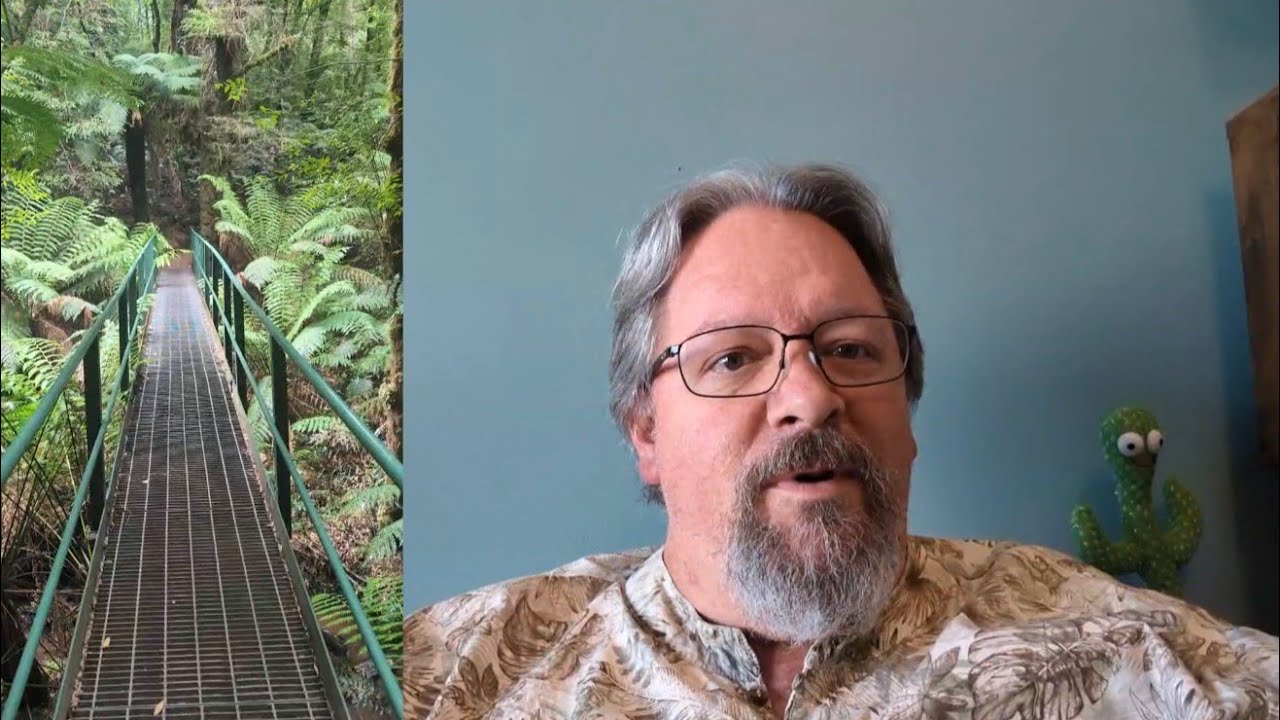
Dave Edgren walks through Mark 4:1-20, explaining why Jesus taught in parables and what each soil type means spiritually. He uses Mark's "sandwich" technique, Augustine's commentary, and agricultural background to show how listeners can examine their own hearts and become good ground for God's word.
Chapters
Welcome back to The Jesus Journey. This is episode 6. We're looking at Mark chapter 4, verses 1 to 20. And while we're exploring this passage together, we are going to go on a walk together as well. I'm going to take you with me and my wife to Atatree, where we went last Saturday. And walked in and saw this beautiful tree that's in the Yarra Valley hills above Warburton. So if you'd like to look over here while I'm talking, you can enjoy the lovely video. And I love that it's named "At a Tree" because that just sounds like something an Australian would say to a tree when they saw it was big. "Ah, at a tree!" What a tree it is. And so anyway, Enjoy this walk and this walk through scripture. So if you have your Bibles, we're going to look at Mark chapter 4, verses 1 to 20, and it will also be on the screen where the tree walk is. And then we'll get back to the tree after each passage of scripture. So first we'll read through the whole section, then we'll go back and pull it to, uh, to bits and kind of understand it a bit together. Again, he began to teach by the sea. And a very large crowd gathered around him. So he got into a boat on the sea and sat down, while the whole crowd was by the sea on the shore. He taught them many things in parables, and in his teaching he said to them, "Listen! Consider the sower who went out to sow. As he sowed, some seed fell along the path, and the birds came and devoured it. Other seed fell on rocky ground where it didn't have much soil, and it grew up quickly since the soil wasn't deep. When the sun came up, it was scorched, and since it had no root, it withered away. Other seed fell among thorns, and the thorns came up and choked it, and it did not produce fruit. Still other seeds fell on good ground, And it grew up, producing fruit that increased 30, 60, and 100 times. Then he said, "Let anyone who has ears to hear listen." When he was alone, those around him with the Twelve asked him about the parables. He answered them, "The secret of the kingdom of God has been given to you." But to those outside everything comes in parables, so that they may indeed look and yet not perceive, they may indeed listen and yet not understand, otherwise they might turn back and be forgiven.' Then he said to them, 'Don't you understand this parable? How then will you understand all of the parables?' The sower sows the word. Some are like the word sown on the path. When they hear, immediately Satan comes and takes away the word sown in them. And others are like the seed sown on rocky ground. When they hear the word, immediately they receive it with joy, but they have no root. They are short-lived. When distress and persecution comes because of the word, they immediately fall away. Others are like seeds sown among thorns. They are the ones who hear the word, but the worries of this age, the deceitfulness of wealth, and the desires for other things enter in and choke the word, and it becomes unfruitful. And those like the seeds sown on good ground hear the word, welcome it, and produce fruit 30, 60, and 100 times. What was sown. So here we have in this passage, Mark is exploring the idea of parables and why Jesus used parables. And to do that, he uses a parable. And in using this parable, he does this thing that Mark likes to do where he creates— I think I'm going to start calling it a Mark sandwich, because Mark loves sandwiching a teaching point between two stories, or the beginning and end of one story, as we saw last week with his family coming. And then the whole point was in the middle there about him being challenged on his teaching, and then his family shows up. Where today we get the idea of Jesus telling a parable and then the question being asked, why parables? What's the point of parables? And then the answer to what that first parable meant as an answer also to the question in the middle. So in this passage, we see some difficult teaching in the middle there where Jesus quotes Isaiah, and we'll look at that in a little bit. But we also see on the outside of this that passage in Isaiah would have been one very, very common to them, and they would have recognized it when he said it. And then when Jesus starts talking about seeds and a sower sowing seeds, this also would have been very common to the people, and they would have been, you know, you can almost kind of feel them settling in for a good story because they, they know about this. Now what's he going to teach us with what we already know? And then he does something interesting where when he gets to the end, he has the seed produce, well, more than it can. Every seed that's planted produces one of whatever was in that seed, and then as it grows up, depending on what it is, it bursts and becomes, uh, if it's fruitful, if it's wheat, you know, it'll have lots and lots of little bits of wheat seeds, or if we crush them up, we can make them into dough, or, you know, um, flower. And, uh, so Jesus uses this idea that if you plant one seed, it can become many things, or it can be— if its life is cut short, it produces much less. Or if it's cut way short, it looks like it's growing good, but then it's just gone, and it actually produced nothing other than, um, the raw plant, but not the fruit at the end of the plant. And in this story. Let's have a look now at kind of digging into what Jesus is talking about and what the passage is going for. So in the beginning of this chapter, chapter 4, verse 1 to 9, let's just have a look at that again here. Again he began to teach by the sea, and a very loud, large crowd gathered around him. Following that theme that Mark's already been talking about, these large crowds that are always around Jesus. So he got into a boat on the sea and sat down while the whole crowd was around the seashore. So he uses this kind of teaching amphitheater idea where there's a valley and it's coming down to the water in the middle, and Jesus sits in the boat on the water and projects out to the surrounding area. And it's not only is it a great amplifier of sound to speak above water, and especially if it's smooth and not choppy, you know, and not a windy day. But also he gets that buffer, that distance that he needs so that he can compose his thoughts and say what he wants to say clearly without everyone stepping forward to be healed. We learned in previous— previously in Mark that Jesus argued with the disciples when they said, "Come, we need to go, and people are looking for you. They want to be healed. Everyone's come for your miracles." And Jesus says, "No, I need to go to the next town, because that's why I've come, is to preach. And so Jesus now has created for himself a, a stage, a stage where he can preach from and have a distance from the crowd. And so Jesus is there, and he now is— and Mark is doing this, he's very, um, very smart in the way he does this. He sets the stage where Jesus is now in a preaching-only mode, and then he starts talking about Jesus Jesus is preaching, 'cause Jesus preached largely in parables. And so Jesus gets into this preaching mode, preaching setting, and then he starts telling a story. And the story is sandwiching in the idea of why Jesus taught like this. Verse 2, he taught them many things in parables. And in his teaching, he said to them, listen. Now that word listen, you see on the screen that was highlighted. And the reason why is because if you look at the end of the passage, it's highlighted again. There's another framing thing that Mark's doing here where he starts Jesus's teaching with "listen" and he finishes it with "listen." And in between these calls to listen is the story. And without the explanation, just the "lend me your ears," you know, and this Shakespearean moment. Listen, consider the sower who went out to sow. Sounds almost poetic, does it? And he sowed. As he sowed, some seeds fell along the path. The birds came and devoured it. Now, this would have been very common for the people, but they would have wondered, like, well, I suppose the other way, the right way to say this is, why is Jesus saying that a sower would sow on the path? And in our mind, we have this idea of really well-constructed fields that, you know, they're square and they've got roads and probably have semi-trucks going by on one of the roads, and maybe there's a river on the other one so they can irrigate their little fields. This is not how it was back then. They owned a piece of property, and they sowed everywhere that they could grow stuff on their piece of property. But for most of the year, well, at least half of the year, there was nothing in that field. It was harvested, and they were waiting for all of winter and then spring, the right time to sow again. And even when it had been sown, you may not recognize that it had been sown yet unless you saw the farmer out there sowing his seed. And so people would take the easiest route from one place to another, and if it happened to be across a farmer's field that was not with a crop in it, they would just walk through that field. And so you can imagine paths being built by the trotting feet of people right through the middle of fields. And so the farmer goes out to sow his seed, and As he's throwing the seed, one of the places it falls is on these, these well-trodden paths that are going through his field. And then the next place it says, and the birds come and they devour it, they see it sitting there so well because it's, it's flat and it's been pounded in. And so the birds come in and they get those seeds before the farmer has had a chance to go back, get his plow, and plow in the seeds. They did this on purpose because if you threw a seed into the ground that was not that was already plowed, it might land on the top, it might land, but if you sowed the surface and then plowed them in, they would all be tumbled into the freshly churned soil. And it's a lot easier than getting down there and pushing your finger in like they do with the giant machines nowadays. If you've ever seen a planting machine, they literally make a hole, fill the hole, make a hole, fill the hole, but it does it in huge volume. That's not how farmers worked back then. So they would first create seeds everywhere and then come out with their plow and start chopping up and or maybe dragging one if they had a bit of wealth behind a set of oxen that would tear up the ground and the ground would peel open and fold over on top of those seeds and the paths would disappear. But these birds are quick and they come in before the farmers had a chance to plow his seed. Verse 5: Other seed fell on the rocky ground where it didn't have much soil. And it grew up quickly. We're going to have a really powerful quote at the very end of our talk today by Augustine, but he talks about this idea of the rocky soil of our hearts. And we know that it says in, in the Old Testament that, that God— in Ezekiel— that God wants to replace our rock heart with a heart of flesh, our stony hearts. And the idea of seeds landing on stony ground. Obviously it's not just a big stone that it's landing on, it's rocks and pebbles and whatever. And that stony ground is not good soil for growing. But when the plow comes through, that's— those will be churned up as well. And there's more of a chance for those seeds to last until the plow comes through. Verse 6: When the sun came up, it was scorched, and since it had no root, it withered away. Other seed fell among the thorns. Now this one's interesting because thorns would come up after— they would be there before the plowing, but they would also be pulled out if they were big enough during the seeding, or maybe before. And so the soil could be a little loose already where the thorns— or maybe even after the seeds have been seeded, the thorns would be pulled up. But you wouldn't want to plow those thorns down into the soil. So there is this possibility, I suppose, that the soil is already a bit looser or going to be looser in the near future where he planted, when it landed near the thorns. But that area, the thorns grow back quickly because, as we all know, getting rid of thorns is really hard. Even if you, especially if you pull them up, often there are seeds for fall straight off, and it creates the potential for more thorns soon. And so we have these weeds growing up and thorns growing up with the seeds. As they take root and they sprout, the seeds are there and they strangle them and take their nutrients. And also the way that Jesus applies it in this is that they choked— well, that's later, isn't it? It says, oh, it says came up and choked it and it didn't produce fruit. And "Still other seed," verse 8, "fell on good ground, and it grew up, produced fruit, and increased 30, 60, and 100 times." So bumper crop, this good seed. One of the interesting things is that this passage is not so much about the seed, and it's not so much about the soil, even though it talks about all these different kinds of soil. The primary action in this is the sower. Without the sower, the soil is pointless. So there's this sower coming through and he's sowing, and this, this is Jesus. And as this sower comes through, he sows into the lives of those around him. And there's a number of different things that this parable— and Jesus finishes, let anyone— or Mark finishes putting this listen, listen framework on here. Let anyone who has ears to hear, listen. And then it's kind of open. What, what does this parable mean? It's a unique parable because a lot of parables, it was like really, really clear. There was one point you could tell what Jesus was getting at. But this parable is— it's left the listeners kind of open to— and, and even those using it later, which is what Mark's doing when he writes his gospel. He's— it's, it's decades after Jesus has come and gone, and Mark is now writing his gospel down, and he uses uses it to apply in this way. But there are a number of other ways that this parable could be applied. And some of them, you could see how they could have been instant mind ideas in the mind of the people as they were listening on that day. One is that, how effective is this Jesus guy at teaching? His ministry is really like— there's some people who get Jesus and some people who just don't get Jesus. Why is this? Why are some people's reception to Jesus so stony-hearted? Why are some of them like nothing goes in? And why are some of these people, these hangers-on who are following everywhere, these crowds, why are they so enamored with Jesus and so buying into everything he says? And one of the things in this passage that really pops out is when it says that he's saying, listen and listen. And some people have said, well, this is like a special knowledge. He's telling them secrets. But one of the signs we can see that it's not secrets is that in, in the next section, which we're just about to read— in fact, why don't we go ahead and read it, and, and then we'll, we'll unpack as we get here. So now we're looking into Jesus digging into, or Mark digging into, why Jesus taught in parables. So verse 10: When he was alone, those around him with the 12— so here's the thing that I was telling, talking about where it's not like a Gnostic secret gospel. There's people standing around the 12 disciples and Jesus is talking to all of them. And in fact, the way that Mark frames it isn't, "Then the 12 disciples and those who happen to be standing around." He makes the center of attention those standing around with the 12, asked him about the parable. So there's a group of people. And this was often in the ministry of Jesus, there was a group people standing around, and Jesus would unpack things for them or tell stories to them, and they would ask questions. His inner circle was not some special knowledge base where he drip-fed just the special stuff, and then they would go out and teach that, and people would say, "Oh, they're just like Jesus. They have special knowledge." He gave that knowledge away so that everyone could have understanding of the kingdom of God, but he gave it away in this really cryptic format, parables. So let's keep reading. When he was alone, those around him with the 12 asked him about the parables. So this is later, this is not right after he's told the story, it's, it's later. And there's just a group of people around him, not crowds and crowds, and he's not on the boat somewhere. He's now probably sitting down having dinner or an evening rest in the cool of the evening in the shade. He answered them, the secret of the kingdom of God has been given to you, but those outside— to those, sorry— but to those outside of this secret— it doesn't say that there, but that's what the context of in the Greek is— is there's this, this secret of the kingdom of God has given to you, but those living outside of the secret, everything comes to them in parables so that— and then he quotes this passage from Isaiah— they may indeed look and yet not perceive They may indeed listen and yet not understand. Otherwise they might turn back and be forgiven. So Jesus is speaking to them in parables, or in riddles is an accurate translation for the word parable as well. He's riddling them a message and he's putting it out there, and those people who are ready for it, it goes in and it goes in deep. And so you can see how the idea of when he tells this story about the seed. People are like, oh, these is his parables. So this is another illustration of what it could have meant is not just his ministry of healing and his ministry of what he was doing when he came, but specifically his parables that they could have been interpreted as— yes, sometimes his parables, people don't get them at all. Some people can be sitting right next to someone else who just burst into tears and goes, that's changed my life. How can it be that the same story can do this so differently to different people? And Jesus reaches back to the call of Isaiah, and this is the quote that he quotes here. And he does something that, um, well, Paul does it and other apostles do it, and people writing in the New Testament and even people in the Old Testament writing about other people in the Old Testament, they do it. They'll take a passage that someone else has written in the Bible and they will change it to make it— the listener go, "Aha!" And that's exactly what would have happened here when Jesus said at the end there, "They might turn back and be forgiven." It's not what it says in Isaiah. It says, "They might turn back and be healed." Some manuscripts of this, of Mark, actually say, "And be forgiven for their sins." So you get this idea of Mark making it mean more. By the word "forgiven" being used by Jesus instead of the word "healed." But why would Jesus do that? Let's flip back to Isaiah chapter 6, and we get this call on, on the ministry of Isaiah. And he's quoting here just verses 9 to 10, but I thought it would be fun just quickly to read through the entirety. It's a short chapter. But it's an awesome chapter of Isaiah being called to ministry, or maybe you would say responding to a call and becoming involved in the ministry of God. Have a listen. Chapter 6 of Isaiah, reading the whole thing: In the year that King Uzziah died, I saw the Lord seated high and lofty. So now he's in the spirit of prophecy. He's seeing a vision. He's not literally being taken up to heaven and there. He's— I saw it, so he's having a vision. In the year that King Uzziah died, I saw the Lord seated high on a lofty throne, and the hem of his robe filled the temple. Seraphim— that's angels— were standing around him. They each had six— or above him— so they each had six wings, with two covering their faces and two covering their feet, and with two they flew, and one called to another, Holy, holy, holy is the Lord of the armies! His glory fills the whole earth. The foundations of the doorways shook at the sound of their voices, and the temple was filled with smoke. This is cool, isn't it? Then I said, Woe is me! Like, he's like, oh no, I'm not supposed to be here. Woe is me, I am ruined! Because I am a man of unclean lips, and I live among a people of unclean lips, and because my eyes have seen the King, the LORD of armies.' Then one of the seraphim flew to me, and in his hand was a glowing coal that he had taken from the altar with tongs. He touched my mouth with it and said, 'Now that this has touched your lips, your iniquity, your sin, is removed and your sin is atoned for.' Then I heard the voice of the Lord asking— now God's speaking— 'Who will I send? Who will go for us?' I said, 'Here I am, send me.' And he replied, 'Go, say to these people'—and here's our verse, isn't it?—'Keep listening but do not understand. Keep looking but do not perceive. Make the minds of these people dull. Deafen their ears and blind their eyes, otherwise they might see.' with their eyes, and hear with their ears, and understand with their minds, turn back and be healed.' Then I said, 'Until when, Lord?' And he replied, 'Until cities lie in ruins without inhabitants, houses are without people, the land is ruined and desolate, and the Lord drives the people far away, leaving great emptiness in the land.' Though a tenth will remain in the land, it will be burned again, like the terebinth of the oak, or the oak that leaves a stump when felled. The holy seed is the stump. So Jesus tells this story about seeds being planted, and Mark uses this moment, this story, to teach about why Jesus uses parables, but also this quote that Jesus uses in Mark from Isaiah. Jesus does that little twist on it where he changes healed to forgiven, and he talks about the secret. Did you see the secret in Isaiah chapter 6? There's— God sends out Isaiah and he says, tell them this stuff, but then make it so that they can't see, they can't hear, they can't understand. Isaiah doesn't have the power to make people not understand. What God is saying, and through Isaiah, to Isaiah, and through the idea of prophecy, is God is going to do things. God has a plan, and people aren't going to understand until the time is right, until things are set up rightly so that people can understand. And the time of understanding is here. And Jesus says these parables are like keys to unlock the doors of understanding of what God is doing, what the kingdom of God is all about. And he says that those who have understanding will understand the parables. And understanding comes through knowing him. It's a fantastic idea and a kind of overwhelming, like, what is this? This is bigger than what I thought. I thought he was just talking about a farmer sowing seed. But Mark takes it and he packs this this call on Jesus's life and the call on Isaiah together into this idea of now you are going to receive the secret of the kingdom of God. And then Jesus says, and this is the final section of our thing for today, um, then he said to them in verse 13, don't you understand this parable? And he gives it a meaning. He gives it one understanding of what the many understandings could have been that people were thinking could— this story could tie into. So we've had the effectiveness of Jesus's ministry could have been, um, could have been a meaning. The power of parables could have been a meaning. Um, the disciples, um, and their effectiveness, or the reception of people to the disciples. Jesus sends out the disciples, and some of them are rejected, and some of them are kind of understood and kind of accepted, and some of them are embraced, and people— whole towns change because of what the disciples said. Some people have said, oh, this story was about the disciples and their effectiveness. And I'm sure some of the disciples would have told that story to people to say, you're like the good seed. And then the final one that's a really fun one is the escalating power of the gospel throughout time, that at the beginning things took root really fast and the church grew really, really fast. But then the gospel kind of went into a lull, and it wasn't the gospel that did, but the receptivity of the soil, the people on earth, and the church just kind of plateaued and kind of— I mean, it's consistently been growing and the soil has been getting to be a better kind of soil. But the numbers have not been going as fast as that first little burst would have been, um, of the soil at the very beginning of the early church and how it grew by thousands overnight. And now reaching the end times and the secret being revealed, the understanding of, of Jesus and his parables. And that, um, if there's a time in human history that understands the idea that justice for the poor is important and puts it into practice, if there's one that's where that's more of an awareness than now. I don't know about it. We have so many justice and kindness, care for the poor, care for widows, care for people who need in various ways. Need is met generously today. We hear the bad stories on the news. We hear the horror stories. But the truth is, if you look around society in general, not just— I mean, certainly in the West we have all kinds of organizations that care for the poor, but even in third world countries there are organizations that care for the poor. And some of those come from the West, but some of them are local and they're growing there. And it's like the seed of what Jesus came, the kingdom that he planted and said, this is the way you should live because it's the most effective to live. It is really taking root and it is really coming to fruition right now. So that's another really cool kind of possibility of, or way to apply this parable, that we're living in the time of the good soil and we're ready. We're ready for the harvest. And we know that the harvest is another metaphor that's used in scripture, and that it's made quite clear that Jesus says, I'm going to wait until, and then a little longer, so that all might be ready. Until the time is right, and then a little longer, so that all might be ready. He's waiting until There's a bumper crop. But Mark focuses in and he says, this is the time that Jesus explained this parable. This is what it meant. Then he said to them, don't you understand this parable? How then will you understand all of the parables? The sower sows the word. Some are like the word sown on the path. So when they hear, immediately Satan comes and takes away the word sown in them. And others are like the seeds sown on rocky ground. When they hear the word, immediately they receive it with joy, but they have no root. They are short-lived. When distress or persecution comes because of the word, they immediately fall away. Others are like the seeds sown among thorns. These are the ones who hear the word, but the worries of this age, the deceitfulness of wealth, and the desires for other things enter in and choke the word, and it becomes unfruitful. And those like seeds sown on good ground hear the word, welcome it, and produce fruit 30, 60, and 100 times what is sown. Such then is the parable of the sower. Its scope is admirably summed up by Bishop Beveridge. He says, we may observe in general that of the three unprofitable hearers, the first hear the word but do not mind it. The second mind it for a time but do not keep it. The third kept it but did not— but did no good with it. But the fruitful hearers do all that those did and more. They hear so as to mind it. They mind so as to keep it. And they keep it so as to use it, to improve it, to God's glory and their own good. Uh, one word by way of caution: no one parable can possibly express every feature of the divine life or every circumstance bearing on it. In this parable, the ground is represented as unchanged, and yet we know from Scripture that that's not the way that our hearts are are represented in Scripture. The fruit produced by the seed in this is only according to the soil. But throughout all Scripture, the soil—that is, the heart of man—is set forth as capable of being changed. God, by the severest of prophets, Ezekiel, says to his people, "I will take away the stony heart out of your flesh and will give you a heart." Sorry, "I will take the stony heart out of your flesh," yeah, "and give you a heart of flesh." Ezekiel 36:26. And we are ourselves called upon to take our part in this. Make your heart new and a new spirit, for why will you die, O house of Israel? Ezekiel says. And then finishing, as I said I would, with this quote from Augustine. He says this: Change this soil while you may. Your heart. Break up your fallow ground with the plow. From your field, cast forth the stones and pluck out the thorns. Be unwilling to have a hard heart such as makes the word of God to none effect. Be unwilling to have a thin layer of soil in which the root of divine love can find no depth. Of entrance. Be unwilling to choke the good seed by the cares of this world and the lust of this life, when by our labors it is scattered for your good. For God sows while we are his workmen, but you be the good ground.
More from Dave

Thor is four months old and already mastering AI! #thor #puppy #jackrussell #cat #mythology #war


Better to have gloved and lost... #puppy #jackrussellterrier #thor #doglife #dog #gloves #wrestling




