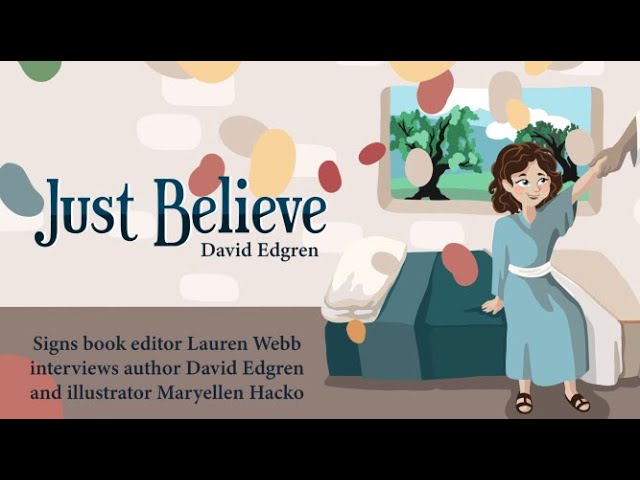
Dave Edgren discusses his children's book Just Believe, which retells the biblical story of Jairus's daughter Talitha to teach resurrection, the Sabbath, and relational faith. The book includes discussion questions for families, and illustrator Mary Ellen Hakko created visuals balancing historical detail with expressive art that works for kids and adults alike.
Chapters
It's the story of Jairus's daughter, um, who is named Talitha, and she wants to meet Jesus more than anything because she believes that he can heal her. And, um, the story is the journey, um, that her father goes through really of letting Jesus— because her father is a Pharisee, he's the, the head of his local synagogue, and he is afraid of bringing Jesus into his house because Jesus is an upstart, he's a rebel according to the people in the synagogue. And so he's nervous about bringing Jesus in. And so the story is the story of this little girl and her need for Jesus impacting her father and her mother and their whole community to bringing Jesus into her home and ultimately not healing her but raising her from the dead because Jesus was— it wasn't that Jesus was too late, but Jairus was too late in getting the message. And so it turned from a miracle of healing to a miracle of resurrection.
Yeah, that's amazing, isn't it? Um, you mentioned a lot that this story, um, although the main character is Talitha, um, it touches a great deal on Jairus's own journey of faith. Why do you think it was that it was so hard for Jairus to believe in Jesus?
It's a difficult one. Like, he would have had his personal reasons, but the main struggle he would have had is his religion was more powerful than his relationship. With God. And he was indoctrinated into being a religious leader, and he knew what he had to do. And Jesus told stories about religious leaders like this, that, you know, they couldn't stop and help people because it would make them unclean for 7 days. And that's just the opposite of the Gospel. That's the opposite of what even the God of the Old Testament says to do for the stranger or, or for the sick or the infirm. And so Jairus has this real battle of, is Jesus really a bad guy or is he a good guy? And for Jairus, he has to take a shift from— and it happens because of his understanding of the Sabbath. And he goes through this journey where he's a Sabbath man, he's a lawman, he goes to church on the Sabbath, and he runs the church on the Sabbath. But then his daughter gets sick and he suddenly wants to be at home on the Sabbath because that's when a day that he has off, a day he could spend with his little girl who's dying. And what if he comes home one Sabbath and she's not there? And so he's afraid of losing her. And suddenly the Sabbath becomes more and more relational for him until he gets to the point of saying the Sabbath is for family. He has this realization that the Sabbath isn't for just obeying and obedience, but that the Sabbath is actually for relationships. And when he realizes that, it's kind of the turning point in the book where he realizes that Jesus is also all about healed relationships. So it's, yeah, it's in my writing, obviously, when I wrote it, I was like, I'm a dad and I have kids and I visualized in my mind, you know, my whole life the story has always been the story of Talitha until I became a dad. And then suddenly it started becoming the story of Jairus and saying, I know I have views about certain things. Would I be willing to invite someone into my house that I thought was a bad influence. And then the journey that Jairus had to go through of saying he's not actually a bad influence, he's actually showing us the way the Sabbath is meant to be. And we've so indoctrinated ourselves with a wrong view of— and it's not just about Sabbath for us, it's about all of our theology— that our theology has become staid and locked in time rather than being about relationships. And, um, so It's one of the things I try to do with all of my preaching and my writing and everything. I'm known as a children's storyteller, but my gift, I guess you would say, is making things simple. And so I try to take complex things and simplify them down into something a child can understand. And when you do that, adults have light bulbs go on as well, because they see that richness of what that storytelling can bring. There's so much you can't just do by telling somebody, "This is the fact you think, this is the fact it is." They're not going to hear you if you do that. But you tell a story of someone's journey and they let you in. Story, story is like a giant door that just opens people's hearts and minds so that they can hear something new. And yeah, I've been reading this book on when I visit churches on Sabbath. And last Sabbath I was in Vansdale Church and I read this book to them. And one person said, when you said you were going to read a children's book at the beginning, I thought this is for a sermon. But then I told them it's actually a narrative sermon, the way I've written the book. It's for kids, but you'll see it's also for you. The main feedback I got was that this book really makes you think about the stories of Jesus and the world that Jesus lived in and what it would have been like to live there, but also what it's like to live here as a follower of Jesus. So Yeah, that's what I try to do with my books.
What was it that made you choose this story, the story of Jairus's daughter, of all the Bible stories you could have chosen to write a children's book about?
Well, there's a previous book, it's like 10 years old, but when Nathan told me to, I want you to write another one like, and then he said, The Perfect Lamb. And The Perfect Lamb is also a narrative sermon, and it's one that I preached, I wrote and preached when I was a student at Avondale College. And that turned into a book years and years later, because someone told me, I was there the day you preached that. And this was, oh, it had to be 10 years later. And she said, we now, I got the tape, you remember tapes? I got the tape of the sermon and we listened to it every Easter on Easter Thursday to open the Easter weekend for our family. And she said, you really should write it as a book. So I went back to it and wrote it as a book and Glendon Harris illustrated that one. And after, You know, that one is all about the crucifixion, and it's basically— crucifixion is a horrible, scary thing, but it's for kids, and it's making the idea of Jesus dying for us a story that can be told in a way that children can hear it that's safe, but also gives them the idea, the core idea, that what happened on the cross is we found a better lamb, and that lamb is Jesus, and he's the lamb, the only lamb now, the only sacrifice, and for all time and for all sin. And so That book was all about the crucifixion, about the salvation. This book is about resurrection. And they're the two core themes to being Christian. And again, trying to make the complex simple, the easiest way to tell a resurrection, the meaning of resurrection to children, is a story about a child. And it just happens to be that there's a couple of them in scripture, but that one's really unpacked quite a lot in the gospels. And so I chose that story because it tells the next deep theological teaching of Christianity, and that's the resurrection and Jesus's resurrection, but also our own resurrection.
And I really like in the book how you see the impact that that resurrection— not only, of course, Talitha's resurrection has a big impact on her life because now she's alive and it makes a big impact on her family, but there's the thread that goes along with that of how Jesus's own resurrection, which came soon after, had an impact on Talitha and her family. Family too. And that was one of the things that really struck me about the book. What is it that you hope that readers will take away from the book?
I hope that they will take the next step, whatever that is where they are. Kids, the next step may be just believing deeper in Jesus and recognizing that he is real and he really does love me and he would do a miracle like that for me. For parents, just believing might be taking that next step and saying, um, I need to be more open to relationships in my life and more invest more time into the relationships, not because I'm trying to accomplish something else, but I'm just trying to build the relationship. Because there's nothing greater in humanity really than relationships and, you know, reconciliation, restoration. That's the theme of the Gospel. And Jesus was sent by His Father here to restore relationships, to make it possible for us to connect with the Father the way He created us to. So relationships are very important to God, so I'm— and should be to us. And so I hope that what the book does is any reader that hears it or reads it, that it helps them take the next step in their relational experience with God, but also with the people around them.
Yeah. Now the book has a couple of really important features at the back of the book. It has a series of discussion questions that parents or Sabbath school teachers or different people or school teachers could go through with their children, um, just to help to draw out some of those themes in the book. Um, and so I think that's a really important tool, isn't it, that people can use to help to explain some of these things, to explain the importance of the resurrection, to explain the importance of faith, the beauty of relationships and the Sabbath. Um, all of these questions will help kids and help even adult readers to draw out their understanding and to analyze what these things mean in their own personal faith.
Yeah, one of the things from my, I guess, my youth, Michael Card was a really big singer when I was a young person in high school and college. And he has this one line in one of his songs that says, "Could it be that questions tell us more than answers ever could?" and that has been an inspiration to me my whole life is leaving people with questions is so much more valuable than leaving them with answers where they're just like, "Oh, I know everything now." Rather, here's a bunch of open-ended questions based on what you've just read, and none of the questions that are in the book are yes or no questions. They're all, "How would you feel? What would it do for you if this happened? How do you think Talitha felt in this moment?" And my hope is that parents will, grandparents will read this to their kids. It's 7 chapters, it's 1 week. If you have your grandkids for 1 week, you know, and you say, we're going to read this every night while you're here, and you ask those questions at the end of each chapter and you just leave it because kids will be like, no, you have to read the next chapter. Say, no, that's a special chapter for tomorrow night. And it creates the relationship with the child and the parent, to the child and the grandparent. And the longer you leave that story to build in their mind, it creates a strong relationship with the child and Talitha. And with you as a parent and Jairus and Jairus's wife, Talitha's mom, who struggles the whole time to balance the two of them, you know, because she loves both and she loves God and she wants, you know, sometimes we're trapped in between other people's relationships and that's the role the mom plays in the book. Questions— since I started writing kids books, I've always put questions at the end of each chapter. And the reason why, when I first started, I wrote this scroll series, which each chapter finishes with 3 or 4 questions. And the intention with those chapters was I left every— I tried every single chapter was a cliffhanger. So kids would beg for the next night and say, "No, we're not going to keep going. We're going to have a discussion now." And they have all these questions and answers and stuff going on in their brain. And so they want to do that. And I have so much feedback over the years from people saying, "Thanks so much for the questions." It just— kids like parents saying, "Kids go so far with these questions that I would have never thought they were thinking like that." And that's, that's the inspiration for me anyway, to have parents think their kids are super smart. Like, wow, because that's a relational thing. If we don't spend enough time with the people that we are raising and the people that we love, we don't even realize how deeply they think. So parents being able to spend time with their kids, hearing their kids answer those questions and also ask their own questions, and the parents going, I don't know, I'll have to find out. It's a very, it's kind of the core of relationships, questions and answers and discussion.
Wonderful. And along with the questions, the book features some beautiful illustrations by Mary Ellen Hakko. And if I could just get Mary Ellen to come on, we'll ask her a couple of questions about her work on the book. Mary Ellen, what was it that appealed to you most as you read through the story and began to think about what type of illustrations might go along with it?
Yeah, well, I mean, I was very privileged to be able to read the book before anyone else got their hands on it, which is, yeah, a real honour. But I think what really appealed to me about the story is, well, first of all, the way that Dave wrote it. You know, it's got a lot of great dialogue, dynamic dialogue, great characterisation. And so, yeah, I think it's the kind of book that will appeal to both kids and to adults. And so in my illustrations, I wanted to make the illustrations not too childlike and cartoonish that they were only for kids, but also relatable to adults, because it's the kind of book I think that people can enjoy together, parents and children can enjoy together. But on top of that, I think what appealed to me most of all was this contrast brought out, and Dave mentioned it before, but just between the childlike faith of Talitha and her friend Josh and their other friend, and also sort of the pharisaical and just adult, I guess, ways of the father. And that conflict there and the way that the kids are able to, you know, be wide-eyed and love Jesus and just really believe everything he's about. And then the way that they can convince their father to follow Jesus and to believe Jesus was just so beautiful. So yeah, it's definitely a story with, um, yeah, just, you know, wisdom for both kids and for adults. So that was really cool.
Oh, cool. And what was it that you wanted to bring out most when you were illustrating the story of the book? Was it a particular theme or something that you were hoping to highlight through the way that you did the illustrations?
Yeah, great question. I think for me, there's a lot to be said in facial expressions and in body expressions as well. And I really tried as best I could to, you know, give the characters big eyes and big expressions and try and have them, you know, looking at each other in a certain way to try and communicate that emotion. And something else as well that we sort of figured out through the illustration process was that originally I had drawn the characters in modern sort of attire and in modern contexts. And then as we went along, we thought, no, no, it's much more important to show the historical context and to show kids that actually, you know, this is the sort of— they wore headscarves and they wore, you know, long dresses and sandals and things. And bringing out that historical I guess, element, I think shows kids that actually, you know, God works throughout all contexts. This is what things look like and looked like in the past. And, um, yeah, I think it's both educational and beautiful to show that aspect. So yeah, it was all about the emotion but also about the context for me.
Fantastic. They really make a wonderful contribution to the book. Um, so thank you very much for your work on those. And one last question for you both. Um, I was just wondering, how has Just Believe encouraged your own faith?
I think anytime you write something, especially with books, like when you write a sermon, you usually read it a few days later. But when you write a book, everyone else is really enthralled with it after you're done with it. You know, it's been months and months, if not years, since you wrote it. And then you come back— where this one actually happened quite quickly, and I started writing it the beginning of last year and finished mid-year, and then it was out by Christmas. And Yeah, it just inspires me to think that what we say and how we say it and what we teach matters, and that it can be handed on to the next generation. It can be the words we say and that we choose and the way, like Mary Ellen said, the way we choose to frame it is really important because when we speak to others, especially when we speak to children, Everybody understands. And so speaking to children is a real honor. And I think that's probably the main thing that comes out to me whenever I write a kid's book is, and also do a children's story somewhere, is the honor that it is to speak to everyone in the room. And that's children's content in general. You're reaching minds at all ages and all levels of spirituality on their journey towards the Kingdom of God.
Wonderful. How about you, Mary Ellen?
I loved what you said, Dave, about, yeah, it's an honour to speak to kids, and I think that's so true. But I think it's also an honour to listen to kids, and it's an honour to sort of get into their minds and see their childlike faith. And for me, just reading the story and how they believed Jesus so wholeheartedly, so quickly, was very challenging to me as an adult who, you know, can be quite judgmental and sort of lukewarm in my faith. Just to, yeah, especially in a year like 2020, maybe 2021, you know, we don't know what's ahead of us, but to have that encouragement that actually Jesus is in control and he is powerful and he can heal and he can work in your life. Um, yeah, it was just a simple reminder but a really powerful one for me that I should trust God more.
Wonderful.
More from Dave

Thor is four months old and already mastering AI! #thor #puppy #jackrussell #cat #mythology #war


Better to have gloved and lost... #puppy #jackrussellterrier #thor #doglife #dog #gloves #wrestling




