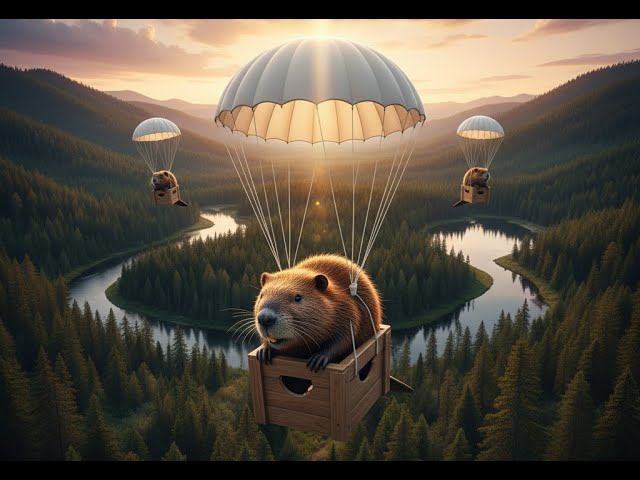
Stewardship means caring for the earth, a responsibility given to humans in Genesis. In 1948, Idaho wildlife officials parachuted 42 beavers from planes using surplus World War II parachutes to restore wetlands destroyed by fur trapping. Forty-one survived and repopulated the forests.
Chapters
Do you know that right after Jesus created the earth, then he made two people, Adam and Eve, and he gave them a job? He said, look after the earth that I made. We have a big word for that, we call it stewardship. But stewardship, or looking after the earth that God made, can take all different kinds of looks. It can look differently. Like, can you think of a way that you could look after the earth? Do any of you look after the earth? You plant a tree. That's a great way to look after the earth. Anyone else? I bet nobody can guess my way that I'm gonna tell you a story about this morning. Anyone else? Have you think of some way that maybe not you, but maybe some grown-ups have looked after the earth? Anything? Yeah, what do you think? I love that. He said, "Plant a flower." I love it. That's true. Flowers are beautiful, aren't they? Yep. This is a story about— and I'm not joking, it's true— beavers falling from the sky. You guys know what a beaver is? A beaver is an animal that God created to look after the earth. I mean, if any animal is good at looking after the earth, a beaver is. What a beaver does— if you haven't seen a beaver before, because they don't exist in Australia— a beaver looks the size of a wombat, but then put a tennis racket on its back end, on its tail. Its tail looks like the racket part of a tennis racket, only it's leather, it's covered in, in skin. So when they slap that, and it is, it's about that big around, and the thing's about that long with the tail And when they slap it on the ground, other beavers can hear it from a long ways away. And they can say— and what they do is they go and they find an area where a river is just starting to reach into an area and it's got a little bit of water flowing there. And they think, you know, if I built a dam out of sticks over there, it would make this area fill up. And then I could have a beautiful pool to do my fishing and my hunting and my living in. And I could have a nice dam to live underneath where I can hibernate in the winter and where I can take care of my babies. And so beavers all around America, when the white men first started, or the Westerners first started showing up in America, the Indians had lived quite peacefully with the beavers, but for some reason, the white men were not peaceful with the beavers. And they thought, you know what, this skin, if you kill a beaver and you take its skin, it's waterproof, amazing. Well, of course, they live in the water, right? So the skin was, and the fur was really, really valuable because you could make all kinds of things that were waterproof and beautiful. As they crossed America, they just shot any beaver they saw. In their wagons, they would stop and they would hunt the beavers until there were very few beavers left. They did this with lots of animals. I'm American, and I don't have— my forefathers were not nice people when you gave them guns. Actually, they're still not if you give them guns. And so what happened with this beaver situation was in the early 1900s, when they were moving across America in the 1800s, they were killing all the beavers. And then by the mid-1900s, they realized, We've gotta stop, we've gotta stop killing beavers, because they're almost gone. And the beavers actually, 'cause what would happen is all the valleys that were created by beavers who'd made a dam and the water had flowed out in that valley and made a nice little marsh, started drying up because there were no beavers doing the farming of the sticks and setting up the dams. And so they said, we need to move some beavers into areas, well, they decided this, they said, there's areas where there's towns that the farmers didn't like it 'cause their fields would just fill up with water. Why is my field suddenly filling up with water? There's a beaver up there who's decided this field to make a lovely area to swim around in. And so they've dammed it up and filled my field with water. So they said, "How can we move these beavers?" And some farmers took it upon themselves. They didn't want to kill the beavers anymore, so they would go and they would trap the beavers, and they would put the beaver in a truck, and they would drive it as far as they could, and they would move it. And that's a lot of work. And it takes a lot of— 'cause where the beavers want to live is not just at the end of a nice road. They want to live in the middle of the outback, well, the west— the— what do they call it in America? The forest? They want to live in the little streams. And so they had to find places, and it was too hard to move these beavers. But this town, there was all— this is in Idaho, and all of these people started reporting, "Yeah, we've got beavers in our backyard. Yeah, we've got beavers in our backyard." And so they all got together, and it was 1948, and there was a whole bunch of leftover parachutes from World War II. And they said, "What if rather than hiking in and carrying the beavers over our shoulder, which is too hard, or driving a vehicle in and then hiking in, it's too hard. What if we just flew over the top and pushed the beavers out of an airplane and they could float down and land where we want them to build dams and do their restructuring and make the land beautiful that isn't where people live? And so they said, great idea, how are we gonna do it? So they caught One beaver, he was an old guy, they named him Geronimo. And you know, Geronimo's the name that like when you jump out of something, "Ah, Geronimo!" And Geronimo went on over 40 jumps where they tested different boxes. They made a box, they put the beaver in it, which isn't easy. You can watch all these if you YouTube Geronimo the beaver, you can watch the whole thing. And they've got live videos of the news of it saying, "And here is when Geronimo jumps out of the plane. Look at Geronimo fall." And and then he lands on the ground. And, and if it worked properly— what, what the— the one they finally invented that worked, it was tied on the top through a, a, a thing that when the ropes of the parachute pulled up, it closed the box. When the parachute stopped its tension, it opened the box just a little bit. Once the beaver could see light, they fight their way out and they, they would go. So they dropped 42 beavers like that, and they all went. Um, 41 of them made it. One of them climbed out of the box when it was in the air and then had a rather uncomfortable landing. But the majority of the beavers, the vast majority, it was— they deemed it a great success. And they repopulated a beautiful area in northern Idaho where there's now beautiful forests and marshlands and everything that a beaver loves to create, all because some people said we should take care of nature, we should be stewards, like God said, of his creation. So you might see little opportunities. I don't recommend you, like, put cats in boxes and parachute them places, but you might see opportunities to look after animals, to look after nature, to plant a tree, plant a flower, and do those things when you see them, because that's how we look after the Earth that God gave us. Thank you for listening to my story.
More from Dave

Thor is four months old and already mastering AI! #thor #puppy #jackrussell #cat #mythology #war


Better to have gloved and lost... #puppy #jackrussellterrier #thor #doglife #dog #gloves #wrestling




