How to Discover New Concepts and Innovate | Dumbo Model Explained
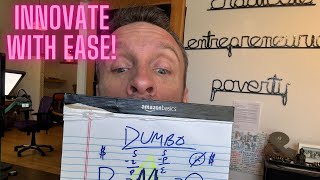
The DUMBO model identifies innovation opportunities by spotting mismatches between what people want and what they actually get. The speaker used it to reshape Profit First (flipping how businesses allocate profit) and Clockwork (mandating four-week vacations). The gap is often not desire but a broken method, poor understanding, or beliefs that block change.
Chapters
I want to talk about a model I call the Dumbo model. Now, to give you some context, I was recently at an event with fellow authors and the question came up to me from the group saying, how do you create industry challenging ideas? How do you discover new concepts? How do you become creative? And I thought I was a no brainer and I shared this and my colleagues are, you got to share this with the rest of the community. So I've written books like Profit first and Clockwork. Profit First. I noticed that the most businesses weren't profitable. And how to fix that. Clockwork. Most business owners are overworked. How to fix that. So I'm gonna show you the model I use. I call it the Dumbo model, hence my beautiful title here. So when creating a new idea, first ask your community that you're serving or yourself, what is the desire that you have? And then compare that to the outcome. So D stands for desire, O for outcome. I'll use profit first as an analogy. Most entrepreneurs I interview want to have financial freedom. That's the desire. Then I ask myself, well, what's the outcome you're actually experiencing? And they are not making any money. They are frustrated. So when the desire does not equal the outcome, there's an opportunity for creation. And often it's the M, the method in the middle. So D stands for desire, O stands for outcome. When you see a mismatch, it's the method in the middle that is usually the problem, not always. I'm going to give you two other scenarios, but here's how I discovered private First. I said most entrepreneurs want financial freedom. Most are not experiencing financial freedom. What method do they follow? Well, they have their revenue, their sales, minus the expenses they incur results in profit. And that is the method. When the desire does not match the outcome and they're following a method, clearly the method is wrong. And that's when I created sales minus profit equals expenses. And admittedly, this is nothing new. This is the pay yourself first principle. I just said this applies to business too. And I found another method out there that already exists, translated it into business. And now there was congruency and we were able to achieve tons of businesses. And every day I'm proud there's more. But we estimate 800 to 900,000 businesses already doing profit first. So when you are creating a concept or trying to kind of challenge the industry norms or just create something new, ask what's the desire and what's the outcome? And when there's a mismatch, check the method and maybe Reinvent the method. Often a flip. And that's what the first was. I took the existing approach and flipped it over the old approach. This approach generally generates about 17% of profitability, meaning 17% of businesses are profitable. That's what the SBA research identifies. In this case, we're approaching 80 or 90% businesses profitable. So literally flex the formula. And we flipped the results. But this is not always the case. It's not always the method that's wrong. There's another element, it's the U which stands for understanding. Sometimes we have the right method, we know the method, but we don't have the proper understanding of how to execute on the method. And therefore we don't get the results. So understanding is a lack of clarity. For example, with profit first, I'm just going to kind of hound on that. When people first hear it, they say, well, I don't understand how that would work, or it can't work for me, or I'm the exception. And so we go through the process. Usually the best way to demonstrate understanding is proof in the past. So what I do with this method, I say, well, maybe you've never taken your profit first in your business, but have you ever participated in a 401k? That's an automatic savings mechanism that comes off your top line income and what's left over is available for you to spend. And they say, yeah, that's very effective. Well, Mike, this is the 401k for your business. So sometimes it's an educational component which is understanding. The best way to give people understanding is to show them in another element of their life how they're already demonstrating this. Listen, I can't convince you of anything unless you say, oh, that relates to something I already believe and know to be true. Therefore it's likely to be true. From Yaeko the clown here, maybe he is speaking. The truth is natural for us and it's a safety mechanism to not instantly trust and just aimlessly believe. So what we need to do if we want to serve someone else to show them a new path is to demonstrate where they're already experiencing that. And that's where understanding comes around. There's also be which stands for belief. Do I have a belief system in place that is preventing me from following the method? One belief may be, oh, profit first. That's unethical. You can't take profit first. That's illegal. Which is total nonsense. But I've actually heard people say that like that breaks the law, really, by transferring money from one account to another. Called profit. But there's a belief in that and therefore there's an avoidance. So what we need to do is look at the belief system people have and again, the way to address beliefs is ask them about their experience with it. So for me to say, well, you believe incorrectly would never work. You know who, what you believe to be true, you're totally wrong, of course that would never work. So what I do is say, well, how's this belief serving you? Do you have other beliefs that are contrary to this to show a dissidence? And if I can show that, then perhaps I can show their own contrary beliefs and introduce them to a new belief for consideration. When I wrote Clockwork, the thesis of this is that most people are struggling to be free of their business. They had a vision, a desire to have personal freedom, do what they want, when they want. So the desire was personal freedom. The outcome is they're actually entrapped by the business. They work harder than ever. So, so like what's the method you follow? And they say it's, you know, I manage all my employees through micromanagement. I'm a superhero for my business. I swoop in and save the business. So I look at that method and say, okay, that's the worst thing to do because the desire of personal freedom is not resulting in that. People are entrapped by the business. So this clearly method is likely not working. And so instead of being a superhero for the business, be the super visionary for the business. Stop trying to do the work, start designing the outcomes and have clarity. But what's the method we use to do that? Well, often it's through micromanagement, working 80 hours, being representative of this. Sadly, we find affirmations of this in the public. We hear like experts saying hustle and grind's a good thing. They're idiots. They are idiots. Hustle and grind is necessary in the beginning, perhaps because you're only resource. But if that's how you're going to run your business, you can't sustain it. You need a team, you need to support your folks. You need balance. It's the only way. If you're just keep grinding it out, the business has become linchpin by you. You're a crutch for the business. So I said, okay, that's not the right method. It doesn't work for almost anybody. So therefore, what's the new method and what I propose? The four week vacation. When I wrote Clockwork, I realized when people stop working for large long increments, it forces the business to depend on its resources. Instead of the superhero swooping in, trying to carry the business up, now the business settles in on its homeostasis, where it naturally falls. Now the business owner's job is to design a foundation that elevates the entire business. But you'll never discuss that or discover that until you extract yourself from the business. Sometimes the best way out of the weeds is to simply walk out of the weeds. But maybe there's a misunderstanding. You know, I've observed others that have run businesses and they hustle and grind. I'm told by all these experts that that is the essence of growing a business. Work exhaustively, sacrifice family. And that is, in my opinion, foolish. And by the way, I've lived that foolishly. And gosh, the transformation when I remove myself from the business. But maybe a belief system, I'm putting burden on other people. It's disempowered. When I tell my other team to work, they're sweating while I'm on the beach. I've now built a sweatshop. And the reality, of course, is not that I'm empowering my team. When I have my team run the operations, it shows that I trust them, that they can step up to their highest level. And what we've done in our own organization is every one of my colleagues takes a four week vacation. Because I believe that when there's no dependency on any individual, it builds the strongest business. So each employee, each colleague of mine leaves for four weeks. And they have to have redundancy for the organization. It's the healthiest organization, the most redundant, meaning we have people filling each other's roles at any time. Because that's what we do in practice. Kind of a fire alarm drill. Back in, when I was going to school was fire alarms. Sadly, we moved to other kind of preparation, but for me it was a fire alarm. And they'd ring the fire alarm, we'd get up, we'd walk out single file. Well, we had a fire one day at our school and no one got hurt because the alarm went off. And we were used to get up and leave the space. My company, I intentionally put under these stressful moments of someone leaving for four weeks every year, every employee at different times to fire drill. So that when someone does leave to move on to other opportunities or whatever happens in life's events, the business is prepared for it. So this is what I call the dumbo method. And you'll see that the opportunity is right here. This triangle right here. It's the method, the understanding and the Belief again, as a quick file recap so you can use this in your own business. Look at the desires that the community you serve has. Then look at the outcomes they're actually experiencing. When there's an incongruence between these two, it is the D, the M, the U or the B. The M is the big letter. Because most often I find maybe 8% of time it's they're doing the wrong method. They're doing something that they told works, but it's not. Or occasionally they're doing the right method. They just don't understand the instruction set behind it. And we have to give them basically basic guidance on that. Usually it's through simplification of the method so it's easier to digest. Or they have a belief structure that's preventing them from achieving that method. And we have to help them explore other beliefs they have that actually does serve them and bring them in alignment. It is very hard to convince people not to do what they're doing. It's very hard to tell people that they're wrong and for them to believe you, but it's very easy for them to see their own examples. So our goal is to guide people through the new method that we reveal by showing people how this could already support them in other ways, by showing them the current understandings that they do have and maybe simplifying it to make it more digestible. And beliefs, working with their existing beliefs that are congruent with the outcome that's going to serve them. That, my friend, is the DUMBO method. I hope it serves you deeply. And if you're an entrepreneur watching this, thank you for being an entrepreneur. The world is starving for your success. Keep it going.










