David Trainer analyzes Charter Communications' acquisition of Time Warner Cable, building a financial model that reveals implied synergies of $7 billion versus the $1.5 billion the companies disclosed. Charter's ROIC of 3% falls below its cost of capital at 5.4%, suggesting the deal destroys value and may represent a $5-$6 billion overpayment masked by market hype and low interest rates.
Chapters
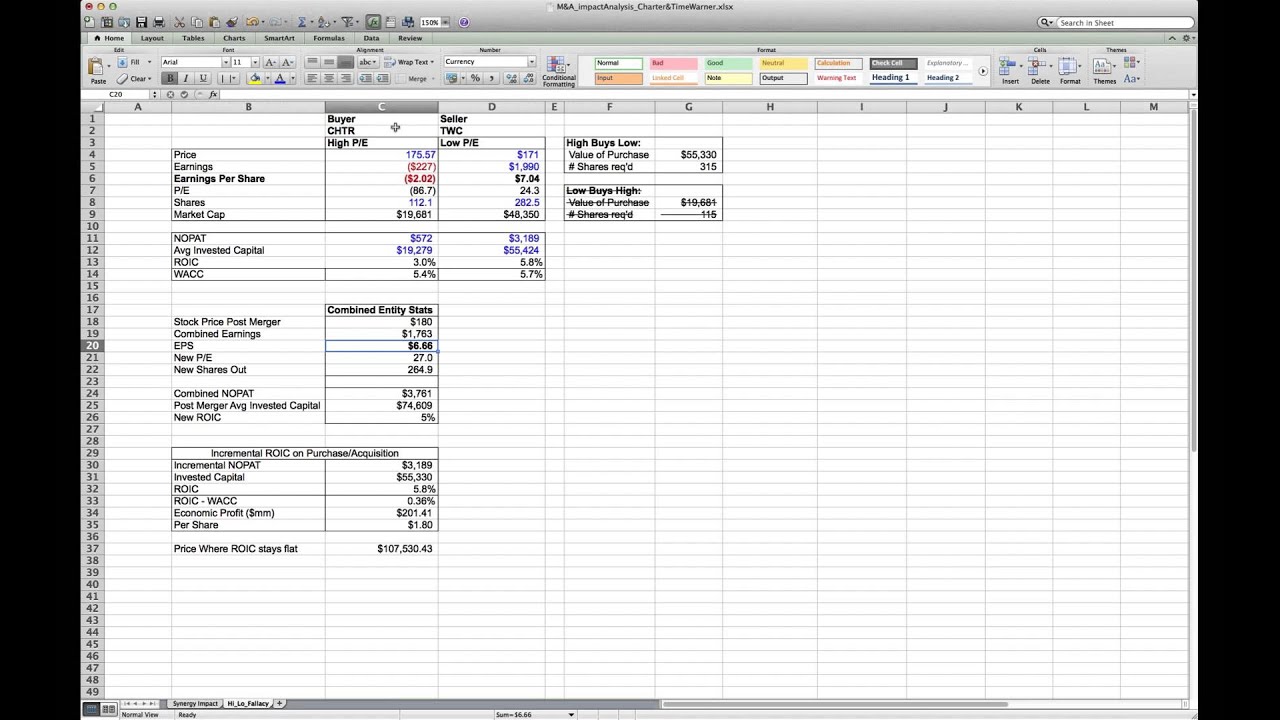
So today I really want to focus on going through the M&A impact analysis and how to think about mergers and acquisitions. And I've got a model here. And look, feel free to ask questions at any time. You don't feel like you need to wait till the end of the conversation. The questions will be logged online as you put them in, and I'll get to as many as I can. You know, I get— tend to get questions throughout the presentation. And I've already got a couple about this transaction. Hopefully some of my analysis will speak to that. I'm happy to share this model with you. This is a pretty sophisticated model. It's not necessarily a brand new proprietary analysis. I don't think you're going to find it in many other places. It's proprietary to the extent that you can't get a model like this anyplace else. But I'm not— I don't mind sharing with you because I'm all about being transparent. I want people to understand how much work we do. So let's start with the basics. All right, closing prices. This was the closing price before the merger was announced. This is the closing price. This was as of the end of the day yesterday. So we might have some slightly different data here. I'm sorry, I had this prepared a little bit earlier today and I haven't updated for the 4:00 PM close. These are the market values implied based on the shares outstanding prior to the deal. And then post the deal, the combined shares outstanding, or the new shares, are going to be a function of the deal terms, which are Charter Communications is, for every Time Warner share, going to provide 0.5409 shares of Charter shares for Time Warner shares. So this calculation is simply multiplying— This ratio times the Charter shares plus the Time Warner shares, right? Or sorry, this multiple times the Time Warner shares plus the Charter shares to get the total shares outstanding. All right. The next thing we want to think about is the total value for Time Warner Cable, right? That was provided in the press releases, etc. And then, you know, that's the total. This is the per-share value. The stock portion of the deal Is based on, again, this ratio, 0.5409. And if anybody's having trouble seeing what I'm showing or talking about it because I need to make the screen bigger, just let me know. I can enlarge here some more. Glad to do that. And so of the $195.86 a share that they plan to pay, $94 or $95 of that comes from The shares that Charter's gonna provide to Time Warner, and the rest is cash. All right, so when we talk about premiums— and, and by the way, you know, when it comes to premiums, it's been studied for a long time. You don't have to just take my word for it. You can look in pretty much, pretty much any book on this subject, any intelligent book on the subject. I can recommend a couple, uh, The Synergy Trap, The folks at McKinsey have done a lot of work on acquisitions, and they show that in general, M&A tends to be unsuccessful for the acquiring shareholders. There's an article that was written when I was on Wall Street by Michael Mauboussin called Let's Make a Deal. Great article explaining how to analyze acquisitions. I think some of that information is on his website called Expectations Investing. And you can look on our site and see how we've identified or analyzed acquisitions. The key thing is whenever you pay a premium over market value, the only reason to ever pay that premium is if you expect to be able to make more with that entity than it could make on its own, okay? So essentially, you know, the purpose of a synergy means that The combined value of the 2 companies is greater than their independent value, right? When you pay market value, you're effectively paying today for all the future cash flows that you expect that company to generate, or that the market expects that company to generate. And typically, especially in these markets, the market's got pretty high expectations for future cash flows, right? So if you're paying a premium above that, There's something that you need to be able to achieve together that you cannot achieve independently. It's called synergy, right? And companies like to throw this around. I love, you know, I mean, it's, it's kind of ridiculous. I remember on Wall Street all the time, whenever they talk about acquisitions, and by the way, Wall Street loves acquisitions. They make money, right? Bankers make a fee of the total deal. They make 3% typically on the total deal. So what's their incentive? Make the deal as big as possible. Right? And by the way, there are laws protecting the shareholders of acquirers, right, in case you pay too low. There's nothing— there's no laws protecting people from overpaying, right? All right. Maybe there should be. But look, I'm not a fan of higher regulation. My point is that there's asymmetrical risk here, especially when executives are incentivized to grow their businesses to be larger, right? These are all the reasons why we see acquisitions fail, right? A lot of the time it's just hubris. They want to be bigger. A lot of times it's about compensation, right? If they buy another company, then their revenue profile is bigger, their EBITDA profile is bigger, their EPS tend to be bigger, and therefore they're in a new peer group with respect to executive compensation. Maybe they just want to boost compensation by improving their EBITDA numbers. If they get paid based on EBITDA, then they can buy another company, improve EBITDA, and it ignores how much they pay for that company. Right? When you add 2 companies, EBITDA goes up every time, even though the EBITDA per capital invested or per dollar invested in the company could go down. Returns on invested capital could go down, but EBITDA can go up, right? Because if you pay— let's just say the acquired company has got $10 million in EBITDA and it's got $100 Or a billion in capital, right? And so that's a very low return on investment, 1%, right? And that's what you're getting from your capital in terms of what the management is— what kind of return management is earning on your capital, right? Even though they're getting a $10 million boost to their EBITDA and therefore making it look as if they've improved the profitability of the business, when in reality they probably haven't improved the profitability of the business because they're out getting a penny for every dollar they invest of your capital. Not good. So let's get to the point here in time order. How do we look at this? So the implied synergy value here is about $7 billion, all right? That calculation comes from looking at what the amount— the amount that Charter wants to pay less the current market value or Pre-announcement market value for Time Warner. That's $7 billion. So I went and I did some research to see what I could find about synergies. And by the way, couldn't find a lot of talk about synergies. Let's do a search. Synergies, Charter, communication, Time Warner. And I looked at a couple of these articles and I really didn't see anything about— right, here we go. Here in the very bottom in the disclaimers, cautionary statement regarding forward-looking statements, synergies. That's the only place we hear any talk about the acquisition. Okay. And this is what's talking— this is the press release on the deal. There are the stats, $100 in cash and $0.5409 per share. Guys, Time Warner approximately $195.71, that all matches my model, right? Okay, here they are talking about the deal. No talk about synergy, even though they're paying a premium. But that synergy comes out to be about $7 billion. Now I did find one article, or really a CNBC interview, that talked about synergies. It's here in this link. And here Comcast hoped to get about $1.5 billion. In synergies. So going back to my model, $7 billion implied synergy, and the most we can find is $1.5 billion. That's what they say they're gonna do. Let's take them at their word. All right, that's still a small fraction of what's implied. So how do you look at the market impact on this? Right. Well, what you look at is who's going to own this underperformance? Who's going to own this overpayment in terms of the synergy, right? Because you just multiply— or you, sorry, you just subtract $1,500 minus the implied synergy. You got $5.4 billion of overpayment effectively, right, of payment for synergy that potentially does not exist, right? That's this scenario here. Well, the way you figure out what the market value impact on Charter Communications is, is you look at what percentage of the new combined company do they own. And when you look at the post-deal shares of the combined company, right, Charter owns— is 42% of that based on their pre-deal shares, and Time Warner is 48%— 58% of that. Right. So Charter's gonna get, on their market value, take a hit of about 3— if there are no synergies, about $3 billion, times 1 or $4 billion. There's $1.5 billion in synergies, the numbers go down, as you can see, as I've got 3 different scenarios here. You could put in whatever you want in this value. This is an input, right? If I put in here, let's say we make this equal to this value. You can see that there's zero impact. If their synergy actually equals— the actual achieved synergies equal what they paid for, well, then there's no impact on the stock prices because they've appropriately paid. Alright, but if their synergies are below, you can see— and this is the percent impact you can expect on the stock price. And this is the per-share impact, right? $26 a share is what Charter is paid in terms of synergy value, right? And that's simply equal to 0 minus the synergy value times their ownership stake in the deal. Divided by their pre-deal shares outstanding. Again, I'm happy to share the model with you so I would show you how to look at this. All right, so you wonder, well, you know, David, this is all great and good, but the stock price went up, dude, so what's going on? Well, good question, right? Now typically, you know, markets love acquisitions. Stock prices go up for reasons that aren't necessarily founded in economics. Netflix comes to mind, right? And, and I think you also see that the banks doing these deals are going to help support the stock. Look, when I was at— when I was on Wall Street, we had talks all the time in the research department about how much the trading desk was going to support the deal, right? Which means they're going to be out there aggressively buying for the bank's books. Shares in the stock affected, shares in the stock doing the secondary, shares in the stock post the IPO, shares in the stock doing the deal. So people think that, you know, that everybody likes it. They're willing to do that because they're making a lot of money, right? What's the deal value on this? $55 billion, right? So if we take the typical banker percentage, 3%, all right, $7 billion deal for the bankers. Divide that amongst 2 or 3 firms, all right? So let's say each is taking home, let's say, you know, 3 or 4 firms. Taking home about $2 billion. It's not a bad payday, right? The bank's willing to take a little bit of risk. Let's say they lose $1 million trading this— $1 billion trading the stock. They're still taking home $1 billion. Not a bad deal, right? All right, so you get what I'm saying. Not to mention the fact that everybody on CNBC is talking about it. All a lot of retail investors like, oh, the market likes it, it's good, momentum up, buy now, right? But there's risk. There's risk here because there's been overpayment for synergy. Now, this is the typical way to analyze M&A impact. There's a little twist in this situation though that I want to go into, and it came to me— I came to realize it when I reviewed my high-low fallacy model, which is a model that I put together for another webinar I did called the High-Low Fallacy for Acquisitions, which basically shows that whenever a high P/E company buys a low P/E company, For the combined company, you've always got higher earnings per share. So it's always accretive, right? Now this is a different situation because Charter had a negative PE, all right? So, but what it revealed when I went through the numbers on these guys is that Charter is actually terribly unprofitable as a business. Their return on invested capital is just 3%. Compared to a weighted average cost of capital of 5.4%. Now they're buying a business with closer to 6% return on invested capital, slightly making money. WACC is low for these guys. So to answer one of the questions that got lobbed in early, is a low interest rate environment good or bad for merger and acquisition activity? It's good. It helps make deals more feasible, lowers the cost of capital to go and get the capital required to do the deal. So it's good. Now, is that a reason to do deals because your cost of funds is cheap? Not really, right? That's like saying, you know, you like one particular high jumper better than another, not because he can jump higher than the other guy, but because he's going to a meet where the other jumpers can't jump as high. The hurdle's lower. Right. Right. At the end of the day, you know, you want to be in companies that have competitive advantage. And that means companies that go out and buy other companies that have high returns on capital, right? Now, that's effectively in some ways what Charter's doing. So this might explain a little bit about the price movement, all right? Because they're buying a company with a higher return on invested capital, right? Right. And so we look at the incremental NOPAT that Charter's gonna be getting. That's $3 billion in NOPAT, right? That's the NOPAT that we calculate trailing 12 months for Time Warner Cable. The amount of capital they're investing, well, that's the purchase price. That's the $55 billion I showed on the prior page, right? And the return on capital on this investment is actually 5.8%, significantly higher from the— not significantly, a little bit higher Then the WACC, 0.36%. The economic profit on this deal is about $200 million for them, right? So, point is, it's actually somewhat accretive, but it's still not nearly as accretive as the price implies with respect to the synergies. All right? But it is making these guys— they are going to make a little bit of money on this deal. It is actually smart at the end of the day. Now, is it worth the amount the stock's gone up? Well, let's see. It started at $175, and see, what did it end at today? $178. Down a little bit. So, right, even though we had the good day, It's down today, even in an up market, I believe. So going back to our model, let's just say you've got— that's what you have, 177.37, and the price is at the end of the day. Is 178.16. Let's copy that. Not far off. So we're not far off. Okay. That shows you the work that you can do to actually understand acquisitions. You know, I think probably the most important number on this page is just the invested capital number. This is the amount of capital that you have to look at in the numerator, how much they paid. All right, most people aren't looking at that. Most people are looking at earnings per share and price-earnings multiples but don't take into account the amount of capital going into the business. All right, so let's have some Q&A. This is pretty complicated analysis, so I'm guessing that there's probably a lot of questions. So what is a successful acquisition? Well, successful acquisition is one where your incremental return on the purchase or acquisition is high, really high, right? Where you want something like 10% or 12%. The higher the better. And by the way, this is called in finance the NPV rule, right? For every dollar you invest, you want to get as high a return as possible. So the definition of a successful acquisition is where your incremental after-tax profit relative to the amount of capital you're investing— again, this $55.33 billion, that's the amount of the— that's how much they're paying, right? So this number, this NOPAT number, you want to be as high as possible. You want to get as much cash flow back for as little capital invested as possible, right? That's the way that most clients review money managers. They don't care how much money you make them. They care how much money you make relative to how much capital they've given you. That's the key. So when it comes to how you, you know, what's a telltale sign of an acquisition going bad? You know, we've done some work on this a lot lately. In fact, we've got some interesting things on our website that look at this that I want to share that we're providing to our institutional clients level. And in terms of like looking at how, you know, what are the telltale signs of an unsuccessful acquisition, right? And those signs are not, you know, they don't come out and make announcements like they did, you know, with respect to the press release. You know, they talk about how great the merger is and how great the synergies are going to be. And typically you do hear a lot about synergies in these things. I remember hearing it on Wall Street all the time. And we used to joke about, before the tech bubble anyway, when we were more analytically rigorous, we used to joke about how companies like to say, oh, well, there's strategic importance in this acquisition, but they would never define that, right? Oh, it's strategically important. Okay, well, how do you define strategy? Boosts my EBITDA and therefore my executive compensation. That's strategic for you. How's it strategic for the client? How is it strategic for the investors who put money in your company? The only way it's strategic for the investors who put money in your company, right, is if you're getting big cash flow here, big cash flow here for the amount of capital you're putting in. That's the only way it's strategic. If you can't talk to me about that, then I don't want to talk to you. All right. I don't want to talk to you. I want to talk about ways you're going to be making my capital larger or my profits larger. So, signs of a bad acquisition? Impairments, write-downs. Notice how over time— this is a chart that's looking at enterprise value I'm sorry, market value and economic book value for the S&P 500 over time, an aggregate analysis. It's pretty awesome work, I'd say. I think it's really cool. You could never do this before, before new constructs. Market value of companies versus their economic book value since 2000. You can see the crashes clearly here. Market values come way down, economic book values drop as well. Interestingly, in 2012, you know, we didn't see really a crash, but we saw a pretty good spike in economic book values Without a corresponding spike in market values. Interesting, right? The black line shows trends in the amount of impairments. Not surprising, when markets are weak, what do companies like to do? Throw in the kitchen sink, right? And so we've seen kitchen sink thrown in here, kitchen sink thrown in here. And a little kitchen sink thrown in here, but even though valuations are getting a little stretched, not so much of a kitchen sink. As long as things are looking good, you don't have to worry about it, right? But when things look bad, we're gonna go ahead and realize all of our write-downs at that point in time, take a really bad earnings, set up for a good comp when the market turns around, or when the economy turns around. So impairments, that's how— that's usually the telltale sign. of an acquisition going bad. One question here. Shouldn't the invested capital be equal to the enterprise value rather than the equity value paid for the acquisition? By using equity value, the numerator and denominator are not like-to-like. The numerator and the denominator. So let's go back to the model here. No, the invested capital should not be equal to the enterprise value because the invested capital needs to reflect the amount— the equity amount paid because the debt effectively cancels out. So the premium is all related on the equity side. I'm not exactly sure if I follow the question, but you You want to look at the incremental amount of NOPAT compared to the total amount of capital paid. So in this situation, yes, I think you're correct. So the numerator here is a little bit low because the invested capital should be not just the equity amount, it should be the equity plus debt, which means the return on— incremental return on this might be quite a bit lower. So you got me. That's a great question on that one. And I should have looked at that sooner. I don't think it affects this part because we're looking at equity values only here, but it does affect this. So let's see, the equity value to look up the enterprise value would be pretty easy here. So we'll just go to our TWC model and I'm gonna get the enterprise value. So the non-equity portion is about— let's see, is 93. That's this 93 minus 51. We're just gonna say 42. billion. So we would add— whoops. So, um, excellent question. So when we add the Debt portion of capital back for the total deal, because NOPAT is an unlevered profit number. It relates to the equity and the debt value. So excellent question, right? And so when we actually update the invested capital for the return on incremental invested capital for the acquisition, we see the return on capital is actually 3.3, which is significantly less than the WACC. So we're not really creating any value here. So, um, because I need to take back my analysis from before, uh, there's really not much of an explanation for the stock going up here because we're showing it should drop by about $18 a share in terms of value destroyed, um, which is not too far off from these scenarios with limited synergies, um, and the stock's still going up, uh, and so I'm gonna, I'm gonna come back and say that, you know, look, this is, this is merger hype, this is market hype, and I would avoid this acquisition. Now, that's not to say it won't still go up for a while, but both of these stocks are going to be worse off because they both share in the unachieved or overpayment of synergies because it's a stock deal, at least partially, right? They both own part— they both have a significant share in the post-deal ownership, combined shares, so they both have to share In the overpayment of synergies. Therefore, both stocks could be hurt, are gonna, you know, are at risk to fall down here. Significantly overpaid. I think it's interesting to note that, you know, didn't Charter previously offer a much lower number for Time Warner, right? I think instead of like $55 billion, it was in the $40s or even lower. So anyway, um, those are the details. Thanks for the great questions. Apologize for A little bit of the error there. I probably should have spent a little more time preparing. If you have any questions, please feel free to email us at support@newconstructs.com. I'm going to end it soon, really soon here. support@newconstructs.com, or email me directly at david.trainer@newconstructs.com. Let us know if you want access to this model. We'll be happy to share it with you. And otherwise, have a great day. Thank you for joining us. Thank you. And, um, we'd love to hear from you. Please fill out the survey when we're all done here. Thank you. Thank you.
More from David




Earnings Recap: Decoding Signals from SpaceX, Palantir, Merck, AMD, Caterpillar, McDonald’s, & More

Watch Our Earnings Recap: Market Heavyweights Apple, Microsoft, Amazon, Meta, Visa, and More



Earnings Recap: Top Insights from JPMorgan, Bank of America, Taiwan Semiconductor, Netflix, and More


The IPO Melt Up: How Smart Investors Use AI to Find Abnormal Investment Opportunities