David Trainer explains how exchanges like NYSE and NASDAQ sell data feeds that reveal hidden orders, letting high-frequency traders front-run retail and institutional investors. He uses Zynga trading examples and references Michael Lewis's Flash Boys to show how the system works.
Chapters
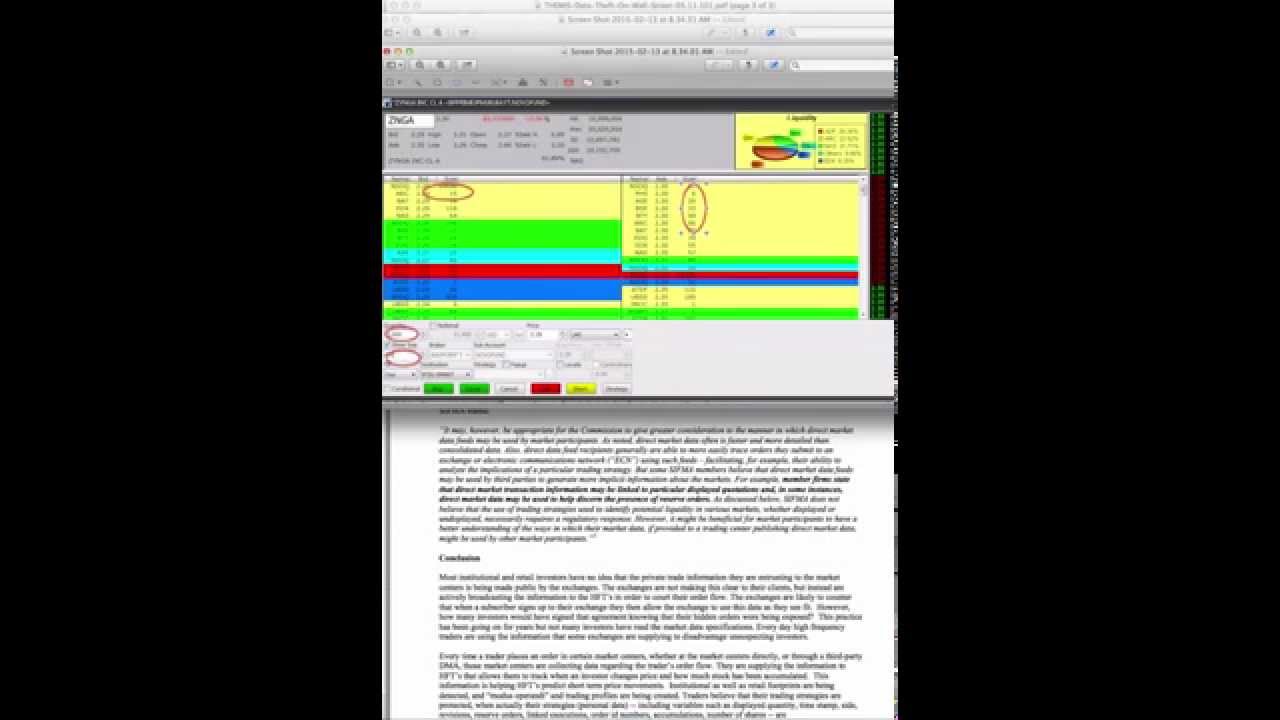
Hi, this is David Trainer, CEO of New Constructs, and today I'm going to explain exactly one of the ways high-frequency traders take advantage of effectively illegal inside information to rip you off. This is going to be very straightforward. It's a follow-on to a podcast I did earlier today, but I want to give you the specifics. First of all, I wrote about this on my blog, May 28th, 2010, as you can see here, and mainly what I refer to is a Article written by Themis, right? And it's the takeaway is that certain exchanges, particularly the New York Stock Exchange and NASDAQ, by admission were selling information about investors without their knowledge. And again, this article was freely available. I downloaded it back in May of 2010, and I put it on my blog. And the key takeaway here is that they found. That institutions that should be protecting your information were actually selling it. Certain market centers are marketing providing data feeds where they are revealing more information than just the original order, depth of book, and trade execution. This is being done legally as a byproduct of market structure that has gone horribly wrong. Exchanges will argue that this information is public and available to all investors. It's technically true, but realistically, not many retail or institutional investors have have the capital to invest in the type of computer systems needed to access the information. Not to mention, you'll get it late if you don't pay for rent in the basement of the New York Stock Exchange or NASDAQ. It takes a whole lot of money to do that. This article speaks specifically to the kind of information that they're providing in the effectively illegal data feeds they're selling to people. And it's not just NASDAQ. It's not just the New York Stock Exchange. It's some of the big online trading firms. It's documented in Flash Traders, which I recommend— I'm sorry, Flash Boys, written by Michael Lewis, which talks about how many hundreds of millions of dollars have been spent on high-frequency trading. Now, one of the things I want to do is reveal to you exactly how this works, one of the techniques. And I'm going to explain, I'm going to show you my trading system. So for example, when you're setting an order Creating an order, like for example Zynga, which by the way we put in the danger zone a while ago. It is down, I guess, almost 14% today, right? But I want to show— if I wanted to put in an order to buy or sell, this is a typical trading screen on the way things work. This shows me kind of what the, what the orders are. Notice how small they are. This is a stock with a lot of volume today. It's traded already this morning And I did this thing around the market had been open for less than half an hour. The volume today was was 11.5 million, but we're seeing these trades, these tiny increments. Are you kidding me? Right. These are the orders that people these are the order size that people show, not necessarily what they're willing to trade. And what you can see here is actually when you're putting in an order, you can see that you can tell them what you want the quantity of that order to be. Right. You can also choose. To show what size of, of an order you want to do, right? So here you can see that my quantity is 5,000. That's how much I want to get done, but I'm only going to show 30. So I don't know, this guy's showing 11, he could have 11,000 in his order, right? And it changes all the time. You know, here's another picture, another example. I, again, same order size. I'm putting 30 in here again, but you can see 6,664 shares, right? And, you know, on the other side, very low numbers, right? So the point is, the exchanges are selling the fact that even if you're showing 30, we're going to tell people that you actually want to buy 5,000 so they know actually what the real, not just stated demand for the stock is, but what I would also call the latent demand for the stock. Or the hidden demand. And this is one of the ways that the high-frequency traders can rip you off. And if you want access to more information on that, on that front, come to my blog and download this paper. This is one of the original key pieces of evidence that Michael Lewis used in Flash Boys to build that story. He did a lot of other research, but this was a key piece of it. And it documents specifically what they're doing. So it's excellent. Excellent detail on how to understand really the truth around how high-frequency traders are ripping you off.