David Trainer shows how New Constructs rates stocks by combining high-quality earnings (rising ROIC, positive economic earnings) with cheap valuations. The Most Attractive list only includes stocks rated Very Attractive, and long-short portfolios of these picks have outperformed the S&P 500. Gold members get monthly lists for $49 to $50 per month.
Chapters
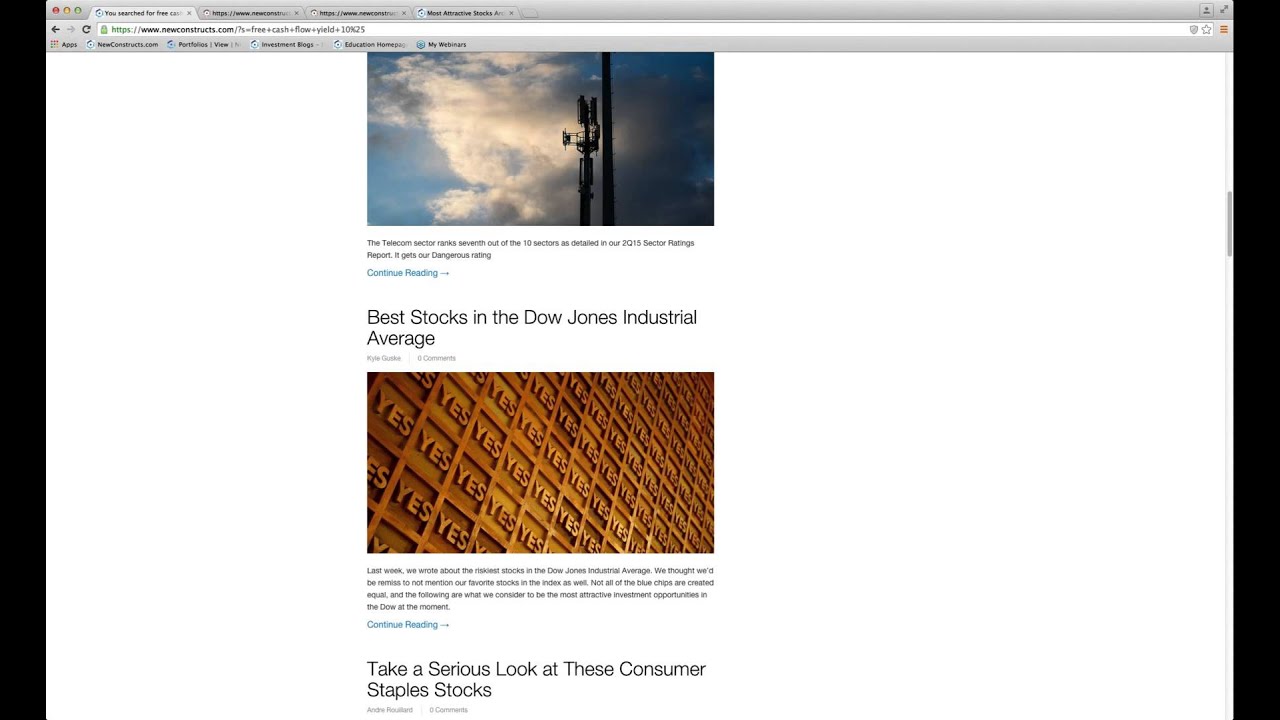
And the Most Attractive Stocks report also has small-cap stocks for May. And this is a list of 20, or we only have 18 make the list. We can only find 18. We aim for 20, but if we don't have 20, we don't put something on there that doesn't deserve to be on there. And so, We only have 18. And those are the key stats for all 18 of those small-cap most attractive stocks. And we'll go on and we'll talk about the performance. These are the stocks that went up last month on the list. These are the stocks on the large-cap list and on the small-cap list. And then we'll go through our methodology, right? And I'll take a minute here just to go through methodology again because I think it's important. But we did talk a lot about this methodology because this is effectively our rating methodology. But in the last 2 webinars, that's what we focused on. But all of the attractive stocks have high-quality earnings based on strong and rising returns on invested capital and economic earnings or cash flows that are positive, right? And then they've got cheap valuations. So, here we're saying high-quality earnings means good company, cheap valuations means good stock. Right? Because as I've said before on a few other podcasts, that if the company's got a great business model, really high profits, but if the valuation of the stock implies that the profits are going to be even greater or potentially tremendously greater for a very long amount of time, well, then that's not a good stock. It's not a good stock investment. I'm not saying it's not a good trading investment. I'm saying there's a big difference between trading and investing. But to make the Most Attractive Stocks list, you have to meet these criteria. And only stocks that earn an overall rating of Very Attractive are allowed on our Most Attractive Stocks list. And the report will also include details on the rating system, as you can get from all of our reports. So that's the Most Attractive Stocks report. Again, this is how you find good stocks on our system. You download the most attractive stocks and also, you know, we have the most dangerous stocks here and that's published monthly as well. You can download that report if you're a client and get the stocks that make our list that you should avoid the most. And they're the flip side of the most attractive stocks, right? They're the most dangerous, but they've got, in terms of methodology, the opposite methodology, poor quality earnings and expensive valuations. A double whammy. Not only does the business not look good, but the valuation is expensive. At some point, there will likely be a correction between the disconnect of the business model and the valuation. So finding good stocks is really easy, right? This webinar is simple, right? You go in, you go to the stocks, you can go in and come into the stock screener and say, okay, I want to find all the consumer staples sector stocks that get a very attractive rating. Click filter. There it is. There's 4 of them. Okay, I'm interested in consumer staples and technology. Let me see how many very attractive I can get there. Okay, quite a few more. All right, and let's say I'm— again, I'm really interested in price-to-economic book value that is, let's say, less than or equal to 1, and we'll click on positive results only as well. Filter. And that's a list. And I've got this list of information technology stocks and consumer staple stocks that get a very attractive rating. Let's say this is something I want to track, then I would just click Add All. And I'll put this into my webinar portfolio, conveniently named as such for this occasion. Add to portfolio. And now in my, my portfolio screen, I've got Webinar Portfolio and it has all these stocks. And I can check off to get alerts that'll let me know for the Webinar Portfolio, daily alerts and a weekly portfolio review alert. It will go to whatever email addresses I put in here automatically is your email address for your account. You can add a secondary address for an assistant or colleague. And the daily alerts will let you know exactly when or if anything has changed on the list. If there's a change in a rating, there's a new analyst note, there's a new model, all those things will be tracked. And you have now able to track in your system 4 new constructs, all the very attractive stocks that you want to have access to, the stocks that you like, good stocks based on looking at the screener, right? Now we also mentioned, again, just circle back ETFs or mutual funds. Let's say you want ETFs also in the consumer discretionary and information technology sector. And again, you want very attractive. And let's say we want assets over, let's say, $500 million. Filter. We've got 3. Let's say we want to add all those as well. Now they're in my portfolio. And here we are, portfolio with very attractive stocks and ETFs that we like. All right, so that's how you find good stocks, good ETFs, good mutual funds in our system. Any questions from the audience? Ah, good one. Performance, the most attractive, most dangerous stocks. So, absolutely, we track that for you. And we've got a quarterly update on past performance tracking. This is as of the end of March. But this will show you— this report will show you the performance by quarter and over time of our most attractive and most dangerous stocks list. So, you can see here for the large and small-cap stocks, this is a long-short that has outperformed. The large cap long-short has outperformed. Small caps outperformed, but the most attractive stocks only have outperformed as well. We're seeing a nice, you know, here recently, a nice sort of extension in our lead over the S&P 500 and Russell 2000. This is large and small cap most attractive stocks. Here's the large cap only. And here's the performance of the small cap only. Again, you can download this report for free from the investment research section. Go to past performance tracking and download. Yes, the monthly list, the most attractive, most dangerous stocks list. Yes, another question. I'll read it for you. How can I find the most attractive stocks list every month? Well, The best thing to do is to sign up to our homepage or our mailing list, right? If you're not a client and you want to get alerts, we will send you an alert. Sign up here and you can get alerts. And we will— so we'll let you know as soon as that list is published. It'll be first published to clients a few days before we make it available to the public. And then it'll be eventually made available for for the public a few days after we make it available to clients. But that's how you get access. And if you are a client, you just come in here and you would access this through here, the Most Attractive page, or you would access it through your dashboard, which at the top of your dashboard— and you wouldn't have that page I just went to, that's an internal login thing. But you would, on your dashboard, be able to quickly and easily download that. How much does it cost to access those reports? So if you wanted to, to get a sense of cost, here you are. Uh, the free membership, you will not get those reports. Um, at starting with the gold membership, you do get our most attractive, most dangerous stocks lists. And I would say that that is a pretty incredible deal. to get that list updated every month considering its performance for just $50 a month. You get a list of stocks that have been screened with an unprecedented level of scrutiny with respect to their footnotes, their quality of earnings, their valuation, and have a strong track record. And you also get a list of stocks to avoid the most. And that starts— you can get that for as easily as just $49 a month. Another question coming in here. Yes. Oh, what's the most important metric for the most attractive stocks? You know, I don't believe in any one metric. I don't believe in any one data point. You know, I think that's one of the challenges with respect to To risk and research in general. I mean, I can't tell you, you know, the big battle I had when I first got to Credit Suisse and getting people to use a more sophisticated model was that, you know, everybody wanted to focus on just one number. Yeah, we want to keep things simply, but— I have a little problem with getting some questions in here. I didn't see a few of these that came through. I apologize. Oh, my bad. I'm not seeing. So, I don't really like to say there's any one metric, to be honest with you, right? I mean, for me, you know, it's all these things in combination, right? You can't have a good company and necessarily good stock. It's hard to find both. And so, to say one metric is more important than the others is tough for me to do. But if I have to pick one, and look, that's what I got to do because that's the question, I'm going with free cash flow yield. And that's because in our backtesting, we found that that's sort of one of the single most important factors in backtesting and finding good stocks. Companies with a free cash flow yield of greater than 10% tend to do really well. And I think we've probably got some information on that on our blog here. That you can look up for historical analysis on that. Free cash flow yield 10%. Let's see, it's an older report. Oof, that's— yeah, I think the, uh, Sorry to take a little while here. I won't search for much longer. I think it's actually why free cash flow matters so much is the, uh, is the search term. But if you guys want to have access to that, I'm not going to bore everybody with my search here. I should have been more prepared on this front. Sorry. Uh, send me an email and I will absolutely get you that report. But it's effectively an analysis of our backtesting, uh, And which, you know, backtesting a free cash flow yield. So that's, um, that's a key thing. Free cash flow yield is— if you ask me to choose one, I'm gonna go with free cash flow yield. Uh, so another question, I apologize. So what's the difference between most attractive and very attractive? The most attractive is sort of a, is a special select group of, of, of very attractive stocks. So, um, you can be very attractive and not necessarily on this list. You can't be on this list and not be very attractive. That's the rule, right? So, um, that's, that's the key there. Uh, inclusion in most attractive is not really subjective. The criteria are fully defined in the report. And so, uh, and by that, that was a question from the audience. Is it subjective? It's more subjective than very attractive, attractive, and the rest of the rating system. Absolutely. Because that's purely quantitative. You know, those are determined. But we went on and added an additional layer of methodology here on very attractive stocks, or sorry, the most attractive stocks that is explained explicitly on the report so that you understand exactly what it takes to make the most attractive stocks list. You can be very attractive and not necessarily have all of these characteristics. So that's the slight difference. Another question. Do we have any favorite leading indicators for quality of earnings changes? Day sales outstanding, for example. You know, that's a tough one too. We're looking at so many things. And do we have things that are a leading indicator? We feel like Most of the time, the economic earnings itself is a leading indicator for quality of earnings issues. So, for example, my Danger Zone conversations and a lot of times on CNBC, we'll point out there's a big difference between economic earnings and accounting earnings. And the economic earnings, the difference between the two, when the economic earnings are low and declining, that were negative and declining and accounting earnings are positive and rising, we call that misleading earnings. And you'll see that that is a core requirement to be on the most dangerous stocks list, right? So you can get a very dangerous rating and not make the most dangerous stocks list because in order to make this list, you have to have a misleading trend or have positive and rising accounting earnings even while economic earnings are declining. So point is, I think the leading indicator for quality of earnings changes that will actually manifest in the public eye, more in the public eye, and hit CNBC and cause numbers to come down or forecasts to come down, estimates to come down or forecasts to come down, is the economic earnings number itself. And we saw a great example of that recently was Zulily. We said that that business model is under attack. And despite the fact that everybody on Wall Street was saying, bye, bye, bye, We said it was one of the IPOs that was going to potentially be a blowup because the valuation was out of control and the business model was not going to be able to hold up. And lo and behold, the stock's totally blown up and you got Wall Street analysts out there apologizing for making such a horrible call. And I did a podcast on this yesterday because it was— these stifle analysts are effectively clearly revealed as folks who are— Making calls for the wrong reasons. I did another podcast recently talking about Netflix, and because there's a big, huge reversal from Merrill Lynch going from a neutral to a buy rating and coming up with some like $1,300 stock price on Netflix, all because of the positive momentum of the stock, nothing to do with the underlying fundamentals. And I was proud to say that another analyst from Wedbush Securities called them out in an interview on CNBC. Now, I was a little upset that CNBC didn't call me to call them out because I've been saying for a long time that you shouldn't be making investments based on momentum alone. But yes, the leading indicator for quality of earnings issues is this one right here. When you start to see a misleading trend, that's when the alarm bells go off for us that, hey, the quality of earnings for this business are not as good as, as they seem. And we're, we're expecting that they're going to have to bring numbers down or take down their forecasts, their expected earnings in the not too distant future. So, I got a question here. How is our method different from rule number 1 or Warren Buffett value investing? I don't exactly know rule number 1 that you're referring to here. So, if you wouldn't mind, and I won't mention your name online, so I'll give you a little anonymity here. But yeah, give me some more detail on that. But how is our method different from Warren Buffett's? Not at all different. I think actually we are the best and purest implementation of the value investing philosophy. In fact, when we built out our education section of our site, one of the things I wanted to add here is learn how to be a true value investor. We effectively allow our clients with about 1,000th of the amount of work, 1,000th Of the amount of work that it requires for you to do this on your own to operate with the kind of intelligence and insight that Warren Buffett-type investors do. I'm not going to say we can replicate Warren Buffett because, you know, heaven knows the guy is like, he's unbelievable, right? Dan Loeb, I think, made some good comments about some contradictions and some of the things he says and does. But let's face it, man, we all love the guy. He represents a lot of what is right. about the world of investing, especially value investing. And I think he gives most of the time sage advice to investors about markets, about being long-term oriented. And yes, we are by far, far and away, the best possible implementation of value investing. We make value investing possible for people that are typically unable to really be value investors. Unless you've got time to read annual reports and build models, you can't really be a value investor. Unfortunately, all the propaganda from CNBC and Wall Street doesn't want you to know that, right? Everything's geared to you should trade now, buy, buy, buy, sell, sell, sell, right? I mean, God bless him, Ben Graham's probably rolling over in his grave every time Jim Cramer comes on the air. He's probably over it by now, but when he first came on the air and the buy, buy, buy, sell, sell, sell stuff, I mean, it's just the opposite of investing. It's trading. And yes, we give you the tools To be a true value investor. And we educate you on how— what that is. Because you know what? You can't get that from anyone else. No one else is going to take the time to educate you on this because you know what? They don't want you to know how to do it because then you'll start asking questions they can't answer. And I highly encourage you, if you're an advisor, tell your clients what it means to be an investor versus a trader. Help them understand that distinction and they'll appreciate it. If you're an investor, ask your advisor if they know the difference. Ask them if they know what a value investor is. Ask them if they know what investing means. You know, we've got a nice little article in the blog on this topic. You know, that was one of my first blog comments. This is back in June of 2010. I wrote a couple comments about the difference between a speculator and investor, right? I'll tell you right now, speculators don't care about very attractive or most attractive. Stocks. A speculator just cares about what's going to go up tomorrow. And I think it's very well articulated here by Ben Graham. If you are a speculator, your decision to buy or sell is based on what you believe about the near-term direction of price. Speculation is the activity of forecasting the psychology of the market. What do you hear all day, every day on CNBC? It's this kind of talk. What you don't hear much is this, except when I go on and a few other people go on. And this is what we're about— value investing, forecasting the yield of assets over the life of the asset. If you look at our models, you look at our recommendations, that's what it's all about. Screening for stocks that have a very attractive or attractive rating, you can go by sector and you can filter in a matter of seconds. Same with mutual funds. And ETFs, as we've shown before. And remember that when it comes to a rating, it's focused on quality of earnings and valuation. This is where we measure whether or not it's a good company. This is where we measure whether or not we measure it's a good stock. You got to have both in order to get a very attractive rating. You got to score well across at least 4 out of 5 of these categories. All right. Oh, one more question. Sorry, we got a little bit of time left. Can simply attractive stocks make the Most Attractive Stocks list? No, you have to be very attractive to make the Most Attractive Stocks list. That's one of the key criteria. We want to make sure that we only give you the best of the best ideas. And that's why this month we've only got 18 on the small-cap list because we couldn't find 20. We're not going to try to pretend something is good If it's not, and I think that gives us a big advantage versus Wall Street, a huge advantage versus Wall Street. If you go look at the distribution of their ratings, and this is true for Morningstar, right? And I did a nice article on this a while ago. There's a largely disproportionate skew towards positive ratings for Wall Street and for Morningstar. Let's see, this was an analysis where we looked at how our ratings compared to theirs. I did some good— there's some good charts here showing the distribution. There we go. Positively skewed, right? Large number or majority of their ratings are gold and silver or bronze. Very, very few negative. Very similar to the distribution of ratings on Wall Street, right? Not surprising. Okay. And that's one of the benefits of being independent. If we only got 2 very attractive stocks, so be it. We're not changing the rules to make sure we only have 2 very attractive stocks, right? Or to make sure we have more than 2 very attractive stocks. They are what they are. We are true to our roots. We are true to our methodology. We are true to our beliefs. And we think that's part of what makes New Constructs a great resource for advisors, for individual investors, and for institutional clients who access some of the more sophisticated datasets and data points and models. Okay, thank you very much for your time today. Keep in mind that we are going to be doing a new series, sort of a fireside chat, where we're going to actually do an entire webinar based on client questions, not just a few minutes here at the end. We're keeping these things to 30 minutes. We're going to do them every week. And, you know, remember, contact us on Facebook, Twitter, LinkedIn, email me at support@newconstructs.com. Anytime. Email us at David— email me at david.trainer@newconstructs.com. We want to hear your questions. We want to answer them. We want to show you how transparent we are, and we want to show you how we do the best work in the world on the 3,000+ stocks we cover, the 7,000+ mutual funds, the 400+ ETFs. Again, thanks very much for your time. Have a great week, and I look forward to being with you next week. Thank you. Muted. Unmuted. Muted. Muted.
More from David




Earnings Recap: Decoding Signals from SpaceX, Palantir, Merck, AMD, Caterpillar, McDonald’s, & More

Watch Our Earnings Recap: Market Heavyweights Apple, Microsoft, Amazon, Meta, Visa, and More



Earnings Recap: Top Insights from JPMorgan, Bank of America, Taiwan Semiconductor, Netflix, and More


The IPO Melt Up: How Smart Investors Use AI to Find Abnormal Investment Opportunities