David Trainer shows why high dividend yields can be traps. Companies often fund payouts with debt or new shares rather than actual earnings. He walks through real cases like Welltower and American Campus Communities, then explains how to screen for stocks with real free cash flow instead.
Chapters
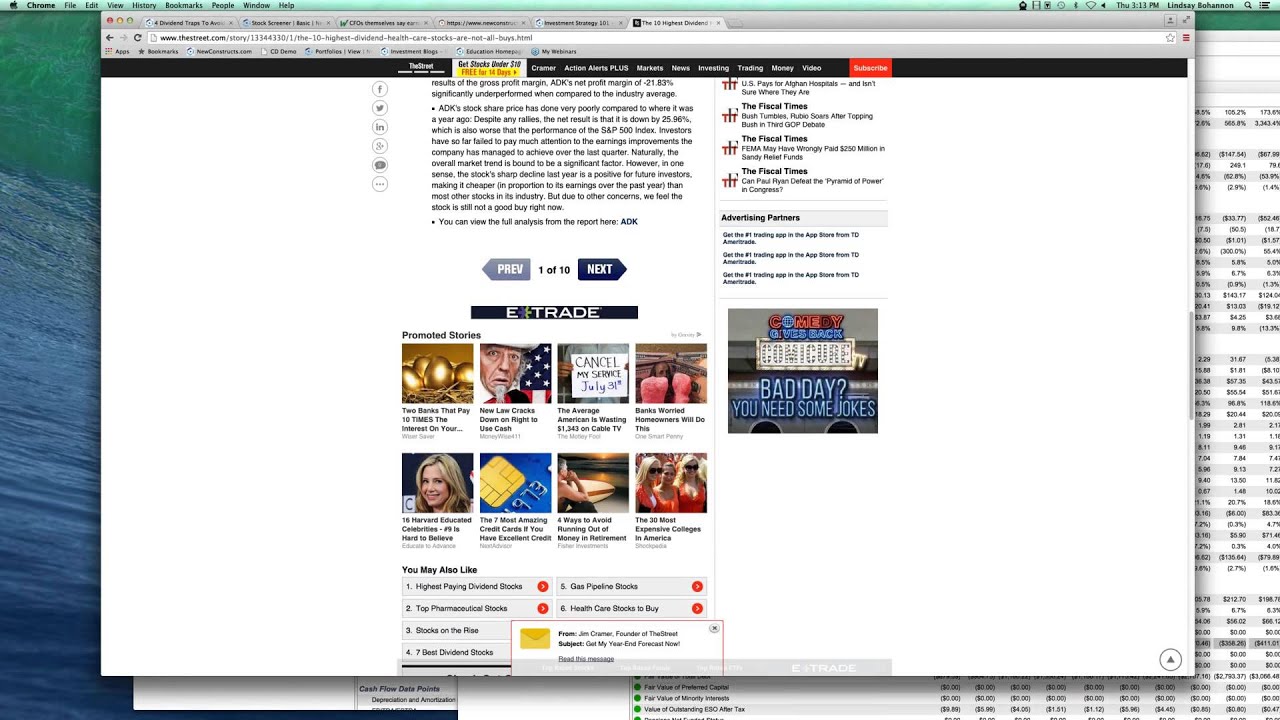
Feel free at any time to email me questions at david.trainer@newconstructs.com. You can follow us on Twitter, Facebook, StockTwits, pretty much any place people like to follow people, you can find New Constructs. So today our topic is how to avoid dividend traps, and I think this is an especially important topic in a world where really people seem more than ever obsessed with dividends. They buy a stock for the dividend without understanding the actual sustainability of that dividend, the capital risk in the stock. If a stock pays a 5% dividend but it goes down 25%, you still lose money. Dividends by themselves are not always a good thing. The issue here is that people have forgotten. I remember when I started in this business, In the mid-'90s, one of the approaches to valuation was the dividend discount model. And as I learned more about valuation, I was like, what the heck is a dividend? Why would you discount dividends? I mean, dividends— well, first of all, when I got started in the business, there was a lot of companies that didn't pay dividends, especially during the tech bubble. But dividends don't necessarily reflect cash flow, right? A company can borrow money. Dividends. They can pay down cash reserves to pay dividends. Dividends are not always, and I think often not, reflective of the profits of the business. A dividend can be misleading. Look, I've got to hammer on these things again. There's a lot of things that's misleading about research. One of the biggest things that's most misleading about research in general, I think, is that Most people assume that Wall Street analysts or any analyst in general, they actually read annual reports, footnotes, and check for all the accounting distortion. They don't, right? And this is not just me saying it. The folks at MarketWatch did this survey. Not only do they point out that companies— 20% of CFOs intentionally misrepresent their earnings by almost 10 cents on the dollar, right? But they also mentioned in the same article, in the same study, that most sell-side analysts don't even know how to detect that. As a former sell-side analyst that worked on Wall Street, trust me, their incentives are not aligned with yours. Wall Street analysts don't get paid for good advice. They get paid for helping do things at other parts of the bank. The other parts of the bank are investment banking and trading. So if you're not helping the bank make money in investment banking and trading, you're You don't serve any purpose, and that means that's where your focus is. And I know in the mid-'90s when I was on Wall Street, very few people read annual reports. As the tech bubble kicked in, people laughed at the idea of reading an annual report. Why spend your time buried in details that don't matter to getting a $50 billion IPO out the door? How much money is reading the annual report going to add to your bottom line? The answer is next to none. So Companies misrepresent. And by the way, Financial Times did a great study on how often buy ratings are not reliable. So I think that it's important to bring an ounce, or at least a pinch of skepticism, to research and certain myths, like dividend discount models as a way to value stocks, that dividends are good, or that earnings are representative of cash flow. Or that stock ratings from Wall Street firms are valuable or can be helpful to your investment process. These things are all many times, in many cases, contra-indicators. Just so you know, I'm not just throwing stones at other people. We have a very specific methodology. We believe that the market is not perfectly efficient, semi-efficient, which means that most companies are probably fairly valued, but there are some that are too cheap and too expensive. As you all know, we've done a number of market-leading studies on profitability and reversing accounting distortion, and so I have a similar model here for how well companies report their profitability. Most kind of do it fairly well. Now it's skewed toward overstated because accounting numbers in general overstate cash flow, but again, there are fat tails here where there are companies who are meaningfully overstating their earnings And there are companies that are meaningfully understating. And it's the overlap of the undervalued stock and understated cash flows where you want to be long, and the overvalued stock and overstated cash flows where you want to avoid. That's our methodology. So dividend traps. We did a special report on dividend traps, part of one of our special offers, 4 Dividend Traps to Avoid. Oh, I'm not logged in, I guess. Sorry about that. 4 Dividend Traps to Avoid, right? It was available only to Our institutional customers and those who bought the report. These are very specific stories or articles on 4 stocks where cash flow cannot necessarily support the dividend. So for example, the last time this company, Welltower, ticker HCN, earned positive free cash flow was in 2001, and every year since They've actually had a negative cash flow despite the fact that they're sporting a 4.84% dividend yield. How do they do that? They just keep selling shares. Over the past 5 years, the share count has increased 150%, effectively a Ponzi scheme where new investors are subsidizing the distributions made to old ones. So if you want to do a little more digging, go to ACN and understand our cash flow model. That's not hard. Where would we get this information? Type in a ticker, open a model. See, the valuation here is pretty strong, too, or pretty expensive. But just go to the metrics page. Let's look at free cash flow. Look at this. 2005— shoot, 2002. 2001 was positive free cash flow, right? $400,000. Negative $71 million, negative $176 million, negative $102 million, negative $10 million, negative $453 million. Negative $300 million, negative $537 million, negative $400 million. Let's see, $2.4 billion, $3 billion, $1.1 billion, $1.3 billion, increasingly negative. How do they afford this? It's pretty outrageous. Let's see, let's look at the cash. Cash is negative. Cash went down a ton in the last couple years, up this year, and we're looking at shares outstanding, split adjusted, huge increases in shares outstanding, huge increases. So again, there's the example of exactly what's going on. behind the scenes with that dividend trap. Tall International Group, 17% dividend yield, even though it's been in decline over the last few years. Negative free cash flow over that past 10 years, and they're financing their dividends with $3.2 billion in debt. All right, so they're borrowing money to pay dividends. Right, so this 70% dividend, not as good as it may seem. The fact of the matter is these guys are not going to be able to support it forever, and you want to avoid— don't fall for that dividend trap. It's just not sustainable. So let's take a look here. Company model, metrics. Free cash flow, geez, we don't see that being positive anytime here in the recent past. Looking at excess cash, almost none. Debt going up significantly. Deferred tax liabilities going up as well. Right. Dividends— I'm sorry, debts and liabilities growing much faster. Then cash flow, well, growing faster than anything. There is no cash flow. So you've got to be careful there, guys. There's 2 examples right there. And there's— let's do one more from the report. We'll leave the 4th one to your imagination. ACC, American Campus Communities. Negative free cash flow for 5 straight years, negative $3.1 billion. And $2.8 billion in total debt, even though it's got a 4.23% dividend yield. I don't know how they keep paying that. It's only a matter of time. So that's my point, is that these companies can pay dividends despite the fact that they're not making any money, which means it's not sustainable unless they want to continue to dilute existing shareholders By taking capital from new shareholders and using that to pay the existing shareholders or borrowing money. That's dilutive to you too as an investor. The more debt in the business, the lower you are on the food chain for getting cash flows. If you wonder, well then how, David, how do we find stocks that can have quality dividends? Well, I think, look, if they have a good free cash flow yield, they're going to be able to pay for their dividends, or they're going to be able to support dividends. So, you know, our models focus on free cash flow yield, and here we are sorting, I think, the coverage universe that we focus on by free cash flow yield. So if you're looking at a particular sector, IT, free cash flow yields tend to be pretty strong here. If you want to look for something in healthcare, Free cash flows tend to be pretty strong here. I got a question coming in here over the line. Comment on KKR's dividend decision this week. I'm not sure. I don't remember what their dividend decision was. I didn't pay attention to that. So if you want to put some more detail in that question, I'll get back to it. In the meantime, let's run through an example here where we look at some high dividend— let's just try to do a debunk some of these high dividend stories that are all over the internet, high dividend stocks. You do a search for that and you get a lot of listings. Let me just go to a file here that I've used to feed things along. So you've got a lot of sponsored stuff, some of this stuff is just for getting people to try and get page views. This article, they're not going to put the list of high dividend paying stocks here. You're going to have to thumb through. Actually, no, it's all right here on one page. Well, no, it's not. You've got to go through 10 pages. Not uncommon. Let's take a look at another list real fast. What you find in some of these lists is these aren't even stocks. A lot of these are trusts. Or some other kind of financial construct that is designed probably to do nothing but pay a dividend. You've got to be careful with these. Sometimes they don't have a lot of liquidity. It's hard to get research on them if there's any research at all. I know some of our institutional clients have begged us to cover certain master limited partnerships, business development companies, not begged us but asked us to cover them because they couldn't get good research on it. You've got to be careful with those. I did find a list when I was preparing for this presentation. There's one pretty decent list that actually was stocks. One of the things I recommend is you can copy something like this off— Copy this. Open some— open Excel. Paste this into Excel. Whoops. I didn't want to do it that way. That takes way too long. But there's the list. All right, I've actually done a little work on this. That's the list when you put it into a form where you can copy and paste it. So if you're interested in getting a sense of what's the quality of these stocks, what's the free cash flow yield, you could type them in one by one. That's the hard way. I created a portfolio here. We can create one from scratch. Webinar High Dividend Portfolio. Stocks screen. Whoops, too long. So we've got this new portfolio created. I'll go to that list. I'll paste in that list from the prior page, and here we are. So we can very quickly sort the group by free cash flow yield. Neutral rating, -7% free cash flow, probably not a good dividend stock. All these neutral and dangerous rated stocks with negative free cash flow yield, probably not good. On the other hand, strong free cash flow, very attractive rating, good dividend, that would be a good one to go with. We got actually a write-in question ahead of the call, which is always great. You know you're going to get your answers. Get your questions answered if you send them in ahead of time. I created, I think, another portfolio. I put those in the wrong one. Whoops. This was the new portfolio. Those are all those. This one was really supposed to just focus on a few stocks. One of our clients wrote in and asked me to look at how do you avoid value traps altogether? Like ABK, AIG, BlackBerry, Hewlett-Packard, and Tyco. ABK is a ticker that I could not— that did not translate to anything in our system. So we're going to remove all the stocks in this portfolio. I'll leave Hewlett-Packard because that's one of them. But he asked about AIG. RIMX, HPQ, and TYC. I don't know, maybe it's not RIMX. What is the ticker for BlackBerry these days? BBRY, okay. So I wouldn't— BlackBerry's got a great free cash flow yield. I think your dividend's probably going to be OK. Now whether or not it's a value trap is a different question. I think the same is true. This gets into sort of a theoretical discussion about stocks that look cheap. I definitely was really wrong about BlackBerry a couple of years ago where we saw just a price-to-economic-book value that was 0.6 or something, and the market was implying the company's profits were going to decline by 40% or more. Guess what? Well, they did. Sometimes when the market is pessimistic, it's correct. The answer is how do you avoid value traps like that? You know what? You can't get away with just trusting the numbers. New Constructs is not intended to be the crystal ball answer for all things stock related. What we're doing is doing your fundamental due diligence for you. We're telling you what kind of quality of earnings the business has, what the health of the business is in terms of profitability, and then we're going to align that with valuation analysis. What kind of expectations are baked into the stock price? Whether or not the company is going to beat or meet those expectations. I try not to be in the business of making those kinds of predictions. That's why I like to talk about our strategy, our approach to investing in that Investment Strategy 101 article where we focus on the fat tails. What's the fat tails? Right. The idea is to focus on the fat tails where valuations are too expensive, earnings are too untrue. That's the idea. And I think that's the real answer in terms of value traps. You've got to make sure that just because the cash flows look decent and the valuation looks cheap, They could be on a big decline. That was the case with BlackBerry, right? They had a really high return on invested capital, 60-70%, but it was going to 39% pretty fast, and the valuation really wasn't even looking at or taking into account how much the profitability was going to go down. So the question on KBR, that they're no longer going to distribute 75-80% of distributable cash flow. At the end of the day, and this gets to another question that I need to get to as well, what do we think about dividends? Well, dividends, as I mentioned before, they are a use of cash, but they are not necessarily representative of how much cash flow the business has. For KKR to go from talking about distributing 75% to 80% of distributable earnings as dividends, but Going to a quarterly dividend of just 16 cents per share. I think that maybe made it easier for them to set it at a specific amount and not worry about how they dealt with it. It may lower the bar. I don't know if 16 cents per share, I don't know off the top of my head what percent of distributable earnings that represents. But at the end of the day, a lot of this is just window dressing. Because at the end of the day, what you need to understand is cash flows. You need to be able to look through to a company And understand what the cash flows are. Dividends are just a use of cash flow, right? I've told you already that, you know what, you can actually pay a dividend whether or not you have any cash flow. So at the end of the day, it's more important to go upstream. Don't just trust what you're seeing superficially, whether it's a dividend, a change in dividend policy, whatever it is. I think a lot of times this is just noise to distract you from more important issues. More important issues which are cash flow and valuation, the fundamentals. What do the fundamentals of the stock look like? By the way, I apologize, return on capital for BlackBerry went from 78% to 0%. I was looking at the free cash flow yield before when I was talking about 39%. Yeah, it went to 0%, in fact a little bit below 0%. So that's what happens when you're in a business and you refuse to be honest about what your competitive pressures are. Things can happen quickly. It's difficult to maintain high returns on invested capital. That's been part of our thesis on Apple. Super profitable business. What's the returns on capital for Apple? 277%, I think it was as high as 370%. That's abnormally high. I don't think that's sustainable, which means if they get back to something more like 60%, 50%, the value of the stock is closer to $40, $50. So I don't know when that's going to happen. It may never happen. I just know that it's very unlikely that any company can sustain returns this high for any long period of time. Apple's a super company, super profitable business, so profitable that it's going to warrant attack and interest from everybody, from lots of other firms looking to get a piece of that. If they can make 250%, they'll be happy to make 250% return on capital. They can make $200. They can make $150. They can make $100. You get the idea. It's a race to zero. That's what the world's about. It's competitive. People are trying to get high returns on capital all the time. They're difficult to get. That's part of why you've got a whole lot more high dividend paying stocks, high dividend yielding stocks out there than there are good cash flow stocks, because companies are going to try and convince you to buy their stock by putting up a good dividend, because they're hoping they You'll focus on the dividend and not the actual cash flows. You need to focus on cash flows to be successful in the long term. Levering up to pay a dividend, can it be a good thing? It's not good. It doesn't sound good to me. Obviously, if you've got super great cash flow and you're levering up, In order to buy back shares, I like that, right? In fact, in some of our recent articles, we've talked about certain stocks that have really great yields, not just dividend yields, but dividend and buyback yields. Here's a good example, Qualcomm. The stock buyback plus the dividend yield is 9%. So $4.5 billion of repurchases, which is what we estimate they're going to do, and that's a— I remember that was a conservative assumption that Kyle came up with. That's 5% of the market cap getting bought back every year. That's a payback, right? Plus 3.7% dividend yield. That gets you pretty darn close to 9%. That's a good deal. That's what I suggest you look at. Look, if you've got cash flow, you don't need to lever up, but to the extent you want to use that cash flow— I'm sorry, use that debt to further buy back stock so that you're effectively changing your capital structure to make it more debt and less equity, which for super cash flow businesses effectively lowers your cost of capital, that's a situation where I think levering up to pay a dividend would make sense. But really, you're not really levering up to pay a dividend. You're levering up to buy back shares, which is a different kind of dividend. Quantitative indicators— another question here— quantitative indicators for finding the best— for identifying dividend traps? It's that free cash flow yield, as I mentioned before. If you're ever curious about a particular company and its dividend, if you guys want to write in some tickers right now, I'll run them through the system and check them for their quality. Some stocks are very cyclical, and they'll be able to pay the dividend because they can make enough money over the long term to compensate for the fact that they're not profitable in some periods of time, but some aren't. And the one ratio I would focus on most is free cash flow yield, because free cash flow is really the cash flow available for distribution to all stakeholders. And that's kind of the best proxy for dividend yield or the quality of a dividend yield. It's the most apples-to-apples number. If the free cash flow yield is good and the dividend yield is high, that's a red flag. And vice versa, it's a good thing because anytime the free cash flow yield is good, That's a good thing. I think anytime you're buying a stock with a dangerous or worse rating, you're taking risk. Either the quality of earnings are bad, they're going to miss on earnings, or the valuation is too high, or both. Valuation is a function of cash flow for us. It's not some multiple or other unique crazy metric. It's a very straightforward assessment of what kind of future cash flows are required to justify the stock price. Highly recommend the tutorials we've done, webinars on how to get to the truth, things like how to get to the truth about valuation, right? We've done some excellent work on Netflix, how to use our DCF model to analyze Netflix, which I think is a really interesting deal. We'll actually show you how to use the DCF, so that's cool. That's a really good one. All right, I got one more gem for you before we go here. Wells Fargo. Total yield, 5.3%. Buybacks at 2.5%, dividend at 2.8%, 5.3%. And it gets an attractive rating. That's what I call a smart investment. So as a takeaway, make sure that what you're investing in is what you understand. Don't trust things that are superficial. There's a lot of superficial influences out there. Earnings are one of them. Dividends are another. Ratings, don't trust them, right? Look, this is a buyer beware market. Anyone who's worked on Wall Street will tell you. It's about making as much money as fast as you can. It's not about being ethical. Investors, advisors, portfolio managers, do your diligence. Read the filings, understand cash flows, make sure you know what you don't know, because knowing what you don't know is just too risky. In markets that have been volatile like the ones we've had over the last several months, and I think like what we're going to expect to have over the next year or so, you're not going to be able to ride the wave of an upward-moving market. You're not going to be able to ride the wave of a positive sectoral theme. You're going to need to make good stock investments. And guess what, by the way, at the end of the day, doing your diligence, it pays dividends emotionally, with a clean conscience. You go to bed at night knowing you've done your real work. You're not resting on the Greater Fool theory. or potentially crowded technical trades that could blow up, be good one day and blow up the next. Thanks very much for your time. If you have any questions, please feel free to email me at david.trainer@newconstructs.com. Tweet us @NewConstructs. Hit us up on Twitter at D_Trainer_NewConstructs. And let us know what you think. Please provide feedback at the end of this presentation. And again, thank you for your time.
More from David




Earnings Recap: Decoding Signals from SpaceX, Palantir, Merck, AMD, Caterpillar, McDonald’s, & More

Watch Our Earnings Recap: Market Heavyweights Apple, Microsoft, Amazon, Meta, Visa, and More



Earnings Recap: Top Insights from JPMorgan, Bank of America, Taiwan Semiconductor, Netflix, and More


The IPO Melt Up: How Smart Investors Use AI to Find Abnormal Investment Opportunities