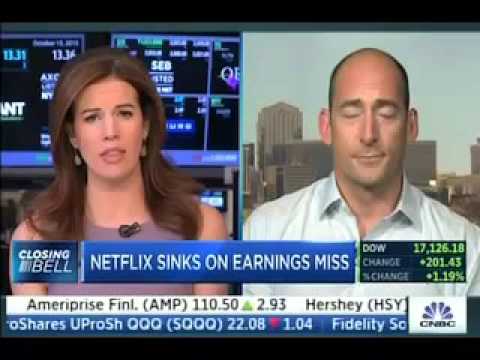
David Trainer argues Netflix stock is drastically overvalued, requiring 25% annual profit growth for over two decades to justify its price. The company burned $2.5 billion in cash over 2.5 years despite positive earnings, and content costs rose 17% year-over-year while international operations are unprofitable. Trainer says the stock needs a 70-80% decline to become attractive.
Chapters
Will it be enough? Joining us with his take now is David Trainer, who's CEO of New Constructs. David, are the shares attractive to you here after this sell-off?
Not even close. I mean, the current valuation implies that the company's profits will grow 25% compounded annually for over 2 decades. It's still very expensive.
What do you think's going on? I mean, one of the things that stood out to me is kind of frivolous. But, you know, this idea that so many of the customers got the new chip cards, credit cards, that they didn't have time to change their cart on their subscriptions, and that's why they saw this slowdown in subscriber rate. Is that what's going on, or is it something else here?
I agree with you, Bill. It sounds like a little bit of a head fake, you know, getting away from the fundamentals, which is that they've got quite a few customers already. I mean, they have like a 13% penetration in the United States. Internationally, they're still growing, right? But their margins are getting worse, more negative internationally, right? So they're not making any money internationally. And I think another head fake is that Netflix has been showing positive earnings for many years now. Their cash cash flows are highly negative. They've burned over $2.5 billion in cash flow over the last 2.5 years. So this company is not making money. And that's why we're seeing them have to go back to the capital markets to raise more capital, keep the business running.
Plenty of people, David, are also focused on the content costs here, which were up 17% on the year. Is their emphasis on original programming going to help mitigate that?
Oh, no. I mean, original content creation is extremely expensive. We've been pointing out for over a year now that there's an accounting loophole that allows them to meaningfully understate the cost of this content. That they're acquiring and building. And so, you know, their earnings are meaningfully overstated. This is a really unprofitable business. And a big part of the reason there's so many positive analysts out there is because they're chasing the banking business for this new secondary or debt raise. Right. So, you know, investors need to look through the headlines and the, and the superficial earnings numbers and understand this is a highly negative cash flow business right now.
Do you— so you may have answered my question. Is there anybody else you like in this category or you just don't like this category?
Well, I think the category is— it's a tough one in I think the streaming content, you know, the advantage is going to be in creating original content. The people who do that well consistently over time are very few and far between. But the one company that's sort of not really in the space but kind of is, is Verizon and their ability to be first to market on streaming live content. Because you can't DVR the live content like you can a TV show or—
Are you talking about the NFL?
Yeah, NFL and concerts and things like that, yes.
Okay. And by the way, yesterday we had a rowdy discussion about whether Netflix could simply just raise its prices to the $15 level or even above it, especially in the US in the years ahead. Do you think they would have at least that pricing power?
I don't know. I mean, look at the price of all the other services. You know, I think the Max one is around $20 a month. Amazon's is still at $8 or $9 a month. Right. And, you know, that's what they're going up against. Amazon's creating new content. But one of the things we did with our valuation models, and this is in the report on our site as well, is that we looked at the implications of doubling their price prices and doubling their margins, they still would have to have over 334 million— I'm sorry, 334 million customers at double the price and double the margin to justify today's stock price. There's only 320 million people in the United States. Right. So the expectations in the stock price are extremely high no matter what they do.
So again, you may have answered my question. Is it ludicrous to ask you, is there a price it would get down to that would make it attractive to you then?
It's a long way from where it is today. I mean, I think we're talking down 70, 80% before this gets to a place it's reasonable.
Wow.
All right.
We'll bring you back, David. Thank you.
Thanks, David.
Thank you. David Trainer, bearish on Netflix.
And look at this. The rally continues. We've got about 40 minutes left in the trading session here with the Dow now up 211 points. But the biggest gainer is the Nasdaq. Those biotechs powering higher. The Nasdaq up 1.7% right now.