New Constructs & Viola Research: Why The Tech Carnage Can Continue
New Constructs and Viola Risk Advisors argue that stock valuations are disconnected from actual earnings, with Tesla, Carvana, and Beyond Meat trading far above realistic prospects. They flag systemic risk in banks holding equity derivatives and recommend tier-1 perpetual preferreds as safer income alternatives.
Chapters
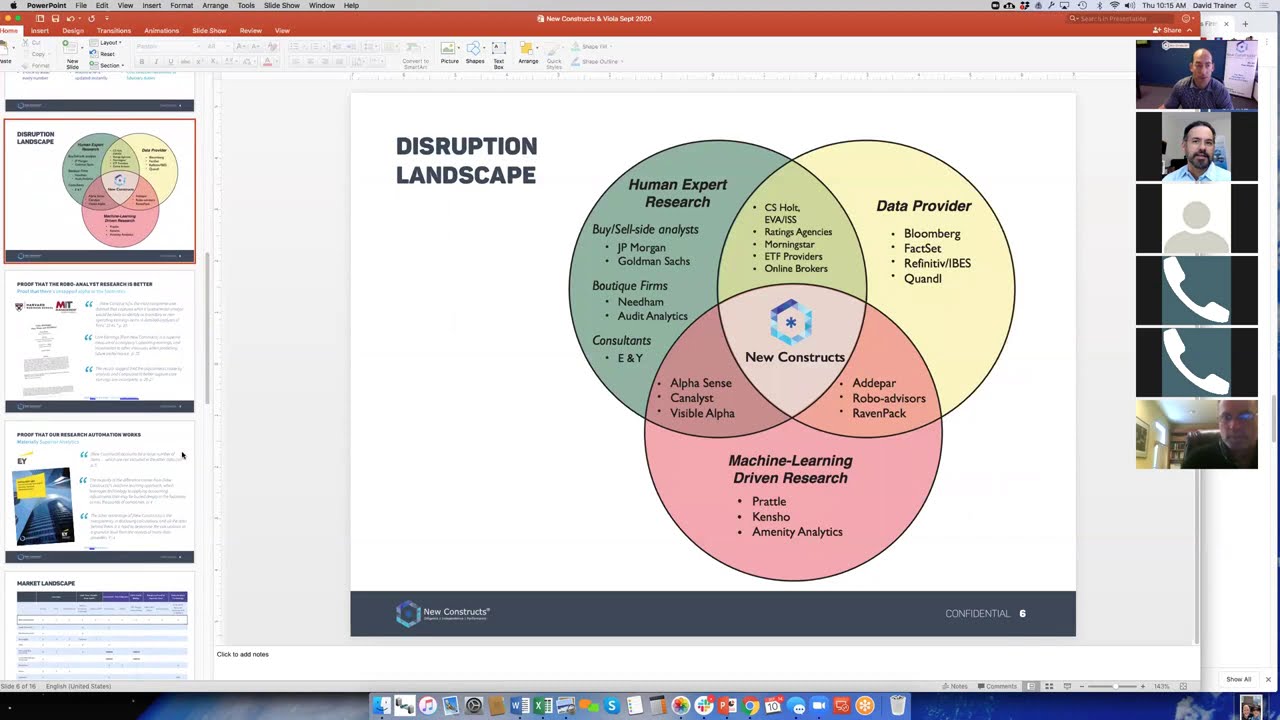
All right, everybody, welcome to our second-ever joint conference call with New Constructs and Viola Risk Advisors. We're gonna try to keep this pretty short and sweet. David and I have been working together for a long time, and as I was mentioning before we officially kicked this thing off, David is— Handler is sort of my analog on the fixed income side. Someone who looks to focus on the underlying fundamentals and the truth behind the numbers in the same way we do on the equity side. And he's done some great work and has some great perspective on what we're seeing in the fixed income market and the derivatives markets and how that can affect equity markets. And David's of a strong opinion that what we're seeing in terms of a setback in the markets is probably the beginning of more pain to come. A long overdue correction that he and I have been sort of thinking about for a long time and feeling it was in the cards for a while. I'm gonna give you a quick background on what it is we're doing, and then I'm gonna jump into some details around what New Constructs has talked about in terms of the overall market and what we're seeing there. And then I'm gonna talk about a few specific stocks where we see a lot of risk, sort of a personification of the reckless investment environment of our day. And then I'm going to hand it over to David, who's going to speak a little bit more. You know, I think just some really interesting stuff around derivatives markets, the SoftBank news, which David believes to be very important to the overall picture, not just to equities and derivatives and fixed income, but to the overall market. And then we'll take some questions. We're hoping to get this thing done in about 45 minutes, leave plenty of room for questions. In the meantime, I've muted everybody. If you want to put some questions into the chat, please feel free to do that at any time. We'll make sure we get to those by the end. But in the interest of preventing, you know, a lot of crazy noise coming in, I'm going to keep everybody on mute except for you, David Handler. I think you should be off of mute so you can jump in at any time. So one of the big themes with both New Constructs and Violet Risk Advisors is the importance of technology, not in technology in the sense of the stock market, but in the sense of what it takes to get through all of the data and noise that comes out on a daily basis. And both of our firms utilize the robo-analyst technology that we think is important for investors of all types, professionals, retail, everybody in order to get an edge. And there's no better way to look at how much of an edge has been lost in the active management community than to look at the flow of funds away from actively managed funds into ETFs. Now, in a lot of ways, the pendulum has swung too far. We think ETFs did a great job of improving the value proposition for investors because we believe the mutual fund industry was too expensive and too little rigor. David and I know that we have a long— David more than I, but we have also a very long history of working on Wall Street. We've met most of these fund managers face-to-face. We know what kind of work they do. And the honest truth was they weren't doing much of it. And they were overwhelmed, not just with the amount of data that was required to do their job, but also the impact of this retail bro and barstool investor types that have really had a meaningful influence on the market since the late '90s. While ETFs have solved the cost part of the equation, we are still not seeing fund offerings and honestly research offerings that solve the rigor side of the equation. That is what the robo-analyst provides to both David and me, that there is real deep analytical rigor, the old-school Warren Buffett type of analytical rigor, where people are actually going through and reading the footnotes and doing all the work that we all know needs to be done, but very few people have the time to do, and a lot of people don't even care about. The reason this work matters is that when you look at our core earnings, and this slide here compares our core earnings to the best that S&P or the S&P Global Information Group provides, and what you're seeing us, with us is the blue line versus their red line. You can see our number's much more normal. Those of you who followed our research on MarketWatch on our website know that we've got this data looking at the operating earnings for the S&P 500 going back to 2004. And our numbers have a lot less noise. And, and that's because we do the work to make sure that we're providing our clients both on the equity at New Constructs and the fixed income side at Viola with superior data to understand the profitability of businesses that you cannot get anywhere else. Why is this important now? Well, number one, the technology's here. Number two, the data sets that the rest of the, the investing universe focuses on are 40 years old. We call them the 40-year-old benchmark or 40-year-old yardstick. No wonder active management isn't working anymore because they've pretty much diced and sliced all the alpha possible out of Compustat. or WorldScope or FactSet or Bloomberg data. All these datasets are built on an old model where you have thousands of people in an offshore call center collecting data. There's no technology, there's no— and very limited data validation. So active managers, whether you're retail, you're advisors, or whether you're a professional mutual fund manager, you need a new source of alpha. And we're providing a new, better fundamental dataset to make you— help you make smarter decisions And protect you from the misinformation machine that is most of Wall Street. And it makes you money in 3 ways. It's better, it's faster, and it's cheaper. So that's what technology is supposed to bring to the table. We're going to give you better information, better insights through our core earnings, economic earnings data that both Viola and New Constructs provide in every report. We're faster. We're processing the filings and giving you the new information from Ks and Qs faster than anyone else out there, and we're much cheaper, right? Our research compared to what people pay for sell-side research is pennies on the dollar, and we tend to be less expensive than pretty much any of the other independent research firms out there as well because we can do more with less. And when it comes to, you know, the disruption landscape, I think the big takeaway here is that most of the traditional human expert research business has been based on humans. And these humans come from sell-side Wall Street firms that we all know to be severely conflicted because their firms don't make money on research, they make money selling stock. So it's their job to help their firm be the firm that Elon Musk or Netflix or Beyond Meat or any of these firms choose to help them sell stock because they make a ton of money selling stock. Same is true with, you know, things— firms like WeWork. They were ready to take that stock public at a $47 billion valuation until the market spit it back, right? 2 weeks later, that company gets written down to a $4 billion valuation on SoftBank's book. David Henlin will get into a little bit later as to why that huge write-down was part of what's motivated SoftBank to take excessive risk and put the overall market in a tough place. And if you ever needed proof that, that what we're doing at Vola and New Constructs is better, there's papers from both Harvard Business School and MIT Sloan that prove our data is superior to anything you can get from, from S&P. And then Ernst Young wrote a similar report that does the diligence, right? So you've got 2 of the most prestigious academic institutions in the world and then one of the most prestigious audit firms. in the world, proving effectively that our research is superior. And so, you know, really part of my takeaways for this presentation or this meeting are to talk about how the overall market is misleading in terms of where profitability— where profits are and where they're not. Going back to our slide here. And also our work pointing out that the S&P 500 has peaked even as earnings trough. And what we're seeing this time around is very different from the financial crisis. When we plot our core earnings number, which is a much better number for getting a sense of where profits are, we saw in the financial crisis that the comeback Or the bounce back, right? The V was not nearly as severe or as fast as what we've seen recently. And you can follow here the big decline in core earnings, right? Matched the decline in the market and core earnings leveled out and the market bounced back. What we're seeing more recently is that the market bounced back even before the core earnings have bottomed out. To me, that's not so incredibly surprising in that the market's looking past or see-through the dip. We've had a very strong research theme focused on seeing through the dip because we do not believe COVID is permanent. We also have not been surprised by the Fed and the White House, both fiscal and monetary policy, bringing out the big guns and bringing them out early. I think They learned their lesson in the financial crisis not to hold back on that stuff. But what this means is that we've already seen the rebound in the overall market. There's real risk. And we've all heard the stories about how so much of this rebound is concentrated in a few big names. We've also seen some really irrational movement in stocks, Tesla and Apple to name a couple, where just because of their stock split, We've seen them run up very significantly. And so David and I are going to focus on a few— I'm going to focus on a few specific names around where we see the most risk and where we see the most upside. And then David's going to speak a little bit more about the overall derivatives market, fixed income situations, and I think some specifics on banks that I think are really interesting. But one of the things we're also seeing is that despite the fact that core earnings have, again, not really even begun to recover yet, the market is more expensive now than it was at any time even prior to the financial crisis on a price-to-earnings basis. And this is an adjusted price-to-earnings based on core earnings. And the prior version of this report, we show how much better our price-to-core-earnings number is than the price-to-operating-earnings that you get from S&P. This is again based on the work that Harvard Business School and MIT Sloan have done to show that our data is much better at identifying and measuring valuation because we got a better earnings number. So speaking of a few specific stocks, those of you who've been following our research, especially the Danger Zone, research, know that we've been highlighting a few big names, most importantly Tesla, where you see some outrageous levels of risk. And I think most of you have probably followed that story. The most important kind of takeaways are that the valuation for Tesla, whatever you believe about how, whether or not the company will take over the world, my point is that even if it does take over the world, and by take over the world I mean they end up with 40% plus market share of the electric vehicle market, That's all priced in. In fact, if you lower the average selling price from what they typically sell today, which is, I think, an average selling price of around $57K, beyond the affordability of the overall— of most people in the market, you're looking at average or total vehicle sales that implied far greater than 40% of the total electric vehicle market share. And that's all in the face of enormous competition that's coming online from the legacy automakers. And there was a really good tweet that I found the other day to put some perspective on how much more downside Tesla can have. But in our report here, I wanna quickly touch on the implied market share or ownership of the total addressable market for EV sales. that the $500 stock price implied for Tesla based on the implied vehicle sales for lower average selling prices, anywhere from 64% to 150% of the overall electric vehicle market. And we've got some nice charts here that show, you know, where GM and Toyota are and how Tesla is effectively expected to be a significantly larger producer than either one of those firms. That was baked into the $500 stock price. But a really cool analysis to get a sense of whether or not you wanna buy the dip in Tesla is to point out a couple things around where the stock price was when, for example, Elon Musk said the stock was too high. That was at $140 in today's terms. $70 is the strike price of Musk's latest option bonus. $49 was the price of stock The cap raise that followed the autonomy day and the fake million robotaxi announcement. $17 is the fair price based on a multiple of revenue compared to Toyota. $13 is the fair price based on a multiple of book value compared to Toyota. And $3.60 is the fair price based on a multiple of earnings compared to Toyota. So that gives you a sense of, of the downside. I'll cover a couple more of our danger zone picks. Carvana is is another one we think has gotten super risky. Its stock price implies that it's gonna have market share that's, I think, more than double what AutoNation has achieved. And that's by far the biggest owner of market share in that space. And all this is happening while Carvana is actually increasingly moving into markets that are much smaller and more expensive. They've already hit all the big metropolis markets, and they're moving into smaller markets where their market share is expected to be even lower, and they're not gonna be able to grow as fast. Beyond Meat is another great one. The Beyond Meat valuation implies that they're gonna be the 6th largest meat and poultry producer. This is for all meat and poultry produced, not just the alternative meat. Be 29% of Tyson's 2019 revenue. So effectively, they're going to be bigger than Hormel, ConAgra, and Pilgrim's Pride are today. Again, not to say that Beyond Meat isn't in a good market, and this, you know, the same is true really for Carvana and Tesla. We think that they have good intentions and these are good businesses, but their valuations have run out way, way, way ahead. Same is true for Wayfair and a few other names. that we have recently covered. And then when it comes to stocks we like, we've also written plenty of reports there on our site. Look for the See Through the Dip theme where we've identified stocks. Some of these have been featured in Barron's as well that are the opposite of these super high flyers where you've got really strong profits and you've got valuations that imply permanent profit decline. So when we're thinking about the big picture and a market that we, I think most people will admit, is closer to the end of a bull market than it is to the beginning, we think it makes a lot more sense to position yourself in a place where you're taking smart risk-reward as opposed to just hoping the music keeps going and the really bad risk-reward that I mentioned in the other individual names on the danger zone side. And by smart risk-reward, we're talking about companies that generate actually a lot of cash flow and whose prices imply that those cash flows will never recover from the COVID crisis and will be permanently lower from where they are today. With that, I will hand it over to my friend and colleague, David Hendler. I am looking to unmute you. Is that working, David?
Can you hear me now?
I can hear you.
Okay, great, Dave. Thanks for the Derek Jeter first at-bat. So basically, as David said, we've been cooperating, collaborating for the last, I would say, 5 or 6 years. We're still trying to perfect it, but I really believe in Dave's platform and approach. He has better data. It's more honest, wholesome, holistic— all those good words we use today— and, uh, it's better for my analysis. And I can leverage his abilities into my abilities. So, so just to review what, you know, Viola Risk does: we've been around for 6 years. Um, basically, I'm the founder and the senior analyst in global financials. I mostly follow the big US banks, European banks, and brokers, and other financials. I also do a little insurance. And on the platform for the last 4 years, he may be on the call, Dr. Scott McDonald. He's our Collaborating country risk analyst. He's been doing great analysis more recently on the U.S. election, but also you know European countries and all their Brexit and debt problems, as well as around the world: Latin America, Asia, China, Japan, etc. So and he has his own newsletter as well. It's on a global and economic. Review. And then recently, um, a world-class high-yield analyst joined the platform as a collaborator. That's Brett Levy. He was highly acclaimed as a metal and mining analyst over the last 20 years with lots of II rankings. And, uh, he's seen the light. He's gone indie, and he's written a lot of reports, I guess 4 or 5, on Companies I never heard of, Ferroglobe, Kasika, other miners, and even payday lenders like, what is it called again, Kovu, I believe, lending. Yeah. Okay. So that's that. So, you know, we collaborate with New Constructs. We also collaborate with NYU Volatility Lab for systemic read. They got the best systemic indicators out there. It's not perfect, but it's good enough to be dangerous. We collaborate with VantageScore. They're a consumer risk credit bureau to get a read on forward credit, consumer credit development. And then in the last year, we've collaborated with Sustainable Research and Analysis. They're experts in ESG risk, which is a new way of investing in green bonds. And that's Henry. Schilling's company as well, and he's collaborated with him as our ESG strategist. So, you know, how what's our approach different than you know other indies and the rest of the street? You know we're looking at it from all the different angles. So we look at we promote stakeholder stack analysis. So what is that? You can't just be a debt investor and look at the ratio that way. You can't just be an equity investor and look at the EPS. forecast stock targets. That way you gotta be both. You have to have both hats on, especially in the bank space where each one affects the other, mostly negatively. So you have to understand where they're coming from and how to factor it into your, you know, performance analysis. Then we also have major relationships and understanding of the risk regulatory stack, which is counterparty risk managers, How do they look at exposure management? How does that impact the capital stack? And then the regulatory/supervisory authorities, you know, we have major relationships there. And, you know, they're basically the NFL referees. Their call is the final call. And even though you don't like to see poor results, Goldman Sachs, there's no replay, video replay in the real NFL, which is bank. credit analysis. You know, we do business useful articles, so we do earnings and credit ratings insights. We have a regular industry view report called Systemic Siren Songs on global banks. We do a risk management type chat— excuse me, risk management chat— looking at the CRM, counterparty risk, and regulatory issues. And then we do with every week with Scott country risk chat. developed and emerging market risk out there. He's also our chief economist for global issues, global chief economist. We have our website, www.viola-risk.com. We do email notifications. We're on LinkedIn. A lot of people say, thank God somebody really has an opinion on LinkedIn instead of sugarcoating things. So thanks for those people. There's other people say other things like I can't repeat it. And then we do podcasts with financial influencers. We've done some with Dave in the past. So that's like the marketing, uh, ad— advertisement. So we look, we look at risk in like 5 major areas: systemic risk, uh, and that includes the CCAR stress test, rates risk, ALM analysis, asset liability management analysis, and interest rate risk analysis. These are areas that street equity analysts do not look at too much, if at all. And then credit risk, we look at COVID-19 exposures now. We're really bearish on the CLO market, which really ramped up Wells Fargo's earnings in the last 3 years when they were on the Fed asset cap list, and they're still on that list, so they couldn't grow their loans, so they just did riskier stuff. And now they can't do it anymore. And then fintech risk, you know, how are the big techs and fintechs going to pressure the banks? And then re-regulation risk is, you know, we're going to have another round of stress tests with the Fed, unprecedented, starting in October, November, announced in December. So there could be dividends further trimmed back and eliminated or barely out there, and even maybe preferred stock dividends will get impacted. And that's what we've talked about. First, on the systemic risk, basically systemic risk has skyrocketed in the last year, especially year to date because of the COVID Whether you look at it in Europe, North America, which is US and Canada predominantly, Japan and China. Right now, uh, the US still has the lowest as a region top 10 systemic risk, but it's catching up to Europe. Citi is in the news today. They're getting a new CEO, the first female CEO, scheduled to replace Mike Corbat in February. It's interesting, they have skyrocketed in systemic risk. It's up about— I don't know, according to NYU Volatility Lab, it's up about 200% in the last year. It's ridiculously high. It leads North America. Next in line is Wells Fargo. That's up a good amount as well. They're up 236%. Correction on Citi. They're up 51%. Bank of America is up 142%. What does that mean? Means that's the theoretical capital shortfall if we went into a stock market tailspin. So you know, basically, when you hear from different industry analysts that the banks are fine, they have more capital and liquidity versus the last crisis. I think that's ancient thought process. They do not. Unless they have 20 to 30% CET1, they're not prepared for things and you can sleep at night without any problem. They're, they're a half to a third of that at 9, 10% CET1. And then when you stress them, some of them are going to 6%, like our friends at Goldman Sachs. Capital One. So things are a lot more pressurized than CNBC, Bloomberg TV, and street analysts would like to say, and Seeking Alpha as well. Basically what I want to go over in the remaining moments or so is, you know, number one, Wells Fargo is in real bad shape. They could be quietly, quietly being intervened by the Fed right now. From various sources I heard that they're stressed that the Fed went easy on them, and they're trying to hope that they rectify their situation. It's been 4 years already, please! The sales practice scandal with opening fake deposit and credit card accounts and other accounts. There's much more deeper problems. Wells Fargo has a lot of problems with commercial real estate. Commercial real estate is going to be highly pressured. Stories on Bloomberg talking about it today. CLOs, they're one of the major CLO originators, collectors, packagers, traders, risk management, swaps, overlay counterparties. This was a big contributor to their revenues the last few years. It's zero now, or essentially. The market's not really growing right now. You're not having a lot of leveraged lending going on. Basically, the Fed and the other bank regulators have told the banks, do not do more than 4 to 5 times debt-to-EBITDA. The leveraged lending is on pause for now. That source of revenue is gone for a while. There's no real other source to backfill in because they have so many different problems. Their liquidity could be vulnerable. They got some big maturities. Look, banks, about 25% of their long-term debt matures every year, but it's big numbers. For Wells Fargo, it's $30 to $40 billion depending on how you want to define it, so $35 billion. That's a lot that has to be done. As news escalates negatively, their credit spreads will widen, and that's more negative noise that will put pressure on their liquidity. That's Wells Fargo. We're also concerned with Capital One. It's got deep credit quality, consumer credit card and auto loan weakness. They did too much subprime. They hit the pedal to the metal too long in the cycle, and they're going to Citizens Financial is another bad boy out of Boston, and as well as Regions out of, you know, the Deep South, but they're also in Florida, Texas, and Georgia. There might be some opportunistic takeover potential. PNC, you know, sold their BlackRock stake and they have about $15 billion of cash burning in their wallet. Equity analysts don't want to see that. not deployed. So maybe they're going to buy Capital One, some of it for cash. Maybe they're going to buy Citizens Financial. And then there's US Bancorp, who, you know, is a very large regional bank that could do something as well and isn't as affected by maybe COVID as other banks, the bigger banks. You know, then there's opportunities in bank tier 1 perpetual preferred. We believe there's going to be $30 to $60 billion of issuance in the next 18 to 24 months by the top 150 banks. I think the smaller bank regionals are going to be issuing in the 6 to 7% region. So that's real good yield, better than BB high yield, single B high yield. You got to go to CCCs to beat that. And there's so much hair on CCC high yield that a lot could go wrong, whether it's The fundamentals, the covenants, whatever. So, I think there's a big opportunity for investment-grade and high-yield investors to look at bank paper. You have to stress test them for a Texas scenario, bad loss scenario. We've already done it for the top 150 banks. When a deal comes, we can respond within seconds. There's also gonna be a lot of convertible preferred issuance, tier 2. Not a lot of people talk about that. And it might be a combination of strategic stakes by acquirers and/or investors being offered these securities. So that's maybe another $30 to $50 billion of issuance to, say, the top 10 troubled bigger banks. And then, you know, Goldman Sachs, we don't believe is going to make it as an independent firm. It's not that they're going to fail, but they can't really reinvent themselves. So the big incumbents are just too big in the consumer payment processing space. So they're going to need to merge with someone. Maybe it's Citi. Now, there's a lot of pros and cons on that. And now that we're talking about Citi, let's talk about the whale and how that investor, venture capital SoftBank investor, how that entity just threw up the banks with knock-on effects. So basically, this whale, from the limited information we've got, has, you know, wanted to go long the tech stocks, pump up the momentum, be the Pied Piper, you know, bring everybody along with him imitating hedge fund trades and retail and regular asset manager trades. And he wants to be long volatility in option markets like call options. Okay, so to be long volatility, he needs parties that want to short him volatility. So that's in the exchange-traded market on the CME. That's kind of the, uh, first source of that. But the problem there is your day trading and delta hedging, and the hedges can get away from you. Um, the other way to do it is, uh, in the equity derivative markets, which is like under the radar. Equity analysts don't really understand it. Even debt analysts don't even look at it. I've been looking at it for 4 years. I think I'm one of the experts out there. Basically, you could concoct selling volatility trades, short volatility that will satisfy the needs of those who need to be long volatility. In equity. And you got to figure out from regulatory reports and other sources how much banks are exposed to this market should it go awry. So I'm just going to summarize it really quickly. In the US, we think Citi has a very big problem in equity derivatives. They basically increased their exposure 346% in the second quarter. That's huge. In comparison, JP Morgan reduced their exposure 82%, and Bank of America reduced their exposure 20%. This is offside, non-consensus behavior using Dave's and New Constructs economic earnings analysis. That's about— Half of Citi's last 12 months of economic earnings as measured by NOPAT, which is net operating profits after tax. So we think in the 3rd quarter, they're going to take a hit. Maybe that's why Mr. Corbett's being shoved aside. This is too much negative exposure. Morgan Stanley, which has been very successful staying out of the negative headlines for the last couple of years, pretty much, They're going to have a bad 3rd quarter. Their equity derivative shorts increased 400% in the quarter, whereas Goldman Sachs was down 50%. So, there's a difference in behaviors here. Why? We don't fully know. We can talk about it offline, but translate it back to Dave's Trainers and Constructs core earnings. Almost wiping out net operating profit after tax, or core earnings. Goldman Sachs is a little bit of a flesh wound. It's 20% of their earnings are at risk, their core earnings. Wells Fargo, it's about 14%. B of A, not a big deal, -6%. JP Morgan, the least, -3%. All these banks have other different issues, but the negative issues for equity derivatives is Citi and Morgan Stanley. I don't think any other research provider to narrow it down so precisely as we can.
So, David, as we're getting close to the end, if you don't mind, I would circle back.
Well, let me just end with the European banks. They're in a much weaker and hard-luck situation. SocGen, a wipeout, almost 200% of earnings. BNP, 250%. UBS, 68%. Those are the most reckless banks out there. And as a takeaway, we think SocGen is going to have to get merged into BNP, and maybe the French government is going to have to take an equity stake in both a combined BNP-SocGen. So I'll hand it right back to you, Dave.
Yeah, no, I just wanted to ask you a question because I think one of the ways it really hit home for me was when you pointed out You know, how the reason for their getting into this derivatives business is because as they sell these derivatives, they sell, you know, they sell risk or they buy, they end up taking on risk. And it's a great way for them to make paper, a great way for them to make money as long as there are no adverse events. And so it's the same thing we saw with the credit default swap fiasco, right? When the banks need to juice their earnings and juice their returns, or just keep their heads above water, as you're saying some of these banks may need to do, they're out there selling out all these products that put them, that make them exposed to adverse events or maybe even, you know, not very adverse events. And so it's very misleading in terms of what, how good their earnings look relative to the amount of risk that they've been putting on their books.
Yeah, I would agree with that. Basically, some banks, their earnings are not as sustainable, the quality of the earnings are much weaker because they're engaging in these under-the-radar excess risk activities that a lot of analysts cannot track and do not understand. So between your analysis and mine, we could, we could, uh, you know, put a circle around and say, this is what— who's at risk, and this is about how much it is. We can make it an earnings per share impact. You could say it's a ratings event or not. We can tell you how much spread impact it might have in terms of spread widening, whether it's cash bonds, preferreds, or CDS, credit default swaps. We can do a lot of things by just digging different ways and triangulating the problems different ways and not just saying, oh, the market's going to bounce back, which is what Bloomberg and CNBC is saying today on TV. Tech stocks are up, I think. Loss of the three-day decline. Oh, you know, banks have a lot of. I think I got muted by the robot. So, how about that? I don't know if that was a hook, a hook or something. But maybe maybe we should take some questions, Dave.
Yeah, I think that's a great idea. Anybody? I've got a couple questions here in the chat. We've only got a few minutes left here before we—
No pain?
What? No pain?
No, but I didn't feel anything. There was no pain or hurt. He's very gentle.
I think it might be better to keep us on mute here, so if you don't mind, let's do the questions in the chat. I got a question here on Simon Property Group. Let's just take a look at that in the system, asking if that's something we wanna dump. That was one of our see-through-the-dip stocks that we liked a lot. So we can type that in and get the latest assessment on Simon Property Group. Still attractive rating here. Still trading as if its profits will permanently decline by 40%. It's a best-in-class operator. They're looking to pick up the JCPenney assets. We think Simon Property Group is still definitely a buy. You're getting a huge yield here, 7.6%. I don't believe that they've— I could be wrong and haven't checked in a while, but I don't know that they canceled their dividend, but I could be totally wrong about that one. It's been a while since we've done the deep dive here, but nothing about our original thesis has changed. So, we still think it's a strong play and we recommend that you keep that one in the portfolio. I think one way to think about malls in the future is to sort of maybe put down the traditional view of malls with lots of people, lots of employees, and think about it maybe through the lens of where Amazon is taking retail, which is they've got these Employee-less or very few employee stores, where like, I think they've got some concepts in New York and some other places where you scan your phone on the way in, you go in, you pick up what you want, you walk out. There's no cash registers, there's checkout, there's none of that. And I think that that's probably the same way that malls will go in the future, which will meaningfully improve the cost structure and profitability of all the mall stores, which will in turn improve their ability to pay rent. Because when you take away the need to have somebody to check you out, have somebody to, you know, have employees in the store to make sure people don't steal from you, that's gonna meaningfully reduce cost structure and really change the way that people think about malls. And I think the way to think about them in the future is more just, look, it's a more interactive shopping experience. Online is great for convenience, But when you wanna buy clothes or shoes or other things that you may wanna touch and feel, the mall's still the way to go. And I think it's clear that Amazon has recognized that by making a lot of investments in brick-and-mortar locations, not just Whole Foods, but we're seeing it in other places as well. So, the mall is just like a— think about Amazon as like a virtual mall, and Simon Property Group is like the traditional offline mall. analog mall where you get the experience and the cost structure of these stores can be meaningfully changed when they can take out the employees that are required to check people out. And also in many cases, employees that, that are responsible for a lot of shrink and a lot of loss.
Hey Dave, just to interject, I just think malls are going to just become mini Nashville. You know, everybody goes to Nashville to have a good time and Listen to the great music and drink and eat. That's what the malls are going to bring, this giant bar scene. I think that's how it's going to go, you know, to some extent, not to the entire extent. So, okay, there you go. Next question.
I got a question about technicals and how much of a role they should play. You know, the answer to that question is really depends on your time horizon. Look, if you've got a short-term horizon, I think anything less than 3 to 5 years, then technicals have got to play a big role in whatever it is you're doing. If you're looking beyond 3 years, I think you buy good risk-reward and you turn off your screen and you wait for 3+ years. That's sort of the Warren Buffett approach. And I think that that's the one that makes the most sense.
I agree.
And that's, that's to the question around very attractive stocks. Look, new constructs and our ratings, you know, are meant to be a starting point. You know, some of my— some of the smartest people I work with, fund managers, other analysts, you know, they see new constructs as an excellent starting point. We don't pretend to have a black box to pick stocks perfectly. If we were— if we did, We'd be all doing this meeting on, on my yacht, right? So, you know, we think that it's an excellent complement to anything you want to do on the momentum or technical side. You know, why not have both momentum and fundamentals in view? We think if you're a fiduciary, you need to pay at least some attention to the fundamentals. I'm not saying it has to be 100% of your process, but it should not be 0% of your process. We think a 0% attention to the fundamentals means you are not fulfilling fiduciary duties. And we're the only firm that, in my opinion, provides you with a truly protected fiduciary level of research. Look, ever since the Harvard Business School and MIT Sloan paper has empirically proven that our data is superior, we think it's hard for people to make a straight-faced argument that making investment decisions while knowingly disregarding what is meaningfully better fundamental data is something that could get them in trouble. How do you explain that in front of a jury or in front of regulators that you knowingly ignored what is a better assessment of the fundamentals, especially now that it's more clearly public knowledge that the traditional sell-side research is not just highly conflicted, but incomplete and not something to be relied upon? Okay, we'll take a couple more questions before we jump off here. David, this one's for you. Should we avoid banks in general?
You mean don't go to the ATM? No, you got to go to the— well, you don't have to go to the ATM. You can just do PayPal. Actually, PayPal's market cap is I think it's still greater than Citigroup's right now. Maybe that's another reason Mike Corbat was shown the door. Basically, look, I think the banks have taken it hard year to date, COVID to date. They're down like 30% to 40%. Wells Fargo cut its dividend 80%. I think after the stress test, you're going to see Capital One cut its dividend significantly. Citizens Financial, Regions. So there's no reason to rush into the stocks. The best capital structure play, I believe, is in tier 1 perpetual preferred stock. Why do you want to buy a bank with a dividend yield of 5, 6, 7, 8% when you can buy the preferred which is senior in the priority of payments for about the same level or more. So, and there's going to be issuance. And, um, you know, from my assessment so far, except for some of these, maybe Wells Fargo, unless they do some radical things, I think preferred dividends, even for perpetuals, are pretty safe by and large. Some I'm talking about the top 30 to 40 banks. So I think you look at the preferreds, stay away from the common for now. You know, this COVID from— you know, I've talked to my medical experts, not, you know, the guys you see on TV, people like I grew up with, went to college with, and they're big infectious disease doctors that do research, you know. And they're basically saying there's no vaccine, This year, maybe the end of next year. It probably won't be fully effective. So the best you can do is a better medical regime to reduce the severity if you get the virus and prevent death as much as possible. So those medical regimes are more likely in 2021. We're already seeing it with Texas, Florida, California. Their death rate is a lot less New York was the height. Basically, New York was the guinea pig of the virus, and there were a lot of mistakes made, but there's a lot of learning that went on that helped these other states reduce the death rate. So, but you shake and bake it up, morale in the U.S. is going to go up and down, and it's probably going down. And with all the shenanigans that our politicians do to get votes, they say. There's no fundamental core reason why bank earnings are going to improve. They're only going to get worse. There's only going to be less lending going on, and the geopolitical economic backdrop is still going to be pretty weak. I would not be buying bank stocks. I'd look at the preferreds. I'd look at the convertible preferreds if they come out and they're offered to the general public and not just strategists. So that, and then there's other stuff out there like structured notes. You can get close to 9% on a 54-week JP Morgan structured note where you're basically selling a straddle on the S&P 500 with a 20% downside protection. I mean, you gotta take a look at that. It's like 9% for one year. It's capital gains tax instead of ordinary interest. Income tax. So there's different stuff out there that makes sense. It's not just CNBC, buy this stock, sell this stock, watch, you know, Jim Cramer have an epileptic fit on TV. So there you go.
All right, we'll take one final question here and then we'll wrap it up. This one I think is for me. Have we ever had a company call us and say they disagree with the adjustments we make for economic earnings or economic book value? The answer is yes. It used to happen a lot more. And we pretty quickly answered those questions by just pointing to the location in the footnotes where we find the data. A long time ago, actually before the financial crisis and before GM's pension sent it into bankruptcy, we were working on a piece with Fortune. magazine around the risk in this pension, which we discovered before the rest of the market. We were going to publish that piece. GM threatened to sue me and Fortune, and so they canned it. But I remember getting a call from the VP of finance and a VP of investor relations, uh, taking a very threatening approach to me and our analysis of their pension. And I said, look, you know, Sure, happy to go to court on this. I'll just bring a copy of your 10-K and point to page 294 where the net pension-funded status is revealed, and we'll see how that goes. Unfortunately, Fortune didn't have the wherewithal to withstand, I think, GM pulling the marketing advertisement budget from them. And so that number stayed buried for a while. Companies are definitely used to— I think David Henler can for certain For sure. I give many examples over his career that where it's him individually or some of his colleagues who have been shut out of meetings, analyst meetings, conference calls, because they say things that are less than positive. Companies are not used to having analysts say anything other than positive things about them because they're so used to the main big Wall Street firms always effectively kissing up to them in the hopes that they get their banking business. So it's important for investors to understand we live in a world where companies are not used to being held accountable. They're used to bullying analysts and they're used to controlling their own narrative. Look no farther than what Musk can get away with, with respect to what he's saying. He's even openly insulted the SEC. They're flaunting how much they can say ridiculous stuff to fan the flames of, you know, less rigorous investors to just pump their stock. And so it's more important than ever that you take advantage of technology and research and experts like David Hendler, who can take this technology and put it together with other important insights to give you a better sense of what's really going on. Not many people are incentivized to do that. Not many firms are incentivized to do that. Wall Street's incentivized to make money many other ways. So are CNBC. So are all the media outlets. They make more money when the markets are going up. They sell more advertising when the markets are going up. They sell more stock. Their options look better. Their compensation packages look better. You get the idea. All the key constituents that control most of the narrative around what's going on in investing have a very strong incentive to keep the party going. And so it's important, I think, to protect your portfolio, to fulfill your fiduciary duties, to look a little beyond the popular narrative and make sure you understand what's really going on. With that—
There you go.
Yeah, thanks. Thanks everybody for joining. There'll be a— we'll post a copy of the recording to our website. I'll share a copy of that with David as well, and feel free to email us. With any questions going forward.
Thanks, David. Thanks, everybody. Thank you.
More from David




Earnings Recap: Decoding Signals from SpaceX, Palantir, Merck, AMD, Caterpillar, McDonald’s, & More

Watch Our Earnings Recap: Market Heavyweights Apple, Microsoft, Amazon, Meta, Visa, and More



Earnings Recap: Top Insights from JPMorgan, Bank of America, Taiwan Semiconductor, Netflix, and More


The IPO Melt Up: How Smart Investors Use AI to Find Abnormal Investment Opportunities