Recap Earnings from Alphabet, Apple, Microsoft, Amazon, Meta, Booking, Coca-Cola, and More
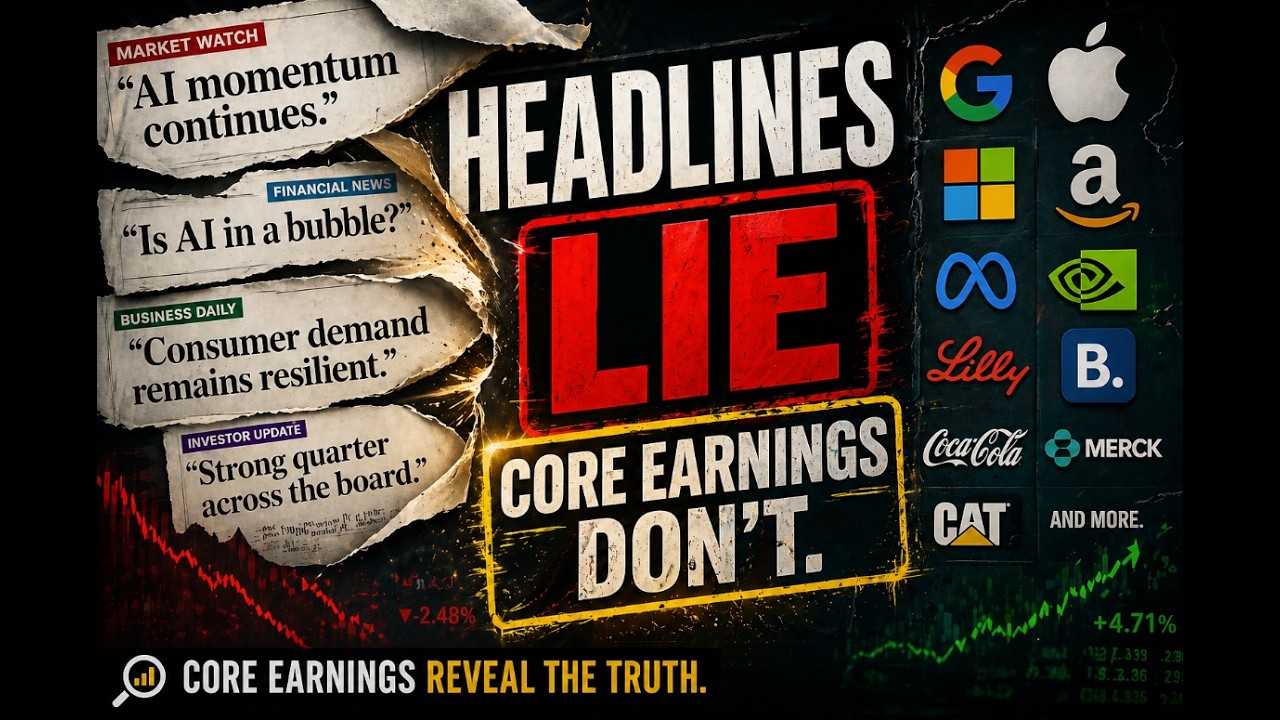
David Trainer reviews earnings from Alphabet, Apple, Microsoft, Amazon, Meta, and others, examining which beat or missed expectations. He breaks down GAAP versus core earnings distortions, return on capital, and which companies can sustain the AI race. Oracle and Meta face concerns while Google emerges as an AI and compute winner.
Chapters
Okay, I'm gonna demo from our institutional membership, which has all the bells and whistles. It's very much like the professional membership. It has just a few more, a few extra things that are super deep dive, but I'm gonna create a new portfolio. 2260501. It wasn't that long ago we were doing an earnings watch for the last quarter. Once this new portfolio is created, I'll find that portfolio and then I'm going to paste the tickers that we are covering today into the portfolio. And now we're going to get to work. So very interesting quarter and very interesting results around the board. I believe 84% of all S&P 500 companies are beating their estimates. Very interesting, right? When we thought there were so many things going against good performance in the economy, good performance in the overall market, it appears that that good performance is overcoming a lot of obstacles, including wars and tariffs and all kinds of things. And it feels like the boo birds are getting kind of shut out here. I don't know what to say. I think there's a lot of risk, as I've said in the past, that The market is expensive, but things just keep pushing higher on most days. April, I think, was one of the best months, best Aprils in a long time. So let's do this in market cap order. Wow. Google is the number one here. And look, folks, my honest feelings about Google, it's just crushing it as a company and I wish it were cheaper. New Constructs is really good at finding companies early when they're really profitable, really cheap. And for example, we found some of the best ever. Google was on our long ideas list a while ago. Nvidia was on there a while ago. And a lot of great stocks, Eli Lilly. These are some of our very attractive, some of our best stocks that have gone on, and Qualcomm, that are just gone on to be super stocks and be unbelievable. And we're proud to have called them. On our long ideas and focus list, we took them off. a while ago because they got expensive. Now, the really good thing about new constructs is that we can do that because we can find so many other stocks that are unknown and cheap and profitable. And that's where risk-reward is great. Does it mean we miss out on some of these stocks that just run? It does. But it also means that we avoid the risk when these things come crashing down. Not all of them will, Some will go on to do extremely well. Google, I believe, is one of those, friends. Look, I saw an interview this last week, not this week, I don't think, with the CEO of Google Cloud, the firm that built the agent, the AI agent on our data. And look, I told you, I've worked with these folks directly. They're super smart. Super. I can't, I hadn't been around that many smart people in a big company in a long, ever, ever. And then, you know what, what Thomas Kurian talked about, the competitive position in Google. And their chips, their TPU chips, which are amazing and doing extremely well. The Google Cloud capabilities, those 2 things give Google's AI an advantage that none of the other AIs have. They have all the compute and chips they need. They're not facing these shortages that OpenAI and Anthropic are complaining about. They're selling chips and compute to everybody. Now they make sure they take care of themselves, but they're selling it. They got it for everybody. Add on that the fact that they actually have an AI model, and they also— that's working very well. It's taking huge amounts of market share, huge jump in market share in the last quarter. Then they got the cash flow. Look, we weren't surprised to see a strong beat here recently from Google. The business is hitting on all cylinders. Let's take a look here. Up 10% here. I just saw a review how these guys were crushing it on all cylinders, and Google Cloud doing great. This is this is one of those where, as I mentioned a second ago, I wish it were cheaper. And this is a different. This company's in a different model. This rating system applies to all stocks, right? And I think Google might be just cut a little different. That's my honest feeling about Google. Let me remind you guys, get into the chat. Let me know if you have any questions. Delico, my question: My small language model says don't drink the Google Kool-Aid, but we all love chips. Ha ha ha! That's a great one because I really do love. I do like potato chips a lot. But I don't drink Kool-Aid. You nailed it on that one. I think what I'm saying here is if I had to own one of the big tech stocks, it would be Google 10 times over, far and above. I think they're really well positioned. And yeah, strong miss, Google GAAP earnings. That's a good question. And this could be one where the underlying profitability of the business is just that strong, it doesn't matter. So this is what we saw, GAAP earnings going up more than core earnings. Yeah. And it looks like they just, the underlying power of the business, it doesn't matter. We had this one wrong on the GAAP earnings front. Tony Frank, if you got a question, please put it in the chat. Why don't we go into FinSights and see what's the Street earnings distortion score for Google? Because there's a difference between GAAP earnings distortion and Street earnings distortion. It's going to— GAAP earnings distortion is based on The current core earnings versus current GAAP earnings, and that's a good indication of what's going to happen. Street is looking at the Street earnings per share and Street distortion, and it was a strong miss too. So we, if you're just looking at GAAP, it's underestimating the power of the business is really just taken over here. And that's happened before. I remember with Google's IPO, I was like, oh, this company is too expensive. There's no way they're going to grow revenue at 50%. Compounded annually for 4 years, they did 200%. It's one of these businesses at times that has basically defied logic in some— basically defied the numbers, defied, beat the averages. This is what you want in investing if you're a gunslinger, for sure. It's just a company that's just that good. And it's expensive, but it's going to just get more expensive because the profitability is unbelievable. So we don't have the new 10-Q. We'll get that hopefully in the next few days, but a really strong report for Google. And I think it's the only company that has all those things, right? It's got the cash flow to stay in the race. If you've not seen our AI winners and losers reports, you need to look at those because it really draws the distinction between those companies that can afford to stay in the AI race and those that can't. And that's a really important distinction. Google's got the cash flow. And it's the only company that also has its own chips, its own compute, and its own AI model. And hearing Thomas Kurian talk about the thinking that went into those decisions, these guys were so far ahead in acquiring land, energy, compute, and building out chips. They saw all this coming, man. It's unbelievable. They got some really smart people in that company. I don't know what to say. It's a little scary. All right. Apple also had a good beat. Let's see, how did the stock do? Also had a good number, did— doing very well. Also great results, great momentum on iPhone, but similar profile here. Expensive, it's been expensive for a while. Inline, we didn't see the, you know, the business is doing well. I think the network here at Apple is doing great. I think people are still very happy, they want to buy the phones, they're taking share again. And but everybody knows that it's popular. The secret's not out. And I don't see Apple as well positioned as Google. I think Apple is probably right at unattractive, whereas I think at Google, I just think there could be a whole lot more upside, folks. I'm not going to be bearish on Google. We have an unattractive rating. And I've said before, our ratings aren't always right. This is one when we've gone back and said, can we put this back on the focus list? Because this business is amazing. And when we do a reverse DCF on it, the expectations are high. It's pretty darn good. But with all the momentum and where it's going and like how it could be not just a winner, but the winner in AI, I don't know. Sky's the limit. We're in a world now where like the singularity's not that far away. So I'm not gonna sit here and say Google can't be as profitable as the market expects. Apple, I don't believe it's gonna be any more profitable than the market expects. I don't, I think this one's, what, this one's cooked. It's great. Like my joke there, cooked. Yeah, they got a new CEO, no longer Tim Cook, but it's cooked. All right, Microsoft. This one's a little more neutral. Microsoft, not as expensive. It's got— it's been killed recently, right? This thing, the stock's been down a lot. I wonder, did it ever get attractive in our system here? No, dangerous to neutral. I wonder if a few days in here, because this is looking at weekly averages, I wonder if it ever got attractive down at the bottom there. We can actually look at the daily. Here we are going backward. No attractive in there, just neutral. So yeah, not quite cheap enough. This is another one that I really would love to get cheap. Now, is it as well positioned as Google? No, it's not. But you got the economics of the business to look good. The cash flows aren't quite at the Google level. Accounting's still going better than economic, which is interesting because the balance sheets are going— these guys are all growing like crazy, which is why we're seeing returns on capital come down. And then free cash flow. Yeah, not quite as strong here at at Microsoft as Google, but it's way better than Amazon, way better than Oracle, and way better than Meta. In terms of winners, Microsoft's got a better chance. How'd it go for this week for these guys? They wrote down not a great quarter. Yeah, good order, but I think people are balking a little bit to spending. I think the markets know that this 190 billion number is something they can't. That's a check that they, their balance sheet can't cash. Whereas Google and Apple can cash that check. So it's going to be interesting. We've already seen Oracle as we've guys, if you've not seen our Oracle report and prediction that it was taking on too much debt to stay in the AI race, Kyle, if you don't mind, please drop that into the chat. You need to see that because Oracle's cooked. I don't think Oracle can survive. It's not going to do it. They can't keep the spending up. They're going to have to drop out or something's going to happen. And that, that could be. A chain of events, the catalyst of a chain of very negative events for some of these stocks and data centers and all the stocks that have gone up this huge AI buildout. Amazon looks like a good quarter. Yep. AWS is growing stuff. Amazon's big AI bets starting to pay off. They're 52% of Rivian revenue. I saw that headline. That's interesting. Not so good for Rivian. And Amazon's chip business is going well too. Selling chips is a good thing. They're smart to be in that. But do they have an AI model? They do not. And do they have the cash flow to stay in the race? I would submit that they do not. Here's why. The balance sheet at Amazon has been growing even while the economics of the business have been improving. The balance sheet's growing even faster. So negative free cash flow. And that's why we've seen over the years the number of shares outstanding going up. They had to raise capital. And we've also seen total debt going up. Look for $163 billion in 2021. Not a small number still, but now $263 billion at the end of 2025. So yeah, they've got a pretty good business for raising capital. But look, 15% return on capital compares to 40% at Google and 76% at Apple, even 23% better at Microsoft. This is part of why we pay attention to return on capital so much, folks, because that's like a key indicator in terms of the width and the strength of the moat. Now, I do believe that Apple is closer to the end of its moat than other firms, only because— not because it's making crazy— not making crazy money. It is still making crazy money. They're going to have to innovate in some way. Now, I do also think that their ability to be the fast follower here and not necessarily build another AI model and invest the hundreds of billions required to do that and just buy one and then plug it into their ecosystem, I think it's a good idea. I think it's a good strategy. I think it's going to pay off well for them. I think they're going to be one of the winners. Will it be the bonanza profits that I think for Google? Not so much because Apple's not so much in the intellectual property aspect of it. They're really just in the access. They're gatekeepers. With all the apps and all that stuff. It's a great place to be, don't get me wrong. They're like the, the old phone companies in the day. It was a monopoly. Everybody had to use one phone company. That's why we had to break 'em up, 'cause that was the only way you could get on the phone that was necessary. It's a new kind of phone, and that new phone also has all kinds of apps and stuff like that. So it's a good position to be in. Amazon, not so much. Amazon doesn't have its own AI model and it doesn't have the cash flow. All that's been spending a lot of money and it's been raising a lot of debt, so it doesn't have room on its balance sheet to take on more debt and spend at the rate that the others spend. Meta, same story, same story. We've seen the spot stock beat up already. We pointed out that they created a new form of off-balance sheet debt, the residual value guarantee. If you didn't see that report, Kyle, you don't mind dropping that into the chat as well? I was actually DMing with Jim Chanos this week, and he was like, great find on the residual value guarantee. That was a cool thing that we figured that we found that new form of balance sheet debt. So yeah, this is one of the benefits of being part of New Constructs. We're not just a bunch of number crunchers. We're extremely good at number crunching because we understand the filings better than anyone else. The Core Earnings Leaders Index beat the S&P 27% to 18% last year. Because we understand the numbers better than anyone else. It's not just because we're out here tooling our models and pulling data out. No, we understand how to read the filings and figure out what companies are doing, and we know how to scale that. That's what gives us an ability that no one else can match. Please. So again, new constructs, getting to the truth of the matter about profitability and valuation. And it's not just about numbers. It's about understanding what those numbers mean and understanding them with more intelligence than anyone else, which is again why we are able to deliver alpha and make predictions about stocks like Oracle and Meta. In fact, I believe Oracle and— or Meta was next in line. Oops, wrong one. In terms of cash flow, I guess I'm looking for another one. Where's that one with the— oh no, this is the one I wanted to share. This is the one that predicts that— predicts that Oracle is going to blow up. And this is the chart I'm talking about, right? This is how we determine the winners and losers. Got the cash flow, don't have the cash flow. Oracle, it's already blown up. Meta starting to blow up. Amazon holding up so far. But guess what all 3 of these firms have in common that you're not seeing from Apple and Google? Layoffs, baby. Layoffs. Why? They got to have that cash. They need a way to get the cash. Need a way to get the cash. Yes, we are going to get— we're going to do a pre-IPO report on SpaceX. As soon as that S-1 comes out, we will be crunching the numbers. We're in the middle of filing season, so that's probably why they're doing that. They're going to make it hard for us. And by the way, they're not giving us the filings overnight either. The SEC is screwing it up on the worst days. We used to be able to get the filing every night with all a big download file every night with all the filings and process it and be ready to go. They're screwing it up, and then they won't let us get it from the website. We're getting blocked, folks. All right, I'm not a conspiracy theorist. Maybe I am a little bit, but the SEC is trying to keep us from getting the filings. It's true. But we are watching for that SpaceX IPO S-1. And yeah, man, Wall Street is definitely pulling every eye toward one shiny object, and we're gonna, we're gonna crush that one as soon as it can. As soon as it can. But yeah, these are the 3 that are in trouble. Again, cash flows, don't have it. Oracle went out, tried to get more debt. What happened? Stock got crushed. Meta, stock's getting crushed. They're creating new ways to put debt off balance sheet. Amazon has had a lot of debt off balance sheet for a while, laying off people. I think the same thing's going to happen to these other folks. So, that's our thinking on big tech, big cap, big cap tech. Lilly beat just like we said. Not good that they didn't disclose their operating lease payments. This is one of our— it's been a great stock for us for a long time. You know, we found Lilly. What is it now, like $934? I'm not sure about the number, and I could be wrong about this, but I think we picked it up first attractive when it was like $9. I don't know. It was like a long time ago. It's one of those you go back in the history of New Constructs and it's like the super picks that we've had. Lilly's one of them. And yeah, they had a big beat, crushed it. So one of the top holdings in the Core Earnings Leaders Index as well. Caterpillar, how did they do? These guys are good. Kyle said we should put this on the list because there's like a global conglomerate. Looks like they did. Look, I think the global economy is doing— it's better. I see the marketing economy doing better than people think despite all the doomsayers and doomsayers. Caterpillar did well. Good week this week. Yeah, business looks good. It's expensive. I think Caterpillar is one of those— I've been saying for a while that the meme stock investors moved away from meme stocks and got into good companies like Berkshire Hathaway and Caterpillar and Google and things, companies that make real money. Because shoot, if you're gonna play, then don't have to play roulette like you are with a meme stock. Play it with a good, a real company. And Caterpillar has been a benefit of that, and that's why we see the valuation just jumping up here. So good company, good performance. I think the market has been a little bit testy here recently, so good performance is going to get, I think, an extra boost. I don't think that's going to last. I see marketing pre-IPO offers for as little as $2. You are in, duh. I don't quite understand that one. Let's see, Q&A. Oh, Roger. One successful ETF, but haven't seen more. I know. Hey, it takes a while, right? It takes a while. We that very attractive stocks index, man. I think it's been crushing. Let's take a look at that. Very attractive stocks index also done really well. We had a tough time there in the middle of March and then right here in April. But otherwise, in the first quarter, I think it was it crushed it. But the very attractive stocks over 5 years, strong outperformer. If you go with that against the S&P 500. Yeah, the S&P anyway, the very attractive stocks are a great concept. And I honestly think if you could actually do an overlap of very attractive stocks and core earnings leaders, maybe do very attractive and attractive that also have really strong core earnings score, an overlap of those 2 would be like a super portfolio. So you get the best of both worlds. Yeah, impressive, impressive. Coca-Cola. So I will always have a soft spot in my heart because it was the Coca-Cola analyst at Credit Suisse that wrote the first-ever report back in 1996 using the model I created at Credit Suisse, which was called the Value Dynamics Framework. And we got a letter from Wayne Goizetta, the CEO of Coke at the time, the most beloved CEO of Coke. At the time, because Coke was like, back in the mid-'90s when I started this work, Coke was like the Google of the time. Like, it was a very well-respected company. The CEO is super well-respected. And he wrote a letter to the analyst that published the report focusing on return on invested capital and the importance of that, which is what the Value Dynamics Framework, and which is a big part of what New Constructs is about. And he wrote a letter applauding us for using that. And it's part of my training program. I pull that letter out every time we do the training program because it warms my heart a little bit and reminds me there's People who really care about the good stuff. So Coke, good company, not so good stock. How'd their report go this week? Coke has been interesting to me in some ways. Yeah, good week too. Tops estimates. I looked it up in ChatGPT and what did it say? That's not the one. Maybe I closed this window. This is the answer I got when I asked ChatGPT, why does AI lie so much? 1, 2, 3, 4, 5, 6, 7. Good reasons. Good reasons. And how about better incentives? Reward correctness over fluency. Admit when confidence is low. That's anyway, sorry to get off track, but Coca-Cola. Yeah. Great company as well. I just feel like they got to get in the snacks thing more. I think that's where Pepsi maybe has an advantage on that. Maybe it's just because I like potato chips so much. I don't know. Merck. We like this stock too. How did they do this week? Okay, medium week, tops estimates, good results, beats quarterly estimates on strength of Keytruda. So we got the beat right here. Great company, still cheap stock. We like this one. Don't know what else to say. We think this is good stuff. Strong core earnings, strong, strong economic earnings, high return on invested capital. Tremendous distribution. AI is probably going to be a boon to these guys' business because it's going to help all the biotechs, going to create new drugs. And Merck's got the distribution and they got the, they got the research infrastructure. I would imagine these guys lean into AI. And I do think like some of the AI promises are crazy and BS, but I think what AI can do for health. And because we're already seeing this, some of these peptides that are out there that really work. Funny story, like the guys in the jiu-jitsu gym, they're all into this stuff, man. Some of them a little bit more hardcore about it than I am. Not going to say steroids or anything like that, but the peptides for sure. And, and they're— and, and this stuff works. And I've talked to some doctors, like the traditional doctor who's afraid of everything new, but doctors that are a little more cutting edge, and they're like, yeah, oh, this peptide stuff works. And what a peptide is to me is just like a It's like a new alga. It's like a, it's like a protein alga. So we figured out a way to arrange proteins to serve a specific purpose, and it can go into the system, be like a software patch on our, on our, on our health system, our individual health system, immune system, all that. And I think that's cool. I think we're gonna be able to see more of those. I think we're gonna get into how to protect cells, how to limit cellular degeneration, which is gonna create more longevity and more health. We're going to have more targeted cancer treatments. And I don't know if you guys heard about the special cancer treatment that Ben Sasse is using that has dramatically improved his lifespan. If you haven't seen his interview on 60 Minutes, I highly recommend it. One of the best descriptions and explanations about what's going on in society. Ben Sasse, former senator from Nebraska, tells it like it is and speaks some great truth. Great truth. Amazing listen. And watch. Look that up. But I do think firms like Merck are going to be able to tap into that, benefit from it in a big way. Booking— like this company a lot. How did they do this week? Oh, not so good this week. That's a bummer. Booking Holdings cuts revenue forecast amid war's impact. Yeah, these are one that's going to get hurt. Travel is going to be down. The stock is still one of the like super profitable businesses. Look, I think this— there's no way the Cerron thing is going to be— we're not going to get into an erect. situation. I just don't think that's going to happen. I don't think it's ever going to happen. I think we're in a really strong position here because a couple of weeks ago, Iran had to print something like a $7 trillion note, like a dollar bill, right? That's not a dollar. It's whatever their currency is called. I don't know. Their inflation internally is going— is getting crushed. If there's one country that needs the canal to be open, it's them more than anyone. Nobody talks about that, right? That's like 100% of their revenue, some huge amount. They're getting it out through some backdoor. They're just in a tough spot. And I think the other Gulf states are now going to start rallying behind what is going on because they need it open and they recognize that long-term, having a terrorist in control, one of the most important channels for energy flow, not a good plan long-term. Got to fix that. And so anyway, I think Booking's going to turn it around and the stock will return. And by the way, you're getting a chance to get it cheap. Get it cheap. Not often do we see Booking with greens across the board. This has been one we've liked in the past because it's got a 4,000% ROIC. That does not happen often at all. And when it's cheap, got to go get it. Okay, folks, I'm not seeing any more questions. If not, we will sign off. Thanks for being with us. I hope you enjoyed it today. It's a great session, a lot of great questions, a lot of good stuff to talk about. Thank you.
More from David




Earnings Recap: Decoding Signals from SpaceX, Palantir, Merck, AMD, Caterpillar, McDonald’s, & More

Watch Our Earnings Recap: Market Heavyweights Apple, Microsoft, Amazon, Meta, Visa, and More



Earnings Recap: Top Insights from JPMorgan, Bank of America, Taiwan Semiconductor, Netflix, and More


The IPO Melt Up: How Smart Investors Use AI to Find Abnormal Investment Opportunities