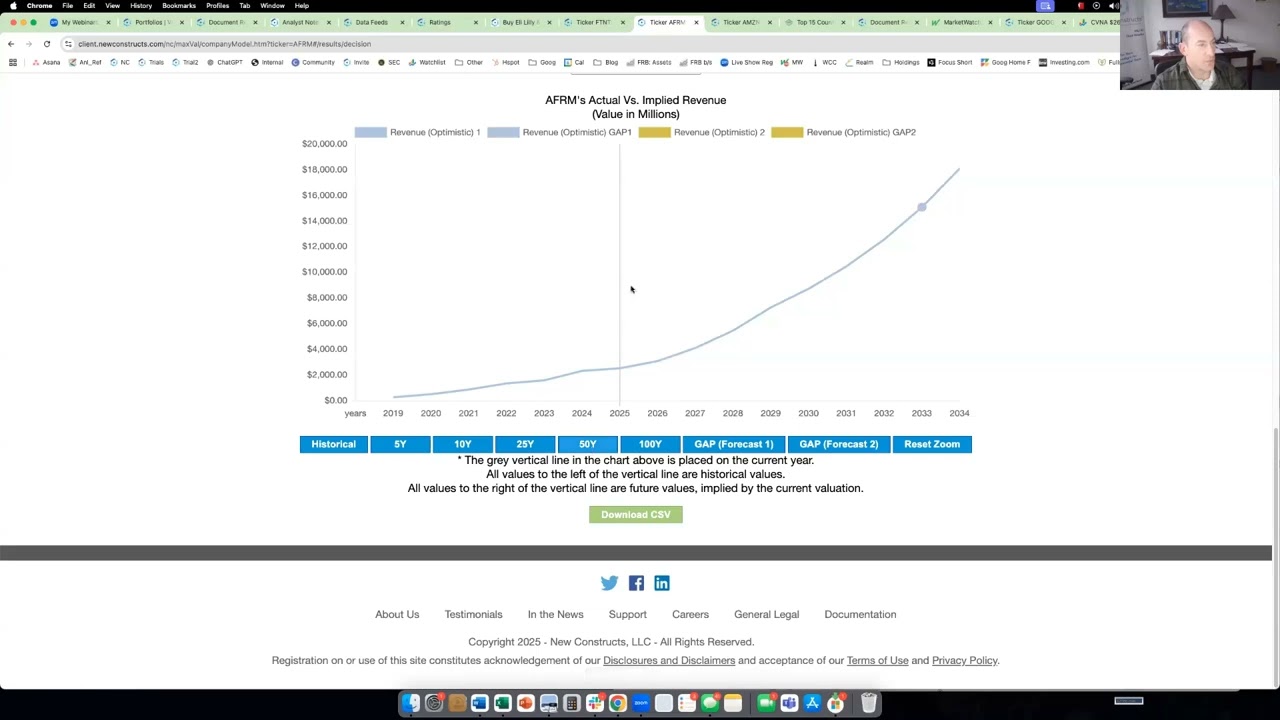
Affirm Holdings trades at a valuation that requires the company to grow revenue 26% annually for eight years and achieve a 122% return on invested capital, metrics that would rank it among the S&P 500's best performers. The company currently loses money with negative margins and no free cash flow.
Chapters
Hello everybody. Welcome. Affirm. Oh yeah. This is going to be fun. Here we're getting bad company, bad stock. Focus list short, -5 economic book value. That -5 means it's a negative profit business. They're not making any money. Margins are negative. Free cash flow. Negative. Economic book value, no growth value to the business. Negative. No profits in this business. So just how crazy is the valuation? Well, I created an optimistic scenario here for us. I did one iteration. I got an optimistic scenario here. You can see high growth here in the past. And then for margins, they've been totally negative. So we're going to give them credit for a dramatic turnaround. All the way up to 20% margin. That's a NOPAT margin that's up around 25%, 26%. Where does that rank in the S&P for NOPAT margin? 26% NOPAT margins. I mean, that's high. 26% is going to put them in the top 100 of the S&P, top 75. Let's go with something closer to expectations, except we'll just assume those expectations go out for longer. Because that probably makes more sense. All right, 8 years at 26% compounded annually while seeing returns improve to 47% on average over the whole time frame. So what we're looking at here, 8 years to get this to a price that's closest to but equal to the current stock price. Let me show you my DCF model here so we can go to the optimistic scenario. See here, 8 years is where it's the model. Gets a price closest to but less than the current stock price. There's our 26.3% CAGR. Here's our 46.6% average economic earnings margin. Here's what the return on capital's got to get to over that timeframe to justify that. Here's the NOPAT they got to get to, $3.9 billion. We can also look at all this on the decision page. So optimistic scenario. What's the implied revenue for the optimistic scenario? See, it's pretty much skyrocketing. It's $15 billion. Where does that rank for the S&P 500? $15 billion in revenue would put them about halfway. Halfway. We know also, though, that the margins have got to be a lot better. So why don't we take a look at the implied ROIC, right? What does that have to do? That's kind of a skyrocket from current levels. So 122%. How does that compare in the S&P 22? We put them in the top 4. So that's pretty impressive. That's quite a turnaround. Top 4 while also growing revenue at an incredible rate. Let's look at implied NOPAT. Puts them at $3.9 billion. $3.9 billion would rank 126th. So among the most profitable businesses in the market, one of the top 3 or 4 returns on invested capital. You could say a lot of good news is really priced in there for a business that's proven nothing, right? They haven't made any NOPAT, but we're giving them credit for huge amount of— be one of the top companies in the S&P 500. They've never had a positive return on invested capital. We're going to assume that they can do that, get to super positive, be one of the top 3 returns on invested capital companies. And we're going to assume their revenue is going to at the same time grow at 26% compounded annually for 8 years and, and be a huge number as well. That seems to be really, really rich expectations. Thanks for your time. Glad for you guys to be with me today.