David Trainer explains how companies use non-GAAP earnings to hide the true cost of doing business, particularly by excluding stock-based compensation. He walks through examples like Tesla and Marketo, showing why GAAP numbers matter and what executives gain by making earnings look better than they are.
Chapters
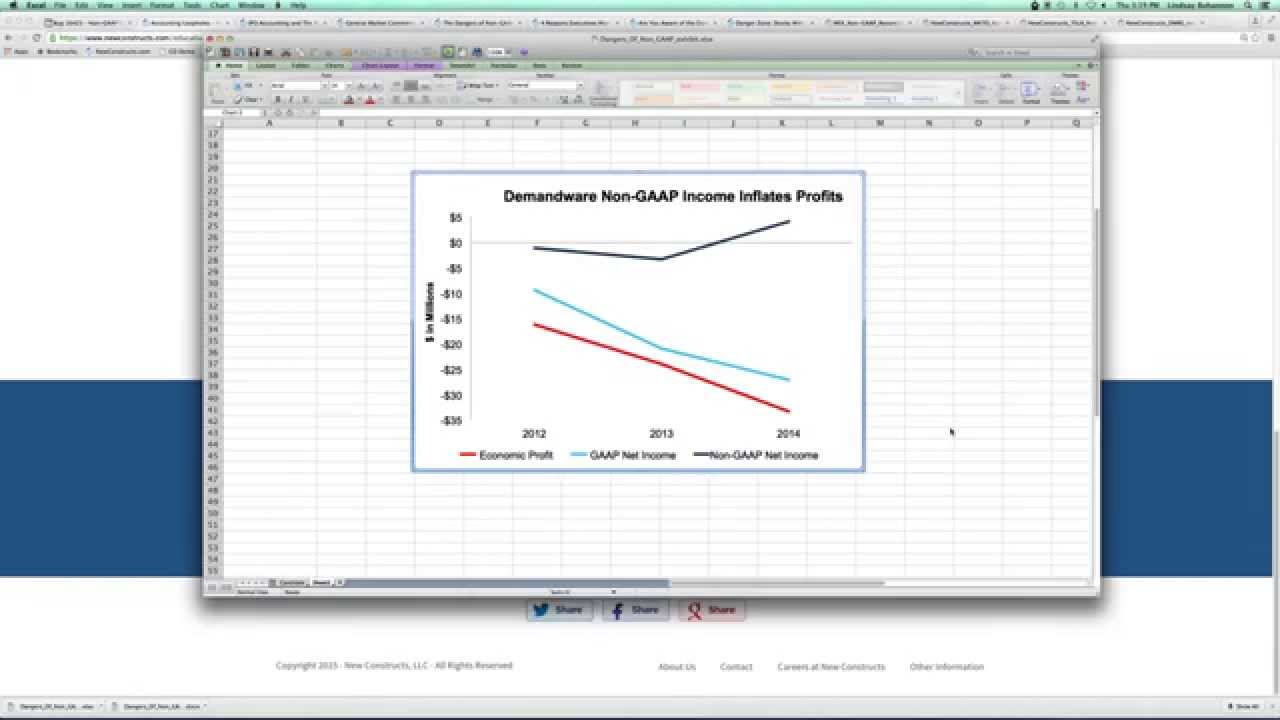
Hi, everybody. Welcome to our webinar on the dangers of non-GAAP earnings. You may have noticed we've written a lot on this topic recently. We've done some work showing how non-GAAP earnings can boost executive pay at the expense of shareholders. This is basically a trick where the companies get paid, or the executives get paid, on an adjusted earnings value that's Easy to manipulate and therefore exceed the target and ensure they get paid. One of the reasons they're doing this more is that a lot of pay that is quote-unquote performance-based is based on a new tax-deductible rule that went into place in 1993 that allowed companies to shift more exec comp into bonuses rather than base, which means they paid less tax on it. Nevertheless, it's a way for them to manipulate earnings. You know, we also go into a lot of times, you know, there's incentives in place for executives and companies to manipulate their earnings, and non-GAAP is one of the most important ways that companies do manipulate earnings. I think that's, that's the big thing to take away here is the danger here is that companies are looking to make sure that number one, executives are going to get paid big time, you know, and that's one of the things we see here. But also a big part of what they're looking to do is make their profits, make the company look better than it really is, right? So for example, this is just one example. To kind of crystallize what's wrong with the non-GAAP earnings, okay? This is a chart showing Demandware. This is one of our Danger Zone stocks, and I think it's down— Kyle would know the answer to this better than I would, but down, I don't know, 20%, 30% or more since we published or put it in the Danger Zone. Look where the non-GAAP earnings show profits. Whoo! Not very negative, and now they're positive. Or even the accounting earnings, the The real accounting earnings are bad, and then the economic earnings, well, that's a whole other thing altogether, right? So, you know, we— you hear us talk a lot about the pitfalls of accounting earnings. Well, I want to circle back here and say, listen, non-GAAP earnings or non-accounting earnings, those aren't better than the reported earnings. They're worse. And mostly they're worse because they like to take out a lot of certain particular expenses. Here's the beginnings of a report that we're doing. It'll be published later, probably be a special report available only to our pro and institutional clients. But here's a list that Kyle put together of all the things that companies take out of their non-GAAP earnings, right? So keep in mind what I'm saying here. They're taking expenses out. The biggest one is related to stock-based compensation. So the cost— so this is the best part, and we've pointed this out for a couple of our bigger danger zone stocks, some of the stocks that have blown up the most. We found a very high correlation between non-GAAP earnings being used to pay executives. And one of those things we find most often in the non-GAAP earnings that are used to pay executives is that they remove stock compensation expense. How awesome would it be To have a business where you were able to measure performance while removing the cost of paying yourself. Say you had your own business, right? And, you know, whatever it is, it's a lemonade stand. And the numbers you reported to your investors excluded what you paid yourself. Let me see. What would that lead you to pay yourself? Probably a lot. And it would not in any way be representative of the real profits of the business, assuming that, of course, Of course, you took advantage of that loophole. And look, companies do. They simply do. That's why you're hearing about non-GAAP earnings. That's why, you know, we wrote a report recently on non-GAAP earnings and IPOs. And one of the big risks is, you know, they use non-GAAP earnings like crazy. And stock compensation is artificially stated anyway because of some other accounting loopholes. Right. But when it comes to non-GAAP earnings, IPOs are some of the worst. In fact, some of the companies— you know, we wrote a report recently, you guys probably saw it, that pointed out how companies were— and on the IPO side, the SEC was actually having to crack down on how they were using non-GAAP earnings too much in their financial statements. And that's, you know, look, let me tell you, I've worked with the SEC over the years and they are very— they're some of the hardest working folks in show business, but they lack technology to see a lot of the things that we're able to look at. And let me tell you, if they're noticing non-GAAP earnings are a problem, then, you know, then you know it's bad because it's really prevalent because they're very limited in the number of tools they're able to have access to. To do what they need to do, which is another story altogether. So coming back to this report, look at all the kinds of things that they pull out. Depreciation and amortization. Oh, let's just take that out of our expenses because, you know, we know that earnings, accounting earnings in general, ignore purchases of property, plant, and equipment, right? Under lease or not under lease. Huh. Basically taking out depreciation and amortization and the fact that regular earnings already ignore CapEx. Effectively, you're going to look at the business as if it never has to invest in itself ever, right, which is not representative. Going down the list, and again, we'll publish this later, but going down the list, you'll see that they, you know, the blatant sort of misrepresentation of the business created by non-GAAP earnings is something I can't emphasize enough. All right. Um, you know, it, again, it kind of comes back to this chart. All right, and you've seen us point out many times and have made many danger zone picks that have served our clients very well because they've been stocks that have blown up. Accounting earnings do not do a good job of representing the true profits of a business. Non-GAAP earnings, even worse. They're a manipulation tool. And I remember when this first started when I was on Wall Street during the tech bubble. And non-GAAP earnings were— I mean, let me put it to you like this. We went from talking about Credit Suisse, we went from talking about cash flow, return on invested capital, all the things we talk about in new constructs. We talked about their Credit Suisse. And then Frank Quattrone and the tech team from Deutsche Bank joined Credit Suisse. And when they did, the conversation— Changed. Around stocks quickly devolved from cash flows, return on invested capital, things that New Constructs focuses on, to price-to-earnings. Then it went to price-to-sales or price-to-revenues, and then it went to price-to-clicks, and then it went price-to-eyeballs, right? And non-GAAP earnings is better than price-to-revenues, but not by much, right? So you get the idea. The proliferation of these nonstandard or really manipulated measures of profitability, I think, is a warning sign. It's a warning sign, and I think it points to the lack of analytical rigor in the marketplace. The fact that accounting analysts— or I'm sorry, Wall Street analysts and most Wall Street analysts are willing to play along with that should be a big red flag. Those of you who've been listening to us and watching or following our research for a while, You've heard me say that Wall Street research is not reliable. We've provided plenty of reports and articles pointing out that CEOs themselves and CFOs themselves admit that they fudge the numbers. Now we know why. They fudge the numbers so they can beat their targets and get paid more. They also fudge the numbers so that they can beat their competitors because competitors are using earnings manipulation tactics. And we just did a piece recently on how big earnings manipulations or restatements— in general, what we're saying is that these things happen in waves. Once one company starts finding a way to goose their earnings number, other companies have to jump on board. Otherwise, they risk getting in trouble with shareholder activists or board members who are asking them why their earnings are not growing as fast as a competitor. So let's look at a couple examples. WEX, right? So this is straight from their 10-K. This is a picture that Kyle took. And so what you're seeing, adjusted net income attributable to WEX, they're taking out unrealized gains. Make this a little bit bigger. Amortization of acquired intangible assets. Okay, it won't all fit on the screen now. Stock-based compensation, deferred loan costs, non-cash adjustments related to tax receivable, gain on divestitures. They take out some positive stuff too, right? I think Kyle mentioned that in one of these years, the non-GAAP earnings were actually worse than the GAAP earnings. So— That's an interesting phenomenon. Let's look at Marketo, recent danger zone stock. Gap net loss attributable to Marketo, and what they're taking out is stock-based compensation. Make this a little bit bigger. Amortization of acquired intangible assets, right? So they went out and paid for assets, and they're not going to deal with those costs. Litigation settlements and acquisition-related costs. Basically making their net GAAP— non-GAAP net loss much smaller than their real net loss. Feel free to chime in with questions at any point in time. We're going to start focusing on questions here in a minute. I'm going to go through plenty more examples. But I'd like to go ahead and get some questions queued up, if that helps. Tesla Motors. Gap loss, non-gap loss. Wow. Instead of losing $107.6 million, we only lost $16 million. The beauty of non-gap. Let's take out all that stock-based compensation. Let's take out all that money we had to— all those fees we had to pay. In order to issue those convertible notes, and look at our earnings through that lens. That would be great, right? That would be really nice, especially since I don't have to record the cost of the stock I gave myself. We look a lot more profitable. Demand where? In the income statement. GAAP net loss. They lost $3.8 million, but by the magic of non-GAAP accounting, they made $4.9, almost $5 million. Isn't that awesome? Isn't that beautiful, right? It's not for investors. So non-GAAP accounting. I think it's pretty clear it's a big red flag, especially if executives are getting paid based on it. And you'll see in the report that we're going to publish, we're going to talk— we're going to list a bunch of companies that are in the danger zone and others where executives pay themselves based on non-GAAP earnings. They're not good. The chart that Kyle put together, I think, really says it all, right? These are The non-GAAP earnings, these are the accounting earnings, this is the real economic earnings. If you're going to look at something that is non-GAAP, you want it to be closer to the profit truth as opposed to farther from the profit truth. New constructs focus on getting you closer to the profit truth, or the truth about profitability. First question, are GAAP earnings reliable with FASB allowing so much wiggle room? No, absolutely not. I think you all have seen, you know, us point many times to the education section of our site where we will show you white papers on 30+ accounting adjustments or loopholes. These are all ways that accounting rules allow companies effectively to manipulate earnings, and we're seeing new ones emerge all the time. I'm working diligently with my Cohorts at the Investment Advisory Committee that works with FASB on a regular basis to help eliminate loopholes. I'm pleased with the new ruling that FASB is putting out with respect to off-balance sheet debt. I think that that's helping get GAAP earnings closer to economic truth. Certainly, it's at least helping the balance sheet. GAAP earnings, of course, mostly, almost entirely overlook balance sheets in general. That's a big failing of GAAP earnings. But the new operating lease rules where they're going to be bringing some of that on balance sheet, we worked really hard with FASB to help them make that really a positive step in the right direction. The first time they pushed— tried to push it through, I think it made things more complicated than it should have been. And you may have noticed that some people in the media picked up on the committee, and I think in some cases me specifically, saying, hey, we shouldn't do it this way, we need to keep it simple. And FASB did a great job of listening. And keeping it simple while adding value to the financial statements. And also, and most importantly, they— FASB in the new ruling is going to require a lot of really important disclosures in the footnotes that are going to help investors, especially firms like New Constructs who are going to be doing this kind of digging. It's going to help us get a real much better sense on what the off-balance sheet liabilities are, especially related to operating leases. And we're going to know even more about those operating leases. After this rule than we did after this rule when it goes into effect in a couple years than we do now. So great job, hats off to FASB on that one, really pleased with that. There's plenty of other places where companies can still— plenty of other loopholes. Some of these are beyond the reach of FASB. Some of these things are just things that are the nature of how accounting really in its job is— needs to be understood as the beginning, not the end. For understanding profits? Right? Accounting data is like the vocabulary of a language, right? And you can't really get meaning out of just a bunch of words on a page. They need to put into form. That's what finance is. Finance is the business or the process of putting accounting words into language to make them useful, to make it meaningful. What would FASB say, or has they said, about standardized economic earnings? Great question. What would FASB say, or has they said, about standardized economic earnings? You know, honestly, I haven't had that much of a chance to speak to them about it because when I do meet with them, they're sort of overwhelmed with the agenda they have in terms of what they're trying to do. But I have talked to the SEC about that going back to 2009, right after the crash in the markets, one of our investors at New Constructs is a fairly influential person who got me in front of some people on Bill Corker's staff and ultimately a meeting with Senator Corker himself, who was moved enough to get me meetings with the SEC, the FDIC, the Senate Banking Committee, the PCAOB, and the FDIC. And in those meetings, I specifically pointed out how accounting earnings were misleading, and I'm going to go into the meeting with the SEC because that's the one that's most relevant. And first thing I showed them was that there were plenty of filings that we had noticed over the years where income statements didn't add up and balance sheets did not balance. We also found many filings where important required disclosures were missing. And I said, hey, you know, look, I know you're really busy. You've got to cover a lot of ground. There's some things you shouldn't have to worry about, like whether or not companies disclosed what their option plan was and how many options they gave out and what kind of assumptions go into valuing those options. And I was pretty surprised that that suggestion was met with downright hostility. And then I was really even further surprised, you know, when their answer to my suggestion that, hey, in addition to the words or the vocabulary, which is just accounting. In addition to just showing people accounting, why not offer the American public some direction on how to use all that accounting, like economic earnings? And we can show them, the American public, exactly how we calculate that, so if they disagree, they can change it. So people have seen me go through this before. Right? We'll show you our ratings, right? You can track our— you can track, you know, any number of portfolios and get alerts on what, you know, anything you throw in here, right? And then if you want to get more information, you click here. You get the details behind our ratings, right? You can get details on the adjustments we make right here. So if you ever wanted to kind of reconcile accounting earnings with economic earnings, You do that. And actually, if you— those of you who've seen our models, you also know whenever we make adjustments, Financials and Metrics, Adjustments tab, everywhere there's a green dot, there's an item on the Adjustments page to change it. Now, right now, we had taken a few green dots off because we're doing a major overhaul on a lot of our calculations. We're going to send out a notice on this to clients soon, but we've— we're doing some amazing things with the automation of our parsing. We are about to, in the next few weeks, that's conservative estimate, it could be a lot sooner, we're going to be parsing about 30,000 10-Qs fully automatically. It's amazing, right? That's the benefit of actually having really smart analysts go through 70,000 annual reports and deal with all the anomalies. With great intelligence and accuracy in our system, it's allowing us to reach unprecedented levels of efficiency and intelligence. Anyway, the point is we're going to gather all the adjustments for you. We're going to gather all that data. And our clients don't need to look at us as someone who's selling religion. Oh, here's the way you ought to look at things. Look at us as someone who's gone out and turned over all the stones that you need to turn over to ensure that you're getting the full picture. about profits, not just what companies want you to see. And if you've seen my, you know, if you've been here since the beginning of the presentation, you know that companies are willing to go to fairly extraordinary lengths in order to show you the picture that they want you to see, which is different from the real picture. So we don't do that with our clients. We're just gathering all the data. And if you disagree, click on one of these green dots. Notice we actually, since we don't have a green dot next to all these items that you want to change, in case Okay, you know, we can't change everyone line item by line item. We— that'll get fixed eventually. There are plug overrides. So if you just want to change the NOPAT number and reduce it, just want to make it 0 just to get rid of the adjustment altogether. For this item, you want to get rid of this adjustment because we don't need to do it every year. And then, and the plug here, you just want to say, listen, I want this to be higher by $10 million across the board the last few years, right? Just the point is, you can do whatever you want. Now you'll see when we go back to the adjustments page, there's overrides. You'll also see it in the NOPAC calculation. Right? The whole model changes any way you want it to change. That's the idea. We're doing the diligence. New question came in here. Why don't more companies use economic profit to manage their business and report their financial performance? That's a super question, and I think that's going to change in the not-too-distant future. I can tell you that we are in talks with multiple consulting firms who picked up on our work and who recognize a huge opportunity to go into the C-suite and say, Mr. CEO, we can help you improve your profitability with all these metrics. And that's what we always talk about, how we can help you improve profitability. But we can also show you how this is going to improve your valuation, because we see in our analysis statistically that there's a very high correlation, over 90%, Between return on invested capital and enterprise value to invested capital, which is effectively a nice price-to-book. There's a very high correlation here, and this is intuitive because naturally the market is going to award value to those companies that produce the most value relative to the capital that's in their business. It makes sense. Why hasn't this been done before? Well, it's actually a lot harder than it looks. It's a simple message, but it's a little too simple. If you're in Wall Street's shoes, because Wall Street wants to be able to sell people IPOs like Demandware and Box and Angie's List and Planet Fitness, right, where they would not look good in this construct. But we have access to a system that has done the work to remove all the accounting anomalies and provide accurate measures of profits and balance sheets so that you can look at return on invested capital apples to apples across large numbers of companies. And when you do, you see very high levels of correlation. So when we improve your return on capital from down here at 10% up to 15% or 20%, we can show you, based on this linear equation, what your valuation ought to be. And the CEO says, well, that may be what you say. How do we get investors to buy it? Well, we will help you write the investor relations message because we know how to communicate with investors. One of our service partners, New Constructs, is actually an expert in what investors care about. And when you go and meet with an institutional investor and you can show them how you're actually going to be making more money with the capital that they've invested in you, well, I think they're going to like that. If you can link your strategic objectives, your strategic initiatives, your decision-making process, your capital allocation Budget. If you can link all of that to improving return on invested capital and economic earnings, do you think investors will like that? Heck yeah, they will. How do you think they'll react to the next company that comes in and shows them a traditional Wall Street presentation? They'll laugh at it. So I think you can get what I'm sort of beating around the bush to talk about here, is that what we're really bringing to the world, to the investment community here, is A new level of transparency, a more direct link between profitability and valuation. And that's of enormous use to investors today because it helps you steer through the noise of non-GAAP earnings and GAAP earnings and other Wall Street propaganda and get to the heart of the matter. And we think that's of value. Here's a good question. Why should stock-based compensation be kept in GAAP earnings? You know, I had a meeting once with a large asset manager not too far from our headquarters here. I met with their director of research, and he told me that he thought it was ridiculous before I even got started. It was ridiculous that stock option expense should be removed from earnings. You know, he said, listen, at the end of the day, if I'm running a business and I got a cash register, And I got $10 in the cash register. Well, my goodness, my goodness, that's what I take home. Southern accent is editorializing here. This guy, I don't think really had a Southern accent, but I think it adds to the effect, right? Because we are in Tennessee. He said, if there's $10 in the cash register, isn't that what I should take home? And I said, well, it depends. Are you the only owner? What do you mean? Well, if you've given out options that equal 50% of the company, Just to keep it simplistic. Then you're not the whole owner of the company. Well, I got— it's the cash in the cash register. Yeah, but you have now created a new partner who owns 50%. Do you think he wants to just let you have all the cash? So naturally that meeting didn't go so well because this guy was way smarter than I was and I had no right to be talking to him like that. But you get this— you get the idea. Stock compensation, there's a cost to that. It's a cost that comes out of the existing shareholder's pocket, and there are ways to capture that cost. There's math out there. It's not perfect. Black-Scholes models are not perfect, but I tell you what, some cost is better than zero. And let's face it, the only reason— it was a loophole when FASB allowed companies to not have to report stock compensation expense. And if there was ever an example of companies taking advantage of a loophole during the tech bubble, that was it. We've got models that go back and show stock option compensation expense before it was reported for certain companies. Oh man, some of these companies have been acquired, so they're gone now. VeriSign, oh, this is a great one. They had stock option compensation expense back in the day. That was huge. So $621 million in the year 2000 of unreported stock compensation expense. Notice this is an adjustment just for the stock— this is before companies had to report stock option compensation expense. So that was a $621 million number. What were their revenues? $1.5 billion. In 2000? Oh, $474 million. So this stock option compensation expense, oh, it was like 140% of revenue. Boy, I'd love to take that out of my, uh, my expenses as well. So, uh, yeah, so an example of where companies really took advantage of that rule, um, and hopefully, hopefully I explained why stock option compensation expense should be part of the expenses related to shareholders, right? Because if I'm issuing stock and I don't report that to you investors, then I'm not telling you that I'm giving away pieces of the company or pieces of ownership in the profits to which you currently lay claim. I am diluting the existing investors' claim on profits. That's why stock compensation expense should be included in earnings. That's why FASB fixed that loophole. And that's why companies like to pull it out of non-GAAP earnings, because they want to make themselves look more profitable. Because that means they get paid more, they look better, their stock compensation— I'm sorry, their stock valuation is higher. Lots of good things can happen when you can overstate your profits. All right, that's all the time we have for today. Thank you very much. If you have any questions, don't hesitate to email at david.trainer@newconstructs.com or support@newconstructs.com. Follow us on Twitter, follow us on StockTwits to get the latest on what it is we're doing. We're putting out great new research every day, more and more interesting things around incentives, explaining why there's a difference between non-GAAP and GAAP and economic earnings. Thanks, David. Because I think we've shown very well that we're experts on understanding what all the issues are in terms of accounting loopholes. And we're spending some time now talking a little bit more around what the incentives are out there. Why are companies and executives incentivized to mislead or to manipulate earnings? And I think that's helpful, right? Because we don't want to sound like a bunch of conspiracy theorists. But look, I just got to say, I was on Wall Street. I've seen how the sausage is made. I told you a story about how I was there during the tech bubble and how that affected a very prestigious firm's research department and how I think it affected all research departments and honestly still affects research today. I think the analytical rigor of stock research, ETF research, mutual fund research took a big step back, back in the tech bubble. And it's only a matter of time before technology like New Constructs gets us back to where we should be, and even better, where everyone is able to make transparent— have transparent insight into the real profitability of the business. And with that comes insights into what drives the valuation of stocks in the market. It only makes sense. That the market is going to award value. Its market value is going to go— market value is going to increase. The market is going to award value to companies that create the most value. And the best way to measure value creation is return on invested capital and economic earnings. Again, feel free to contact us anytime. Thank you for your attention. Please fill out the survey at the end of the webinar. Thank you.
More from David




Earnings Recap: Decoding Signals from SpaceX, Palantir, Merck, AMD, Caterpillar, McDonald’s, & More

Watch Our Earnings Recap: Market Heavyweights Apple, Microsoft, Amazon, Meta, Visa, and More



Earnings Recap: Top Insights from JPMorgan, Bank of America, Taiwan Semiconductor, Netflix, and More


The IPO Melt Up: How Smart Investors Use AI to Find Abnormal Investment Opportunities