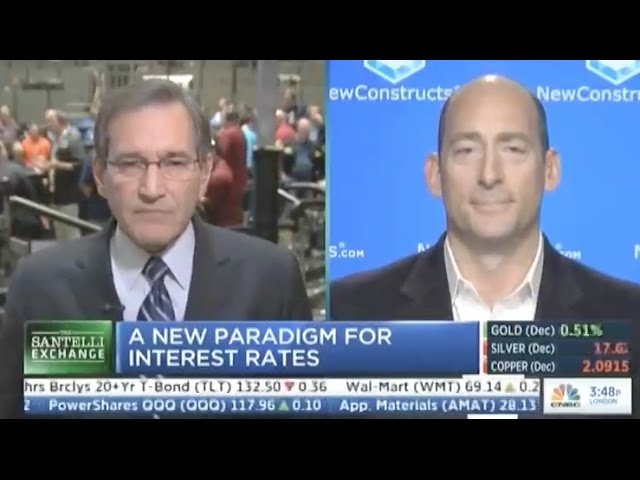
David Trainer argues the Federal Reserve's influence is overstated compared to fiscal policy and Congress. He discusses the Fed's balance sheet relative to the U.S. economy and questions whether Janet Yellen or Congress truly controls monetary policy.
Chapters
Good morning, Rick. Good morning, Sarah, and thank you. I'd like to welcome my special guest, David Trainer. David, thank you so much for taking the time this morning.
Glad to be here.
All right, David, let's start out just getting the landscape numbered up. Roughly, what's the size of the U.S. economy these days? Just roughly, get me close.
You mean in terms of GDP or global revenue?
Total GDP. Total GDP. I'm thinking it's close to $17.9, $18 trillion. Does that sound about right? That sounds about right. What's the— last Thursday, right around late afternoon, we get the size of the Fed's balance sheet. Do you recall what that was last Thursday?
I think it's pretty big. I don't exactly remember the number, though.
But it's about $4.5 trillion, about $4.5 trillion. So we have an $18 trillion economy. We have a Fed balance sheet that's $4.5 trillion. David, who's the boss of the Federal Reserve? If the mandates were to get changed or issues were to crop up, who is Is the— whose name's on the door as the boss of that organization, that entity?
Janet Yellen.
Yeah, well, I mean, if Janet Yellen— wouldn't Congress in some way be considered the boss, for example, if they wanted to change the directives of the Federal Reserve?
I think ultimately, yeah. I think there's a lot of political influence on the Fed, and since they kind of have the final vote, yeah, I think they're not afraid to exert some influence there.
A year ago, we had a debate at CNBC. I asked 2 questions regarding the Fed. You've written rather extensively as of late that Clinton and Trump talking about the Fed is a sideshow. It should be meaningless. I think talking about the Fed should be one of the highlights of this political season. And the reason I think that is just because most people have no idea the power they wield over their lives and how their policies have taken care of just a select few. Goldman's trading returns were up 17%. I think they should thank central banking policies and Mario Draghi and the corporate securities they're trying to find to buy. Why do you think the Fed should be off limits?
I think— I don't know if it's off limits. I think we need to focus more on fiscal policy because I think our economy, our country has evolved past the need for a central bank. I think markets are better at setting rates on the margin than central bankers. Capital's not disseminated through loan officers anymore. Those loan officers were risk-averse. You needed a minimum level of return to make sure they didn't allocate capital to low-return activities. We don't have that problem these days. Markets are better than ever at allocating capital to high-return businesses. And I think the Fed's pushing with the same—
No, you make a great point. You make a great point, David. You know, we were just talking about angel investing, unicorns. You know, the Fed's the head regulator. Regulations is cited as the number one or number two problem in the country by every entrepreneur that's successful that I've ever heard over the last several years. But at the end of the day, even though the Fed's the biggest regulator, a lot of these things are now outside. These entities, these investors, they know how to do the go-around. But the point is that central bankers may have control over less in that regard, but they have control over more in so many other areas. We're running out of time here, but I guess my last issue is I understand fiscal policies. Don't you think the fiscal policies would have been under the microscope? If we would have started talking about the Fed years sooner than we have. Your final comment.
Final comment is that the Fed really doesn't have as much influence as people think. Low interest rates are here to stay. And as long as we understand that, then we don't need to worry about what the Fed's going to do next. Because guess what? They're not going to do much. And even if they do, it won't matter. So let's focus on what does matter and what will move the needle. And that's fiscal policy.
You know, at least on one issue we agree. I think an algorithm could duly replace a lot of their short-term issues that they seem to be so wishy-washy on with regard to rates ought to be. Thank you, David Trainer. Sarah, back to you.