Watch Our Earnings Recap on Tesla, Alphabet, Visa, Coca-Cola, Lockheed Martin, Intel, and More
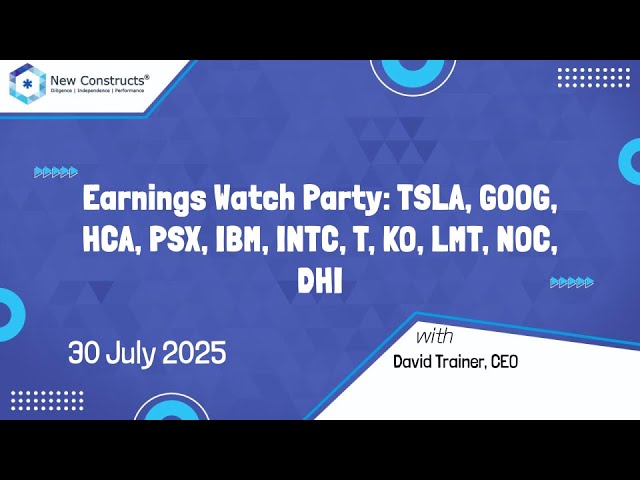
New Constructs breaks down earnings for Tesla, Google, Visa, Coca-Cola, Intel, and others using core earnings and free cash flow instead of analyst estimates. The firm's research shows that stocks like Tesla and Nvidia require unrealistic cash-flow growth to justify current prices, while its core-earnings indices have outperformed the S&P 500 over five years.
Chapters
All right, let's get started. Glad to see you all today. A lot of action, a lot of action. Markets are pretty muted the last couple of days, to be honest, flat to down. Let's kick it off on the Fed minutes. I don't think there's a lot of sort of new news there, and I don't think it's bad news. Certainly not good news. If anything, on the margin, good news because you had 2 people dissenting with a cut. But then why is the market not going up? I think it's because the market's been going up for not a lot of good reason for a long time. And we're going to see what we've been talking about here at New Constructs for a long time. I think we're going to continue to see a market that is challenged. I'm not saying it's going to get crushed and go down. That could happen. Things are super expensive, don't get me wrong. I think it's more likely we're going to see churn. Everything will look pretty calm on the surface in terms of the overall performance, nothing super great, nothing super bad. But I think underneath you're going to see the market become more discerning. By that I mean good companies are going to get more capital, bad companies are going to get less capital. That's why they say the Mag 7 is now the Fab 4. Even the crowded great, great trades aren't working like they once did. We've got meme stocks, but they don't go as high and they don't stay as high for as long. And so, I think even as much as the market is overwhelmed with liquidity, which creates more and more speculation, we're still seeing a market that is more rational on the margin. And rational in a lot of ways. In particular, I'd love to talk about demonstrated rationality in the form of our index and our core earnings research, really just proving that the market cares. about value quite a bit. I mean, if you want to go versus the S&P, I mean, just today, this— we're up, the S&P's down 10 basis points, but year to date, we're almost double the S&P. Almost double. And this is just an ETF that focuses on core earnings. Core earnings. No valuation. No valuation implied at all. Just core earnings. So what I'm saying here is that the market is rewarding those companies that are more profitable. Now, it's not really paying that much attention to valuation. Don't get me wrong, but there is a fundamental light at the end of the tunnel here. Fundamentals are mattering, and it's proven that it's mattering in the performance of this index right here. And we're not just talking about year to date. If you want to go back over a year, way outperform. Five years, really outperform. Really outperform. And if you want to talk about five-year performance, I mean, let's go ahead and we'll put in our. Very BNC VA, VA one. This is the ETF based on just our ratings. Now that takes into account fundamentals and valuation, and you can see over time it's the one that performs the best. Makes sense. But in this market, awash with liquidity, a lot awash with speculation that we've seen really kind of since COVID This is where it all— that's when it all matters, right, is over longer periods of time. But even in the short term, short and medium term, we're seeing the core earnings really does matter the most. And that's what our research is all about. And that's part of why we do these earnings watch parties, because all this talk about earnings, earnings, earnings, earnings, and those numbers aren't really true. They're not representative of the real profitability of the business. They certainly don't have as much of an impact on valuation as people would like to believe. So, let's go through a few slides here. First of all, disclosures and disclaimers. We are not investment advisors. We do not pretend to be investment advisors. We are research providers. We provide information for you to make more informed decisions, nothing else. And please feel free to speak up in the chat. Those of you who have been with us before know that I love your questions. I like to try to take some requests by the end of the, end of the show. And generally, I think it's more fun to make this more interactive. So. Feel free to ask me anything. All right. So, one of the key takeaways here is that New Constructs is different. I think some of you may have been with me before. If you are new, you need to understand that we decided a long time ago we wanted to build something better for investors, to give clear, honest performance. And proof is in the performance. I mean, I've been ranked the number 1 stock picker on SumZero, which is a buy-side-only platform, for like 45 straight months. Wow. In a row consecutively. And that's versus buy-side professionals, professional stock pickers, not a bunch of yahoos on Seeking Alpha. No offense to Seeking Alpha, but they kind of let anybody on there. Trust me, I know. I've been on there for a long time. Haha. But I've been watching, and I've honestly— I've had my work cut completely and utterly plagiarized and gone to the editors, and they're like, what are you talking about? I mean, it's pretty nutty. So we don't put nearly as much up on there anymore. And by the way, our work has been vetted. By the best in the business. When I say vetted, I'm not talking about some yahoos. I'm talking about MIT Sloan School of Management, the Journal of Financial Economics, one of the top peer-reviewed journals in the world, and Harvard Business School, Ernst Young auditors, right? Nobody's got to be more honest than an auditor. And then let's talk about performance right now. I talked about one of our indices a minute ago. They're managed by Bloomberg. They're not available for the public to purchase. But they are great benchmarks for how good our performance is. You can see here the Very Attractive Stocks Index is beating the S&P 500 in the first half and by 77% over the last 5 years. Again, this is an index of just the very attractive stocks. That's what I was showing a second ago when we were looking here. This is the Very Attractive Stocks Index in orange. Really, they should put it in green because green means good. Red means bad in our rating system. But the Very Attractive Stocks Index, it does extremely well. So does the Core Earnings Weighted S&P 500. What is this? It's just an S&P 500, same as an S&P 500 index, but you weight based on core earnings as opposed to market cap. How's that for a novel concept? Why do we just always weight things on market cap? Oh, why? Because that creates momentum that just makes things go up, go up whenever there's inflows. It's a great way to trick people into believing the market's doing better than it is. Everything can fall apart on a bad day if this unwinds, but you get the idea. But an S&P that weights based on core earnings as opposed to market cap performs better by 31% over the last 5 years. And we talked about this one already too. This is the Core Earnings Leaders Index beat the S&P 500. 500, almost doubled it in the first half. It's still about double now, and then 48% over the last 5 years. That's impressive, right? And I think it's really important to say that this is stock picking that is proven to work. These are live-traded indices. It's not me just pretending I got some special magic formula. Fundamental research matters when it's done right. When it's done right. There's a lot of fundamental research out there. You can look it up, ask the, ask the AI, whatever. They'll give you some numbers. Do you know they're right? You don't. We know ours are right, not just because we've got some of the most prestigious clients in the market as, as our customers, but because the performance shows it and it's been vetted by auditors, etc., all that. So you can't invest in these indices, but you can invest in our research. And why is it important to have good research? 96% of stocks covered by Wall Street get a buy or hold rating. Right? They get paid to have good ratings, or they get fired if they don't have good ratings. Why? Because they get— because Wall Street doesn't make money on research. It's a cost center. They make money selling stock in IPOs and investment banking deals. What does that mean to you? It means that there's a huge conflict between what Wall Street tells you and what is true. 57% buy ratings. How is that even possible in an efficient market? 57% of the market is undervalued. Yeah, yeah, these days, no way. And yet here they are, 57% of stocks have a buy rating. Crazy, right? Let's talk, let's talk for a second about earnings, right? I, I, I'm going to tell you and show you about how you can't rely on earnings, but I want to also let you understand that the earnings estimates Game is a huge game because earnings over the next couple years for a lot of these bigger stocks are utterly inconsequential to the valuation. Let me show you what I mean. This is something Wall Street doesn't want you to see. They don't want you to understand that you shouldn't obsess over a penny here or a penny there or a couple million bucks here for revenue, beating revenue on the top line or beating earnings estimates on the bottom line. That is all a bunch of noise to hook you in and to make you watch the news. Beat or miss. Oh, it's a big deal. Oh, I mean, you ever seen anybody create a movie that doesn't try to have something interesting in it? They're not going to get you to watch TV if they can't give you something interesting to watch. So they're making something about nothing. Here's my example, right? Analyst estimates— this is what's available to the public— going out to 2030. Oh, it seems like a long time. And people say, oh, it's silly to try to project that far out. It is absolutely silly to try to project things out to the penny. To the penny that far out. There's a better way. Let me explain it to you. It's looking at all of the implied cash flow required, required to justify the stock price. And the gap between these earnings estimates and the required cash flows is staggering. And let me show it to you in a picture. This is what you got to justify for Tesla at $276. We know it's more than that now, right? Though it's coming back down quite a bit here. But these are the implied cash flows that Tesla's got to— that Tesla's got to generate to justify just $276. And then these are the analyst estimates. What does that justify per share? Nobody wants to go out farther than that. So you got these precise estimates that don't mean much, and it's a big distraction from the fact that there's an enormous amount of cash flow, free cash flow per share that the company's got to generate. Same is true for Amazon. Huge disconnect between the earnings per share versus the free cash flow per share that the company's got to get to. Nobody wants you to think about this because when you do this kind of analysis, and I'll show in a second, it will scare you what the implied sort of performance metrics are. The revenue growth, the margins, and the duration of growth required to generate this much free cash flow means like Amazon's going to be bigger than The entire country of Japan. Their revenue is going to be greater than the GDP of Japan. Nvidia, greater than the GDP of Japan as well. When it gets— when to justify— what is it now? Like $150, $140 a share? This is just for $117. It's nutty. And we've done the work. We've done the math. If you're interested, I've got very specific demos and case studies explaining exactly how we do the math behind these kinds of analysis. Let me know in the chat if you want access to those and we can get those to you. So what is our edge? It's robo analyst technology. Let's just jump right into this. Let's talk about some of these earnings that we've been that we that we have on the docket today. We've got Google, Tesla, Visa, Coca-Cola, IBM, AT&T, Lockheed Martin, Intel, HCA, Northrop Grumman, Phillips 66, and D.R. Horton. So Google kind of a mixed bag in terms of earnings. And let's pull up— I like to pull up the stock price here as we go through some of these. In the last 5 days or so, pretty much flat. I mean, it had a pretty good day, I guess, on the earnings, but mostly down. It was kind of a mixed bag in terms of what's going on. So nothing, nothing sort of new or, or incredibly insightful from, from Google. And so let's go a little bit deeper into the rating here. For Google, you can see it gets an unattractive rating, but that doesn't mean this is a bad company, right? Google is a very profitable business. The issue is it just got expensive. So if I'm an owner of Google and I'm an employee, I'm happy. The market is appropriately valuing my business, right? I want to be expensive out here, especially on this metric. And so, and that's why I got downgraded, right? Because the stock is is up. And it's now what we call fully valued. Look, we love this business. It's been super profitable. But again, when we're talking about the future cash flows required to justify the stock price, you're talking about something really, really high. You can see economic earnings looking pretty good. The problem here, and the reason we're getting an unattractive rating here, false positive, is accounting earnings are looking even better, going up a lot faster. We don't always like that. But for a business like Google, I wouldn't worry about it. I also love seeing the shares going down. By the way, this is a view. From our, from our institutional and professional membership here. These are all professional membership features that I'm showing for Google right now. You can see return on invested capital and return on tangible invested capital. It's a beautiful chart. Super steady. Super steady on a big business. Yeah, Google, one of the greatest businesses of all time. No question. Let's take a look at free cash flow. Free cash flow, $32 billion, $49 billion, $27 billion, $53 billion, $48 billion, and then $37 billion in the trailing 12 months. Yeah, that's pretty good. That's pretty good. But the free cash flow yield, 2-year average is our number right here. We like pretty low. Why? Because the market cap is huge. The enterprise value is huge. So even though these, these free cash flow numbers are amazing, It's all priced in, folks. It's all priced in. That's what you call a crowded trade. That's, that's why the Magnificent 7 isn't so magnificent anymore. Crowded trades. What do you got to do to get an edge? You got to go find something that no one else has figured out yet. If everyone's figured it out, then there's no advantage. Why should you make money if you have no advantage? Why should you outperform if you have no advantage? Why should you outperform if you're just doing what everyone else is doing? You shouldn't really, right? You shouldn't win a game if you're not outperforming your competitor. You shouldn't beat your peer investors if you're not picking stocks smarter. That's the way the world works. All right, Google Tesla. Okay, you guys know this is one of my favorites to pick on. So last 5 days, Up 3%, right? Look, if Musk is anything, he's an incredible promoter. He has been amazing at getting people to sort of keep their eye off the ball. This is one of the most expensive stocks of all time, of all time to be in the S&P 500, of all time. No question that this is one of the most, in my opinion, most overvalued businesses of all time. Does that mean it's going down tomorrow? Probably not. Have you guys all probably made a ton of money in it? Yeah. Have I? No. Am I jealous? Not really. I would rather make my money honestly than make it any other way. I'm dumb like that. Trust me. I've got the worst portfolio, like personal portfolio management. I don't even want to tell you how bad I've been. I've had everything about being true to new constructs and done almost no trading until the last couple of years, really until COVID, because I just didn't want there to be any even perception of conflict. But when I saw that huge dip at COVID, I was like, all right, we got to buy the dip here. Anyway, Tesla, yeah, it's just, it's not a profitable business, folks. And unfortunately, I think that we're going to see Optimus and robotaxis go the same way as batteries in the insurance business in terms of like really never ever adding meaningfully to the bottom line. It's a distraction. Tesla's a piggy bank that, that Musk can borrow money against so that he can fund other businesses. And and be the richest man, one of the biggest bullies of all time. That's just the way it goes. This is a horrifically overvalued business. You can see economic earnings going down even worse than accounting earnings. Shares standing going up because they're selling capital all the time, selling shares, returns on capital. They did all right for a little while. It's pretty good. There was a peak time. I mean, the business for a minute, not compared to the valuation, but the business for a minute. Looked pretty good. We now know the competition is catching up in a million different ways, as evidenced by losses in market share and declines in market share. Free cash flow compared to Google, negative all the time. This is the thing people don't realize. Never made real money. Never made real money, Tesla. And then let's look, let's look at the economic book value of this business. Look at this over the years, and our models would go back to the IPO. But basically, the economic book value, the no-growth value of the business, how much money the business actually deserves to be valued at, peaked at $21. But you can see, even though from negative $18 to $21, that's a pretty big change, it's completely muted by how much bigger the stock price is. And I think ironically, we see the stock price drop when fundamentals were the best, because this is back when they were making an argument. Musk was making an argument that the fundamentals would work, and he's since now shifted people away from that successfully. But this is when he was making the argument that fundamentals would work, and that's when they peaked. But that is when they peaked, and that was the best they ever were. And back then, there was only $21 of value really in the business as it was, assuming no growth. Now, obviously, there's going to be some growth. How much growth? Ridiculous. But I think the big misses, top and bottom line— and by the way, the miss was way bigger than what Wall Street really talked about, right? Because the shares have been— the estimates have been coming down all quarter to make the bar easier to beat. That's the game they play all the time. So Tesla, unattractive. Nothing really redeeming about that business, in my opinion. Visa. Another example of great company, bad stock. All right, how did Visa do in its most reported? I don't think anything too special here. Yeah, nothing too surprising. Look, it's a, it's a great, great business, and I'm guessing they're able to return a lot of capital to shareholders, which is good. You like to see that, but super profitable business. Will they be around forever? That's the question. They own some rails for doing a lot of transactions that make this a super high margin business with returns on capital. Oh my God, look at this. 200% return on tangible invested capital. So excluding acquisitions, 200% to 500%. The regular return on capital is very good too. Margins, super high. Look at these margins, 50+% amazing margins. Capital returns, okay. It's a capital-intensive business, but super high-margin business because once the rails are up and the technology's in place, you're just running transactions, an infinite number potentially through there. So Visa, great business and nothing too exciting about the numbers. I mean, it beat the quarterly estimates and steady forecast, not good enough. So what does that mean in terms of like the stock price performance? Why we just kind of get a big meh? Nothing, right? Or even though it beats and the forecast is not awesome, it's okay. Why is the stock going down? Because it's priced for perfection, folks. Super expensive, great profits. It's all baked in. Everybody knows. Crowded trade. You want to do better, you got to go find something where everyone hasn't already figured it out. Coca-Cola. Yeah, flat too. What's going on Coca-Cola? Good company, not so great stock. So it's not as extreme, but it's the same thing. The same thing. No reason to really be in this stock because, right, it's pretty fully valued. Now the growth expectations in terms of the valuation, not as extreme for Coca-Cola as we see for a Tesla or a Visa. But of course not. It's Coca-Cola. How many of you guys ever heard my story about Wayne Goizetta, the the former CEO of Coca-Cola? Raise your hand or put it in the chat. Nobody's heard it. I'll tell it. It's a great story. But if you all heard it, I won't I won't bore you. But yeah, Coca-Cola, decent profitability, but fairly expensive. Fairly expensive. And we saw that strengthens long-term value with cane sugar soda launch. Earnings beat. Yeah, they had a beat. Didn't go anywhere. Why? Fully priced. Fully priced in. So yeah, I got a couple of you all asking to hear the story. So back when I got my start at Credit Suisse, I was building out a special template for all the analysts to use. And eventually we did have every analyst around the world, not every analyst, but like 80% of all analysts. And we were growing fast using this special template. It was an Excel model. It was an earnings model. It was just a better version of an earnings model. And it did work like what I do with the new constructs, right, in terms of getting to the economic earnings and understanding valuation. And the first time that that report was public, or that model was included in an analyst report, was in a report about Coca-Cola. The report was written by Marty Rahm. And shortly after that report was published, Wayne Goizetta wrote a personal letter to Marty congratulating him on using return on invested capital in his analysis because Wayne said that is the right way to run a business and that's the right way for a Wall Street analyst to look at a company. Wayne was one of the greatest CEOs in the history of CEOs, but for sure for Coca-Cola, I think he led them from low, I don't know, $30, $40, $50 million market cap, I might be exaggerating, to hundreds of millions of billions. Right? Or low $100 million to billions in market cap and very super well-respected. And so, it was a huge honor to get that letter. I had actually my training materials for the team, all the new analysts. We go, we talk about that letter and we talk about how for so many people, not so long ago, economics mattered. Returns on invested capital mattered. And as you guys can see in everything we do, Return on invested capital plays a big role. It's a key element in our ratings, and it's a big driver of economic earnings as well. But so it's really in here twice in that it's a big part of economic earnings and return on invested capital by itself. Extremely important number. Extremely important number. All right. IBM. Love IBM, right? I mean, it's I mean, it's the classic company. I love the old saying, nobody ever got fired for hiring IBM. That's kind of a— that's such a great way of pointing out how people are super conservative about some of their decision-making, especially within a business. And yeah, so IBM shares drop as software revenue misses. Second quarter results rise on consulting, stock slips on slower revenue growth. So what do we see at the end of the day? A big nothing burger. Stock is basically flat, maybe a little volatility here and there, but nothing really happened. We look at the valuation. Anyway, you kind of, you kind of got a good company, bad stock thing going here. Why are we seeing so many bad stocks? Because the market is near all-time highs, like since the tech bubble, for sure all-time highs. What does that mean? It's a lot of really expensive stocks. All the more reason That for us to think that Wall Street is crazy for making 57% of all stocks a buy rating. So anyway, companies' profitability is getting better. I think IBM is getting better. But look, folks, the turnaround is all priced in. The turnaround is all priced in. AT&T, people love this one because the big dividend, 4.1% dividend yield, not such a good company, but cheaper stock. Kind of the opposite. I don't really have much to say here. That you haven't heard me say, and that is like, hey, it's neutral rated. I don't have anything to get excited about or happy about. Last 5 days, earnings didn't really matter. They delivered a big subscriber beat, strong second quarter, not looking good despite great subscriber growth. That's what it's all about for these guys. But yeah, it's because the businesses— I mean, sometimes you got to put all this into a bigger picture framework as well, right? And that is that, look, I mean, is it in a great business? You know, we had a thesis on Verizon years ago when they were still in the live entertainment business. They had a big streaming service, especially for concerts, and I think they were going to get into sports. We're like, what? This is the way to go because live entertainment is the one place that you can't just stream. That's the one place you can really get eyeballs. And we're seeing all the major streaming and entertainment platforms move in that direction, right? Amazon spending billions to get free NBA basketball and NFL football, and Spotify spending billions and hundreds of millions to get great podcasters on board. I mean, that's where it's going. So anyway, but when you took that out of Verizon, we were like, yeah, it's, uh, that's a big stock. I mean, I don't know. I mean, cell phones, who knows, man? Maybe we're going to catch something that replaces a cell phone in the not too distant future. And AI glasses, I, I don't know, maybe AT&T will sell this because we need the bandwidth. But bandwidth is a commodity, and it's kind of a commodity business, which is sort of what you see in terms of profitability and valuation. Not a lot of growth priced in here, folks. So that's why, again, neutral rating. Meh. We're going to get to something good here. Oh yeah, how about Lockheed Martin? Those of you who have been on some of our trainings might know that we've mentioned Lockheed Martin for a very special reason. You can see also that it is a defense stock, and I think this would be a pick-and-shovel play, or at least One of the few defense stocks that's not gotten overpriced. This is what I would call gold, diamond in the rough, example of going places where other people are not going. Here you go. You're welcome. Lockheed Martin. Let's see, what did they report here recently? Down a little bit, down a fair amount. Maybe they report soon. They don't— they haven't reported yet. I think that they've Interesting. Maybe it was a couple days ago. Anyway, new 10-K. Yeah, they've reported because we got a new 10-Q here recently. So yeah, look, this looks very attractive, folks. What did I tell you about very attractive rated stocks? Looks really good. Here's the very attractive rate. Here's a very attractive index. This— these stocks are so good that Bloomberg created an index to track them. And that index has performed very well, beating the S&P by about 70%, 70 percentage points over the last 5 years. That's pretty good. That's pretty good. So Lockheed Martin, I kind of don't care what happens with earnings. This is a good stock because there's no way they're going to— it's anyway, I mean, if the stock does go up a ton, you'll see the rating change. And if you're a client and this is in your portfolio, It will get updated immediately. So, or it'll get updated and you'll get an alert the next first thing the next morning. That's part of the membership. Whether you're a Stock Tracker 50 or whether you're a professional member, we let you know immediately when these prices change. Intel suspended rating. Big. So I guess it's potentially an acquisition target. We got a new 10-Q in here recently. Yeah, Intel turnaround story. Profits bad, valuation bad, unattractive rating. I think what this tells you over here is that a lot of the turnaround, as much as you want to believe in, is already priced in. Turnaround already priced in. So not a lot of, not a lot of good to talk about there. You can see, wow, economic earnings headed down. Economic earnings not maybe as bad as accounting earnings. Number of shares going up, that's not good. They're having to issue shares to keep Shares to keep the business going. Return on invested capital dropping a lot over the last few years. And let's see here. I'm guessing free cash flow been really bad. Spending a lot right now. That's part of the turnaround story. And I think of the onshoring of semiconductor development and building is should be really bullish for Intel. Could be great. They got to they got to they got to spend a lot now to make that happen. But the economic book value is still— it's negative now. So look, this could turn around. And when it does turn, and I'm imagining you could make a pretty easy bullish case for these numbers to get green in the not too distant future. And we've got a model where we could actually look at and quantify what it would mean to the valuation if that happens. And when this turns green, these numbers will change. Especially the price-to-economic book value, that'll get positive. Whether or not this number changes, different question. And that's, that's where our valuation model would really help you really understand how much good news specifically is priced in. This tells you a lot of great news is priced in, a whole lot. And that may be all you want to know. But if you wanted to specifically understand what the, what the revenue growth, the margin, and the balance sheet implications are for this high valuation, that's what a model like this is opening right now. would show you. All right, HCA. Oh, another very attractive rated stock. This is on our focus list. We like it for good reason. We just think the hospital business is going to be in good shape. I mean, the aging of America, the aging of the world. Yeah, they're going to have challenges with Medicare and Medicaid, but the demand story here is so huge, and hospitals are in short supply, and they're all— I mean, I don't know if any of you have had any loved ones in the hospital. I pray for you, man. Be careful. Have an advocate there. They just seem so overwhelmed and they can't pay attention to stuff. My dad was recently in for some stuff and they're like giving kind of the wrong medication. Like, and, and I, I was there to be an advocate and he's home now, but they're still messing it up. And at least he notices, notices right away. And they're excused. The doctor's blaming the pharmacist. The pharmacist blaming the doctor. Like, come on, man. Like, it was a really dumb reason too. So. Be careful, but they're making so much money. And by the way, they're just, they're like, service is worse. I think they're making themselves more profitable. And I, anyway, this, this price is if it's never going to grow profits again. That's what you see here. 1.0, zero profit growth implied by the stock price. And then you've got great profits rising. Look at this economic earnings, shares outstanding going down too. That's a good thing. We love to see that, right? When we, when we see the shares outstanding, This is what we call, this is what I like to call the unstoppable stock, right? Because the deal is like, even if the market doesn't see the value, they're going to keep reducing shares outstanding and the price is going to go up. It's like they bully the stock, right? It's like the opposite of a meme stock. The insiders are buying their own shares, not some wackos meme stocks. And so we like to see this a lot. That's why we added this chart. One of our clients suggested we added this to the site. We did. It's, I think it's a great addition. I love seeing it. Whatever direction it's going, even if it's going flat, it's a great piece of insight. Strong, consistent returns on capital. Look at this. It's almost like Walmart, so consistent, but higher returns on capital. So we like HCA. Northrop Grumman, defense stock, doesn't look so good. Profitable like Lockheed Martin, but all the good news looks like it's priced in here, folks. All the good news looks like it's priced in. And it's a pretty heavily indebted business. Switching over to the credit rating here. Pretty heavily indebted business. So that's, that's not great. But back to the stock rating. Yeah, it's looking good. Economic earnings should be looking pretty good. Positive and rising. Accounting earnings looking quite a bit better. But yeah, these guys just must have barely have an increasing, slightly increasing ROIC here to get that top rating, 9.5 to 5.5. So maybe they're going up at least, at least a little bit. But Yeah, profits looking good. Should be. People are spending on defense like never before in the US and Europe now. I think that's good. We, we, we don't need to be naive about how— what it's going to take to protect ourselves. And, and then, but the valuation. And so I think we go and we look at earnings report, Northrop Grumman, last 5 days. Yeah, nothing special. Flat. Tops estimates, revenues increase, profit forecast is strong. They lifted it. All good news. What happened to the stock? Nothing. Why? All priced in. All priced in. Crowded trade. If you want to make money, got to do something different. I think, I think Phillips 66, another business where it's all priced in, just got a new 10-Q. And let's see what happened here. When did they report? I feel like this is really super recent. Just yesterday, 2 days ago. Strong refining midstream. All right. Good news. All priced in. And look, the business is kind of coming out of a hole. I think crack spreads are getting better, which is good for the refining part of the business. But in general, I think we're seeing more supply coming onto the market. And I think we're seeing a more stable global economy, probably, or at least socially and militarily more stable, which I think is not great for oil prices— or I'm sorry, oil companies. Good for oil prices, good for consumers. All right, D.R. Horton. One of our longtime favorite stocks, homebuilder, super profitable and super cheap. Current stock price implies profits will never grow from current levels. 1.0. We like that. I want to buy a stock whose valuation implies no profit growth when I can go in and say, oh, but profits have been growing. Well, profits haven't been growing so much, but they will grow again, I think, for D.R. Horton. So what I'm saying here, like, this means never grow from current levels. And so, yeah, housing business not so strong, but it's not— it's going to get better in the future. It has to. And the number of shares outstanding going down, that's a good thing. Again, they're their own internal meme stock capabilities. And I think with free cash flow, you've got steady free cash flow all along. Economic book value, you can see economic book value has been a lot higher. It's come down recently, and, and now it's above the stock price. So I think the stock price is a A little too negative. All right, I got time for one, one request. Give me a request and we'll stick it in here. Oh, that was quick. Oh wait, who was first? All right, PANW. We'll add to the portfolio here. PANW, Palo Alto Networks. Oh yeah, this has been one we've been looking at really for a while. Great business. Love it. Great profitability. Expensive. Very expensive. Very expensive. Good news priced in. Crowd to trade. Crowd to trade. All right. Thank you very much for joining me today, everybody. I hope you will join us on Friday. We'll be doing this again. It'll be in the morning. You'll get an email. Don't worry. Please leave me some feedback in the survey at the end. And any questions, email us at support@newconstructs.com. I'm here to help with anything you ever have questions about. We are here for the integrity of the capital markets and making you a smarter investor. Thank you.
More from David




Earnings Recap: Decoding Signals from SpaceX, Palantir, Merck, AMD, Caterpillar, McDonald’s, & More

Watch Our Earnings Recap: Market Heavyweights Apple, Microsoft, Amazon, Meta, Visa, and More



Earnings Recap: Top Insights from JPMorgan, Bank of America, Taiwan Semiconductor, Netflix, and More


The IPO Melt Up: How Smart Investors Use AI to Find Abnormal Investment Opportunities