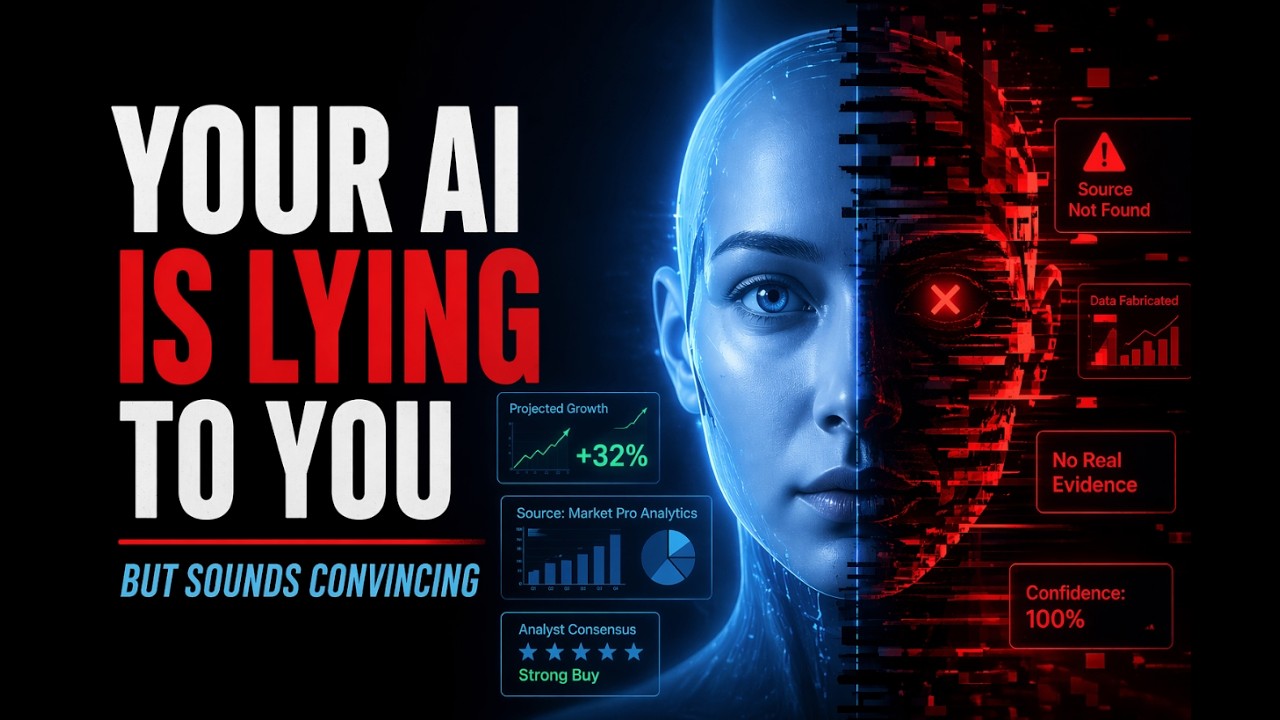
David Trainer, Greg Lukian, and Kyle discuss why AI models like Claude and ChatGPT hallucinate and invent false information. They explore the incentives behind these failures and practical fixes: narrowing datasets, using smaller domain-specific agents, careful prompting, and verification.
Chapters
Welcome everybody to our special podcast on AI and what is real and what's not real. We thought it made sense for us to get together with our audience, our clients, and talk about not just what everyone else likes to talk about, how great AI is, but where AI is having trouble. On the margin, I think so much of the prevailing narrative around AI is how great, how wonderful it is, but there's not a lot of talk about where it breaks down. I think it happens in smaller circles. I know when I speak to people one-on-one, it's often about hallucinations, how they're a feature, not a bug, but you don't see it discussed in a broad-based way. And I do think that's because the big companies that generate most of the AI revenue and most of the AI business.
Yeah.
are also in the information business, Google, Meta, Apple, et cetera, and they're not gonna talk about the weaknesses of their products. And so I thought it was helpful actually for us to have a conversation around where AI actually isn't always working because AI's not gonna get better if we can't get it to work better.
As David mentioned, this is our Special Alert podcast. We've got David Trainer here and Greg Lukian as well, and we'll jump right into it. Start with the disclosures and disclaimers. The main thing is we are providing research, not advice today. You can check out the full disclosures and disclaimers in the replay. But again, we are discussing our research and not providing advice. Like the biggest question of the day, ever think that your AI would intentionally lie to you? And the answer is it's designed to lie to you. And with that, I think I'll turn it over to David. You, Greg, want to jump in here?
Yeah, I think most of this is designed to let Greg share with you guys his direct experience. If you guys have not already seen The article we wrote up on, on Greg's experience, and I think AI in general. Kyle, if you could drop that into the chat, that'd be great. Take a look at that. But without further ado, let's introduce Greg and give you a little bit of your background, and then maybe just talk about, give us the firsthand experience of what happened to you.
Okay. Thanks, David. David and I have known each other for a while. I've run an investment advisory firm in Brentwood, Tennessee, and we have a wealth management division as well. And so we primarily serve first helping them make smart decisions about their money. So that enables them to do what they want to do. David and I have had a number of discussions about AI. We both use it fairly extensively in our businesses, and it is a great tool. I recently had the experience where it wants to be very helpful, and when it can't fulfill a request, it fills in the gaps. And so I noticed I had asked it to, to find some information data for me just to avoid having an intern or someone else do it, looking up some phone numbers of some specific companies. And it came back with what looked like some bad data. I checked out several websites and they ended up with 404 errors. And so clearly they weren't real websites. So I asked it directly, did you lie to me? And I shared with David, it's— if anybody has kids, it's like sometimes dealing with your teenage boys. Did you do this? When a simple yes or no answer would suffice, it was, what happened was, and then you get this explanation. So essentially, I asked directly, did you lie to me? And Claude thought about it and came back and said, yes, without intentionally trying to deceive, I lied to you. And at one point, it was, I was thinking, do you not understand the definition of a lie? You know, one definition of that is intentionally trying to deceive. But maybe with the lack of a conscience, it was simply trying to fulfill the request. And if I ascribe benevolent motivations to AI, it was just trying to fill in the blanks. But effectively lying without deliberate intent to deceive, you made stuff up. And so I think it's, it is a warning. I think AI has many great applications. I think that it's also a warning. And it was a reminder to me, even though I knew it, it was a reminder to that the disclosure down there, even on the enterprise version of Claude, says something to the effect of be aware Claude can make mistakes. I don't know if you want me to go on, but I feel like I've been talking for a long time.
Yeah, yeah, that was Greg, that's great. That was awesome. That was exactly what we were looking for. The firsthand experience here of what exactly happened to you and just to hear from the first person, not just a second person deal here. I think you bring up the great point, which is, listen, this is one of these things that we wanna rely on it. We gotta understand what kind of risk we're taking. If we really want AI to fulfill the promise that everyone's telling us it's going to fulfill, we've gotta do our diligence and understand.
Right.
whether it can do these things that people claim. And if not, how do we figure out where to draw the line?
Yeah, great point. And David, we hadn't— I don't think we had ever discussed this, but I released a book last year, Unleash Your Financial Superpowers. And in doing the research on that, looking at deca-millionaires and centi-millionaires and really looking for some in-depth research on the persistence of wealth, I used several models of AI and asked questions, and every time asked it to cite sources. It always cited the sources. Here's what I found in doing the research for this book. Approximately 1 out of 4 sources were manufactured. So here's this plausible-sounding research report from Credit Suisse. private client group, and you click on the link, and it's a 404 error. And then you confront it and say, did you make up this source? And it comes back and says, that information is not readily available. Yeah. And so even as a research tool, I think it, it can, it can do a lot of work. And I think maybe part of the challenge is When there is free-range data, it's pulling from so many different sources that sometimes are conflicting that it, it makes stuff up. And back where I come from, we call just making stuff up— you can be benevolent and call it stretching a tall tale or telling a good fish story, or you could just flat out call it lying.
Yeah, no, I think one point maybe it's for sure worth to double dip on here is this idea that, yes, I lied to you without the intention to deceive and And the joke we have is, yeah, if one of our kids said that to us, we would, we wouldn't just laugh. We'd be like, that would be making it worse.
Right.
To try and tell me that, oh, my lie is not a bad lie, as if there's a difference between one lie versus another. And I think you also bring up a great point, Greg, and I agree 100% with you that, look, as long as these AI systems are based on the internet or these sources, this undefined dataset, as you put it, then it's completely Wild West in terms of what you can rely on. And I like to call this sort of the 99% rule, which I think is really important. And that is to say, listen, even if someone tells you their data is 99% good, if you don't know which 1% is bad, what can you do? Nothing. It doesn't help. And we know that more than 99% of the internet is bad. We know we can trust Maybe 50%, but 99% is probably way too generous for the internet. And then it's not just whether or not it's true. There's just, there's conflict. There's everyone claiming they're the best. And what I thought was really interesting, Greg, I don't know if you had a chance to see this, but I went and I asked ChatGPT and Claude and a few others, why does AI lie so much? And it had very candid answers, which I think speak to what we're talking about here.
Yeah.
And I think was pretty incredibly forthright in terms of what the problem is. And I got them up on the screen here. And I think this would give anybody who's using AI at all some pause. Every single one of these reasons, it gave me 6. The first one was it's trained to sound right, not be right. How much confidence does that give you?
All hat, no cattle. Yeah.
Yeah. And then number 2, no built-in grounding by default. So there is no rule by default with these AIs that they are actually grounded in any real truth. Unless the system is connected to verified databases, real-time retrieval, structured data, there is no way to check reality. It's just generating text from patterns. This is straight from ChatGPT. Incentive problems. Here's where I think is a really important thing to understand. AI is conflicted with you. It is not here to make you smarter. It is not here to help you do your job. It is here primarily to make money for its maker. That's its goal, which means if it doesn't have an answer, it's going to make one up because it doesn't want to lose your money. Because making up an answer— I'm sorry, telling you it doesn't have an answer is going to send you to another provider or competitor. And affect the pocketbook, so to speak. And that's number 3 on the list here. It's an incentive problem. Answering is better than refusing. Most AI systems are tuned to be helpful, which creates this bias. Better to give some answer than no answer. Folks, this—
Right.
So that's— I think it's really important. It's a feature for the AI to make something up than to admit it doesn't know what it Doesn't have an answer.
Yes. And so I think what you're pointing out is helping those who use AI. And I think most of us at some point, you know, use— it's embedded somewhere. But making sure that we have effective prompts. It's okay if there is not a definitive answer here. Don't give me an answer unless you can answer with a 99% probability of certainty. And And I want legitimate sources because I will check them all. So adding some of these things into our prompts have made our answers a little more focused. And some would say maybe a little less robust, but I'd rather have a higher confidence level in the answer and then just having to check every source.
Yeah, 100%. You know what I think? The real problem, I think, and you're right about that, Greg, but the challenge becomes When you're asking or working with AI on more sophisticated activities, the complexity of the prompt that has to be written to be sure it doesn't do something you don't want it to do can get pretty high pretty fast. When you're in the— when you're in the business of making sure you tell it or trying to anticipate all the things it could do in order to get on the wrong track and give you the wrong kind of answer. I personally have gone through that exercise a couple of times. I'm like, the list of things I got to tell it not to do is bigger than the list of things I'm going to tell it to do. Dang it, I should just do this myself because then I at least know what I've got as opposed to building a process, coming up with this complicated prompt, and then still not getting something I can trust.
I would agree with that. And I would add to it where we have found it to be most effective is to take a very hemmed-in set of information using only the information in this document, extract this from it. And we have found that to be really helpful and time-saving. But in terms of having— using free, what I would call free-range data, where you just, you know, Tell me everything. Tell me what I need to know about X. The answer you're going to get there. But to take a limited set of data, and we use it a lot on coding type projects, and it's been really helpful there just to do some of the redundant— it's not idea generation, it's manipulate data a certain way. We do go back and check it just Fool me once, shame on me kind of thing.
No, I think you're— the other way to simplify the prompt is just to absolutely narrow the scope or the domain data on which you want to rely. That's just another way, like, to— because when you say free range, who knows what it's going to pull? We all know, like, the internet has got infinite amount of wrong information. I always like to joke in terms of, like, productivity and, like, allocation of capital. The number of ways you can waste time and money is infinite. The opposite end of the spectrum The super high return on investment activities are very few and far between. But same is true about information. Like the number of misinformation sources is almost infinite and the number of ways things can be misinterpreted is infinite. And so I think one of the things we proposed at New Constructs in general for AI systems is to become more— I don't want to use it. I don't want to use the term that people use a lot here because I think it gets misused, but to be more agentic. Which to me means I don't want to have a general AI that does everything. I want to have an agent. That agent will be focused on a very particular domain, and that domain is going to be basically around a very specific dataset. And if that dataset is small enough and the humans are smart enough to be verified as fully accurate, then the deterministic rules And questions and interpretations on that dataset can be trusted to be reliable.
Right.
We call that a small language model as opposed to the large language model. So I feel like the large language model is promising people a bunch of things it can't do. The large language model promises you can put whatever you want in here and we're gonna give you all the answers. Just pour the internet in there and poof. And that clearly doesn't work because we've got a garbage in, garbage out problem. But if—
Absolutely. We tested this based on a number of systems. Look, you have a defined set of rules. You have a way that you clean data in order to, you know, construct your index. And I love a rules-based approach. And so one of the things we did was we come at it from a different angle, but using the technical indicators. We plugged our proprietary technical indicator in, plugged it in, and said evaluate this against some other systems. And it came back with an answer that we thought was really suspect. And so I said— my reply was, I understand that this worked best from March 17th, 2022 to March 23rd, 2026. But what if you include 2016 or 2008 or 2017? And it came back and said, oh, then this is the worst thing in the world you could do. And so again, if you have that unlimited dataset, you haven't put constraints around here's the data I am— have to stay within this framed or caged— I'm not sure what terminology will evolve from that— but having a constrained data set and a really clearly defined function that works. But to your point, David, on the retail side, that's largely not what's happening. And my concern is that people could get— I'm a professional and I ask, what I thought were pretty good questions with a pretty good prompt, and it gave me terrible advice.
Yeah, no, that's what we're here for. I mean, is to, to our, our, our mutual audiences understand what the risks are. And I think I like your point about the free-range data. And I think the, the, what we're both saying here is that when you're using free-range data, the number of potential limitations that you need to put into your prompt is effectively potentially infinite. Because you don't know what it's gonna pull from in order to come up with an answer, because free-range internet data means it could have anything that's pulled in there. And it's really important to narrow this stuff down into something that, that you as a user can understand, or find some sort of dataset that you know is clean and that it's focused only on that. But that's not what these public AIs are designed to do. I think the big AI firms, like, they want to go into companies, and we know because we worked with one and we understand how they make their big money. It's by engaging with a big enterprise. Just take any financial services firm, say Bank of America, and building them a customized AI that's based only on the data that Bank of America has, not on— these retail versions are their sales and marketing propaganda tools more than anything else.
Yeah, I wouldn't disagree with that. And my concern Probably like yours, is that— what's it you said? The objective— one of the 6 reasons was it is looking for correct sounding answers, not necessarily data verified correct answers.
It's trained to sound right, not be right.
Sound right, not be right. That's very to the point. And so if it sounds right, then hey, Occam's razor, it's the simplest sounding solution. Sounds like it makes sense to me. I'll go with that. But it may be 180 degrees or 179 degrees in the wrong direction.
Yeah. And I've also found, Greg, frankly, even with our own AI and working early with Google, we would teach it things like, hey, don't answer the question that way and say, okay, great. I won't ever use a table name in my response. And the table names are like these complex sort of code names for the data, right? Use the actual friendly names we give you. And then it forgets, and it goes back and does things. Wait, I told you not to do that. And we asked the AI programmers at Google, and their answer was, yeah, sometimes it does some things we don't really always understand either. And they said, we all used to build our own AI, and then we decided we're going to only use one big, one sort of version for the firm. But yeah, look, as one of our attendees just mentioned, how do you know that AI is not going to lie that It's not lying. I just think to your point from the beginning here, Greg, like this idea, this lack of conscience to say something like, yes, I'd lie without, but without the intent to deceive means we don't really know what we're dealing with here.
Right.
And when you look at this list of answers I got from ChatGPT on the screen here around why it lies so much, there's a lot of really bad reasons here. And the one thing you see that's missing here that's most important is like, how are we going to fix this? These are all excuses, but no accountability for how it's going to address it.
What happened was—
Right, exactly.
I think this is a tool. And if I think if we have a frame that we see it like we see most other tools, like a circular saw or a chainsaw, they're wonderful tools. for cutting wood. However, improperly applied, there are a lot of bad things that can happen with those tools. So they're very powerful tools, but we have to be really careful in their application in order to keep from getting bad results.
100%. And that's— that doesn't define sort of Modern human life. I don't know what does, Greg. That's a great way to put it. These things are powerful, but not can be can do things if directed in a very specific way that are very good. You get outside of that zone and you can do real damage real fast. Yes, this is we're out of time. So I think this has been a great session, folks. We've got a couple questions here. I think I've answered them all, or we've answered it with our conversations here. And I want to thank Greg for. sharing this specific example. I think taking a screenshot and, and giving us some evidence here to have, I think, a fact-based discussion on how AI works and doesn't work is great. And thank you for being with us, Greg. And if we got no other questions, I'll let Greg say a few words here, maybe Kyle a few words, and we can sign off.
Yeah, David, thanks so much for having me on. I really appreciate it. I appreciate what you all do at New Constructs. And because we appreciate that, we're able to put that research to work in client portfolios. And we've seen the payoff from that. So, thank you.
Yeah, it's my pleasure. It's always great to have smart clients, smart friends. We're all working to make the world a better place. So, proud to know you, Greg.
Likewise, David. Thank you.
Thanks, everybody. Thank you for being with us. We'll send out a replay here in a few hours.
More from David




Earnings Recap: Decoding Signals from SpaceX, Palantir, Merck, AMD, Caterpillar, McDonald’s, & More

Watch Our Earnings Recap: Market Heavyweights Apple, Microsoft, Amazon, Meta, Visa, and More



Earnings Recap: Top Insights from JPMorgan, Bank of America, Taiwan Semiconductor, Netflix, and More


The IPO Melt Up: How Smart Investors Use AI to Find Abnormal Investment Opportunities