32 things I wish I knew when first learning to metal scream

Tata Kalo shares 32 lessons from learning to metal scream, covering vocal techniques, safety, and how to overcome fear when starting out. The video walks through what actually works versus common mistakes beginners make.
Do you have doubts if you can scream? So did I. In fact, it took me 15 years until I finally cracked the code. And now I've helped over 2000 students discover their screams and had over 3000 non student consultations. In this video, I'm sharing the things I wish I knew when I started. So you can learn faster and avoid my mistakes.
There is a lecture.
Tata Kalo. So first, when I was learning to scream, I kept hearing the same thing over and over. Even if you feel pain, you're doing it wrong and damaging your voice. And honestly, that really messed with me. I was so scared of causing damage that I barely gave myself permission to explore or experiment. I just stayed stuck. Now, I still agree with part of that idea. A good scream shouldn't feel painful. It should feel pretty physically okay once it's dialed in. But here's where things get a little more nuanced. The idea that pain equals damage isn't always true. Now, there hasn't been a ton of research specifically on this in screamers, but there are studies that suggest your actual vocal cords have way fewer pain receptors than the tissues around them. Which means you can be hurting your vocal cords and not even feel it. Or you could feel pain from using other tissues that are more sensitive, even if your vocal cords are perfectly fine. In fact, a lot of students I've coached in Fry screams actually say they feel nothing at all once they're just using their vocal cords and not using other tissues. And that lines up with my own experience, both as a screamer and as someone who's coached thousands of students since 2019. This nuance matters because I see so many people get so afraid of pain and damage that they never give themselves room to explore and figure things out. They want to avoid damage so badly that they never unlock their scream. So don't let fear stop you. Pain doesn't always mean damage, and no, pain doesn't always mean safety.
Next.
So what actually does cause damage? Well, it's usually not the distortion itself.
The.
The real danger comes from what people do to compensate when they can't get distortion working right. For example, when I was trying to sound like Slipknot, I couldn't get the gritty tone right, so I leaned way too hard into just shouting. And that wrecked my voice.
I would try to speak afterwards and.
No sound would come out. It took me one to two weeks to recover. That's because shouting with your clean voice, not distortion, is what really slams your vocal cords together. And if you do that enough, you can end up with vocal nodules or polyps. And by the way, if you want damage free ways to unlock these screams, I'll go over how to build your fry and false chord screams in a training you can get by clicking the link in the description. But back to the video.
Next.
I went to multiple different vocal coaches that each had their own method for getting me to scream. I tried the deep Sigh for four to five years to get my false scores. I tried pushing out my vocal fry. Ah, cracking my voice. None of that worked for me. But that's okay. Everyone's relationship with their voice is super different. There's no one screaming method that works for every single person. So I'd recommend trying different approaches until one clicks for you.
Next.
I always thought my voice was too low to do high screams, and a lot of people think their voice is too high to do low screams. Fortunately, you don't have to be a big muscular person to go low and you don't have to be a tenor to go high. If you want to do high screams, just try screaming in your head voice register. If you want to learn how to do low screams, use your chest voice register. Now, the thing with chest voice register is that there's two different places where you could scream in your chest voice. Either up here or down here. So if you want to go really low, you have to use the lower one.
Next.
You don't need to learn every single scream in order to be a great vocalist. Many vocalists like Corpse Grinder from Cannibal Corpse make entire careers out of pretty much just one type of scream.
Next.
A lot of people told me to.
Just practice when I couldn't get the right tone. But that took me five years of practicing every day before it finally worked. The truth is, when somebody says just practice, it's usually because they don't actually know how to help you improve. Just practice is only helpful advice after you found the correct tone and when you're working on just making it more consistent. But if you can't get that tone at all, you don't need more practice. You need to find a different approach.
Next.
I was told by many that my false chord scream sounded good when deep down I ran out of air and I just knew it didn't sound as distorted as I wanted it to be.
This is because pure false chord screams sound a little boring. It sounds a little bit more full, in my opinion, when you add a little bit of fry to it. So as an example, here's pure false chord screams and here's when you add a little bit of fry to it.
Next.
I was told by many people that if I flapped these guys I'd be able to get a cool false cord scan. I spent six months to a year going down this path. But these tissues are arytenoids and they're not the same thing as your false cords, even though they can sound kind of similar. Next. Every teacher I had in YouTube tutorial would spend about 75% of their instruction on emphasizing the use of the diaphragm. They made me feel like diaphragm use was the key to fixing every problem. But screaming is kind of like whistling where using just force won't get you what you want. You have to use the right amount of force to get the sound you want. Not to mention you have to get the shape of your lips just right. Similarly, when it comes to screaming, using my diaphragm was important, but but it wasn't the fix all solution to all my vocal problems.
Next.
I used to spend so much time trying to figure out the exact type of scream that Slipknot pierce the veil A Day to Remember and other vocalists were doing. I'd ask myself, are they doing fry false chords? I was so confused. So in my opinion, if it tends to sound more crunchy and flappy, then it's probably closer to a false chord scream. And if it sounds more wet, gurgly and smooth, then they're more than likely doing a fry scream. Now the thing is that it's possible to combine both fry and false chord screams together, and many vocalists end up doing a hybrid scream whether or not they realize it or not.
Next.
I used to think that screaming science was perfect, that it always had all the answers. But in reality, science starts with people making observations and forming hypotheses. And ideally those hypotheses are tested and challenged over time, not just accepted as truth. In even the best scientific ideas aren't 100% proven. They're just the best explanations we have until better ones come along. The same goes for screaming. The science of vocal distortion is still developing. Most of what we know comes from people observing and guessing based on what they think is happening. So don't treat any one method like the gospel cause remember how most people once believed that the earth was flat? We have to stay open minded and keep evolving our understanding.
Even as someone who teaches screaming full time, I've changed my methods many times over the years. When I realize something isn't consistently getting my students the results they deserve, I don't double down. I challenge my own Assumptions, my understanding of the science, and I adapt. That's how I stay effective. Next tip.
Often a student will come to me and say that when they do false chord screams, it ruins their abilities to do fry screams. They usually start to get really worried. But what most of them don't realize is that a false chord scream is louder than a fry scream by 20 to 30%. But if you don't know that, then it's easy to be at a certain volume for your false chords and then over push your fry screams when you switch to your fries, making them not work. So remember, different screams have different volumes. Next, can you make this sound with your lips? It's okay if it sounds silly or it doesn't come out perfect, but. But did you need to warm up before doing that? Nope, you kind of just did it. And that's kind of like how fry screaming works. It's not about warming up your body, it's about doing the right thing with your voice. That's why I think that warmups are not as important as everybody makes them out to be. And don't get me wrong, I used to do warmups every day. I followed long routines and tried to get everything just right. All my teachers told me to warm up a lot and I even taught warmups myself. Now let me be clear, I'm not anti warmup. But after coaching full time since 2019, I've seen how people can often over over rely on them to the point where it holds them back. Some people will say, oh, I didn't practice because I didn't have time to warm up. Or I can't scream well today because I didn't warm up. And for a lot of people the idea of warming up becomes a crutch because then they start telling themselves, oh man, I won't be able to scream unless I warm up. And then that becomes a self fulfilling prophecy where if they think they're not going to scream well because they didn't warm up, then they scream terribly. But here's the truth I when you're starting out, you'll make faster progress by just getting to the sound. You don't need to treat warmups like a ritual. And there can be value in warmups, like reminding your body where the right distortion or register lives. And I still do those exercises sometimes, but I don't do them to get the blood flowing. I do them because they help me find the placement faster. Back then I'd spend most of the lessons with my teachers warming up when all I really wanted to learn was to learn how to scream. And that's what I focus on on now with my students.
Next.
I used to be terrified of hurting my voice. And anytime something felt even slightly off, I'd immediately rush to YouTube to figure out if I had vocal damage. Most advice said to gently test your vocal range and to try singing different notes to see if they're missing. So I did, and I panicked. I'd think, oh no, I think part of my vocal range is gone. But here's what really happened. Because I was scared, I started singing more cautiously and unknowingly added a lot of breath to my already breathy falsetto. And when you sing like that, there's generally less range. And this isn't just anecdotal. There's research backing this up. And it made me think my voice was damaged. But if I was just singing normally and I wasn't worried about vocal damage, I'd place my voice more forward and use a non airy head voice instead, and suddenly my full range would come back. So here's how I would sing when I was scared, and here's how I'd sing when I'm not scared. And an ENT even confirmed that my vocal cords are still completely healthy. So the key takeaway, it's easy to psych yourself out and think you've damaged your voice, when in reality, your fear is just changing how you're using it. Next, A lot of students tell me their screams feel easier or harder in the evening compared to the morning. And like with most things in screaming, they'd often assume it's because they're damaging their voice throughout the day. Day. But that's not actually what's going on. You see, when we sleep, blood tends to pool in our vocal folds and surrounding tissues, causing them to swell slightly. So in the morning, your vocal cords and false cords are a bit puffier, which makes screaming feel different. And as the day goes on and swelling naturally goes down, things usually feel different by the evening. So, no, it's not vocal damage. It's just normal, daily changes in your body. Next, I see the following happening all the time with my students. I'll get them to unlock their scream on one lesson and things will go good. But then they'll hit a stretch for about a week where they completely lose their scream and they can't get it again. This is normal. And here's why. You see, when we're just learning our screams, it can be easy to have a bit of excitement tied to it. But let's say for that particular scream that they're learning. They need to push a 5 out of 10. Because of their excitement, they come in pushing 6 out of 10, and when they hear themselves not sounding as good as they want, they get antsy and they push harder out of 7 out of 10. And when they realize they sound even worse, they push even harder at an 8 out of 10. And they continue this negative feedback loop. And their technique gets worse and worse. And pretty soon, and pretty soon, they doubt whether or not they got it ever to begin with. So sometimes, so sometimes the best thing to do is to take a break, relax, and try again when your mind is calm. Next. People often think about vocal damage as an end state where you'll never be able to recover. And this makes things seem extra scary. But even in the worst case scenario, if you cause vocal damage, you can heal. And in the most, most, most extreme cases, it's about $4,000 uninsured, which is a lot of money, but it's not 10,000 or $100,000. With insurance, it can cost only a couple of hundred bucks to do the surgery. And just knowing the numbers gave me a lot of peace of mind.
Next.
Falsetto is not the same thing as head voice. If you use head voice as a base, that that will get you much louder screams compared to if you use falsetto, which is a much airier bass and voice falsetto.
Next.
When I was starting out, I remember asking one of the best vocalists. I knew how they screamed, and they said I needed to imitate this sound. When I did it, I coughed and it felt really painful. But they said I was doing a great job and that it was normal and I needed to develop scar tissue. And although that made me really anxious to hear that I wanted to scream so badly, I was willing to pay that price. Many years later, after I actually learned to scream, I found out that not only did I not need to use those tissues, but the vocalist that I asked wasn't using those tissues to do their screams. Also, and this taught me a valuable lesson, just because someone's a great vocalist doesn't necessarily make them a great teacher.
Next.
If a screaming technique doesn't work for you at first, try, try it with different vowels and it may help it click easier.
Next.
With the right personalized approach for you, screaming should not take years or even months to unlock. For my students, it often takes 15 minutes to figure out what approach helps them get the correct sound and about two to three weeks to get it more consistent to the point where they can start covering simple songs. So it's not as much about just practicing for years and years. It's about having the right information and the right approaches that work for you. You. Next. After I learned to scream, I never really believed it until I professionally recorded myself and listened to it back. Learn how to professionally record yourself. That will give you a more accurate read on how your screams sound. But be warned, there's also a possibility that your screams might sound even worse than you thought. Which is what happened to me for many years before I figured it out.
Next.
After I learned my first fry scream, I thought my voice was too low. But it wasn't until a year or two later when I discovered that there was another fry scream that actually allowed me to go super high. So the thing is, there's different types of fry screams, not just one blanket fry scream. For example, here's the low fry scream, here's the higher one.
And by the way, if you want more structured help about how to unlock these screams, I'll go over how to build your fry and false chord screams. And in a training you can get by clicking the link in the description. But back to the video.
Next.
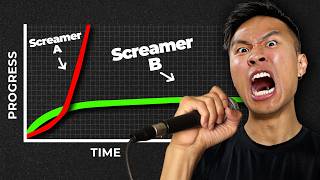
Progress isn't a straight line. In the short term it can feel very up and down, but in the long term it will trend up so long as you stick at it and have the right information. The problem is that most people don't stick at it long enough to consistently see that compounding effect where everything builds. They only see the day to day fluctuations and give up. So stick to it and don't measure yourself by your day to day performance performance, but your performance over the long term. Next, there's this quote I love. A dumb person makes their own mistake and then repeats it. A smart person learns from their mistakes, but a wise person learns from the mistakes of others. So if you struggle with screaming and feel stuck, get help. Because the thing is, you don't have time to make every mistake. It was a 15 year journey for me.
Ten of those years I didn't ask for help. I didn't know to ask for help. I had a dream of screaming, but whenever I tried, I got discouraged and I just told myself I couldn't do it. It took me five years to unlock my screams with screaming coaches. But had I not done that, it would have taken even longer. I might have gone my entire life having never figured it out. If I could go back now and help my younger self, I would have unlocked it way quicker and my life would have been very different.
I could have joined a band As a vocalist, I could have done more covers. I would have felt like, like more of a complete version of myself earlier. But since I've learned about the importance of asking for help, I've had teachers for everything from learning how to dress better to video editing to dating to life coaches. And it's split up other areas of my life. So if you're struggling, get help. Pride on being self sufficient and figuring everything else out yourself, in my opinion, is frankly overrated.
You're not going to get a medal for figuring it out yourself.
Next.
So I'm an introvert and I'm shy and that might surprise you given that I have a YouTube channel. But filming videos like this, like right now, is actually kind of emotionally draining for me and I just enjoy my solitude. As a result, I have a lot of anxiety when it comes to showing something so personal like my music and even more so my voice and my screams when I'm doing it live. And I remember the first time performing live, my screams did not come out. And this is because I spent my entire time with practicing my vocals by myself in a safe environment. And during my live performance, I was so overwhelmed and shocked by the idea that other people are now watching me that my throat tightened up and my technique suffered. And it was one of the biggest disappointments. So here's the thing. If you're shy and introverted, but you eventually want to scream in front of people and play live shows, you need to slowly start practicing screams in front of people to get over that.
Do it with a supportive friend or someone who isn't judgmental. Then do it for two friends, then three.
And slowly work your way up so that you don't end up having the horror story that I did.
Now I have way less anxiety when I perform and you probably couldn't even tell because my vocals sound fine.
Fried screams are for highs and false chord screams are for lows, right? Wrong. You can false chord scream in your.
Head voice so you can go quite.
High and you can also fry scream quite low with your fry screams.
Next.
I remember when I first started teaching my student Cody how to scream. He first didn't have enough compression to make distortion. After we fixed that, he became too quiet. After we fixed that, he became too voicey. After we fixed that, he got headaches from screaming. After we fixed that, he started using the wrong tissues. And after we fixed that, then his screams sounded amazing. The reason I tell that story is because most of the time, most people teach screaming like it's just about just doing this. One approach and then unlocking your screen from there. When in reality about 60 to 75% of the time, it's about fixing a series of problems that come up and. And at the end you fixed all the problems and you're left with nothing but a cool scream.
Next.
Once I was working with my student Tanya. After trying several different approaches to unlock her screams, I noticed none of them were working. But after digging deeper, I realized that.
This is because she thought she should never use a full forward placed head voice.
Because whenever she did it, she ended.
Up using her false chords in an unpleasant way.
But by avoiding using her head voice, her fry attempts were very weak and thin.
So. So I had to give her permission to use a full forward placed head.
Voice and then show her that she.
Could do that while changing the tissues she was using, leading her to finally get the loud fry scream she was searching for.
The reason I'm telling you this story is to teach you the following lesson.
Sometimes it's not just a lack of technique that's holding us back. Sometimes it's our beliefs that can hold us back. Now, this last tip is the number one thing I wish I could tell my younger non screaming self. And before I go into that, I want to remind you that if you want more structured help about how to unlock your screams, don't forget to check out the link in the description. I'll give you different methods to unlock multiple different types of fry screams, False chord screams and hybrid screams. So the number one thing I wish I could tell my younger self as he started screaming is that you 100% can scream. No matter how many years you've sunk into screaming without seeing success, no matter how many teachers you've gone through, no matter how many unsuccessful approaches you try, I promise you, you can scream. And the beauty is that once you finally unlock it, it's going to have a ripple effect into your life. And the next time you encounter something else difficult in your life, you'll think back to your experience learning to scream and think, hey, I used to think that I'd never be able to scream, but now I can. So why shouldn't this be any different? And it will show you that you're more powerful than you realize.
So now that you have a lot of information, I wish that I knew. Check out this video to figure out how to unlock your screams in 30 days.