Employee Recognition & Rewards with Deborah Merkin - From Day 1, Brooklyn 2024
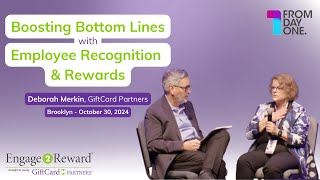
This is a YouTube video titled "Employee Recognition & Rewards with Deborah Merkin - From Day 1, Brooklyn 2024" featuring an interview conducted by Steve Capp with Deborah Merkin, CEO and founder of Gift Card Partners. The discussion centers on the importance of employee recognition and rewards programs, the impact of gift cards as incentives, and how personalized rewards contribute to employee engagement and company profitability. The conversation also touches on managing diverse workforces, scaling reward programs, and the features of Merkin's Engage to Reward platform. The content is from November 2024 and provides insights into workplace motivation and HR strategies.
You.
I'm Steve Capp, co founder from Day One. I'm the editor of From Day One. And I have the pleasure of interviewing Deborah Merkin today. She is the CEO and founder of Gift Card Partners as well. And we'll be talking about how recognition at work is just crucial for employee engagement, fulfillment and many other things, and especially for companies overall financial health. So welcome, Deborah.
Thank you.
Great to have you here in Brooklyn. This is our home base, so thank you for being here. Now, I did a little reading on this subject before we talked here and found that rewarding and recognizing workers goes back as far as 538 B.C. long before credit cards or anything digital things, when Cyrus the Great used a ceremony to recognize his construction workers for building the Jerusalem Temple, the ceremony included a pat on the shoulder, a drink, and a coin with his image on it. So now we know this is a very long standing tradition and you are the latest incarnation of this many millennials of tradition. What inspired you to get into the field and start your own company?
I was in high tech, in software and hardware companies before this for a long time. And basically I liked, I liked the, I like the fact that it was in those days easy. There were no contracts and we were rewarding people with gift cards. And gift cards were fairly new to the reward mix. So we, you know, we've been in the business for now it will be 20 years in December. So it's all good.
Now here's a really fundamental question and we will go on into some nuances of this, but why give people a gift card instead of just a little cash bonus in their paycheck or somewhere?
So a gift card is part of a whole program. You recognize somebody for doing a good job, you reward somebody so that it's like emphasizing and remembering that I did this great thing for my company and I was recognized. And the reward is the thing at the end that you might get from your employer as an added recognition, which then you remember it because you might share a dinner with your spouse or your girlfriend or boyfriend or you might, you know, it might be a special day on a, on a family trip, you know, as long as you share it. And a gift card can let you do that. It's memorable. It's trophy as trophy value.
Yeah. And it also, you can show individualization of it too, that you know the person. And we'll get into that a little more. Now why in 24, going into 25, do you think that there's this recognition of employees and engagement is more important than it's ever been.
Oh my God, it is so important today. It is just the. There's a diverse workforce that has. I figured out today, not today, but when I was preparing five generations. Because now you have Gen Alpha, so you have baby boomers, millennials, Gen Z's and now Alphas which are coming right into the workforce and they want different things and they need different things. They're in different life stages. So if you think about it that way, it's so important to do that. And then you add on to it that you have quiet quitters. Has anybody ever heard that? Okay, I just want to make sure.
Because there's a lot of quiet terms that came out of that. In fact, my wife wrote a. She's a therapist and wrote a story about quiet thriving. So if you don't want to quiet quit, you could quiet thrive. So that whole meme launched a lot of little spin offs. But you don't want the bottom line.
The bottom line is you have all these diverse groups. You also have well being of employees who need extra help and they want to feel that their boss knows them, that what they do gives back to the company and that it's important. And that is another way to look at it.
And also it just creates some engagement too. Someone earlier on the main stage said, don't ghost your manager. Well, you don't want to ghost your worker either.
Basically the information we were reading a Gallup study and then there's another study from the Incentive Research Federation that was done with insperity and both of them basically said the same thing. You look at your employers, employees as being engaged and thriving in your community. They need teamwork. They need to make sure everybody needs to work together for the common goal, the KPIs, the strategy, et cetera. And they need to know where they fit. So given that you're looking and you have this diverse group, I would like.
A Shake Shack card.
All right, a Shake Shack card. There you go.
It's right around the corner down here. And it's, you know, I was at the original one.
It.
Wow. Yeah, well, the car, it seems like also a gift card is like an authorization to go spend something rather than a little indulgence or something like that that you might not get otherwise.
There are two kinds of rewards, quite honestly. There's an everyday spend reward. We're in a health care program and let's say you have a Medicare, Medicaid, you know, person, you might want to reward them for healthy behaviors and you might want to do that because they Live in a food desert. So you give them a grocery card or a new card that's just coming out on the market, which is a card that goes to 70,000 grocers in the country to get them healthy fruits and vegetables. May do it another way too, but that is a thought as well. That's an everyday spend. Whereas if I'm giving you, our reward will go back to my RFP example. I'm giving you dinner or an experience or whatever through a gift card. That's a aspirational reward. It's something I wouldn't do. And they have different purposes as you can see, but they're both very valid rewards.
Now is this, Are these. You mentioned Tom, the. You know, a person you made up, Tom, who doesn't like a lot of attention, does a gift card award. Is it made public generally? What's the philosophy on that?
It depends on the company.
Yeah.
And again you have to know your employee. So Mary is very like, she wants everybody in the department to know. And so you know, the next departmental meeting, maybe you have a Monday morning meeting or something. Frank, the manager is going to make a big deal out of it and give her maybe a physical card or surprise her with a digital card with an SMS text.
Either way it's good, just put it on your phone.
Right. But he makes a speech. He recognizes the work that Mary did on whatever. And so Mary wants that she wants to be in front of her peers and feel like she belongs and, and she's part of the work community and that she's giving back. Being authentic from the manager is very important that the manager knows Mary and knows the difference between Tom and Mary. So each person is different.
Now you mentioned earlier about like the impact this has on the company. So for the people in the audience, if they implement a program that's like this by some means, apparently there's a tangible effect. There was a wide ranging survey by Gallup and Work Human and they found a real connection between praise and profits. As part of the study they looked at just thousands of people around the world. It seems to be a really good question.
Yeah, I think it was the first time. And the IRF has a similar survey but they look at it a little bit differently. But in the end, if you run a company or you're part of the management team of a company, there are four pieces that matter to you. It's the wages you get. Do I get a fair wage? So that's compensation, the variable compensation. You're in the sales department and your variable compensation Sometimes is more than your wages. You also have non cash compensation, which could be that your boss gives you a day off. It could be that you get a gift card and you get a choice card and it's sent to the whole. A choice card is a card that we have that is good at 300 locations, 300 brands. So then the person comes in and chooses what they want, what's important to them. So it has better, what I call trophy value.
So in tracing this in the big study, how did they figure out that somehow. So I get my Shake Shack card, I get my bacon cheeseburger and I'm going to be more like collaborative with my colleagues because of.
Yeah, because you feel good about what you're doing, you know, and you also feel like, you know, I'm a member of this team and you don't know a aspirational reward, it's something I wouldn't do. And they're. And they have different purposes, as you can see, but they're both very valid rewards.
Now is this, are these. You mentioned Tom, the person you made up, Tom, who doesn't like a lot of attention, is a gift card award. Is it made public generally? What's the philosophy on that?
It depends on the company. And again, you have to know your employee. So Mary is very like, she wants everybody in the department to know. And so the next departmental meeting, maybe you have a Monday morning meeting or something, Frank the manager is gonna make a big deal out of it and give her maybe a physical card or surprise her with a digital card with an SMS text.
Either way it's good just right on your phone.
Right? But he makes a speech, he recognizes the work that Mary did on whatever. And so Mary wants that. She wants to be in front of her peers and feel like she belongs and she's part of the work community and that she's giving back. Being authentic from the manager is very important that the manager knows Mary and knows the difference between Tom and Mary. So each person is different.
Now you mentioned earlier about like the impact this has on a company. So for the people in the audience, if they implement a program that's like this by some means, apparently there's a tangible effect. There was a wide ranging survey by Gallup and Work Human and they found a real connection between praise and profits. As part of the study they looked at just thousands of people around the world. It seemed to be a really human thing.
Yeah, I think it was the first time. And the IRF has a similar survey, but they look at it a little Bit differently. But in the end, if you run a company or you're part of the management team of a company, there are four pieces that matter to you. It's the wages you get. Do I get a fair wage? So that's compensation, the variable compensation. You're in the sales department and your variable compensation sometimes is more than your wages. And you also have non cash compensation, which could be that your boss gives you a day off. It could be that you get a gift card and you get a choice card and it's sent to the whole. A choice card is a card that we have that is good at 300 locations, 300 brands. So then the person comes in and chooses what they want, what's important to them. So it has better. What I call trophy value.
So in tracing this in the big study, how did they figure out that somehow. So I get my Shake Shack card, I get my bacon cheeseburger, and I'm going to be more like collaborative with my colleagues because of.
Yeah, because you feel good about what you're doing, you know, and you also feel like, you know, I'm a member of this team and you don't know. We were talking about last night at dinner. You don't know when you hire an employee or you work with an employee what's happening at home all the time anymore. People work in remote hybrid less frequently these days in an office, but whatever. And so you don't know them the way you kind of used to know them when you sat next to the cubicle and you kind of habitually overheard what they were doing or talking about or you talked to them at lunch or whatever. So you don't have that kind of connection peer to peer, I think. So in reality, you want to be able to again acknowledge and give back to them what they need. And having a selection of cards helps you identify if you're a manager and you know that the guy has been saving up to take his wife out for their anniversary dinner and they want to go to. I hope not Shake Shack, but you know, a more, you know, a special restaurant. And we have that gift card, Levara.
It's a very. Okay. It's in Cobble Hill anyhow, anyway, so.
So. And you give them that. That tells the employee, you know me, so you're being authentic in that gift. If you're doing it every quarter, you just kind of hand out cards. That's not as authentic as you're doing it for behavior or something that they achieved to the current research anyway. Does that make sense?
Yeah, absolutely. In fact, I know one of the members on our staff is at the front registration desk, loves LO rolls. So I'm going to keep making a mental note about this. Maybe get her a lobster roll.
Maybe I'll take her to me now.
In the psychological, we develop a lot of tools and HR tech that helps people do their work and it's pretty digital and calculating. But the impact of this, this kind of reward recognition has a subconscious effect too. You don't think, oh, I got my card and I'm going to stay an hour later. So how does that kind of work?
Well, because they know that they're contributing to does it shows up on the bottom line, which I didn't say. But the poll that Gallup put together basically says for every 10,000 people, you get almost $92 million more in profit if you have the right tools. And, and it's done from the top down in everything that the company does. So that's bottom line profit. That also is in the form of keeping an employee, retaining employees for more than two years. I guess the average is two years when I started looking. And the inspirity piece talks about that you're 45% more likely to keep an employee with these kinds of programs and recognition and reward programs and having KPIs. And from the top down, everybody's beating, rowing upstream together in the boat.
Well now how do you scale a program like this up so that managers are empowered to do something with in a timely way, in an appropriate way and all that? Because it seems like if there's too much bureaucracy, it won't happen.
Small company, but, but in a. Yeah, big ones. But in a big company you have more tools at your beck and call basically. And they have procedures and if they do it right, they're talking about the strategy for next year to the whole crew. They're putting KPIs at the department level. And the department manager then breaks that out and says I'll pick on Tom again. Tom has to do, you know, their individual KPIs. So you're breaking that up. So everybody is doing is. Is all going for the main goal of the company together.
Overall goal. Yeah.
Okay. And that's the KPI part of it. The reward, the. Your financial package, if you will. What I just said is, you know, your salary, your variable comp, your medical and dental and all of those things and non variable comp, those gift cards, etc. That you may have or a day off or whatever goes on are also very important. But it's all Got to be orchestrated from the top down creatively. In our portal, our B2B engaged to reward portal, we can divide the gift card component, the reward component into departments. So the department, you may have a corporate budget for rewards and in the sales department, you get a little more because maybe that will be some not only variable comp, maybe that will be their bonus with a Visa card or a custom Visa card or whatever. So you want to be able to deliver those and you might want to do. I lost my train of thought.
Different programs. Well, I have another question for you though.
Okay, go ahead. Good.
Which is we all talk in these conferences we have. There's a lot of talk about inclusion and bring your whole self to work. And that sort of sometimes seems like lip service. But this is a way of recognizing people for what, who they are and not just what they do.
Exactly. That's why the individual and the personalized messaging on when you give a reward again, in Engage to reward, you can upload 500 names with either their SMS text or if you want physical delivery to the whole company at the same time. And you can put an individual message from, from the manager, the CEO or whatever you want in that. You know, we're recognizing you for this. Harry and Tom, you got that RFP that got us a million dollar sale. You know, so it's individual. So they're feeling authentic about it. It's. You might be giving everybody a reward, but it also causes it, it creates teamwork doing that. And you're doing a rah rah. But those rah rahs help.
Yeah. You know, do you notice any patterns lately in terms of like all the offerings that you're trying. Well, you're giving people something of value that means something to them. Are there any trends in terms of what people crave or need? Like, you know, a dining experience or an adventure or sneakers.
Every sneakers. It's a good one. Foot Locker. We, you know, again, it's individual. Yeah, it really is. And you gotta. That's why we have this choice card, because that's an easy way to give it. You know, then the person chooses what they want and they'll remember it more than if you gave, I hate to say this necessarily a Visa card that's got $100 on it, but they got that $100. If there are sneakers that are $100.
At Marshalls, you can go get a pair of marsh.
You know, that's the way you look at it. Okay. They won't, you know, cash doesn't. I know they say Cash is king. But in this, you want something memorable with trophy value. And if you can remember that and personalization, those are the, in customization, those are the things that you have to remember with a diverse workforce.
Now here's, here's where you would love to know just something very specific about which is your engage to reward platform. Do you want to tell us just a little bit more about how that works?
Sure. It's a B2B platform. You get credentials, you can log in, you can have. It's, it's flexible, it's really easy to use and you can do all sorts of things with it. So we have all sorts of programs and what we like about it really is that you can log in, you log in. You can log in as an administrator and you have the departmental budgets and the administrator. Okay. Because it's within your budget. So you can do those kinds of things. You can do the idea of giving the whole company all at once as a surprise at a company outing or something. By the way, we made this financial number that our goal was to do $10 million. We did 20 million. That's a big company for me. $20 million this year because of all of you participated, working so hard and really being with the program. So all of a sudden you'll see on your phone flashing. You know, everybody gets either a text or a link to a card. I mean, that's kind of a big. Wow.
Yeah, A big moment. And everyone gets at the same time. Yeah, yeah, exactly. All right, well, all right. I wanted to ask you two more questions. One is your company is a female owned business. It's you.
Yes, we're certified women owned business.
Just for HR leaders. What has been like one of the biggest challenges in growing and evolving a business, it's always getting cash and having a team.
Right. And keeping up with it. For us, it's having the money to always keep up with the technology, quite frankly. But the biggest challenge is just we have lots of.
More from Deb





Employee Professional Development & Leadership Skills: Create Workplace Rockstars



Boost Employee Morale & Workplace Culture in Q1 with These Creative Strategies