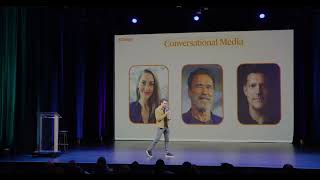
Delphi CEO Dara Ladjevardian on Stage at GrowthDay LIVE 2025
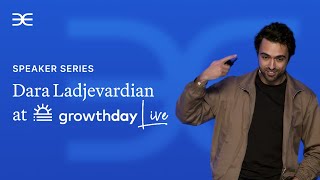
This is a YouTube video titled "Delphi CEO Dara Ladjevardian on Stage at GrowthDay LIVE 2025" featuring a keynote-style presentation by Dara Ladjevardian, the CEO and founder of Delphi. Recorded in April 2025, Dara discusses the future of AI, its exponential growth, and its impact on society and entrepreneurship. The talk covers AI fundamentals, historical technological revolutions, and the vision of creating digital versions of human minds through AI, emphasizing optimism and the transformative potential of AI technologies.
Let's get excited about the future. I want to tell you about my future. I want to tell you about the future of the world. I wanted to do all that, but I thought, Dara, man, he can do it like nobody else in this house. If you could give a Growth Day welcome, the CEO, founder of Delphi is in this house. Darling. Let's go, Dara, let's go.
How's everyone doing? So I was telling Brendan that the first time I ever did a talk was at a Brendan conference. And I've done other talks since, but it's just no one has the Brendan energy. No one. You guys are just something different. So I appreciate you guys. That's what I'll say up front. So raise your hand if you are afraid of AI or a little bit afraid of AI. I'm raising my hand. It's very, very normal and it makes sense. Media has been training us to fear AI. Hollywood has been training us to fear AI, the Terminator, iRobot and Black Mirror. Anyone seen Black Mirror? Yeah. So today I'm talking about White Mirror, because those of you who are fans of Joe Dispenza, you know that your thoughts affect your reality. And if you can come into the future with the right thoughts and the right intentions, then you can create this optimistic AI future that I see and I think you guys will see by the end of this. So my goal with this presentation is for all of you to walk away feeling hyped about AI with the right mental models and frameworks for understanding how to leverage it now and in the future. So let me tell you first, what is AI, And I'm sure a lot of you know, and so I won't spend too much time on this. AI is just a system that can replicate human intelligence. How does it do this? Pattern recognition. Let's say you have a newborn child and you show them 100 pictures of a cat, and then you show them 100 pictures of a dog, and then you show them another picture that's either a cat or a dog. They're probably going to know if it's a cat or a dog. That is how AI works. And when I got into AI in 2014, the coolest thing it could do was say whether a picture was a cat or a dog or classify whether one of Trump's tweets were negative or positive or the first project I ever did was given the room someone booked in the Titanic. Did they survive or not? That was mind blowing at the time, but obviously a lot has changed. And I would say it has changed in a massive way, but this is still the same technology, pattern recognition. LLMs are AI models trained on human text and it recognizes patterns in those texts to predict the next thing it's going to say. And so I like to say they are calculators for languages. The same as a calculator helps you combine numbers. Large language models helps you combine language. And this is the same for images and videos. Pattern recognition with images allows it to produce more images. Pattern recognition for videos allows it to produce more videos. So we're going to play a little game. We're going to play guess the next word. So feel free to scream out loud what you think the next word is. What's the next word now? All right, A. Yeah. And farm. So what you guys just did is leverage everything you've ever read in your life and everything you've ever heard to predict what the next word is going to be. That's how large language models work. And so right now we are experiencing exponential growth. And the difference in exponential growth is, you know, take 30 linear steps, you move 30 yards. Take 30 exponential steps, you, you move 1 billion yards. And this is what's happening with AI progress right now. Just three years ago, GPT3 had the intelligence of a fourth grader. And now GPT0O1 has the intelligence of a PhD. Things are moving very fast and a lot of money is being poured into this. The Apollo project, $20 billion per year. The Manhattan project, $6 billion per year. Anyone want to guess what they're spending on AI? $500 billion. It's a lot of money. So the stage has been set, you understand, where we are, how much money we're spending into it. And the question is, what does our role as humans? How does that change with this new technology that is as consequential as the printing press? First, let me tell you a little bit about myself and how I got here. So my parents immigrated from Iran in 1979. They're actually right there. Everyone say hi. And they wanted me to be self reliant because when you come to a new country and you figure things out on your own, you want the same things for your kids. And I think I'm very grateful for that. But it also caused me to never really seek out a mentor because I wanted to do things on my own. And so when I was working on my first startup in 2021, which was, it was an AI startup where you could buy anything with a text. Yes, I was too lazy to go through Uber Eats. I just Wanted to text a number and get what I wanted. I was a solo founder, and many people here are business owners. And you know what it's like the first time you start a company. It's very lonely. You don't really know what you're doing. You wish you had a mentor. And my dad had been pushing me to read my grandfather's book for quite a while. So I finally picked it up and I read it. And my grandfather was this legendary entrepreneur in Iran before the revolution. And I really wanted to be able to ask him for advice. What would you do in my situation? He hadn't had a stroke a couple years prior, so I couldn't really talk to him. But around this time, I remembered a book, the book that actually got me into AI in the first place in 2014, how to create a Mind by Ray Kurzweil. Anyone know Ray Kurzweil? Yeah, he's a legend. He's a legend. And in this book, he talks about the mind being a combination of building blocks and complex intelligence actually is a result of those different parts working together. You have the cerebellum, you have the visual cortex. And there's actually another guy, Marvin Minsky, who said the same thing in 1986. My mouth gets really dry up here, so excuse the water. And so let's see what Ray Kurzweil said. Everyone think of their favorite song and sing it. Not out loud, but I appreciate that. I think she said, don't you want me, baby? Is that what you said? Okay, well, you'll notice when you sing that song in your head, you're usually starting from the beginning or at a chorus. And this is because our memories are segmented in chunks. And then everyone say out loud their Social Security number. No. No. Okay, well, now try to say it backwards. It's a bit harder. That's because our memories are stored sequentially in order. And last thing is, think of all the steps you take to brush your teeth. You pick up your toothbrush, you put toothpaste, and you brush your teeth. But even in those steps, there are individual steps inside. When you pick up your toothbrush, you're activating a muscle. And this indicates that our memories are nested. So what are the actual parts of these organizations? Ray Kurzweil says they are pattern recognizers. And in the mind, the lowest level, you have pattern recognizers that can recognize shapes and that passes up to higher level pattern recognizers that can recognize sentences. And at the very top, you have consciousness. What else is a pattern recognizer? Anyone LLMs, maybe. LLMs are pattern recognizers on language. So it was this insight that led me to creating a clone of my grandpa based on his mind that I could talk to for advice. And it kind of got me down the rabbit hole of how we learn and how the current ways of learning are passive. You read a book, you watch a YouTube video, you listen to a podcast. But these things don't grow with you. They don't change with your circumstances. And the problem is time. The most unique thing that every single one of us has is our mind. And up until now, the way you express that mind has a cap. You live and you die, and that's it. And there are ways. We have tried to scale ourselves. We write books to scale our thoughts. We hire teams and train those teams in our way of thinking to scale our thoughts through them. But nothing can scale one on one authentically. And so since the beginning of time, from cave drawings to the printing press to the radio, we've constantly tried to think of new ways to scale ourselves. And the trade off was always personalization and scale. But what if you could combine the personalization of bidirectional conversation with the scalability of broadcast media? And that's what led to the founding of Delphi, which we allow people to create a digital version of their mind. Many of you guys may have seen Brendon AI. Yeah, I speak to Brendan AI a lot. And it combines the personalization and the scalability. So that's a bit about Delphi. Let's get back to AI. The why now is, I think, pretty obvious on the technical side. Every new technology has led to a new form factor in communication. Flash led to YouTube. Smartphones led to WhatsApp and Instagram. We got zoom and video. So we're always thinking of new ways to communicate, but I think more interestingly are the market shifts. I think TikTok and Reels are destroying some people's attention spans, not all of them. And the solopreneur economy, the creator economy, is on the rise. So there are more. There's a higher need for things that help people do more because they're not. They're joining big companies less. And they want to start their businesses, which I think is great. I think entrepreneurship is great. And people should be in charge of their lives. And AI, I mean, last in 2023, Will Smith eating spaghetti. 2024, Will Smith eating spaghetti. That's insane. And this is exponential growth. When I created the clone of my grandfather, it was very expensive, like 10,000 times more expensive than it Is now the only reason I'm allowed to make a company out of this is because these costs are going down to zero. You can't think of the limitations of today, but rather think with the end in mind. What is the end? Probably near free, instantaneous AI at all of our fingertips. And I say near free because Deepseek came out, I think a month ago and they kind of released an open source model that's very high quality at a very low cost. And when competition comes in the market and releases lower cost, they're all going to go down to zero because they just want more people and attention spans. I put temporary there, which I'll get back to later because I don't think this is a long term phenomenon, but our attention spans have gone down to less than a goldfish. It's not great. People are not reading books as much, they're not finishing courses. And with the infinite array of things that appear on the Internet, everyone is competing for your attention. And people are just going to want really easy things. They're not going to want to work for the things that come to them, at least right now. So these are the common fears you hear people say about AI. AI is going to take away all our jobs. AI is going to make everything fake and meaningless. Younger generations are not going to appreciate life. People are going to get married to AI instead of humans. That has actually happened a couple of times, but I don't think that is going to be the norm. The thing is, we've been here before and I'm going to walk you through all of the similar past technological revolutions that share similar patterns. The printing press, it allowed people to scale their thoughts. It wasn't limited to the people that they were in the same room of. And by the way, all the cartoons that you see in the next 10 slides are all AI generated. And some of them are good, some of them are not so good. So just it's going to improve. So right now everyone's saying AI is going to make everyone a software engineer. But if you look at this, it's not crazy to think that, oh, the printing press being available means everyone's going to be a monk. That didn't really happen. And I think the learning we can learn from the printing press is that to not be limited by the circumstances of today, to think bigger than today, because the future is likely going to look a little bit different than what we can predict. The discovery that the Earth was not the center of the universe, that caused a lot of people to question their meaning. Humans are not the center of the universe, but we found a new meaning. And I think humans are actually very, very, very good at finding meaning in new things. So just because one framework of thinking about meeting goes away doesn't mean there isn't something new there to replace it with. The first industrial revolution, the steam engine allowed people to not have to work dangerous jobs in the factories. That was actually a very good thing because then they got to focus on new kinds of innovations like the airplane. And some people were worried that the Industrial revolution is going to make people lazy. But I think another thing about humans is that we constantly try to do hard things. Does anyone here do ice baths? Exactly. There we go. We like to do hard things, no matter. Even if we've done all the hard things available, I imagine there's going to be an even more extreme version of ice baths. The second industrial revolution, you had the tractor, people didn't have to plow in the fields as much as. And again, you see the same trends, people finding new ways to work, new ways to learn. In the radio, people were worried that you're going to be talking to some voice coming out of a box and you're not going to be social. But on the contrary, you can now call people across the world. People are starting podcasts, and listening to the radio actually made people curious to read even more. And of course, the Internet, the knowledge economy, the knowledge work economy, which I would assume the majority of the people in this room are in, is only a phenomenon of the last 30 years. The Internet happened and we adapted pretty, pretty fast. We have jobs that may no longer be relevant, like a milkman or a postman, but every job that was replaced was replaced with multitude new jobs, and we learned those things. And on top of that, pre Internet, who you worked with in life, who you befriended, who you married, it's kind of limited to the hometown you grew up in. That's pretty much all you had. But the promise of the Internet is that you don't have to settle. You can now connect with someone across the world to start a business with. You can find a partner in a city, in another country, and new jobs and not settling. That's the promise of technology, specifically the Internet. And now we have the AI revolution, and it is easier than ever to learn a skill. You can become a programmer, you can become a designer, and there are probably going to be new jobs that we can't even picture today. But I think the promise of AI is that you don't have to settle specifically for a job you can become whatever you want to be. And it's not roadblocked by education requirements or time. You can learn something in a very, very small amount of time. So AI is here to stay and what does that end state of AI look like? I think it's really important to think with the end in mind. And an example for why that's important is because maybe right now you're thinking of hiring a developer to build your website and it costs $100,000 and it's likely in six months you're just going to be able to do it on your own by describing what you want. So maybe the timing. Think about how these things go down to zero and you don't agree we can chat after. So thinking about how fast these things are accelerating and how that changes your business, what's possible with the work that you do? The end state of AI is instantaneous. Free, hyper, intelligent, the smartest person in the world who can solve all of the mysteries of physics and biology and chemistry.
More from Delphi
How Hadar Shemesh Is Helping Thousands Speak English—with Clarity, Confidence, and Connection