$5K vs $27K Project – The ONE Question That Changed Everything
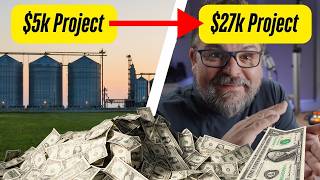
Den Lennie shows how videographers can charge five times more by diagnosing what clients actually need. Caleb turned a $5K grain-silo video into a $27K strategy package by connecting video to the client's $20K profit per sale. The shift: stop selling shoot-days and start selling business results.
Questions this video answers
Over 30 filmmaking businesses in the last 90 days (also referenced as ~20–30 in other remarks).
If someone indicates a budget under three thousand dollars ("under three grand"), disqualify them.
About $3,000–$5,000 for a straightforward promotional video (often quoted as "three to five grand").
Retail price cited: $50,000; cost to make: $30,000; profit per silo: $20,000.
Increase average customer purchase from two silos to four silos.
Chapters
Ever wonder why some videographers are killing it right now while others are struggling to stay afloat? I've spoken closely with over 30 filmmaking businesses in the last 90 days, and there's a clear pattern which is separating the winners from the whiners. Here's the cold, hard truth. Nobody actually wants to make a video. That's right. The video itself is just an obstacle standing between your client and what they really want, which is the result. But if you miss this crucial insight, you'll be stuck competing on price forever. But if you understand it, you'll transform from order taker to strategic partner overnight. Let me share how you can do it. So I just dropped my wife off at a retreat she's doing here up in the hinterland near where we live. And I thought I'd just share some observations that I've made in the last 60 to 90 days. Probably spoken to 20 or 30 different videographers, including, you know, people in our programs. And I've been observing the different traits between videographers and the ones who are winning and succeeding versus the ones who are whining, complaining. Now, I'm pleased to say, for the most part, no one in our programs is whining and complaining because there's a degree of sovereignty that we teach and encourage. From day one, we've had a couple, but they are exiting the program because in any situation where there is not a good culture fit, you have to exit those, those apples who are not aligned with the wider mission and goal that we're all working towards. One of the reasons that I created the VBA was when I started my business back in 2009, 2010, I'd had many years experience working in other businesses and also as a freelance cameraman. I didn't really understand anything about business. You know, my knowledge was really, you know, adding an extra monitor, a couple of lights onto a shoot and charging extra for it, thinking this was great. This is easy. When you run a business, you've really got to. Well, you've got a choice to adopt a different mindset. And that is most of us, when we start our business, we apply our freelance methodologies to the business. And by freelance methodologies, I mean we charge per day or per hour. We may or may not charge for gear, but it's a very transactional time for money mentality. And that, that's okay. That's. That's what we're used to doing. Okay. And you're also used to working with production manager people who typically have, have a broad range of People, they can call and have a benchmark of range of rates they're willing to pay. So it somehow it somewhat constrains you because if you work for an agency, for example, they will say, well, we can get a cameraman for X number of dollars a day. Whereas if you're doing direct to client and you're a production company and you're solving a problem for them, they're less interested in how much it costs for a shooter to come for a day than they are solving the problem. A great example of this was Caleb, who's one of the coaches in the program. And I'm gonna. You've probably seen his content on this channel. Caleb was having a conversation with a company that made hay silos, grain silos, and they approached him through some of his outreach. They got in touch when they were ready, and they said, hey, we'd like to make a promotional video. And he has a survey on his website where he gets a good range of a gauge of their budget expectations from the outset. If you're not doing this, by the way, you should absolutely do this. Have a form on your website that please just doesn't say contact us, get in touch, let's have a chat. Because nobody has time for a chat. People are looking to solve problems. So if you have a website form that says things like name, email, phone number, you can ask for the web address, but if they've got a good email, they probably have the web address in that. It's a balance, right, between getting enough information to be able to have a meaningful discussion with yourself or your team or your coach or whoever you're working with. If you're working with someone about the opportunity versus so much information that they just don't want to fill it out. But the more information you ask for, the more qualified someone will be. And so it's always a delicate balance between asking for information and qualifying a prospect so you're not wasting your time on people who aren't really serious. And so I would ask things like, you know, do you have an example of the kind of film you're trying to make? What is your timeline? When does this need to be delivered by? That gives a sense of their commitment and urgency for this project. And also I'd have a drop down with some questions around. You know, what is. What is their budget expectation? And if someone says under three grand, then you can disqualify them. But nonetheless. So Caleb had this inquiry and he sat down with him on a discovery call, and his discovery calls are very. They Repeated the same way every time he has a system for them. A lot of filmmakers who are not working with us often talk about wanting systems. And one of the things we deploy in our program is systems for all of this stuff so that you can repeat without thinking the same way each time. And the greater benefit of that is that when you have a system, you can systemize yourself out of that role eventually, when the time becomes right and you feel like you want to bring someone else to do that for you. So he has this meeting, and in the meeting they're talking about the fact they want to make a promotional video because they want to sell more grain silos. Now, that's quite a common type of situation where a client will say, we want to make a video because we want to sell more of our product. And I would say that about 80% of the videographer population would probably go, cool, yeah, well, we could probably do that in a couple of days. And it'll be this many days editing. And when they say how much, they'll say, well, probably about, you know, somewhere between three and five grand. Cool. Our budget, seven. So great. End of story. They often made the video. But where Caleb has a real edge, and I would say that the majority of our VBA clients have the edge is that we never take the initial question, the initial request at face value. Because if we're going to build long term relationships with clients and we're going to become lifelong partners with them, or certainly an ongoing partnership, collaboration starts with you asking deeper questions. And so in that scenario, he was like, okay, let me just. Do you mind if I just ask you a few questions? I'm like, no, that's cool. So what are these grain silos retail for? Let's say they were 50 grand. He's like, okay, and how many do you normally sell? Well, the farmer only buys two, but we'd love to be able to sell the farmer four. Okay, what do these cost to make? Let's say they cost 30 grand to make. He's like, okay, so you make $20,000 profit on every grain silo. He's like, yeah. And the cost of you acquiring that customer, whether they buy one grain silo or four grain silos, is exactly the same. Yeah. Okay, so what are the main reasons people don't buy the grain silos? And they will list off a reason, a bunch of reasons, so on and so forth. So you keep digging, you keep asking deeper and deeper questions to discover and diagnose what is really the objective here. Because here's a really fascinating insight. Nobody actually wants to make a video. The video is an obstacle in the way of your client or prospect getting what they really want, which is usually more sales or to communicate a particular message. So they can retain staff or they can retain customers or they're explaining something. Videos, one of the mediums that they've decided would make sense to use. So I think from memory the story went something like. So Caleb said, well, so you realize that if your customers knew and understood the long term value of having more grain storage, they might be able to achieve more results for themselves, whatever they may be. So he reframed the problem and said, so if we could create a content package and did some strategy around how you could utilize these videos not only on your website, but cut them down for socials, have daily reels going out on Instagram, have some stuff that you could create for Facebook ads. And just on that note about Facebook ads and Instagram, I had this conversation the other day with someone who said, oh well, you know, my clients work in government and so they won't be on Facebook and Instagram. And my retort to that was maybe not in the office, but when they go to the bathroom, when they go for a break, when they're coming from the, from the train, they're sitting on the train, what are they doing? He said, they're on the phone. I said, what are they looking at? Probably Instagram and Facebook. So you've got to remember that people are people and that when you have a marketing decision maker in a role with a fancy title, they're still just a man or a woman with a family and they've got to take the kids to school and swimming lessons on a Tuesday night and blah, blah, blah. And they've got a lot of time that they're spending just scrolling on the phone. And so if they're scrolling on the phone while the kids are at swimming lessons or soccer lessons, then there's a chance they might see something that might be related to their work and it might, it might get more of their attention. So Caleb said, let's, let's just reframe this problem. If we were to make a bunch of videos, stuff for social stuff for some Facebook ads, you know, some stuff, your website, some explanatory stuff, some training stuff, how would that impact, you know, your business? They said, well, actually it sounds like we could be doing a lot more. And Caleb really emphasized the fact that, look, when it comes to filming, if we're going to go and film for a day, we may as well pack the day out with footage so that we can build a library of content we could use again and again. If we're going to interview the CEO, let's make sure you get enough content where you can produce more than one piece of content. And this might seem obvious to you as a filmmaker, but to someone who's not in filmmaking every day, they are more likely to be not averse, not fluent in filmmaker speak and filmmaker language. They're not thinking about three months down the line. They're thinking about the problems they've got to deal with today. So what you have to do is you have to reframe the problem. And in that scenario, Caleb says, so guys, you know, this sounds like we, we could Certainly make your 5-7k video, but it sounds like we could take advantage of this opportunity and, and help you make a lot more content and as a result achieve a much better outcome. Does this sound like five grand problem you're trying to solve or does it sound more like a 20 to 25 grand problem? Because if we can have the average order value from a farmer go from two silos to four silos, instead of making $40,000, you're making $80,000. Now, if you've got 100 customers, that starts to add a significant amount of revenue to your bottom line. Now, what's important to note here is we're not promising that our videos will make sales. What we're saying is if you had video content that helped someone understand how your product, service or feature of your widget had a direct benefit to them, they joined the dots in their head and they're like, well, if we have more opportunities and we could sell more products, this would make sense. And then you're now framing the video as a tool in the sales process. And so as a result, I think they ended up spending about $27,000. And that client's come back subsequently and done other work with Hebron. So I think the lesson here is to be very clear in how you are positioning your service and reframe that as something that helps the client get what they want. And if you can frame that, you will start to see a big shift in the conversations that you're having. And so I wanted to just share that story with you today because it's a great example of another quick story actually, while we're here. Another client that Caleb had were manufacturing a particular type of interior cladding for commercial buildings. Now, this particular cladding was a bit more expensive than the competing product. And what they were Discovering was that the competing product was getting used more on site by tradespeople because the developer saw the product as being cheaper. But one of the issues they had was the competing product took a lot longer to install. I think it was like an extra day to install this product compared to this new technology. And so when Hebermer approached to solve this problem, they actually wanted to create a series of install videos so that they could teach trades how easy it was to install this product. But the obstacle in that case was trades. People are busy. They don't really want to watch videos on how to install something. If they know how to install this existing cladding with, you know, a drill and some screws, they'll keep doing that. So the company wanted to solve that problem, which was to teach people how to install this product. And they thought in that case, that would result in, you know, faster installations and more uptake with the product. But while they were doing the project, they recognized that actually the greater understanding was in the time and capital saving of investing and buying this product. So the videos had a secondary benefit. And so really, really the thing I wanted to kind of really share with you today was if you really want to grow and scale your video business, there's a lot of challenges just right now. A lot of people are in the market, a lot of people are offering straightforward video services. But if you want to build a business, one that's sustainable, then you've got to help clients solve their bigger problems. And the fact that you use video to do that is kind of neither here nor there. But what you get with this is very strong partnerships with clients where they'll never look anywhere else because you're doing more of their thinking for them. And that's really the lesson here, is that in the current state of the video industry, there are so many competitors now that the market has so much choice. Either do it themselves, they bring it in house, they get some friend, cousin, relationship to the family member who knows someone, he's got a video camera, and they do it that way. So don't worry about any of that stuff. And if you're competing in that place, then you should pay attention to this video or if you're listening on the podcast, this podcast. So the key here is you have to adopt more of a business mindset. You have to think about your business, your video business, not as cameras and lenses and lights, but as a vehicle, a tool, a marketing tool, to help clients solve bigger problems with. And that is the reason that Hebron Films wins in a small country town. They work in a town of less than a hundred thousand people and they're dominant. And they're not the only video provider. So if you want to really dominate in your niche, then you have to be clear on the problems you solve for the people you work with. And as a result of that, become the diagnostic partner who helps them think more broadly about the problems they're having. And then that can give you an opportunity to solve all of those problems with videos, because we know that video can solve many, many, many, many problems. But you have to identify the problem first. Ideally, work in a niche that you understand deeply, and from there, get in front of people, sit on meetings with them, discuss the problems widely, Be that partner and you will find yourself with a very robust business with strong repeat business and clients who will never, ever consider price as the main reason not to hire you. So hope you found that helpful, folks. As always, if it was useful, hit the like and subscribe button. And please share this with other people that you think might find it helpful.