Around the Kitchen Table - How to Build the Perfect Salad
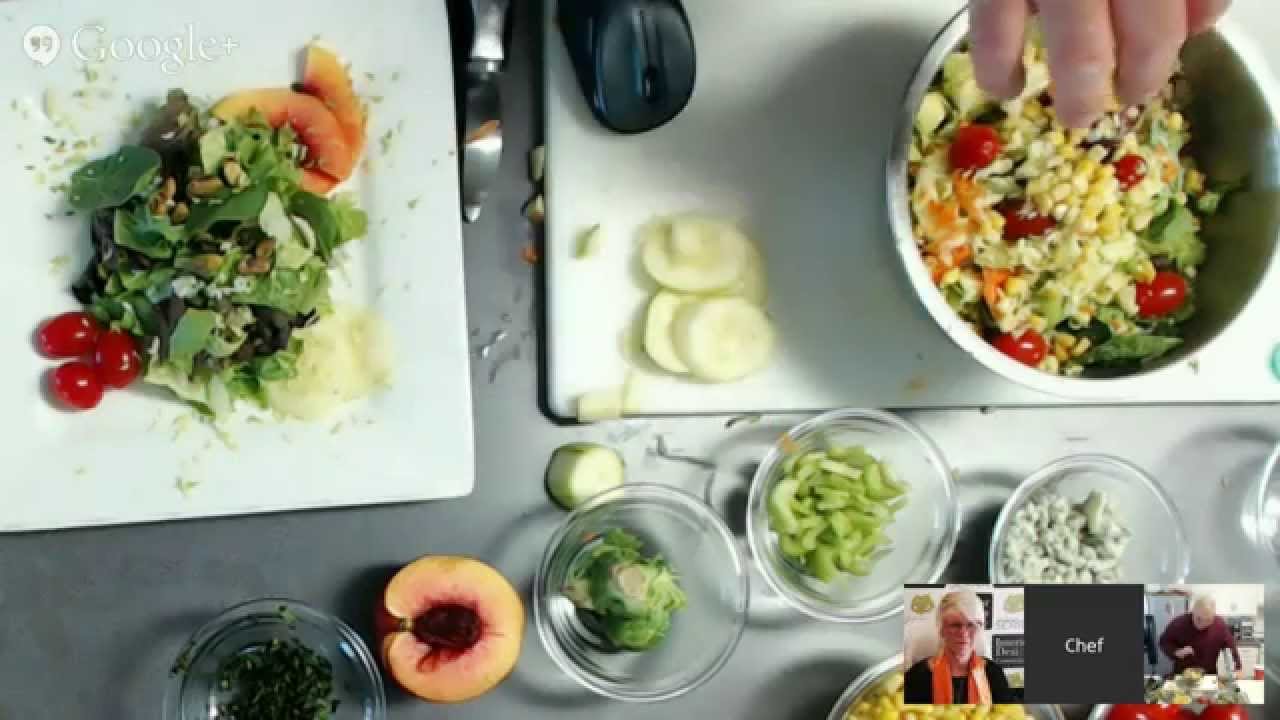
In this episode of Around the Kitchen Table, Chef Dennis Littley and co‑host Susan Sarah walk viewers through creating a versatile honey‑Dijon salad dressing and assembling a balanced, visually appealing salad. The segment begins with a casual chat about Florida weather before moving to the kitchen, where Dennis demonstrates a simple dressing made from equal parts honey and stone‑ground mustard, vegetable oil, finely chopped onion, garlic, sea salt, black pepper, and fresh basil. He explains why he avoids extra‑virgin olive oil, prefers a blended vegetable‑olive oil mix, and offers troubleshooting tips for a dressing that may solidify in the fridge. The conversation then shifts to salad construction, outlining four essential components: a colorful base of greens, a crunchy element (cucumber, carrots, Brussels sprouts, etc.), three optional flavor boosters (cheese, fruit, nuts/seeds), and a thoughtful dressing. Dennis shares design principles such as using odd numbers for visual balance, varying plate shapes, and arranging ingredients in sections for texture and color contrast. He discusses ingredient flexibility (substituting shallots for onion, using prosciutto instead of bacon bits, adding seasonal fruits, cheeses, or proteins) and practical prep advice—avoiding pre‑cut lettuce with stabilizers, buying romaine hearts, batch‑making salads that keep for two days, and storing components separately. The episode concludes with a reminder that salads need not be boring, encouraging viewers to experiment, and a teaser for next week’s steak‑diane tutorial.
Chapters
Hi everyone, I'm Chef Dennis Littley and welcome to Around the Kitchen Table with my co-host Susan Sarah. How you doing, Susan?
I'm doing great, I'm doing great. I'm really looking forward to this, this show today that we're doing. There's endless possibilities and you know, who doesn't love a good salad? So how about you, how you doing?
Pretty good. Florida's— the evenings are cooling off here, summer starting to leave us. The Days are still mighty hot, like today we were out there and it was just baking, but the mornings are a little cooler and then the evenings are turning into very comfortable. So we're getting ready, I think, for the really good reason, you know, the reason we did move to Florida for this beautiful weather.
But which is 70 degrees in the winter, right?
Yeah, yeah, I may have to turn the heat up in January and February when it hits 55.
Unbelievable. Yeah, no, we're, we're getting a little, you know, chilly here too. And you know, you may remember October from Philly, it is now really good sleeping weather.
The best.
Yep.
This is my favorite time, and that's the one thing I really, really will miss about being up there is those crisp October evenings, you know, when it's dark and the stars are out and you just need a sweater or something. Those were my favorite times.
Oh yeah, yeah, pretty soon we'll have the fireplace going.
There you go. Not here. We have a fire pit outside, but No fireplace in Florida, although I have seen people that have them. It's kind of crazy.
But yeah, I mean, that's something you should be able to cook around, right?
Yeah, yeah. Well, anyway, just to sit outside and have some wine and enjoy, enjoy the stars because it is just spectacular here at night.
Yeah, I bet. So you have such a spread in front of you and I see some kind of liquid too. So what's going on there?
Well, that's oil. So what we're going to do is I'm going to start showing you how to make a very simple, very tasty salad dressing where you're controlling all the ingredients. There's nothing in it that you can't pronounce. It'll hold up, you know, doesn't have all the preservatives, but it'll actually hold up in your refrigerator for about 30 days. You know, I don't taste it, it would last that long, but it really will, you know, stay in there refrigerated. The one problem we have with it sometimes is it solidifies. Because there aren't any stabilizers in it. There aren't— there isn't anything in it to like keep it from tightening up too much. But if that happens, you just let it sit out. Remember to take it out, you know, half an hour before dinner and let it thaw just a little bit so you can mix it up again. Just throw a whip through it.
That's great, that's great. I'm gonna have lots of questions for you.
So, so let's start then. And now let me change the camera over to the mixer. What I have here is in the mixer bowl, you can see already, I have some mustard, some dark mustard, and I have some honey in here. This is the basis for my dressing. It's a honey Dijon. I don't really use straight Dijon mustard. You can, but I kind of like a stone ground mustard, so something in a brown range, even like a Gulden's Brown or a French's Brown. Doesn't have to be real expensive. Just have that that seedy mustard kind of flavor, you know, that the stone ground ones do. So that's gonna— this is my emulsifier, and if this is done right, and even I have some trouble every now and then with getting it to thicken up properly, but if it's done right, this honey and this mustard will act as a thickener as I'm putting the oil in, and it'll help bind it.
Okay, so how much of each? How much honey, how much mustard?
I have 2 tablespoons of each in here right now.
Equal parts, would you say?
Yeah, equal parts.
Okay.
Equal parts of honey and mustard. I do have a recipe up that I brought down in size. This is something I used to make. Everywhere I've been, it's been a house dressing, even at the school. Everyone loved it. They'd come out, "Where's the house dressing? You're out of it." I said, "Yeah, I got to make it." At the restaurant, every day I went in, Even when we were slow, I would make 5 gallons of this every day.
You know what? It sounds like it satisfies that sort of sweet and salty, or sweet— everyone loves that. I love that.
Yes, it's not so much salty, but it's got that little vinegar bite.
Right, right, right.
Sweetness to it, and it works really well on a variety of different kinds of salads. It is a really nice— it's good in pasta salad, too. It really is a nice dressing to make, and it's pretty simple. The only problem, like I said, every now and then it will break. What happens when it breaks is it just gets ugly, and you just need to run a whip through it, just like you would have a separate dressing. Hopefully, this will thicken up. I have my Dijon, my mustard, and my honey in here. Now I'm going to put in some finely chopped onion and a little bit of finely chopped garlic.
Now, what about— it's interesting you say onion and garlic. Can you just split the difference and put shallots instead?
Sure. Absolutely. If you like shallots, that's not a problem at all. If you don't like garlic, you can leave that out too. I'm going to whip this up a little bit. Then what I'm going to start doing is I'm going to start adding— this is just vegetable oil. I would not use extra virgin olive oil. I would not use it for one very important reason. It has that strong flavor.. You don't want it to be the focus of this dressing. You want the flavors, and the freshness, and everything else going on to be the focus. I've used straight extra virgin, and I'm really not happy with it. It actually does something to the mustard. It brings out a bitterness in the mustard to me.
What are you using, then?
I'm using a good vegetable oil. Wow. For years, I used blended oil. When I say blended, it would be 90% vegetable, 10% olive oil., and it gave it that little bit of nutty flavor from the olive oil without giving it too much flavor. So, you know, for a salad dressing, if you're gonna just use oil and vinegar, then of course use extra virgin olive oil. When you're making a salad dressing, I don't really think there's any reason to use it. It just really doesn't do it.
So it serves the function solely as a sort of foundation to the— just the binder, an element.
Well, the binder is the mustard and the honey.
Yeah.
The oil's the body. So I'm gonna start the body, and I'm gonna get this going. So it might be a little loud.
Okay, that's okay. You can turn the mic off if you want.
All right, if you have anything you'd like to talk about, go ahead. And what I'm gonna do is I'm gonna drizzle this in very slowly. So I'll turn the camera over to you and do this.
Okay. All right. So I don't have images of salads, but you know what, I'm sure we all have our favorite salad dressings, and please comment after the fact on the stream and share your favorite salad dressings, too. You know, when I was in France both times—I've only been there twice—but the classic mustard vinaigrette is something that I just absolutely love, and it's so simple. I'm trying to find the perfect mustard vinaigrette, and I think I'll actually talk to Chef about that. I've looked I looked for a lot of recipes and there's minor variations with a lot of them. One of the best recipes for vinaigrette, actually it's not a mustard vinaigrette, but I suppose I could add a little mustard to it, is by Pierre Fournier, and that had in it a red wine, red wine vinegar, it had a garlic clove, it had of course I think it was olive oil, or maybe it wasn't olive oil. I'm not sure, but you can look it up. Vinaigrette Pierre Fournier. And of course, blue cheese, being Scandinavian, blue cheese is a huge favorite of mine. A blue cheese dressing, a good blue cheese dressing. And for my money, the blue cheese that's called Danish Blue Danish Blue is by far the best blue cheese. It's creamy. It has a real great bite to it. It's a very, very good quality blue cheese. And that's something that, of course, you can use on a salad. We have to watch our calories with salads, of course. You can— my goodness, you can— you know, that's another topic, how salads you know, aren't necessarily the lowest calorie either. But, you know, you can have candied pecans and all that stuff. But in terms of dressing, you know, blue cheese is one of my favorites. And now I'm seeing at my farmer's market that there are lots of different olive oils. There's the blood orange olive oil. There's the peach olive oil. There's the basil olive oil. And I think that's very, very interesting.. It's a trend that I'm just starting to see too, and I wonder if you have seen this too. Please comment in the stream after the fact and give us your experiences too. I'm saying, Chef, that I have seen recently olive oils such as blood orange and peach at my farmer's market, and basil and other flavored olive oils I see coming on the market. Have you seen that? Absolutely.
I even have a You'll see the same thing with vinegars, too, and balsamics. I have a coffee balsamic in the cabinet, and we have a— I don't know if it's tangerine, but it's an orange balsamic. They're infusing these, and there's a lot of places you can go to now where you taste them, and you can sample them, and you buy little bottles of them. That's trending. That's starting to be a little trendy thing with oils and with vinegars. Then they bottle up whatever you want. They have the spigot, and they pour it for you. The thing to remember with olive oils when you're tasting it, treat it kind of like a wine. First thing you want to do is you want to warm it up a little bit in your hands. If they give you a cup, get some body heat to warm it up a little bit. Then when you breathe it in, same thing you would with the wine. Breathe it, get the smell, and then pull it into your mouth and get flavors from olive oil. It's going to taste the same way. I've actually gone to some olive oil tastings.
Oh, yes. I did one, too. I went to one, too. Very enlightening. So what do you have there?
Okay, so this did separate just a little, but I am going to just mix it together.
Okay, so it's repairable.
Oh yeah, yeah. So, you know, it's just, it just becomes a separating dressing. So now, I mean, I have all the ingredients in there, and I'm going to add a little sea salt and black pepper, and then I'm going to add what really makes this the dressing that we love is a little chopped basil.
Nice, very flavorful. Oh, it is.
And like I said, it's colorful, it looks good, it's easy to make.
Trying to find the right— there we go.
Yep, nice.
That looks great, very nice.
And a little vinegar, I forgot the vinegar.
That's unexpected. I did not expect the basil.
Well, that's, that's really what adds that really nice kind of flavor to it, and the vinegar. And what I did was I add in— I usually use all red wine vinegar, or if I replace maybe a teaspoon with balsamic. I don't want to use all balsamic because it's going to be a little too bold. Even when you get a balsamic dressing, more chances than not it's not all balsamic because the flavor would just be a little bit too strong for you. But anyway, that's my favorite dressing. It's easy to make, and give it a try. Like I said, if it doesn't thicken up for you, that's no harm, no foul. Yeah, just want to mix it up a little before you serve it.
Mm-hmm. Okay, so now what's next?
Okay, now we want to talk about composing a salad, and we want to talk about making the salad interesting. Now I have a lot of things here, and we're not necessarily going to use them all, but I wanted to talk a little bit about them. Now when you lay a base for a salad, and we're going to get to that after I just show you this ingredient and a couple things, is We want to have some crunch. There are 4 components to a salad that are—
Oh wow, I'm intimidated now.
I didn't expect that. You shouldn't be, because they're not strange components, or they're not any kind of components that you may not have on hand. It's just when I make a salad and I want it to be seasonal, I just go with whatever I'm using for the season. Now, the 4 components for the salad would be the base. And for me, the base is going to be the greens, whatever kind of greens you're using. And the important part about the greens is getting some color into them, getting some variety into them. If you want to use all of one type, that's okay. Just try and add a little bit more color into the rest of the ingredients, like the other components of your base. And the components for the base would be something crunchy. It's like a cucumber celery, carrots. I have some Brussels sprouts here, corn.
So something on the crunchy side. Green pepper, green or red peppers. Yep, anything that you happen to like.
Onion, you know, anything else that you happen to like. So you're building your base, and your base will be the few little vegetables that you put in along with your greens. So that's your base salad. That's generally, other than tomatoes, where everybody stops. That's what's the difference between enjoying your salad dressing or enjoying your salad. Hmm. Okay, because I mean, think about it. When you're eating your salad, what are you really— what's the flavor that's really grabbing you? It's not the salad.
It's the dressing. That's true.
Okay, so we've created a bland salad because now we know we're supposed to eat greens. We want greens. We like salad. It's just that we've overcome the flavors of it by putting this really heavy dressing on it, and because the dressing becomes the star. So now we want to step back a little bit and let's make the salad the star. Now, if that's just a starter, or in a European meal it will be when you're done— if it was when you're done, then maybe you just want a plain little small salad. And in that case, it's gonna be a small salad. It's not going to be a dinner salad. And remember that it's an accompaniment. If it's to end a meal or just to get the taste buds, you know, in America we eat it before. Yes. Portuguese told me they eat it with— they eat their salad with the whole course. So depending on what it is, if it's an accompaniment salad, keep it an accompaniment size. It's just, again, a small salad. Doesn't have to be overwhelming. Alright, so, but now you want to add some interest into it. So I say, now that you've got your base There's 3 components that every good salad should have. Okay, one is cheese. It can be any cheese you want. Two is fruit. It can be any fruit that you want, seasonal fruit. And three are nuts or seeds. So those are your 3 components that are going to take your salad from being just uneventful, they're being very tasty.
And do you mean to use those every time or use one of those three?
I would put all three. When I throw a salad together, and you know, and I don't— it's not like I'm crafting a masterpiece. I'll start with a big bowl of greens like this, and then I'll add in some spring mix, okay? Or if you want to use all arugula. If you want to use a mix, they have the super green mix of greens and spinach and different other things. But we want to get some color in here. Now, I would never say to eat all of just spring mix or greens because they're very light and you still need some crunch. This is romaine I have in here with my green— with my spring mix. You can use iceberg. I really don't recommend iceberg for salads because there's really no nutrients in it. It's great for sandwiches. Unless you're doing an iceberg wedge salad. Oh, I love that. For the most part, I would stay with romaine for salads, and then some nice greens. If you look in the grocery store, they have a lot of organic options with nice baby greens—baby kale, baby arugula.
Spinach. Spinach. Baby spinach is great.
You can get a mix of spinach and field greens.. So it gives it a little more oomph, but still you need some crunch, and romaine or iceberg are really the ones that give you the crunch when you use them. So that's done. So I mean, that's going to be my base, but then we want to add on to other ingredients and then make them a little interesting. When I do carrots— there's my peeler— I will generally shred carrots on towards the end, and when I do them I'm just using the peeler, okay? I'm just gonna shred a bunch of carrots on like this. Now I have some long strings. They look a little different. If you don't want to do that, you can always use a grater, and then you're gonna have more of a smaller look, grated look. But if you want to add a little pile of carrots on that has a little more personality, you can grate them.
Yeah, I mean, it looks elegant that way. I like the first way. It looks more elegant. It's a different— you have the color and the texture.
And if you want it—
it's a great idea—
if you want more crunch, just cut them a little bit on a diagonal. Say you really, really like carrots and you want this to be the star of this, you can still, if they're small enough, you can still put them on like that. But it's interest, okay? We're having fun with our food. We're not just, we're not just eating it. We're making food more interesting, so we're going to enjoy it, and there's going to be a little bit of a story to tell. With cucumbers, when you add cucumbers, you want to peel it down for the most part. So you don't have the— the skin is what really gives you all the problems, the burping and everything. So you can, you can do a cucumber a couple ways. You can either cut again on a thin diagonal And if you're going to decorate with it, you're going to have slices that you can use. If you want them to be more functional and eat well, then maybe you just want to dice them up a little bit. So now they're in bite-size pieces. It may not look as pretty, but it's going to be nice and easy to eat, and it's going to blend in. So these are things you want to think about when you're putting a salad together.
Well, that's a good point that you bring up, Chef, because I am wondering about, about the size and proportion of different parts of this salad. Should they all be small bite-size pieces?
Pretty much. You don't want people to work at the salad. You want them to eat the salad and enjoy it. You don't want to have to take a knife and a fork to it, really, if you don't have to. You want everything to be kind of ready to eat. Ready to just— blended together so you can mix it together a little bit. Then that's the other part of the question, too, is whether you pre-dress the salad or you give them the dressing on the side, too. Depending when they're going to eat it, if they're going to eat it fairly quickly, pre-dressing is not a bad idea.
You know what else you can do? You can always do a chopped salad where everything is chopped to the same— I like that a lot. It's just— it's— it's a taste, consistent taste sensation, sort of.
Yeah, and again, you eat with your eyes, so sometimes shapes are interesting, too. That's generally why I cut shapes, is because you want to have some variation. An all-chopped salad is a wonderful thing, and you can just really get into that. It's more of a robust eating experience, a chopped salad, to me. I like those, too. But now we're going to get to building a salad. This is going to be for sake of— this is a little big, but this is still going to be an accompaniment salad. So we're just going to start with a base. So sometimes a nice thing to do is to build your base up a little bit and just to make it high. If you're serving, you know, a fancier dinner, and you want people to be a little bit more amazed. Like, I've seen them use molds for it when they're doing it. Hmm. Okay, so now that we have this, now we want to add our ingredients. Now, I'll show you another way as soon as we get done with this, but if we're using our components, well, first we're going to add a little cucumber to it. And maybe I want to make this more of a decorative salad, so I'm going to place them on the side. I'm gonna add a couple tomatoes to it, and they're gonna go in another corner. Alright, now we talked about the different components. One was cheese, so I'm gonna put a little bit of— this is gorgonzola— on top.
I love that! That's really looking so artistic.
And then I'm gonna put a few pistachios on top, and now I'm gonna take my fruit which are nectarines. Wow. Now I have really plenty on the salad because now I'm going to mix it together when I go to eat it. Now it's going to become— let's say I wanted to go just— I want to add just a little bit more flair to it. I have some Brussels sprouts here, and I'm just going to shave with a grater Oh, what a taste that will add to it. Okay, so now, not a lot, but these are raw Brussels sprouts, and you can see how they've— this way— how they've also helped the plate.
Yeah, so that will add sort of a nutty taste, right? Yes. Yeah, interesting.
So now I would just drizzle the dressing over top of it, or if you had some balsamic reduction, a really good aged balsamic, that's now the time to add that in, too, because that will help with the plate, help make the plate pretty.
All right. That looks great. You know, I haven't thought about putting the different parts of the salad around the greens, and I mean, that's really very, very creative to do the greens in a mound and to do just what you described. You know, it changes every day, everyday cooking.
Now you'll notice too that I have 3 items surrounding it. It's an odd number, and odd numbers seem to have better eye appeal.
You're right, and in design as well, that is absolutely a design fundamental.
So if you were wondering why there wasn't anything in the other corner, that's why. So I have balance. And you know, sometimes if things are too symmetrical, your eye just kind of forms a circle, you need a starting and stop place. So this gives you that by, by just using 3. And that's one of the reasons, one of the few times I'll use a square plate too, is on a salad. I'm not real fond of square plates, but I like them on appetizers and salads. Okay, so now let's get back to this, and let's say I was making a salad just for everyone to eat. And enjoy. I'm going to make it in a bowl. Let me get a smaller bowl so it doesn't look— this will be like, say this is going to the table and I'm going to do this family style. Now I'm going to add some different ingredients. Sometimes I like— well, one of the things that Lisa likes and I really enjoy is chopped celery because it gives you crunch.. It gives you a little bit of bitterness to it when you're eating it. I like using that. Then we're going to add some more cucumbers in here. You notice I'm not going to toss this. I'm just going to add all my ingredients into it. I'm going to use all these different carrots because I can and add the flavor in. Lots of texture. Oh yeah. We're going to add our tomatoes in. This is one of the things I like to add here is olives. Green olives go really, really good in a salad. If you wanted to put a little more, again, the Brussels sprout. This is going to be like a heavy-duty vegetable salad.
I see that.
Now I have a little sweet corn.
When you say olives, I think feta cheese.
Absolutely. This one, I'm going to leave these kind of nuts out because I don't think they really go. If I had some pine nuts or some walnuts, I would I'd probably add them in. Rules are always made to be broken. This is a really crunchier vegetable salad, so it's okay to leave some of the components out. When I'm making a side salad, that's when I try to keep all those components in. You'll notice I have a lot of color, I have a lot of textures, and fresh vegetables in this.
What about what has been in salads forever, at least in our lifetime, is bacon bits. Does anyone put bacon bits in salad anymore?
I hope not. But who doesn't love bacon? Bacon, yes. Bacon bits, no.
Oh no, you're right about that. You're right about that.
We were on the bacon bit bandwagon for a while. Now, I'll tell you, if you want to try something different, is if you want to crisp up some prosciutto. That's a wonderful complement instead of the bacon bits. If you want to fry, you can either oil it and put it in the oven and fry it or pan fry it a little bit and let it get crispy. That's a real nice substitute for bacon. Bacon's a wonderful thing. When I think of bacon in salads, I think of Cobb salads.
That's true. I have to qualify it. I did not— never in my life did I buy the the jarred fake bacon, but never bought fake.
It's the same thing with croutons. For years, we would buy those little boxes of croutons. What happened, I think, was that one Thanksgiving they had too many bags of stuffing and they needed to do something with it, so they started selling croutons for salads. Those have gone by the wayside.
Yeah, they really have. Except for Caesar.
Caesar's about— and then you should make your own if you can, or buy some rustic-looking croutons. But anyway, if you're going to have an enjoyable salad at home, this is a really— and you can throw some blueberries in here. You could throw some apple bits. I think even Chick-fil-A has a salad with blueberries and apples or something. I mean, everybody's getting wise to the the addition to the salad.
And you know what, Panera— do you know the chain Panera? I love Panera. They have an apple, very thinly, super thinly sliced apple in one of their salads, sesame noodles in their salads, a lot of interesting things.
And I just threw a little more cheese on mine because we love cheese. Cheddar is a great cheese to use, too. You can see how colorful it is. Now, really, if it was a dinner salad, this could be a little bit more lettuce-based and maybe a few more vegetables, and this would be plenty to throw some grilled shrimp on top of, which is what I'm going to do tonight, or to throw some grilled chicken on it if you want to Forget about the meat. Maybe just put a little more cheese into it if you like, or some egg, or hard-boiled egg, hard-cooked egg.
Oh, yeah. There's more to life than chicken Caesar salad.
Yeah. Granted, chicken Caesar salad is good, but yeah, there's more to life than that, or shrimp Caesar salad. If you have a good favorite dressing, I'm not telling you not to use it. I hate to tell you what my favorite dressing of all time is. I love blue cheese, but I love Catalina. Catalina is probably—
Catalina? What is Catalina? That red French dressing. Oh, you're kidding!
No. You give me Catalina dressing and some sharp cheddar cheese, and I am a happy— you can put it on anything. Okay. I mean, that just happens. I mean, I have some odd tastes. I grew up eating and chefs generally will eat bizarre things that you wouldn't think we would eat. We won't feed it to our customers, right? But, you know, we'll eat it. And that's one of my favorites.
But that's funny you say that, because that's like kitchen designers, you know, we do the same type of, you know, the cut— the client wants what's on trend or whatever. And then when it comes to our own, what we really like personally, it's usually far outside the mainstream. I get that.
I mean, for the most part, I would eat plain pasta every night. That was it. That was all I wanted, depending upon flavors and tastes. For an experience and to teach someone who isn't always around— it's just like the Carpenter's family. Their house always needs repair. Oh, yes. Same thing. Unless you're working with food, it's easier for me to tell you what to do to enjoy it because this is how I make people happy. This is appealing to me. It's beautiful. It's got so many nice colors and textures in it. I love the corn. The corn has been phenomenal this time of year. Even down in Florida, we really are enjoying the heck out of the corn. This, I took it off the husk, and I just actually steamed it a little bit just to get a little of the rawness out.
Oh, okay, good idea. That's great. You have a lot of texture, you have texture, you have color, like you say, you have different tastes in the Brussels sprouts and the cheese, and it makes things interesting and it doesn't take much more effort.
Not really. And use up— I mean, when you're making a salad, look in the refrigerator, see what you have.. We have some Italian meats left over that I got from— we wanted Italian sandwiches. Strip it up and throw it in and make a little bit of an Italian meat salad if you have it. If you've got asparagus laying around, or broccoli laying around, or cauliflower, or anything else that you personally enjoy eating, put that in your salad. Make it a little more interesting. Liven it up. Then don't make the dressing the star of the salad. Then, at this point, you might want to try— if you have a good olive oil, use a little good olive oil and some nice balsamic vinegar on it and really get the flavors from everything. That makes sense.
Good. Lots of good tips. That's it.
My whole thought on this was salads don't need to be maligned and be boring and be the last thing you think of. Are we having a salad? I tell you one thing, too. I just don't always want to think about making a salad. A lot of times I will make the size bowl you saw or even bigger. All this is going to hold up for 2 days. Nothing here is really going to go south on you. One of the things I'll tell you to stay away from is some of that pre-cut lettuce if you can. Okay. I don't mind the field greens. They're not pre-cut. They're just baby stuff. When you get those bags of like precut romaine and precut— they put some stabilizer, some thump-stump, something in them so they don't turn brown. That just is going to affect your taste, affect your taste buds, and it's going to be expensive. I got these heads, and I buy romaine heads, I mean hearts. I never buy full heads anymore because you have so much waste. They sell a pack of 3 hearts. That's good for— yeah. If you have a small box of spring mix, not one— I bought a big one, but if you have a small one and a bag of 3 hearts, you can eat salad for 3 or 4 days that way. If you make up enough for 2 days, and then the next day you don't have to go into— maybe you leave the fruit out, something like that, or add that on at the last minute. Strawberries would even be good in a salad. Strawberries, blueberries, anything. I wouldn't put bananas in it, but people love grapes in salads.
You know what, too? I like the idea of— usually when people think of one-dish meals, they don't think of salads. Now, this is a great way to get a whole bunch of vegetables and really eat in a healthy way and then have the meat part be sort of secondary. So I really like that. I like that idea.
And one thing to think of too when you're building a salad is to build it in sections. Now granted, I don't have it here, but when you're topping a salad— picture, say this is the base of greens. Say you have your field of greens here. Then what you want to do is you want to start building components to it.
Oh, good idea. Wow, love, love. Now see, that makes people want to eat salad.
Right, so, and then break your colors up. Don't put all whites next to each other. But anyway, so you have your green, so you run lines of all your ingredients on them. Love it. Love it. You know, if you wanted to put shrimp or chicken, then you could put it on the edge and you could slice it so it looks pretty. So think about textures, think about color, and think about how you're going to style it.
Styling. Love it.
It really isn't going to take you that much longer to put it on that way.
No, that's true. That's true.
And the cheese, you can buy crumbles already done for you. If you like cheddar, if you like Swiss, you know, buy the shredded, that's fine. Buy the little bags of shredded, make your life easy, but add some flavor to your salads. That's all.
Good. So great, great tips as usual. You know, we covered a lot of territory here between side— besides side salads and, you know, the creativity of it and building it. One-dish salads.
Absolutely. Yep, it's not just—
what do we have— it's not just greens and tomatoes.
That's it. Those days are long behind us. So enjoy life and enjoy what you eat, and you'll be much happier about it. So that's all I have for today. And next week, though, I will tell you now, we talked about it, we are going to be doing a steak, my version of Steak Diane. So I hope you'll be around for that.
Okay, so see you next week, everyone. Alright, thanks for coming. Thanks again, Chef.
We'll see you around the kitchen table.









