Around the Kitchen Table - Pesto three ways for your Summer Cooking!
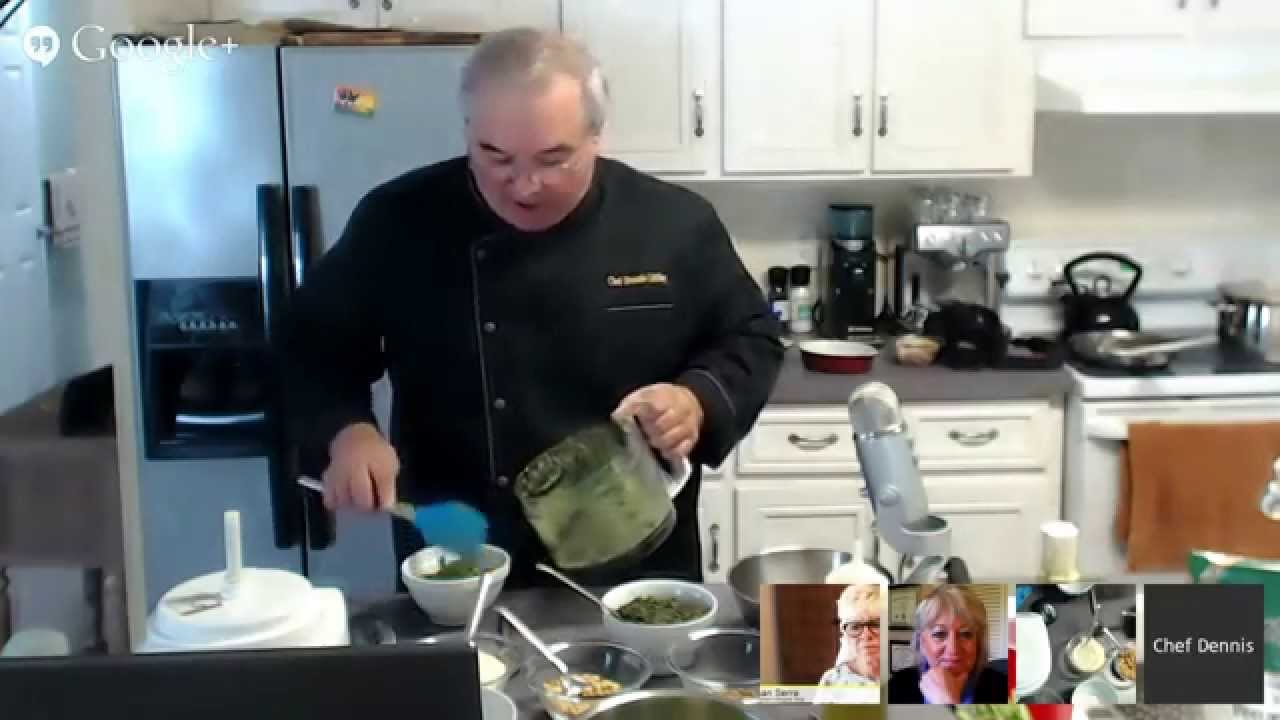
In this episode of Around the Kitchen Table, Chef Dennis Littley, co‑host Susan Sarah, and guest kitchen designer Rhonda Kanucki demonstrate three pesto variations—classic Pesto Genovese (basil with Italian parsley), an arugula‑pistachio pesto, and a sun‑dried‑tomato pesto—while discussing ingredient flexibility, storage, and serving ideas. Throughout the cooking demo they answer viewer questions about nut and cheese substitutions, vegan alternatives, and how to incorporate pesto into pasta, grilled vegetables, proteins, open‑faced sandwiches, and marinades. The conversation then shifts to kitchen design, covering small‑appliance planning, ergonomic mixer placement, aging‑in‑place considerations, and current design trends such as colorful mixers, open shelving, and concealed appliances. The panel also shares regional food insights, recommending Oregon Pinot Noir producers and describing local farmers‑market experiences. The episode ends with a preview of next week’s grill‑pan skewers series.
Chapters
Hey everyone, welcome to Around the Kitchen Table with my co-host Susan Sarah and our special guest Rhonda Kanucki. I think I said that right. Excellent. Good. And today we're going to make for you something that speaks of summer to me. And when I make this in the wintertime— well, in Florida there is no wintertime anymore, so it doesn't matter. But up north—
thank you—
yeah, when I used to make it in the winter, it was always like a breath of fresh air, uh, bringing the basil out, making pesto and tossing it with something. It was just a great way to talk about summer that's coming and how to use some of those wonderful greens you have out in the market. Because you can make pesto just about out of anything leafy and green. We're going to show you how to do one variation of that today. But right now I want to say hi to Susan. Susan, it's good to see you.
Good to see you too, Chef. Did you have a good weekend?
Absolutely, you know, we had some rain here and there, not quite biblical rain, but it was getting close Sunday. And, but other than that, the sun was out for a good part of the day, and we haven't hit the humidity yet. And I preface that with yet. So it's coming.
I know you keep saying that, and I'm— and the way I look at it, your summer is really our winter.
There you go.
I would imagine, except, except that you could take a dip in the water anytime you want. So yeah, we can't quite do that. But you know, I had a good weekend. I went to yesterday, I went to the farmers market. It was the first time this spring our local farmers market was open. And do you have farmers? You must have farmers markets nearby.
You know, we had one that was open when we moved here, which is maybe 2, 3 miles away at the most, and it hasn't opened back up. It closed right after Christmas. And we're patiently waiting for it to open up. It's right across from one of the— you know, there's cattle ranches on the way to where we live. It's just insane. And then, you know, you're not that far from downtown too. But that's the closest one. And no, we really don't. You know, they have— Celebration has a thing on Sundays. It's a market and a farmers market. And Kissimmee has this little tiny one that's like maybe about 10 booths. But, you know, not as much or to the extent close to me as when I was in Jersey. But if you drive into Orlando, holy moly, there's a farmers market. Or Winter Gardens, there's a farmers market and all farmers markets.
And how far are you from Orlando?
To go to the farmers market in Orlando would probably take me about 40 minutes.
Okay, all right, so it's not around the corner.
No, it's not a terrible drive. You know, they're going to build the SunRail coming down. They did the first stage of SunRail.
Wow.
Station right near our house, you know, within a mile at that, and Winter Garden— Winter Park. Winter Park, Winter Garden, Lisa. Which one do we go to? Winter Park? Winter Park. I always get them mixed up, and one time I drove to the wrong one when I had a meeting, so it was a bad thing.
Oh gee, I hate when that happens.
Yeah, and it was 35 minutes away, so it wasn't a good thing.
No, but we have such a nice one. There's so many booths, and they come from the— I'm about an hour outside of New York City, actually Specifically around 37 miles, although it could be 2 hours, you never know with traffic. So we're in the suburb of the North Shore of Long Island, and they closed down, I think, in November. They just opened, and we have booths that come from upstate New York, from the East End of Long Island, and a lot of like organic type of, you know, small artisanal providers, whatever. So we bought some. I saw this— oh, I mean, all kinds of words like sustainable, organic, free-range, no this, no that in terms of hormones and everything. So I figured, well, that must be good and it'll make me live longer. So I bought a bunch of meat and they had a freezer truck that they go into to pick the meat. So everything's frozen. When I bought What did I buy? Brisket, I bought steaks, I bought— I don't know, but a whole bunch of, I think, pork and beef. I don't know, Dennis Littley, the beef is like this maroon color. It's this dark, dark maroon. It looks like nothing I've ever seen.
It's like a blue-red.
Yeah! Yeah, you know what I'm talking about?
I do. That's— that's— we're just so programmed into seeing meat that's been injected and, you know, other things added to it so it has that happy red color that we're all familiar with. But that, that like bluish-red, you know, a lot of times what you see on, on the good cuts of meat, or the meat that has not been processed quite as much as we're used to seeing. You put that in a supermarket, people will walk away from it.
Tell me about it. I thought, "Oh, boy. What am I in for?" We haven't had it yet, but I'm sure it's going to be terrific. I look forward to it, and then that's it. We can just have it for the rest of the season. That was kind of interesting.
The one thing you need to watch with some of it is, and not always, but a lot of times, that kind of meat is not as fat, which is a good thing and a bad thing. It's a good thing because you're not getting all that extra fat that you don't need, but it's a bad thing because fat adds flavor and fat makes it tender. That's something. It keeps it from drying out. That could be a good thing and a bad thing, depending on—
Yeah, you're right about that. There wasn't much fat, so we'll see what happens. They sell out so fast in terms of the vegetables, so you really have to go there like 8:00, 8:30 in the morning. I think I'm going to— start doing that. But I'm so thrilled you're making this today because I campaigned for it. And, you know, after a long winter, I, I want my pesto. And I'm gonna play Stump the Chef because so many questions about it. And then later I'm gonna play Stump the Other Kitchen Designer. We have with us Rhonda Kanucki. Hi, Rhonda. And Rhonda is She has more initials than I do, and I'm very proud of my initials, but she has more. She says C-M— C-M-B-K-D. C-M-B-K-D. Yeah, she has the bath— right, right, she has the bath certification that I don't because I'm all about kitchens and I only do baths under protest. So Rhonda has the whole deal, and so Rhonda and I— then I'm gonna play stump Rhonda. And I have a whole bunch of images. And you know, the mixer has to go somewhere on the countertop, and sometimes it's a problem, and sometimes it's there and it's taking up space and you don't use it. I have— let me tell you, because also I went to Milan, as you know. I have killer images and so many options of what to do with a mixer. And Rhonda and I are going to play Love It, Hate It, or Meh.
We'll have the certifications on the wall, but we'll see if we can do the game show lightning rod today.
That's right. So Rhonda, tell us about, you know, about— you have your own business for yourself and you do consulting and you execute full projects, right?
I do. For many, many years I worked for a design-build firm and I now do design only. I work in conjunction with general contractors, mostly kitchens and bathrooms, also whole houses. And really like looking at the kitchen holistically with the entire house. My mother was a caterer, chef Dennis Littley, for 33 years, so we lived in that kitchen for 20 hours of the day. I think that's really where I got my baptism by fire, was growing up in the kitchen, literally. So we were in that kitchen really about 20 hours a day.
Wow.
Later as a kitchen designer, and now I'm also a certified agent and place specialist. So you see where this years going. Now I'm aging in place and helping others do it too.
Yeah, that's, that's terrific, and we're going to talk more about that in a little bit. So, shalom from Portland. Yep, and you're from Portland, Oregon.
Right, I live in Portlandia, so we just had our big Rose Parade this last weekend, our annual Rose Parade, a lot of open markets, and I just planted some fresh herbs, so I am so ready.
What do you see here? Roses from my garden.
I should have mine out, that's for sure. That's right.
Yeah, and mine are just coming out.
Just got rose bushes for Mother's Day and birthday, and so they're blooming their little heads off. And, uh, loving Portland.
So you're, so you're in Portlandia like that show?
Oh, I am one of the ones helping keep it weird, honey. That's definitely my job. This will be in my job description, and that's what one of the certificates is for too. It's CMKPD, CAPS, but also helping keep Portland weird.
Love it. Love, love, love. Okay. All right. So there we go. Good introduction. So, Chef, you know, give me some pesto.
Okay. We're ready then. We're going to start off with a classic. We're going to do Pesto Genovese, which, you know, will have as many interpretations as there are, you know, days in the year. Everybody has their own little tweak on it. But I'm going to show you how I learned to make it. Oh, I hate to even think back that far how many years ago it was, but it was decades. And before pesto was really fashionable or popular or we started making anything other than basil pesto, it was the recipe that was handed down to me. And I make it that way sometimes, and other times I do make adjustments to it, but it's a good way to start and give yourself a feel for how you like it. And the difference with my pesto is I do use some Italian parsley in it too, just to cut down a little bit of the overpowering flavor that basil can have. So, I mean, you want it to be enjoyable, you want it to be tasty, but you don't want it to really just knock you down with the flavor. So it depends on, you know, what you're using it for too. If you were using it with meats as a, you know, as a layer of stuffing in it or coating it with something, you might just want all the basil.. But we're going to show you the way I learned to make it originally. And I'm going to start— let me switch cameras here so you can see a little bit. I'm going to start, I have my food processor up here. You know, in the old days we used to use a mortar and a pestle, so we did not make anywhere near this much pesto at one time. But thanks to modern technology, and I'm going to load this up.
Yum! I can smell it from here.
Let me tell you something, nothing says, like I said, nothing says summer I worked in a restaurant for a few years that was bordering a farm, and I would come in to work sometimes and there would be a bushel basket of fresh basil sitting on my doorstep at the restaurant because the farmer knew we loved it. And I would just bury my head in it and just inhale. It was just such a lovely aroma.
Oh yeah.
I'm going to start to grind this up just a little bit, then I'm going to add in Pulse it. Tell me if this is too loud.
No, it's pretty good. It's fine.
Probably when we start adding the—
No problem.
All right, so I'm just getting the pulse. It's not quite ready. Now I'm gonna add in some fresh Italian parsley.
Oh, that's a lot! I think that's a lot.
Wow!
That's about a third.
Oh yeah, I didn't expect that much.
It's about a third. And you know, it can be as much as you want or as little as you want or not at all. You know, it's not a deal breaker. It's just like I said, I really enjoy pesto. I like using a little bit more of it and this helps keep the flavor.
But you know what? You know what, Chef? I think parsley is underrated. Too often it's only used as a garnish.
Oh, absolutely.
Or you just put a little bit of it in foods. But I really, I think it has such a fresh taste and it deserves to be a more prominent, have a more prominent role in in dishes, don't you think?
Absolutely. You know, it doesn't have a real strong flavor, but it does have some flavor and it does add something to the pesto.
I think it has a fresh sort of taste.
So I've added in my basil, my pesto, and I've just ground it up a little bit. Now I'm going to add in some pine nuts.
Okay, pine nuts, stump the chef.
Okay.
Pine— you know what, my son who is a foodie and his fiancée, they make everything from scratch He said to me, "Ask the chef what I can use that's not as expensive. We're starving college students, and what can we substitute?" Walnuts. Okay.
When you don't have pine nuts, bring out the walnuts.
Okay.
They'll do the same kind of thing to it. If you want to change the flavor profile a little, experiment with some of your flavor nuts, favorite nuts. I'm going to make an arugula pesto with pistachios in a little while.
Oh!
But I would say with something a little bland, and so walnut is a good choice. And really the nut isn't a deal breaker. I know it should be in there, but if you have someone with a nut allergy, leave the nuts out. It's not really going to—
That's true.
Yeah, we have a ton of hazelnuts here, which blend in really nicely with a lot of things.
Oh, you do?
Hazelnuts would probably be wonderful. You just want to watch that they don't overpower the flavor. Whatever nut you're using is mild enough that it doesn't give it too distinctive of a flavor, although that can be an excellent thing too, because then you've got a hazelnut basil pesto, which is—
I'm writing that one down.
Yeah, that's what I'm saying. Don't be afraid. You know, like, this is, you know, if you want to make a cilantro pesto If you want to make— we're going to make an arugula. If you want to use baby kale or some other leafy green, you have to temper it. I mean, you can probably make something just about anything, but you have to think of what the applications of it's going to be and how it's really going to taste, how the flavor profiles are going to work.
So I think what you need, Chef, is you need a spreadsheet.
You need a food processor and the willingness to experiment. Okay.
Take notes.
So I have, I have some nuts in here. I'm also going to throw in a clove of garlic. I don't like to use too much garlic because I don't like it to taste hot, you know. I know, and garlic fresh— yes, yes, too much heat to it. So that's a good-sized clove, and I'm just gonna pulse this up.
Interesting, because I use a lot of garlic. How about you, Rhonda?
Yeah, it's a thin line, isn't it?
I put in more than—
you can't take it back out. And you're right, I would have never described it as a heat.
Add in some cheese. And Alexandra, Alex, had asked me about not using cheese, and I had to look around, actually. I knew I'd heard of someone who had done that. And I found someone used yeast, and it wasn't just regular yeast. I'm trying to remember what kind of yeast I told her, but it was one of these— where the heck is it?
What are you looking for?
The nutritional yeast.
Oh, I missed that one. I didn't see that one.
And Oxid asked about making it without because she's a vegan.
Right.
—have cheese. My first thought was, "Well, I have seen soy-based vegan cheeses before, like Romano. It's not quite the same. I've never used it, so I don't know how it tastes." I said to be careful and try it. Then I did check with someone, and they had said nutritional yeast is a good substitute because it had the same flavor. Again, you have to watch what amount you put in. But, you know, that could be a way to get that little flavor into it that you like so much.
Now, what do you— okay, another Stump the Chef question. What do you think about adding lemon?
To this, you could. I don't know if I would. Lemon is not something that you can— once you put it in, you can take it back out. If I want a little lemon with my pesto, I might put it into it in whatever application I was using it or serve it on the side that you can do a squeeze with it.
Okay, because I did see a parsley lemon.
You can use lemon, you can use some of the— there's different herbs out there that they call lemon parsley or lemon basil.
There's some different kinds. Oh, that's funny. Maybe that was it. So, you know, using like—
I have a chocolate parsley Chocolate mint out there. I mean, you could throw something like that in. You can change it up just by adding a little twist to it if you want to have that little, like, hmm. But you want it to always be like, what's that flavor? That's really interesting. You don't want to be like, oh my God, what's that flavor? So there's a fine line between the two, and you have to experiment and find it when you start adding different elements into it.
Yeah. Hey, Chef, Shannon Steves is asking, what kind of cheese are you using?
I am using Pecorino Romano, which is what I always use, and I buy that. It's not an expensive, overly expensive brand. I buy it by a 2-pound bag, and you can usually get it at a lot of your big box stores. Of course, you know, if you want the best, you want to get Locatelli. That's the name brand of Pecorino Romano. But, you know, you can always use other cheeses too, as long as it's a hard, grateable cheese. Grana— what is it? Grana Padana? My mind is blank. Padana, that other hard cheese, Asiago. You know, it's going to change the flavor though, so you just have to be aware. And you don't want a really strong cheese unless that's what you want. Again, it can be very interesting, you know, so you could change the flavor profiles that way. You can also leave the cheese out. And add it into the dish that you're making.
Oh, okay.
So I'm going to use Gorgonzola, and you can either blend it in when I do the arugula, you can either blend it in or you can add it to the dish later, like if you're using it as a coating on chicken or into a pasta even, you just let it melt in that way. All right, so let me pause this.
Are there vegan recipes or restaurants In your parts, Susan, and Chef Dennis, we have a lot of vegan restaurants here in Portland.
Wonder if you had many there. No, I— but I'm sure you have more than we do. A lot. Yes. What are you doing now, Chef?
I'm just pulsing it all up. I have everything in there.
Okay.
Okay, now the last step is, of course, oil. This is almost more to make it more easy to use, to make it easier to store. And I'm just going to put oil in. You watch it, it'll start coming off, it'll start to form, it'll start coming off the sides a little, and you can see the liquid. You don't want it oil You don't want it too thick.
Okay, I counted 15 seconds, so if I get a bottle like that, I could just count 15 seconds.
That's a great storage and application with the squirt bottle. You're right.
That's a chef thing. That's a professional chef thing.
That's right. It's great. Something we can all use though and do.
Yeah. All right, so you can see it's not oily.
Oh, I like that.
Yeah, okay, but it's wet enough. Now the oil is also going to help protect it when you store it too. All right, so that's pesto, and that's that easy, and it's done. And I'm going to show you how to use it. I have some water on for pasta, and one of our favorite ways to use it when the pasta gets cooked. But right now I'm going to move this to another bowl and I'm going to wash it so we can move into our next facet because We can get KitchenAid on and they didn't send me new food processors with extra bowls so I don't have to keep washing them. Hint, hint. Hopefully we can find them later. So why don't you guys talk a little and I'll be back with you in a few minutes.
Sure, sounds good.
So I did see a question or two pop up on the screen here.
Yeah, we'll take it in a little while so that the chef can answer it too. So Rhonda, you know, I'm thinking about the mixer. Tell me, you know, small appliances, when we plan kitchens, you really have to consider that, where it's going to go, what type of questions do you ask your clients about small appliances?
Sure. It's really truly a category I call small appliances right down the checklist. Because everybody has either you're kind of anti-small gadget, or even if they consider themselves pretty minimalist, let's do the list, shall we? And you get the pencil out, and there's always a few more than, than they think of. So oftentimes daily habits, you know, what's out all the time, sometimes coffee maker, sometimes the toaster. Oftentimes I have clients that do daily We have a lot of juicers here, so a lot of juicers and veggie drinks and so forth. So the blender, food processors, mixers, and that list starts to add up. So if there's things like pasta makers not used as much, different kind of storage, different kind of application as a designer, wouldn't you say?
Oh, definitely. And you know, there's always the balance. It's like peeling the layer off. What is habit and what is a true desire or need. And sometimes you have to, you know, talk our clients through it. And just because they've had it there, you know, forever, and they may not, you know, use it, and then they'll think, oh well, either they'll want it there or not. A good example is in my other house, I had double ovens. You know, double ovens, good-sized kitchen, double ovens. Rhonda, I use the second oven one day a year, and that was Thanksgiving. But you know what? I was happy I had it. I was happy I had it. So in the case of a KitchenAid mixer, it's very heavy. You know, people, you know, people don't always use what they tuck away.
Right. Well, and the opposite is true. We have it out when we shouldn't or don't need it. And by the same token, there are things that we would use more often, like a food processor, if it was just a little handier. So while people love walk-in pantries, it does take a little effort, and sometimes you go, eh, you know, I'll just grab a knife and get to it. But if it's handier, like anything, we'll use it.
Yeah, that's true. You know, I have some images here. I'm going to go through a few And Chef, if you can hear me, just tell me when you're ready to take over again. So I'm going to do screen share and I want you— are you ready? No, we're fine. Keep going. Okay, good. So Rhonda, you're going to tell me love it, hate it, good idea, or eh, you know.
Thumbs up or thumbs down, huh? Okay.
Yeah, so that's what we're going to do. Okay, so here we go. Okay, so first image is a kitchen, black kitchen. Now what I like is that you have the shelf, which is a little bit deeper. Now, I'm not sure how deep that is. It may, it may be a little too shallow, but what, what do you think if that shelf was, say, 9 inches? Could you see putting a mixer there, or would it be— would it ruin the vibe?
I don't know that I'd do a mixer there because ergonomically it's going to keep raising the height of the working wall cabinets, but I had lived in a previous house with a 6-inch deep console shelf that all those small things that you see on that counter is a great example, are up and off your counter. So a console shelf, as the Europeans remind us, we waste it. It's 18 inches of primo— Yes. —economic space and we throw it out the window. So utility racks, small console shelf like this, I think is a good way to put that extra.
Yeah, I think so too, and it really looks great too. I'm going to move on to the next one here. It's a very contemporary kitchen. And we see a mixer which looks very retro, you know, just at the end, and I'm not sure I love it. I don't know if it's out of place for me.
What do you think? I do a psychological profile for clients too, and I'll ask what kind of things, like for all of us, either it makes you uneasy to have more things out, or mental clutter, or sometimes it's soothing. So that's one of those things I ask clients. Did you feel good seeing your bowl of potatoes or canned goods? Yeah, definitely. I mean, we are— Your mixer out makes you think of happy birthdays.
Yes, I mean, by virtue of our certifications, I think we should be able to do some therapy, don't you?
We've talked about that before, Susan. Absolutely. Should be another certification. And saving marriages, of course.
There's that one. Saving marriages. Absolutely. Yep, yep. So, and then there's another one. Let's see, what do we have here? Same thing but looking at it at a different angle. This was actually a shot of a kitchen that I took in Copenhagen.
Ah, lovely. I'm doing a white and wood mix. Thanks for the inspiration.
Oh yeah, yeah, I'm all over that. Love it. Now here's one that I saw in Milan, kind of, you know, a little industrial maybe. You know, and then there's— I'm not sure if it fits there either. It's just kind of there. I might have put it someplace else. What do you think?
Susan, how many European kitchens do you see with slicers out? Right? Oh, that's right. That's part of, you know, in Germany especially. So again, that's one of those things that clients— and oftentimes there's a family of kids using it. It doesn't always get cleaned up really well.
That's true.
Sometimes you tuck it away.
Now here is a big island with a rack underneath. I mean, it could be designed so that the mixer is tall enough, but I love this look. I do. It has—
again, with kids in the mix, you can go over there, start setting the table on the other side of the island, other things can be happening on the other side. And that's kind of a nice mix. People get concerned about it being dirty and dusty. Obviously it's the ones you use every day.
Right, right. Now, Chef, can you tell me if you can see these images? I can. Are you ready to go on, or should we go through?
I'm ready to go to the next one. I have a couple more.
Okay, because I have more images, so we'll just pick it up again.
Yeah, we're going to take another little break when I have to clean out my bowl. There. So let's get started, and I just have to grab some cheese real quick for this one. And a different kind of cheese? Well, I'm going to use gorgonzola in this.
Oh, my other favorite.
Okay, so what I'm going to make now is I'm going to make an arugula pesto. And again, it could be exactly what we made, the way we made it before, just using, you know, Romano cheese. I'm just going to make it a little different. I have baby arugula here. Whenever I make something that's going to be a pesto or this kind of a combination of herbs or greens, I always try to get the smaller, the baby greens for it because they're going to give you that flavor profile without being overpowering again, or without as much bitterness as they start to get older. So this arugula is going to be wonderful. I'm going to put that in.
Yeah, I always try to get baby arugula too.
It's just, I don't know. It's just great. It's good on sandwiches. It's good in salads. I like it on pizza, you know, after the pizza comes out of the oven, of course, and you put some on with some of your other ingredients. So we're going to do this. Nice.
I haven't made that before, arugula pesto. Okay, I have to broaden my repertoire.
So again, we're just pulsing it down.
How much of the stem do you leave, Chef Dennis? I'm sorry? How much of the stem do you just—
On the baby arugula, I just— it was organic, and I left it the way they gave it to me. Generally, on a parsley or basil, I try to remove as much of the stem as you can, but again, I'm not going to knock myself out pulling each leaf off of it all the time too. In a restaurant, I have people that would do that.
Depends on how much my OCD kicks in that day.
Well, my OCD never quite kicks in that much. Yeah, other things it does, but on this one—
Oh, you are too, Rhonda? Me too, all the way.
Now, look how much time I've spent, you know, so I really wonder in something like this with the blender, how much of that can just— or if that's considered a real no-no. Does it add any? Well, I would not.
It's going to get you're going to get those strings in it. You're going to get a little coarseness of the fiber in it. So I would stay away from the stem.
Don't be that lazy, right?
You don't have to be crazy about it. I used to actually take my parsley and I'd hold it upside down and I'd carve it off with a knife. Yeah, good shortcut. Yeah, without going nuts. Parsley's not that expensive. I could go buy another bunch if I lose part of it. Basil's a little easier to do because the leaves are bigger, so you don't mind plucking them. It's a little easier to see because they have really big fat stems, so they're easy to pull out, too. Arugula, it's just the leaves. If you're going to use baby kale, it's the same thing. It's just the leaves. Baby spinach, anything along those lines.
That's the only thing that gives me green thumbs because I don't have green thumbs. I pinch off all of it. That's the only thing. Good job.
We have the arugula in here, and now instead of— I'm going to add a little piece of garlic, but instead of the pine nuts, I have some pistachios, and they're salted pistachios, so I'm getting a different flavor profile on this.
I'm telling you, I need a spreadsheet. Spreadsheets are starting.
All right, now I'm going to put the cheese in I'm gonna do this a little backwards, so I'm gonna start adding some oil in now.
So why are you doing it backwards?
Well, because the cheese is gonna really gum it up a little bit.
Okay.
So this is adding a little lubricant before the cheese goes in. Yeah.
Keep it blended. Oh, right, I forgot it's Gorgonzola. That's right. That's right.
Again, enough oil so it starts to come off the wall. And this is going to be a little more— I didn't grind the pistachios down quite as much because again, I'm going for a little bit of a different kind of a pesto. So they're, if they're a little bit bigger bites than the pine nuts would have been. Again, if you want to make this and just keep it more standard, you can use pine nuts in it or walnuts in it.
So would you use that— would you also use that pesto on pasta, or would you use that on different dishes?
You can use it on pasta. You can use it on any other dish you wanted to. Just use it any way you would normally use pesto. It's again up to you on how you want to use it and what flavors. Now the only thing different now, this is not a really good gorgonzola. I had a piece in here and it was not good anymore, so I had to grab something really quick and I didn't have time to go to Whole Foods for some good gorgonzola. So this is gorgonzola crumbs.
You know, Chef, one of my favorite gorgonzola-type cheeses is Danish Blue. Do you know Danish—
I love blue cheese. My favorite gorgonzola is a Mountain Piccante. We started getting that down here, and that's got a little bit more of a sharpness to it. Because for years I got the standard wheel, I forget the brand name, but it was a blue aluminum wrapper on it, and that's all the only gorgonzola I ever saw in my whole life. And then I started finding some really good ones, and the Mountain Piccante was just wonderful. And then there's this Dolce, which is really sweet. But it's a creamy gorgonzola, and that is so good to put on bread, and it's still got a nice kick to it.
You know what I could see this for? I could see this as a spread for open-faced sandwiches.
Yeah, it would be good for that because it would give you the arugula, the nuttiness. So I'm just going to pulse this a little.
It sounds like a Scandinavian dish. How did you guess?
That's right. I mean, it's the simplest thing to make open-faced sandwiches, and they're so festive and dressy.
So you can see that the cheese did make its way in very well. It did blend in nice. So that's, uh, we put that in last. So that's it for there, and that's an arugula pesto. And I'm going to show you some applications for everything in just a little bit. But you said there were some questions too.
Yes, I have some We have some good questions. Okay, let's see. Coach G. Moore says stems have great taste. What do you think about the taste of stems?
Well, again, there's flavor in them. There's flavor in everything. There's no reason to throw everything away, but it depends what you're using it for. If it's in a salad, you know, I might leave more stems on it because it's going to have more fiber. To it, to what you're eating, and it's going to give you more of a different mouthfeel. But something like pesto, you know, you again, you can grind them up if you have a nice sharp blade, you can. And it's all a matter, you know, what you like.
Mm-hmm. Okay. And Kim Baltman says beautiful lines and lighting on the first two kitchens. The third one looks like a restaurant kitchen. The third one was a big display in Milan, and that was a booth. In Milan, it was the Electrolux booth, and it was just amazing. It was just stunning. So yes, a lot of the lines that I saw in Milan, they were very clean, they were very, very straight, they were, you know, it was a sort of horizontal sort of feeling and very, very—
The asymmetry of the cutaways and the shelves, Susan, were wonderful. That's sliced half in. Yes, yes. And not to line those up, but that's really adding architectural stacking interest there.
There was so much architectural interest and so much of a flow, which it was so much of a built-in sort of look. And Carmen Mandic says, which is interesting, I use a small old coffee bean grinder used for espresso coffee to chop nuts, garlic, etc. Well, that's interesting. I haven't heard that before.
Yeah, you could use one. It's, it's gonna do the same job. The whole problem with something like that, if it was like one of the newer style, it would be cleaning it. But if it's an older style, even a hand grinder, you know, absolutely.
Yeah, I wonder if it flavors the coffee at all.
Well, I don't think she uses it for coffee too.
Oh geez, oh geez.
Oh, she said it's old, of course. Boy, yes, see? I told you, I said on one of my posts, I'm going to ask questions anywhere from dumb to smart.
Well, I wasn't dumb, that was just— Well, it wasn't smart. I'm going to show you one of my applications for the first pesto we made. And I have some pasta. Right out of the pot. Okay, so I'm gonna put this in here. This is how Lisa loves it the best. Put in a spoon of pesto in here, and you can do this with any of the pestos, but while it's hot, you're just gonna mix this all around. Get a nice— and again, depends— and I can use a little bit heavier so it looks a little a little heavier on this than normal because I had some basil in it. I mean, parsley in it, which cut back the flavor profiles a little bit. Mm-hmm.
Do you have any, a little bit of liquid from the pasta at all? No, I didn't need it.
You know, it's just, it's coming out of the pot nice and hot and it's just loaded.
Ironically, I did a pesto and pasta twice last week and a little bit on the dry side. Good tip, Susan. I should have doing some of the greens, but also some of the roasted tomato pestos.
Oh, nice. About that later.
But you can see the nice oil on it. There's a nice sheen on it. If you felt it needed a little bit— now that again, this is the time you bring out your really good olive oil. Now you could just drizzle a little bit of some really good nutty olive oil on it. That's what I meant. Sprinkle it a little more cheese. And if you want a little crushed red pepper on it or something, but it doesn't get fresher than this.
This speaks springtime. And where's Lisa? Is she just right off the—
She's got to come out and grab it. She's on the porch. But this also served with some grilled vegetables. Okay, if you want to do something, you set up a nice big platter, have this all ready. Grill your vegetables or roast them ahead of time. Let them be room temperature, and then serve this with a nice plate of grilled or roasted vegetables. If you want to grill some chicken or shrimp, I mean, but by itself, this is wonderful. This is just a really pretty presentment.
Yes, this is—
I mean, that's, that's a great way to eat. So any of the pestos, you know, just get those pasta right out of the water, toss them, sit down and enjoy.
It looks Absolutely delicious. Tell me something. I like to make ratatouille in the summer. I love ratatouille. I love it. Would you think about adding pesto to ratatouille? It just occurred to me.
You could, but you're going to change the flavor of those wonderful— oh, do you make a liquid ratatouille?
I just put all the vegetables in and—
Oh, you do a pot.
I do a pot. Okay. And then just cook them for a couple of hours.
I don't think you would want to use pesto in it because it would be a waste of the pesto, because what you want to put in is the basil and some of your other seasonings. If you're going to go to the trouble and expense to make a nice pesto, putting it into that isn't really going to be a good use for it because it's going to cook down. I make a Mediterranean ratatouille, which is a roasted one. And I use all different kinds of herbs in it when it's roasting, and it has tomatoes in it, but it's not a sauce one at all. It's a dry one. This old— actually, an old chef from Norway taught me how to make this. It was amazing. He had made it— he'd cooked for presidents and kings, and this was something he had learned, and he used to make a lot when he worked on cruise lines, and it was a Mediterranean version of it., and it was just wonderful. I have never made a potted ratatouille since that's really cooked down because it just becomes, I mean, it's a mélange of flavors. Yes, yes. When you roast them, everything still has its own unique flavor.
It's just wonderful that way. Yeah, no, when I make it, it's one big mush, but it is delicious. So we have to watch our time, Chef, so I'm keeping you on track. You have another? Yeah, come on, of course she's going to take it.
She says she's not hungry now.
Oh, you don't have to. I'll take it.
Yeah, really? She's not going on camera.
That'll be gone in a few minutes.
Yeah, let's move on. So why don't you guys chat a little bit while I clean up the food processor and we'll move on to our last one.
Sounds good. So, yeah.
I have a quick question for you. When the time is right, there was a question that popped up We're talking about great food combinations and ways to prepare and serve. There was a question about some good Pinot Noir out of Oregon.
Oh yeah, that's your turf, so tell us.
In Portland, we can go about 1 hour, we're at the coast, and another hour we're in the mountains. So we also have in between there some really nice wine country. So there's Eminent Domain, which is a Ribbon Ridge, has been great, Maasahn. And also just Chapter 24 Purple Hands, do you love that name? Purple Hands is another Oregon one here, and Raptor Ridge. And I'm not sure about availability for those nationally, and your You know, of course—
Yeah, well, we have it on tape now, so we can always come back and—
Really reasonably priced, I think, King Estate, and then Argyle, also out of the Willamette Valley. It's another very nice Pinot Noir. And I love Cooper Mountain, is one of my favorites, and St. Innocent. Oh. There's a short list, long list, and Monte Ferra. Great, great, thank you.
Well, Pinot Noir is one of Lisa's favorite wines, so if any of you Oregon producers would like to send us some, I'll be happy to review them.
Yes, there we go. Let's look like— let's take a look at another couple of kitchens. Everyone seems to love the kitchens. Yeah, so now this one, Rhonda, is interesting. Take a look at this. This was in Milan, And this is an island, and at the end of an island is this, you know, sort of bright blue open shelving piece. Now, would you put a— I'm not so sure I'd put a KitchenAid mixer in this fabulous, glamorous area. Susan, we can't really see it.
You have like 3 of them up there.
Oh, I have 3 of them up there.
Help me, Rhonda. Okay. You had 3 of the same picture across across, or I don't know if you got the right screen share on that.
But while you're doing that, Susan, I can answer that real quickly in that you'll see— we've seen a lot of the color introductions as opposed to white stainless and making them disappear. We've also seen some that are punching up the color. So again, like anything, psychological profiling for the client. If you want to do a personality mixer, there's all kinds of colors available now, unlike any other time.
I know, that's definitely— that's That's absolutely the way to go. Open shelving. Yep, and open shelving. I saw open shelving everywhere. I don't think that's going away anytime soon. And of course, that's conducive to— well, actually, there is a mixer right here. So it's good to have a home. It's good to have a home for the appliances. I mean, that's what you have to plan for in advance. And sometimes it's a process. Now, also in Milan, I saw lots of concealed sort of separate areas where the doors open and they close and then the mess is confined. And, you know, so that's, that's been a trend for a couple of years, wouldn't you say?
I also do a lot with downsizing because absolutely, if we look at sociologically and economically, we've been downsizing with spaces. So we're doing a lot in a small space, and there's oftentimes that— I call it— I do what I call almost like robotic changes that can happen in spaces. Now you see it, now you don't. Transformers, basically.
Yeah, exactly. That's funny because I call it— I call it a similar thing. I call it flexible living. Yeah, living in a flexible way is— that rules.
It's something that I've borrowed from his era of transformer designs now, but Thank you. But the appliances like this can either, you know, pop up or disappear, and I know that you've got some other great suggestions.
Yes, I have that too. Here's another one which again, this is a concealed sort of area which we have some ovens below and then we have the mixer on top. So that was very popular in Milan. Here's a kitchen just with a mixer on the countertop, basic countertop. The only thing about that is it does attract dust. It gets so dusty. And here's another one too. It fits, you know, the useful items and decorative items always work very well together. This I love, Rhonda.
I did one recently very similar to this with that bottom shelf. Love it. Slide it in, slide it out. Love it. In fact, in their case, we kind of embraced the era. We did it, we found a vintage looking toaster and a vintage-looking mixer.
Yeah, just rolled with it. Yes, it's just so functional and it's so beautiful too. Here's a, you know, bigger pantry slash open shelving area where, you know, the question is, do you want to pick up the heavy KitchenAid mixer and bring it across, you know, 4 feet over? Some people don't care, you know, some people do. Here's a very formal kitchen.
Glad you mentioned that because also as a Certified Aging in Place Specialist, and that does not mean that we are, you know, have one foot on the banana peel and one in the grave. It's a matter of having kids at whatever age, we're having them cook in the kitchen, do you want them schlepping the mixer over or for some of us carpal tunnel, it doesn't mean that we are handicapped in many, many ways, but just lifting mixers or appliances, safety and ease.
And you know, you're right, it's for all ages. I'm also CAPS certified, so the, you know, it's for generations. It's common sense. And so what you're saying, it can be beautiful and ergonomic at the same time. So you're ready to move on? Okay, sure.
Let's, let's take one last pesto to make because we're starting to run a little close on time.. This is sun-dried tomato, so this is going to be a little different than making something with greens because we're going to use the sun-dried tomato to make this instead. I have reconstituted these, and I'm going to squeeze out some of the juice as much as I can. I didn't drain them because I hate to throw this juice away because I'll use it in other sauces and other dishes, and it's got a nice flavor to it. This is going to be a little wetter. I'm probably not going to use anywhere near near as much oil for it, but I want it to be a little bit more of a paste. So I've got these in here and we're gonna—
and those were the dry? Those are the dry that you— okay. Do you remember, Rhonda, when sun-dried tomatoes were so big? What was it, about 10, 15 years ago?
Yeah, I'm from the Midwest originally, so we canned it quite a bit, but that was fairly upscale that we hadn't— Right.
Add a little bit of oil to it now because I want it to paste a little bit more before I add— Alright, that's a little better. Now we're going to put in our pine nuts.
I mean, what do you think about that pesto with, you know, on a platter with mozzarella and basil leaves? Sure, you could put it on for bruschetta.
You could use it as a topping on bruschetta. You could use it on any meats and seafood. So I've got my garlic and my pine nuts. This is going to be a little— you have to watch it a little more because of the consistency of it. You probably could have almost put everything in together at the same time. Garlic's not wanting to go.
Well, do you want the tomatoes to be a little chunky? Or do you want it a puree? What's that? Do you want the tomatoes to have any kind of chunkiness to them, or do you want it a strict puree?
No, I want it to be more of a puree.
Doesn't have me thinking about the open-faced sandwiches. My friend is coming from Norway next week. Oh, you need to do it. And having a big party. So I'm gonna have to think about some other open-faced.
There's so many things you can do. There's greens like watercress you can put on it and you know, cold cuts and salmon or so many things. Good idea. Take a look at Pinterest, actually. You can find some there.
Now we're going to hit some oil. Okay.
Mix it up a little.
Again, you want to see it start to pull away from the side a little. And done. So now we have this beautiful red color. And you know, if there are a few bits in it, you know, it's no harm, no foul. That's fine. We have this beautiful—
That is gorgeous. That is just— and it looks so fresh, and it's— I love the fresh.
And the flavor of it is just outrageous.
You said benchmark. You said if a little bit of oil is added, it wants to pull away away from the side a little bit, that's one good sign to look for, right?
Yes, with any pesto, as it starts to pull away, you know you've had enough oil in it. Otherwise, because again, you don't want it to be an oily mess, but you want it to be liquid enough and pliable enough that you can use it.
That's what I said. Yes, I do. Good tip.
The pasta dish that I did do, like I said, it really wasn't dry because there was enough oil in the pesto to keep it from drying out. And again, though, but if you want to add a little more, you always can.
Now, what will you do? Will you— can you freeze these? I mean, I know I've, I've always frozen Pesto Genovese. Yeah, you can freeze them if they last that long.
And how long will they last in the refrigerator? They'll last a couple weeks. The, the one thing you'll see more than anything with the green ones is they'll start to darken a little bit, and you just wanna pull away some of the dark. Like, even with this, it's darkening just sitting out here. As you move it away, you get that beautiful green color again.
Nice. That is just beautiful. What do you think, Rhonda?
Perfect.
Yeah. Real quick, we have a couple applications for it too, if you'd like to see. Just what I was hoping for. Let me just show you how I would use some of it.
I was going to ask you about proteins. It was a Stump the Chef, but you beat me to it.
So I've got some chicken here. Let me grab another plate.
I was actually going to ask you if you could marinate it.
Yes. Absolutely. I haven't done that before, but as I was thinking about it— And you really wouldn't need to marinate it in the traditional sense of marinade. Let's say I wanted to marinate it. I'll take one of these and I wanted to use my basil pesto. All right, now I'm not gonna— I'm gonna use my hand because I don't want to touch— I don't want to use this.
Well, that's nothing unusual, Chef.
Yeah, but just like if I was doing this I just want to rub it in really well. All right, and get a nice layer.
Oh my, I'm totally going to do that.
Oh yeah. Oh yeah, I'm going to do that.
I don't know if you can see it with this camera. Let me change the cameras.
Well, yeah, perfect.
Good, good, good, good.
All right, so this would be one way. Now, when you talked about marinating, You know, I might just hit it with just a little bit more oil. I might do 4 or 5 breasts this way, or thighs, or whatever you want to use, then wrap them up or put them in a bag, put them in a bowl, and put them away. That's your marinating. It doesn't have to be in a ton of liquid.
How long, how long can you marinate it for?
Uh, the longer you marinate it, the more the flavor is going to infuse. I don't think I would want this to marinate overnight, although it probably could, but probably about 4 hours.
Okay, I'm having a party on Saturday, and I think I'm going to— I'm doing skewers. I think I'm going to do that chicken, you know, chunks marinated in pesto on the skewers. Nice.
Now we're going to add We're going to take our pesto. Ah! Instead of— it can be the green one. I'm just using this one. Yeah. But instead of doing the marination, now you could also add, like, if you wanted to really change things up, you could take a little capicola or maybe a little prosciutto or another meat that you like and put it down on top of this layer of pesto that you're doing. I mean, you could even go as far as to do a two-color one. Put a basil— Oh, cool! All right, now I'm going to take it and I'm going to roll it.
Oh yeah.
Okay, I'm going to put it in my breadcrumbs. Oh no. Yes, breadcrumbs. Now you might want to toothpick this because otherwise it's liable— if you're not really careful, it's liable to come out. But this is— then I'm going to take this Beef could be made up ahead of time in the morning without the breadcrumbs and then just breadcrumb them before you go to cook them. Now I'm just going to sauté these gently to get a little color to them and finish them in the oven.
Nice! That surprised me. I didn't expect you— I didn't know you were going to do that. That's cool. This is another way.
You can use any of these pestos that we made to do something like this. You could do the same thing with flounder or tilapia. Okay, just put a nice coat. If you want to put a piece of cheese down first, you know, you play with it, do what you want with it. But these are your flavors to really enhance what you're making. So that's another way. Now the other thing I wanted to show is like we have some shrimp. Now you talked about barbecue and grilling. Now I want to take— well, I'm going to do some of them. I'm going to take my pesto I'm just going to really rub them up really well. And I might, with this, I might take a little crushed red pepper.
Mm. I mean, I, you know, this is a show where we need to do a spreadsheet because there's like 100 different variations of how to use pesto.
Absolutely. You know, while you're tossing there, you know, as again from Portland and Oregon area, A lot of salmon, always thinking about 110 ways to do salmon. Pasta is wonderful for salmon.
Ooh. Especially the arugula one with the pistachios.
There you go. Yeah.
You can put a little bit more pistachio on the top of it. So this is another way to use shrimp. So let me move this out of the way. And then we have a few more shrimp left. So again— Oh, okay. Same thing. We have. We're going to take a little bit of the sun-dried.
I think you just can't stop.
Well, this is all you can do. Keep going. You know, so I'm going to rub these down a little with these. Good too. Maybe put a little more cheese on them. And if I had a little fresh oregano, even to chop on them. And now I'm going to let these sit for a while.
Uh-huh. You've so inspired me. You know what I'm going to do? I'm going to introduce a pesto donut at Voodoo Donuts here.
But now you grill these— perfect for Porlandia.
You grill these up and side by side you have some red and green shrimp. Beautiful.
Just perfect. Yeah.
So this is just to show you some of the things you can do with these pestos that we made. That's—
I mean, this was inspiring. I can't believe all the things, the protein, the marinating, the open-faced sandwiches, the everything, and then a little pasta too.
Oh, you know what's a really good one too? Is a grilled cheese with some pesto on the bread when you toast it and do some tomatoes and do like a caprese grilled cheese.
I think it's lunchtime now. I think it is.
Rhonda, tell us where, where can everyone find you online on your social channels?
And you bet I'm online. Again, it's Rhonda with an H, just like the Beach Boys spelled it. Yes. Remember Help Me Rhonda? I also do services like that where you can do either whole house, just kitchen or bath, or maybe just a few questions, sort of like a Stump the Designer. Yeah. Personal HGTV time if you want. I've been doing that a lot. So that can be found on my website, but also I have a profile on Houzz and a lot of conversations we jump in and out of on Houzz.
Yeah, no, that's, that's a tremendous, tremendous platform. Okay, Chef, well, I mean, you outdid yourself this time around.
Thank you. Well, you inspired me with this when you started talking about pestos last week. I'm looking forward to next week's show too because we're going to do— you know, it's summertime and Susan told me, says, you know, why don't we do more items that we can grill or pretend to grill inside if you have a grill pan. That's pretty much what we're going to be doing because I'm not going to traipse outside as the summer gets really, really hot. Oh yeah. Dennis Littley isn't going outside to grill. So we'll leave that for winter, but we're going to give you some ideas on some things you can make. Some really easy, flavorful skewers that we can use some different proteins with. So we'll have that for you next week. I'm excited about that.
That's exactly what I'm making this coming weekend. I'm doing a bunch of skewers. I'm putting all kinds of things in it, so we'll compare notes. And Rhonda, thank you so much for joining us.
Thank you for inviting me. It was wonderful.
Yep. And anything else, Chef?
We'll see everyone next week.
Yeah, we'll see you all next week, and thanks so much for stopping by. Bye-bye.









