Around the Kitchen Table - Ratatouille Two Ways
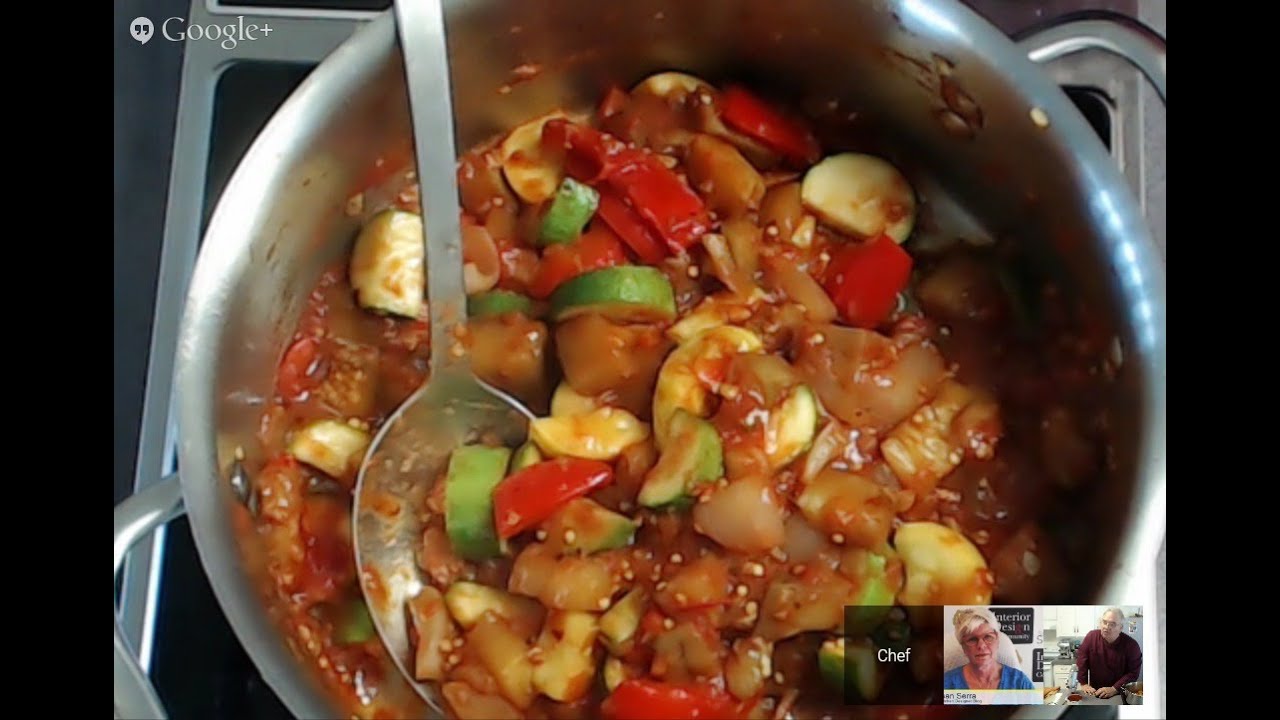
Chef Dennis Littley and Susan Sarah make ratatouille two ways: a classic version with just onions, peppers, garlic, and tomatoes, and Dennis's roasted Mediterranean style with eggplant, zucchini, squash, fennel, and herbs. It keeps for a week and tastes better the next day.
Chapters
Hey everyone, I'm Chef Dennis Littley, and I've got my little French hat on today, my toque, courtesy of Mickey Mouse and the Epcot Food and Wine Festival, because today we are making classic ratatouille. And not them, not the movie version, but the kind that they actually make a Julia Child representation of the dish is what I'm using. And I'm also making a roasted version, which is my preferred one now.. It's more of a Mediterranean style, but we will get to that. I want to say hello to my co-host Susan Sarah. How you doing?
Hi there. I'm doing great, but I certainly can't compete with that. I mean, you know, it's just you. It's you. Was that the extra large size you bought?
Yeah, that was, I think. That was the rat size, not the mouse size.
Yeah, you know what we should have had? I mean, speaking of Ratatouille, I don't know if you have them down there, but Have you ever seen those gigantic, tremendous blow-up rats? See, on union jobs, the non-union jobs. Yeah, that's what we needed right behind you, one of those gigantic rats.
I'm telling you, well, I think down in Florida we'd probably have an armadillo instead because, you know, we don't see that many rats. I think the alligators eat them all.
So yeah, yeah, I bet. I believe it. So what'd you do this weekend?
What did I do? This weekend I kind of stayed in. It was a quiet one, which is nice for a change because, you know, on the weekends here things get crazy. What I did go to though Thursday night was I went to— oh my God, and I can't think— Pachu Cachu. And Pachu Cachu is—
Bless you. God bless you.
I know. It's P-E-C-H-U K-A-C-H-U, I think it is, but it's Pachuca Chu, and it's a presentation. And once you see it, you will never think of slide presentations in the same way again. You know the ones where they usually do them and they read off the slides like you're not bright enough to read for yourself, and then sometimes they give you a booklet that says exactly the same thing. Regular, what do they call them on Microsoft, the PowerPoint.
PowerPoint.
PowerPoint. You know, it's like PowerPoint has become the most mundane, just boring, painful thing to see. So this guy came up with it, it was in, and actually it was Best Hours conference that I got to see it at, and I fell in love right away. And what they do is you get 20 slides to tell your story and each slide stays on the screen for 20 seconds. It's timed. So you can't stop it, you can't slow it, you can't go back.
Oh, discipline!
You just continue. So you're telling a story and the story just flows and you'll laugh, you'll cry, you know, there's a full range of emotions with the stories that they're telling. It was really, really fun and all the presenters, it was their first time None of them were professional speakers and they all did a really amazing job telling their stories, you know, telling what they were talking about. It was fun, it was a nice—
It's called Pachu Kachu?
Pachu Kachu, yeah. And they have them all over the world. There's over 700 sites worldwide. We had 300 people at this one. It was sold out way ahead of time. They do one in Tel Aviv that they sell out at 4,000. They have two shows of 2,000 each. They do it in an airplane hangar. So, you know, some of them go from having maybe 8 or 10 people to the most, you know, that one. But they have them all over the world, all over the country. You just have to look for them. And usually the people hold anywhere from 2 to 4 of them a year.
And you make your own slides.
Yes.
Obviously. And each one is 20 seconds and it's sort of, I guess, a global sort of vision of who you are, who your brand is, and that kind of an introduction?
It's just whatever. Like, the first guy did one on inspiration, and he talked about inspiration and what inspired him and what inspiration does. One woman came up and told how she had been in second grade, she had decided she was going to be an artist, and the nun in charge of her school promptly told her no. That is not where your gift is. And she asked her where her gift was. She says, I don't know, you're gonna have to find that out. And she went home and asked her mother, and her mother said, no, we're not artists, our people are not artists. So for 35 years she believed that, and all of a sudden she stumbled across this class that taught art just for— I forget how she put it now, but it was not— there was no model, there was no still life, you just painted what you felt.
Wow.
It was a little surreal. Most of her art was surreal, but it was nice, it was good. So she told her story in that, in her journey, and how, you know, never to give up on something if you want to do it. So they were all personal. Yeah, inspirational. Yeah.
Remember when they had those— I don't know if they still do— Twitter sort of meetings that would be all day, and everyone would have, I think, like 4 or 5 minutes I've done a couple of those in the Long Island area. I forget who ran them nationwide or even worldwide, but same kind of thing. You have a certain— the clock is ticking and, you know, you have time to tell your story. So I think that's really great.
Yeah, it was fun. We really enjoyed it. We didn't know what to expect. Lisa was afraid that they were going to call her up or have her do something because they made you wear a name badge when you came in.
So did you speak?
No, no, that was prearranged. No, there was— there were 8 presenters. No, they're set for the night. I mean, these people must practice to get the timing down and everything.
Yeah, that's how it was. That's how it is in the Twitter thing too. I don't know why it's connected with Twitter. Somehow it's connected with Twitter. I don't know. So good, that's great.
That was the fun part. And then Elisa just got a call today and she starts work tomorrow. Woohoo!
Wow, okay.
So we'll see, see how she likes it. But she's, you know, she's needed to do that to get herself back into the system. She's too young to be not doing something, you know, a little bit more.
So, uh, yeah, that's good. She'll have a good time. We had a fall fair up by us, and we have, uh, uh, you know, it's a nice fall fair at the nurse— local nursery, and there's a lot of crafts and things like that, and things for the kids. And, you know, we have two grandchildren, and it was just so relaxing. It was a lot of food, food and crafts and plants. And I mean, what else, you know, shopping, you have it all. So we did that for a while. And just, you know, we've been having great weather. So except for overnight. So I'm feeling good.
Well, the overnights are our best part because it's been going down in the 60s for us. So That's really nice sleeping weather. The days are still in the low 80s, but the nights have been getting nice and cool. It's just really fun to be outside. I was actually thinking of getting a little fire pit for outside. Now I have this new tablet Lisa got me, so I can sit out there.
Oh, yeah.
The tablet is amazing. It's so thin. I got a Samsung Tab S, which has new processor in it, but I can't believe how thin it is.
Have you had a tablet before?
I did. I got one of the first ones when they came out. Out. This is about a third of the weight and a third of the thickness of it. It's smaller than your iPad. I mean, it's amazing.
Cool. That sounds good. Well, I'm excited about today's show because I begged you to do Ratatouille. You know what? We're kind of at the end of the harvest season, but in some parts of the country, of course, we still have a lot of harvest foods and veggies and things like that and specialty onions and whatever. Locally grown, so I think this should be fantastic.
Yeah, it is a nice dish. I haven't made it classically since I learned how to make it roasted, and I did do some, a little bit of research on it to see about how many different ways are made, because I had someone, as soon as I put this up, doesn't someone call me out on it's not ratatouille? I'm like, Did you read the whole thing? I said, it's my roasted version of Ratatouille. But someone from France pointed out, and they were a Ratatouille master, of course.
Of course.
And I'm like, yeah, okay.
You can't win for losing. So where do you start? Where do you break this down?
With a traditional Ratatouille, you start with onions, peppers, and garlic. Now, I did see a variety of recipes recipes and some by some noted Italian experts, and they put a variety of seasonings in it, from bay leaf to thyme to basil to parsley. But when I looked back, and I looked a little further back, because I never remember using all that when I made my ratatouille, and like I said, it's been, oh, 20 years maybe since I've really made this type. I don't remember putting any of that in, so I look back and there really wasn't. It's garlic, salt, and pepper. Wow. The only difference that we're going to have today that a classical really would have is that they would use fresh tomatoes in it, and it really wouldn't be as liquidy as I used to make it, but since this was the version I made, I thought, you know, I would not reinvent it. I would just make my restaurant-style version, you know, that I learned originally. I've been making it for a lot of years. But, you know, like with any dish you start, you want to always start with what's going to take the longest to cook. But in this case, although I think the eggplant will, it just seems natural, more natural to cook, start with the onions and peppers. So that's what I'm doing. Mm-hmm.
Now, you know, what about squash? Are you using squash?
Yes.
Okay.
Yeah, it's actually a very simple dish, and it calls for green zucchini, but I do have a mix. I have some yellow and I have some green, and eggplant, and that's basically it. Now, again, I did see recipes that put a little bit of vinegar in it. I did see recipes, like I said, that had bay leaf. There were quite a few that included thyme and basil, and I think that comes from probably one of them doing it. And they were really like all the big sites like Allrecipes and Food Network and those type. And I think what it is, is somebody made it that way, then they basically copied it and they're all making it the same. And then I, like I said, I look back on Julia Child, I look back on Jacques Pépin to see how they made it because, you know, that when we're talking about a classic dish, more faith in what they did.
And what about You know, I mean, the red, the peppers, they take quite a while to become tender. They take much— don't you think they take quite a bit longer than the onions and garlic and the other? So will they continue to get tender or will they stay tender?
And this is actually, this is actually going to cook down a little bit longer. This is more sauce-type ratatouille than just a vegetable ratatouille where it may not be as moist, it may not be as saucy. That again comes from using fresh whole tomatoes. You might use grape tomatoes in it, or you might cut up, if you have some fresh tomatoes, just cut them up in there to make the sauce. They would be pretty much the last thing that you would put in if you were using fresh tomatoes because you would want to keep the integrity of them and not let them get too soft and mushy.
So did I see you put salt in at this point?
Yeah, I'm doing it right now. It's funny you should say that. I just reached for it and I was going to tell you first that I was going to put some salt and pepper in it.
I was wondering at what point and when you test for the seasonings and maybe you do that again later. I'm not sure.
Yeah, you always test for it, but I mean you can get a pretty good idea of what to put in. I mean, for me, I always kind of COVID a nice layer on the top of whatever pot I'm using for whatever type of spice I'm using, and that's worked well. So I just put a little coating, whether it's a small even coating or, or, you know, a little heavier depending upon what it is. But this should be pretty close, and if it's not, you know, you can always add more salt to it. It's very difficult to take it out.
Yeah, and it takes time for the eggplant to get nice and mushy. Do you want to take a look at this slideshow I have, or should we wait?
No, let's do it now. This is going to have to cook for a few minutes, so let's go right to your slideshow.
All right, so I was inspired by Ratatouille, and I went— as some of you viewers may remember, I went to Paris in the summer, and I stayed in an apartment, wonderful apartment by the Seine.. And it was just so— it was furnished just so authentically. It wasn't modern, it wasn't, you know, just made for renting. In fact, it was a real home. It was the woman's mother-in-law's home. So I put together this slideshow and I want to show it to you. So here we go with the screen share. And again, I want to preface, don't expect fabulous in the tradition— traditional way, but to me it's a very emotional— it's about kitchen, it's about food, it's about preparation, and here we go. Here we go. Okay. So right now, okay, here's the beginning and let's get right to it. So this is a shot I mean, it's not what you expect. It's a little bit jumbled. It's a little bit crazy. And there are architectural details here that to me, and I have some close-ups, look like, you know, Provençal tile. We have the dark woods. We have white textured walls. I mean, look, and then we have the luxury of herringbone floors and inlaid flooring. It's just that Parisian look, which is so inviting. Here's another little bit of a wide shot where we have the sofa right nearby, and so you can see sort of the context of the kitchen. You know, beautiful dining room table, black chairs, you know, tablecloth, and it's just lovely. You know what, it's really funny, I'm not sure I even ever opened that door. It looks like one, I see hinges on it, so it's a door to something, but I'm not even sure what it is. So this is a little bit of a side view. View. There's a little kind of tea table at the end of the countertop. Some of the pictures are better than others. I was, you know, kind of going quickly. It was moments before we were leaving and the luggage was elsewhere. But now, this is the main part of the kitchen. Chef, look at this. It's so simple. It's furniture. It's shelving and with you know, pantry items, dishes, old. It just looks like to me, it's not perfectly arranged like we may see in the Crate and Barrel and Pottery Barn catalogs, but it's just what the people use. It's just how they use it, and to me there's a beauty in there. And here's another shot. This is a Good context of what the one wall of the kitchen looks like, and there's another opposite wall. I think it's absolutely stunning. The countertop is red, it's a lava, it's a lava stone which is made in France, very popular. Then we have the white walls and we have— look how functional that— it's a piece of furniture, that shelving is. And you know what? I mean, anyone can do it. It could certainly be a DIY project too, but It's just formal. It has a formality. It has a luxury. You can see the molding at the top of the ceiling. This is the granite that's in the countertop, which I think is very interesting too, kind of unusual. Now take a look at this again. Look at these tiles. They look, they look really old. You can see some chips, you know, for example over here, and then you see, you know, different types of glassware and Again, the white textured walls. Here's the flooring, which to me, it looks quite worn. Terracotta is— we see so much in French interiors. And another shot. Now look at this, look at where they have the utensils. I mean, it just looks so French, and the red and the beautiful china. Baker's rack. So we're seeing a little bit of a baker's rack at the end of the countertop, and just there's that black iron and that, you know, Parisian luxury. And a closer little shot of the, again, the shelving. I had never seen shelving like that. Just haven't seen it. It just blew my mind. It's charming. It has personality, it has character, it has age, and the simple useful things that are on these shelves just blow my mind. So, you know, different little pieces of pottery, and I mean, look at these dishes and the colors and the plate behind it. So I'm just kind of loving this. And here's a shot, this is looking up at the ceiling, this is ceiling molding, so we see again this tile, which to me looks really old, and the beautiful tile surrounding it, the white, very textured. This is another little context shot where we have the lamp and we have the ceiling, and you can kind of see what it looks like. Now look at this. What about this? Now this is a pantry. Again, you can see at the side, you can see the sort of baker's rack, and then off to the left is a usable pantry. So I looked inside the pantry, and I'll show you. I think I have some shots of what's inside, but I mean, it's stunning. I don't know where this door comes from. Is it from the South of France? I don't know the provenance of—
It's beautiful.
The woodwork is amazing. Isn't it stunning? It's simple, it's country-like, yet it's elegant.
It almost looks a little Basque.
You know, I was wondering if there was— if this was a Spanish influence, actually. I was wondering. I don't know. I don't know that if it's more southern country, southern France, or— but it certainly does look like it could be Spanish. And then just a little, you know, shot of, again, a clay pot. Here's a painting off to the side, and, you know, you don't have to arrange everything perfectly. Just get the things that you want to use, that you love, get your good stuff out, put it, put it pretty much anywhere, and it will raise the whole upscale level of the kitchen. Now, amazing little hardware there. Here's a peek inside the pantry. So we have some pasta there, we have up here, we have some, I guess that's peas. Yeah, that's peas. I'm not sure what this is, but you know, it's like a little shot. And here's another. I don't know if owls are French or what. I don't know if that's the kitchen owl. You know, you have the kitchen rooster. I don't know. I mean, look at these. You know, we have the grater here, the baker's rack, herbs de Provence. I mean, come on. It was just so charming. And it's so funny because it's not like the kitchens that I see in my inbox and when I go around to kitchen showrooms. This was— I just felt it just touched my heart. And beautiful woodworking, you know, really interesting wood. I don't know how old this kitchen is. It must be quite old. Look at the grain on that wood. Isn't that something? So, is it oak? I'm not sure. It looks like it could be oak, but maybe not. And again, of course, the Parisian glam with the red lava luxurious countertop. And then this is something right alongside of the kitchen. I don't know what it is. I— it's some kind of built-in cabinet. So these are hard to see it in context, but here you go. Here's a little bit of a wider shot. It's a very small kitchen, very, very small. And here we have a microwave. You know, but it's, to me, it's charming. Yeah, so this must be some kind, I think I forgot to look in here, must be some kind of built-in cabinet, must be an antique, but it's certainly one sort of style. And on the other side of the island, we have this fireplace, and look at these tiles against, you know, juxtaposed with the rug, the rug and the simple stools and the herringbone floor, I mean, You know, really, really lovely. And another shot, now here you can see we have in the back, we have these sort of furring strips, or, you know, for stability, and then the front we have the decorative pieces. So here's another, here's a pretty good shot of the context, and it's just kind of wherever they wanted to put it, put things, you know, they felt it. It seems. So here's another wider shot to the right where you have the table, elegant table. It's like that casual elegance that the French just do so perfectly. They do it perfectly, and you feel like you're in beautiful interiors, yet you're relaxed. And those Europeans, they do that so beautifully. And, and that's it. That's what I have to show you. So what do you think?
Oh, that's gorgeous. I just love that apartment.
That was pretty cool. That was pretty— oh, so okay, let me get back to stop my screen share. I'll come back. And how are you doing now?
I'm doing good. I just threw the zucchini in and the yellow squash a little while ago. And again, remember, you know, traditionally it would just be just green squash, but, you know, I like a little more color in it, and I had some yellow, so I added some yellow into it as well. So everything is kind of soft. I mean, it has to cook a little bit longer, but I'm going to add some crushed tomatoes in now.
Okay.
I'm not going to put a lot in. I want to see what it does. I don't want it to be overly saucy. I mean, you could add a little bit more, and I just wanted to have a little body to it. I think that's a good amount. That's not too much. You can still see the vegetables. And if you wanted, again, if you wanted to use fresh tomatoes, you could put some fresh tomatoes in and get pretty much the same results. The only other thing I'm going to put in is a little crushed red pepper just because I like a little heat. And I did see that in a few recipes, but it wasn't as prominent in all of them. But, you know, again, this is your dish. This is something that you like, so season it the way you want. If you want to use thyme, and I did see one that even had oregano in it, or marjoram. So depending upon what you want to put in, what you like, you're not bound by other people's thoughts on what a dish should be. You're creative with what you enjoy to eat.
You know, Chef, sometimes I've made that, and I've made ratatouille quite a bit, and I love it. I love it. How long would you say it would be good for in the refrigerator?
You know, it depends on how long you cook it. It'll be good for a while, but I think it's going to break down the longer it sits in there. But I would say, you know, this way, up to a week, depending upon how the vegetables hold up.
Yeah, that's what I was thinking. I was thinking close to a week. Yeah, yeah.
I mean, and depending again on how you like to eat vegetables, it could be ready now. Because they're soft but they're not mush. Or you could let it cook down for another 15 minutes to half an hour on a very low heat and let it simmer. And just get that— you'll get some richness to it, you'll get some body to it. It'll start to develop a little bit more characteristics. Now the longer you let it go, the more it's going to it's going to start to blend together. The flavors are going to start to get to be about the same. That's the only thing you want to think of is the longer you leave it in there, the more you're going to lose the individual flavors of the vegetables. That's it. This is it now. This was our cooked version of it. It's very good, makes a very nice side dish. I want to grab my other version, which should be pretty close.
Oh, look at that. Oh, you know what I didn't see in there, Chef? What about mushrooms?
Not in the, not in the classical one.
Oh, really? Okay.
Doesn't mean you can't put them in if you like them, but in the classical version, They don't have mushrooms. It's very simple. It's eggplant, zucchini, and tomatoes.
Okay.
And onions and peppers. I mean, that was it. Yeah. But this is a roasted version, and in the roasted version I have celery. I have— and you can leave the skin on the cooked version of eggplant if you like to. I did take it off that but I left the skin on this. And I have some fennel in here. I have red peppers, as you can see. I have onions. I have yellow squash, green squash, mushrooms, grape tomatoes. And then I seasoned it with some fresh thyme, some fresh rosemary, and there's little pieces of garlic— a lot of garlic, because I like garlic.
Oh, you mean— oh, so partial Partial cloves? Oh, whole cloves.
Yeah, you know, like—
I love roasted garlic.
Yeah, so I mean, they get so nice and sweet. Lisa hates it when I say a vegetable is sweet, drives her crazy, but they get sweet and they're just lovely when they're roasted. So you have a nice roasted blend. I'll toss it a little. I'll let it get all the sauce, all the juices mixed into it, and the vegetables all retain their individual flavor this way.
And you know what? And the texture is certainly one of individual pieces. What about the flavor one to another?
They all retain their own flavors. I mean, and so it really is quite a wonderful sense of taste when you start eating it. And I mean, I've even been known to throw some carrots in there because I love carrots. Lisa doesn't, but I've been known to throw some carrots in there. For some more color too. One thing you want to think about when you make a dish that's going to present— now this is good room temperature.
Oh, I love it room temperature.
Yes. You don't have to serve it piping hot. You could cook this, keep it on top of the stove or near the stove, just let it sit and stay room temperature. This is one of my favorite vegetables to serve when I was doing parties because it had so much flavor. I mean, you could even put little potatoes in here if you wanted to, depending on how complex you wanted it to get.
Do they get— do the vegetables get charred?
No, not really. They're not charred. Now, this version, and when I first saw it, I thought, oh, this is crazy to cook this this long, but it cooks for 45 minutes covered with foil. Then you take the foil off and you cook it for about another half an hour just to let Dennis Littley color. Now, if you wanted to, you could pop it under the broiler to get a little more color to it if that's what you wanted. But I don't think it's really necessary. The only thing I would do is I would take out like there's some fennel leaves or some of these spice leaves pieces from here before I plate it just because you're not going to eat those. I did use some of the fennel leaves just to spread because I love that fresh fennel flavor.
What about parsley? Would you put a bunch of parsley in there just to freshen the flavor a little bit?
I would top it with some fresh parsley. Fresh chopped. At this point, yeah, I would just— and it's not so much that it's going to add any flavor because parsley really doesn't have much flavor, even Italian parsley, but it's going to brighten it up a little bit. It's going to add a little vibrance to it.
Right, that's what I was wondering.
And it's not something I would add in until it was going to the table because if you put it on, it'll get wet, it'll start to get dark, it'll start to lose its vibrance. So anytime you use a fresh parsley It doesn't go on until you serve it, with the lone exception of anything that has melted cheese. Like if you're doing a chicken parm or lasagna, put the parsley on when you put the cheese on and it goes in the oven, because then it melts in the cheese and it looks really pretty.
Oh, cool! Right, good tip.
Things that come to mind, you know.
Good tip.
Now here's another tip. You know, I've been buying organic since I came back from ShiftCon. I have been shifting a lot of my thought towards organics. I'm actually trying a gluten-free diet, which is— it's going to be interesting to see how it goes. I started that Saturday. But these rest of the tomatoes, I didn't buy a small can. This is pretty much the smallest can I ever buy. I'm going to freeze these. I'm going to put these in a Ziploc bag, and I'm going to throw them in the freezer. So I don't know when I'll use tomatoes rather than waste them or put them in the refrigerator and then throw them out in 5 days.
So, oh, good idea. That's a great idea. Now, I mean, when I make ratatouille, sometimes I put it on pasta. Oh yeah, it is so satisfying. It feels sort of substantial, especially, you know, when you put a good amount on that, you don't miss the protein, I find.
Now there's a lot, you know, mushrooms do make up for that. When you're eating, mushrooms are such a great substitute for protein because they give you that satisfying chew, the flavor. They really add, I mean, even if you're using, use them to cut down on protein when you're cooking, it's a nice way to do it. So yeah, this over pasta, or maybe, I mean, you could do it over linguine, you could mix it with a shape, would probably be better, like a penne or, or something along that line. Side dish for any grilled meat, chicken, fish, or over top of it even. If you had a nice little piece of flounder and you topped it with these vegetables, provincial vegetables. This I call a provincial ratatouille, which— and I may be wrong for calling it that, but that's what I've been calling it. It's a Mediterranean-style. This I had in in the outskirts of Nice, and that's where I first had it.
So would you say it was similar? Is that a replication of the ratatouille you had there?
Yes, yeah, pretty close. It had, it had pretty much everything in it. That's how it was seasoned. I don't think there was yellow squash. It was probably all green squash, and there was some fennel in it. So that's where I got the idea, because up to that point I had never really cared for fennel or tried fennel.
I don't try— I bet a lot of people don't try. I don't know what to do with fennel, so I never—
If you don't do anything with it but roast it, you'll be a happy camper. That's the only way I cook it. I mean, if I get a head of fennel, and I'll just roast it by itself if nothing else. It is so tasty roasted. It gets this— and I don't like licorice at all. I don't like sweet—
Oh, I love it. I'm crazy about it.
I don't like anything like that. For me to like fennel, I mean, that's why I stayed away from it because it was always that thought of it was licorice. It's just wonderful roasted. It really is.
This looks great. It looks colorful, beautiful texture, and you know what? It's so inexpensive to make too. It's inexpensive, yeah.
You know, again, if you start buying organic veggies, some of them, you know, it'll get more costly. Actually, I found too BJ's has started carrying a lot of organics at a really good savings, so I've been buying stuff there.
Cool.
But yeah, you know, really isn't that— and this is, I mean, this is for 2 people, so we're going to eat this for a couple days. Although Lisa will attack this with a fervor because she— this is her favorite way to eat vegetables. Wow. Anytime you roast them, they really add so much flavor. You're caramelizing them a little bit. You're bringing the natural sugars out depending on how you season them. This was just seasoned with salt, pepper, extra virgin olive oil, and then I used, like I said, the rosemary and the thyme on it.
Do you think it's better the next day?
It is. It loses a little bit as it softens., but the flavors are more pronounced. You know what this would— like, I would like to see this the next day. Then I would probably make a pasta salad with it if I was going to do that, and I would let it sit overnight. Or believe it or not, I'd make a sandwich out of this. I would make like a veggie hoagie, top it with provolone, and just love it.
I mean, I could see it with a French bistro kind of chicken too, a roasted chicken.
Pretty much anything. Like I said, if you want to kill it and make just one side vegetable, throw some little baby potatoes in there when you roast it. Again, it's not ratatouille, it's a tian, it's whatever you want to call it. It's delicious, that's all.
It is. Well, thank you so much because I really wanted to see your take on it. I think I'm putting too many extra things in it. I think I think less is more, like a lot of things.
Yeah, you know, try it with less and then you can always make it different the next time. And again, it's what you have on hand. If you're missing something, don't go crazy. This has got celery in it too, but if you're missing something, just leave it out unless— I don't think there's an essential ingredient. I mean, it could have— not have the eggplant if you don't have any. It's just still roasted vegetables are just such a nice way to eat and a nice healthy way to eat.
Yeah. Yep. I mean, you know, sometimes I feel like all I need is our roasted onions. I love onions.
Oh, yeah.
So it looks great. Beautiful dish. Beautiful. Nice to see it done two ways. Great to see it done two ways.
Absolutely. And remember, those are— these are my takes on the recipe there. So don't get your your underwear in a bunch. It's not as classical as you may think. And just enjoy and eat well, be happy, eat what you like, and enjoy life. And we hope to see you again around the kitchen table soon.
Good. Okay, take care everyone. Bye-bye.









