Buffalo Chicken Tacos with Blue Cheese Slaw
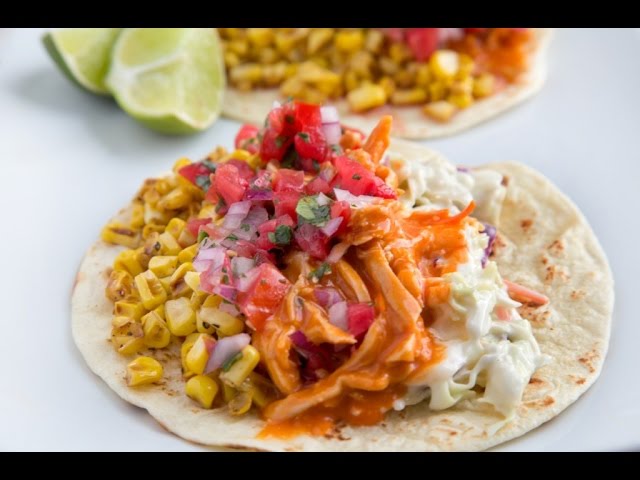
In this episode of Around the Kitchen Table, Chef Dennis Littley and co‑host Susan Sarah walk viewers through a complete, flexible buffalo chicken taco meal. They start with casual banter about weekends and car shopping before introducing the dish: soft flour tortillas filled with buffalo‑style chicken, a homemade blue‑cheese coleslaw, roasted corn, and a fresh salsa. Dennis demonstrates the buffalo sauce, emphasizing a 1:3 butter‑to‑hot‑sauce ratio, the addition of honey for balance, and the importance of low‑heat cooking to avoid a greasy mess. He explains how to simmer and shred chicken thighs for tender meat, and how to make a quick salsa from tomatoes, onion, cilantro, lime, and salt. The pair discuss knife selection, sharpening (favoring a $100 Chef’s Choice sharpener over expensive knives), proper cutting technique (keeping the tip down), and tortilla heating on a griddle. Throughout, they incorporate viewer comments (e.g., blue‑cheese brands, Carolina Reaper suggestion) and share broader entertaining advice: setting up buffet‑style taco bars, flexible table arrangements, using blackboards for labeling, and inexpensive warming equipment. The episode blends cooking instruction, kitchen tool tips, and casual design ideas, ending with a reminder that the coleslaw needs a short rest while the tacos are assembled.
Chapters
Hey everyone, I'm Chef Dennis Littley and welcome to Around the Kitchen Table with my co-host Susan Sarah. And, uh, how you doing, Susan?
I'm great, I'm doing good. It's Monday, I'm energized for the week and from the weekend. And how about you? Did you have a good weekend?
I did have a good weekend and I actually went somewhere to watch the World Cup yesterday and They said it was an exciting game, but honestly, I've seen paint dry that was a little more exciting.
Oh, come on. No, I watched it too, and I don't know how they run without stopping. That part I just don't get.
I'll give you that. They are incredibly athletic. They have stamina, and they are amazing athletes. But oh my goodness, were both defenses so good that the offense—
Yes, well, that's true. They were so evenly matched. It was really incredible. Yeah, it was, it was, you know, so the ball was going back and forth and back and forth, and that part was cool. But before then, I spent the weekend, which I didn't tell you about, I spent the weekend in the city. Oh yeah, I spent 3 nights in New York, 3 nights in the city. And so I did a lot of good eating, a lot of good eating. I had Italian twice. I had Daniel Balut. But no, not the big, not the big fancy one. There's another kind of café bistro type on the Upper West Side, which is where we hung out. We hung out on the whole Upper West Side and walked around Central Park and just kind of chilled, you know, in that area. And so that was really, really great. Oh my gosh, I had linguine. In fact, I had pasta, I think, 3 nights in a row. And I had this linguine that was fused with saffron and lemon, and then I think it was served with some squid. So it was very yellow. It was, you know, I mean, it was all about the food. I wish I could have gotten into Carmine's, but I would never have gotten a reservation.
Hard to get on a busy day, especially during the summer in New York. So yeah, we know we didn't do a whole lot other than that. I mentioned I'm starting my car shopping, so That's still a process and finding it to be a little bit different in Florida, not quite as pressure. So that's a good thing.
Yeah, yeah. I mean, there's so, so many options and you just have to see how many bags of groceries. I mean, that's what you— that's what you check, right? How many bags of groceries will fit? And I would assume you need a hatchback. Don't you need a hatchback?
I like SUVs. I've had them for a while now and I feel a lot more comfortable in that with a hatch.
So yeah, I do too. That is absolutely my criteria. We'll be looking, looking pretty soon also. And it's just so much easier. And, you know, and now with these electric cars, I've been thinking, going, trying to find out more about that, the electric cars. And I don't know if they're perfected yet, but, you know, things are changing.
Absolutely. I don't know if we'll see a perfected one while we're still driving, but, you know, they are getting closer.
I know, I know. So, so we have a good menu today. Tell us what's on the menu.
Well, today we have kind of a hybrid, and it's a taco with a soft tortilla, flour tortilla, and I'm doing buffalo chicken, and I have a blue cheese coleslaw with it, and I roasted some corn. And you know, there's a lot of other things you can serve it. I'm also going to show you how to make a fresh salsa, which is incredibly simple, but you know, I don't know how many people really know how to throw that together, how easy it is to throw together. So one of these things about, about this kind of a dish is I wrote that it's a great serve-yourself meal. It's a fun family night. I mean, you can get some crunchy taco shells. You don't have to make all the chicken buffalo. You could season some of it with a little taco seasoning if you wanted to. You could give some options. You could do some ground beef. You could give different meat options, or you could do a vegetarian option.
Oh yeah, I mean, doesn't everyone have taco night? I know we have taco night at our house, and you know, it's anything goes. It's really anything goes and there's so much versatility. I mean, blue cheese, you are talking my language with blue cheese. There's only one kind of blue cheese that I like and that is the Danish blue cheese.
Oh, absolutely.
Oh my gosh.
I wonder why. That's kind of from your home area, isn't it?
I know, it really is. But do you know that brand, that particular blue cheese?
I do not because I rarely buy— I like— I'm trying to think of the brand name. It is made in the United States, and it's a buttermilk blue cheese.
Oh, okay.
And you know, it's not quite as heavy. I like a nice bite in the blue cheese, but I don't like it always— you know, I love— what's the other real strong one? Oh my God, my mind just went blank. Roquefort. I love Roquefort.
Yes.
But when I'm doing a dressing, I like to just keep it a little bit milder. So I like the Buttermilk Blue, and I don't recall the name of the Danish Blue, but I know which one.
Oh, no, it is called Danish Blue. You go to the cheesemonger, it is called Danish Blue. I'm gonna send you a block.
Okay.
I'm gonna send you a block. There's also the Point Reyes. I don't know if you've ever heard of that. Point Reyes, California makes a pretty well-known blue cheese and You know, they make it right there, but it's sold around the country. So I love blue cheese.
Yeah, I love it on burgers, on pizza, on just about anything. Salads, especially on salads. And then we eat a lot of gorgonzola too. You know, I like the Mountain Piccante. That's just a wonderful cheese.
Love it.
Love it. But today we're going to do a little change on it, and we're going to do some buffalo chicken. I'm going to show you how to make the sauce that, you know, has been my standard sauce for so many years, and I buffalo just about anything with it that'll stand still long enough, and it's really good. Now, I had a comment here, I do want to pull it up. Where is it? Christopher— where the heck is it? Well, he said he's from Buffalo, and in Buffalo they just call buffalo wings wings. I can't find it, but I saw that, Christopher. Alright, alright. So again, he's saying about Buffalo as blasphemy with there are few, if any, vegetarians in Buffalo. Blasphemy.
Oh, I wouldn't be surprised at that. And you know what reminds me of the buffalo wings, or the wings, I guess they were just wings, they weren't really— yeah, they were a little buffalo. We had a Carmine's Oh yeah, they were the scarparello, he called them.
They were his Italian version, which is really nice.
Wow, you remember that? I would never have remembered that.
No, but you know, it's just nice to do it. I don't like them terribly hot anymore, you know. I never really— yeah, where I like to keep the sensation in my mouth still sometimes. I don't like to lose it. So, you know, this is, this is, uh, not as hot of a sauce as you might like, but you can always add more heat to it. So I'm going to grab some stuff and get started.
Cool.
And I have some melted butter, and I'm going to tell you why I use what I use. We're going to start with— now, I don't make this sauce temperature-wise, as in, uh, heat on the stove, terribly hot, and there's a reason for that. And that's because a lot of times You see sauces and they are greasy messes. Let me switch the cameras so you can really see what I'm doing here. Here we go.
Yep.
Because they're a greasy mess. So I have the butter in here, and I have 1 part of melted butter, and now I'm going to add in my hot sauce. And you can, of course, use your favorite hot sauce.
That's the hot sauce?
Yes.
It mustn't be— it must be— wow, that's a lot of hot sauce.
Well, it's about 3 parts hot sauce, 1 part butter.
Okay.
And one interesting thing about this, because I'm not keeping it— now the butter melted way too long, I had that on for a while, so it's got a few little clumps in it. And then I'm going to add a little bit of honey to it, and I add about half a part of honey.
Honey, nice.
1 part butter, 3 parts hot sauce.
So you have sticky and greasy going on. Oh, sticky, greasy, and hot. You have it all.
Absolutely. Okay, that's right there. What I use is, because you want to have a little heat, the honey kind of tempers it a little bit, adds a little bit of sweetness to it. I don't know if you can really notice or not, but this sauce is really kind of thick. It will cling really, really well to the chicken, especially the wings, and it gives it a really pretty appearance.
I wonder if the stickiness of the honey helps that.
No, it's the fact that you're not getting it too hot. Because as you heat the sauce up, the butter will start to break in the sauce, and it gets that oily mess that you always have in the bottom of a basket when the sauce starts to melt, and you're left with just a pretty much a mess. It's not a, not a happy thing. So anyway, that's my sauce. Very simple to make. And I started to tell you I use Frank's wing sauce. I don't like it straight because I just don't like the flavor of it. So I use that because it's not just hot, it's got a little bit of flavor to it as well. So it has some taste to it. I add my butter to it and then honey to it, which is probably blasphemy in Buffalo to do something like that. But I've used Frank's regular hot and it's just sometimes too hot, doesn't quite have the flavor.. So I found that their wing sauce adapted really does a nice job. My old favorite used to be Louisiana hot sauce, and I had such a hard time finding that that I switched over to this because it's easily available.
Do you know, when you go to New Orleans, which I'm sure you know, I mean, there have to be 1,000 different types of hot sauce.
Oh my God.
Just so, so, so many. You know, it's like looking for tile or wallpaper. For me, there's just so many. I mean, it's good to have a brand name to go to. Do you know where that's out of? Do you know where that's made from?
Frank's? Actually, no, I do not. Let's see. No, just says made in USA.
All right, that's good enough.
Well, Frank's RedHot was the secret ingredient used in the original Original Buffalo Wings created in Buffalo in 1964.
All right, I like the word original.
All right, so anyway, that's, you know, that's what I use and I adapt it. But you know, any hot sauce that you enjoy, that you like, you know, play with the recipe. And but just try it next time, try it, you know, melt your butter, add the butter in. Don't get— you can throw this on the stove and you can get it warm, just don't let it start to boil. Don't let it get too hot because then what happens is it breaks, and then once it breaks you can whip it back together but it's just going to keep breaking and you end up with a mess. And this really clings to the chicken and it makes a really nice presentation and it's tasty. So moving on, and Christopher, I wanted to throw this up. His law firm is Sticky, Greasy, and Hot, so he liked that, that you said, you know, as opposed to his old one which was Dewey, Cheatham, and Howe. Well, let's move on. So what I'm going to do next is I'm going to get some chicken And I have some thighs here that I cooked because I like thighs. They have more flavor, there's more fat in them, they have more taste. But actually, a lot of times I'll buy a roasted chicken and whatever we don't eat off the roasted chicken, I use for other things. And a lot of times it'll be buffalo— buffalo grilled cheese. And then what you do is you just take a fork and just kind of pull the meat off of it a little bit with a fork. It's kind of a shredding. It works easier when it's hot. Once it starts to set up and the muscle tightens, it doesn't pull quite as easily. So you always like to pull meat when it's a little warmer.
Hey, Chef, did you say— I don't know if I missed it— did you say how you might cook the thighs to make them easily shred? You know, for example, do you cook them to death like in a crock pot so then they easily fall apart?
You can. They'll tend to dry out a little bit if you do overcook them. I pretty much just simmer them. I get the pot up to boiling, turn it down, and let them simmer for about half an hour to 40 minutes and cook that way. Then when they come out, like I said, if you do— see, it's a little bit of a shred. It looks better. It just makes a— it will eat maybe a little better, but it's more about the looks than anything else. Okay, but I said even off of roasted chicken, leftover chicken, whatever you have, that'll work fine. So your chicken's ready. What I did with the coleslaw is I actually, I put a recipe for blue cheese, homemade blue cheese, up there that I like to make, and it's really good, it's really simple. And you know, once you make it, you probably won't want to buy any jarred sauce again. But for the coleslaw, you can use a jarred sauce, you know, make your life simple. I'm not trying to complicate it. You can buy a pre-shredded cabbage mix. This has some purple cabbage in it, this has some carrot in it, or you can pull out the food processor, you can cut it by hand. You just want the shreds to be a little on the thinner side when you do it for any coleslaw. So this is pretty much just blue cheese, a little salt and pepper, blue cheese dressing that I made, salt and pepper, and a little bit of vinegar just to add a little bit of tartness to it.. This can be, again, as strong as you want. If you want to add more blue cheese to it, you can. If you want a little less, or if you just want plain cabbage, plain shredded cabbage, that's really a kind of a nice base too. You get that crunchy taste to it.
So the vinegar doesn't cause the other solids to sort of break down?
No, no, because when I make regular coleslaw, I add vinegar to the mayonnaise. It's the same pretty much basic. Some people put a little vinegar in other kind of creamy dressings too. It's just a matter of not overdoing it just so it doesn't have too much of a vinegar flavor more than anything. It gives it that little bit of a tartness to it.
Do you put sugar? Do you put sugar in it?
I put sugar in coleslaw, but I don't put sugar in my blue cheese. I have actually the rest of the package. I made regular coleslaw out of it, which you can do too. You can have a couple variations if you like. Or like I said, just plain shredded cabbage is really nice. I remember up in New England getting a grinder, and they didn't have lettuce on it, they had shredded cabbage on it, which was really interesting. And you think it's going to be terrible until you start eating it. It's wonderful. So plain shredded cabbage would be good as well on these. Okay, so we have that. I roasted some corn up, and this is a nice item to have on a bar too. And you can also mix this with some black beans, some cilantro, a little red onion, and make a salsa out of it if you wanted to. And that's a good item for it. And then what I'm going to make is I'm going to make a little fresh salsa for you. So let me change the camera.
Cool. And we have something from Coach G. Moore, and he says tacos are basic Texas. I think they're just about every state, any type. I think they're for everyone, and the New England fish tacos, oh, terrific.
Oh yeah, for sure.
Yeah, love fish tacos. We should do that one time.
Oh yeah, well, you know, you could add this onto this too. You know, it's just a matter— we have different toppings with fish tacos, but yeah, we can do them shrimp tacos. So I'm just gonna cut up some, a little bit of onion. I don't want to do too much onion because I'm not making a lot. So we're just going to chop up a little bit of onion here. Change camera so you can—
Oh, that's a sharp knife, I could tell.
Oh yeah, I have a— these are not expensive knives, but they're sharp. So I buy a good knife sharpener and not real expensive knives, and I keep them sharp all the time on the sharpener.
So, okay, do you use one of those like long, like stick type of pole type of sharpeners?
Steel doesn't really sharpen. The steel removes all the burrs and imperfections from the knife. Never really sharpens the blade. But I have a Chef's Choice knife sharpener, and I pretty much have had one everywhere I went. Now, I don't like buying $300 and $400 knives. I'd rather buy a $100 sharpener and just keep changing the knives as I—
I've heard of that sharpener. That's been around for a long time. Yep.
Does a really nice job.
I mean, you know, that's a good knife if you're slicing through a tomato and it's not squishing. That's it. You, you have the right tools.
And this isn't— this was sharpened probably 2, 3 weeks ago, so it's not overly sharp. So it's just a matter of cutting up. And you notice, I don't know if any of you can tell, I keep the tip of the blade down when I cut. You don't want to pick up and drop. You want to keep the tip down and move your wrist, and that's what allows you to be able to cut a lot of things. If you're cutting—
can you show me? What do you mean pick up and drop?
Okay.
Oh, right, right, right. Pick up. Got it, got it.
People— you don't want to saw. You don't want to saw. You want to keep the tip down. And a lot of times I'll teach— when I was teaching students, keep your hand on the tip. So you keep it there.
That looks good. That looks efficient. So would you say it's almost rocking a little bit?
Yeah. Okay, you're, you're going, yeah. So there's the beginning of our salsa right here. We have onion, we have tomato, lime, cilantro.
I learned 10 things already. I learned that the steel that I've been using for 30 years, I have to get rid of. No, no. Good job.
No, if you sharpen a knife and you keep it sharp and you don't abuse it, the steel will help the blade do what it's supposed to do by removing all the burrs and imperfections because that's what makes it harder to cut. It's just like with a razor blade. You know, it's all the little things that build up on the blade that make— that give a dull shave. The blade itself is still fairly sharp. It's just all the imperfections that go along the way. So I have some herbs here, and if this was parsley, if it was basil, whatever, how I always tell people to chop it is you pull it into a bunch and start your chop, pull it back in the center, chop, and you keep doing that until it gets small enough Now, do you ever use those little, those little mini electric choppers? I depends on how much I'm doing. If I'm doing a small amount like this, no. If I'm making enough to feed the school, yes. Then I would use my food processor. To chop it up, but I don't use one of those little hand choppers.
Right, right.
Still kind of old school, and I do it by hand. Okay, so let's put everything in here.
Those look, those look like good tomatoes. They look like local ripe tomatoes. They don't look like the, you know, the other ones.
They're actually—
they're winter ones.
No, we found a really good Florida tomato. It's called a Tasti, T-A-S-T-I. I think that's a Tasti. Look at that. Yeah, Tastily. I'm sorry, Tastily. And They're really as close to Jerseys, because Jersey tomatoes were the best, but they're as close to Jerseys as I've seen. They were available a good amount of the year. So here I've got my tomato, my red onion, my cilantro. Gonna add a little salt, add in a squeeze of lemon. Or lime, I'm sorry.
Nice, nice.
Mix it up, and that is fresh salsa. And you can adjust it with, you know, if you like a little less onion, if you like a little heat to it, you could put a little jalapeño in it. That wouldn't normally go in, but you could add it yourself. There's fresh salsa.
Yeah, cool. That looks great. You have to have fresh salsa with tacos. I mean, it has to be fresh. It makes such a difference.
Yeah, that's not really that difficult. It's not like the typical that you think of from the jar. But actually had a friend that went to Mexico and they ordered, and he told me that he kept asking for more salsa. He says, "No, I want— do you have some good salsa?" And they made him some fresh, brought it back out again, and did this twice before he realized it wasn't like the jarred stuff that had all the liquid in it.
Right, I know.
So, alright, so we're gonna put our tacos together. See if we have any other—
Oh yeah, I know I have a bunch here. I have a bunch saved up. Let's see, we have. Kim Baltman. Can you see it on the screen?
Yes, I can.
Yeah, okay. Knife skills are my weakness. Too scared of cutting my piano-playing fingers off. Slow and steady wins the race, or jin tsu.
That's it.
Christopher Vogelman suggests. What do you think about that, Chef?
Jin tsu knife? I've never had one.
Jin tsu, not jin tsu. Okay, that's someone I know.
I've never felt the need to cut tin cans with my knife, so I don't have one.
Funny. And we have Aslan Bloor. Hi, Aslan. Would you like a Carolina Reaper for that sauce, Chef Dennis?
I'm not sure what a Carolina Reaper is, but I—
Oh, it could be a beverage. I wonder if it's a beverage.
Might be a hot sauce.
Yeah, maybe that's what it is.
But Aslan, if you're offering, I'll take it.
Oh yeah. And then Christopher Vogelman, our good buddy, says, love a sharp knife. Buy a $100 sharpener rather than $400 knives. And, you know, I mean, they just try to push these expensive knives, and they're so— they make them look so sexy, and they make them look so, you know, like you've got it like status symbols.
Well, you know, the most important thing to realize about a knife is the balance, and it's got to feel right in your hand. So that's what you have to think about when you're getting a knife. Sometimes the cheapest knife, you know, if there isn't the right choice, sometimes the most expensive knife isn't the right choice. This happens to be an instance institutional one. It's— and you know, I cracked up when I finally put two and two together. And I wonder if this is where the directors came from. But it's a Dexter brand. Oh, okay. And I'm wondering if Dexter from the TV show Dexter—
yeah. Oh, geez. Oh my gosh. Nice.
That's where they got his name from. But it's just— this is about a $30 knife. And it'll last for 5 years, you know, sharpened easy, or longer. I've had knives for longer than that. But you know, it's just, it's weighted good. It can go in the dishwasher if you really, really must. I always tell people to wash all their knives by hand, not to use too hot water on them, and just to, you know, do them by hand. But you know, in the restaurant, these would go through the dish machine all the time just for sanitation-wise. But then we always kept them sharp too. You have to sharpen it.
Yeah.
Put the edge back on it.
Yep. Okay.
So I'm gonna make my tacos now.
Okay.
And what I'm gonna do, and one thing I want to talk about is the flour tortillas, is a lot of times— let me change the camera again too so you can see— we get these tortillas, and let me get an unheated one, an uncooked one. And it's the same thing with wraps. A lot of times we order wraps And my mother— I'm Mexican— my mother said one time, she says, "They're raw." And they're basically— they are. See, this is the edge. One side had a little heat put onto it, but this is basically still kind of a little uncooked. Alright, so when you put it back on the fire and get a little more color to it, and this could still use a little bit more because you can see these like little wet spots on it.
Oh yeah, so what do you do, put them in like a nonstick pan or—
Well, put them on a griddle, uh-huh, and like a pancake griddle, and just put them on and heat them up and let them get— and sometimes they'll puff up, and that's— you can see them, you know, cooking even more as they puff up. And get some heat to them. Now, if you do a bunch of them together and you're having a party, you can wrap a little wet towel, moist towel around them. They make containers that you can buy at some kitchen stores that will store tortillas in them that will keep them a little bit warmer. Like a clay pot kind of a thing. But the important thing is to get some heat on them so that they're a little more cooked. So we have our tacos here, they're cooked a little bit, they're heated. And I'm going to start— and again, this is the beauty of it, you start it any way you like to start it— but I'm going to start with a little coleslaw because I want to see the chicken. Oh, and we have to sauce our chicken too, I didn't do that yet. So before I get too crazy with this—
oh, the anticipation! That looks so good.
Buffalo sauce. Add another fork here. All right, so then this is going to go in.
Boy, you, you measure those bowls exactly right. I either use too big or too small of a ball.
It's years and years of practice. Okay, so now we have— let's go back to this. Wow.
You know what that reminds me of? And which it has no connection at all. It reminds me of when you're You're piling on like a Reuben sandwich.
Uh-huh.
You have the pastrami, you have the French dressing, you have the coleslaw. That's totally unrelated, but that's what comes to mind. This is blending, this blending. That's the beautiful thing about a taco. It's the blending of everything, right? Sure.
I probably should have put the corn on top of this so you would see it a little better. Anyway, those are our tacos.
Wow.
Now, you can make them any way you like. Have some black beans here for people to use to add on. If I was going to do a bar, I'd have some vegetarian options as well. You can have— if you want to use shredded lettuce, you can have some shredded lettuce. That's the beauty of this. This. It's not a lot, a lot of work, not a lot of expense in the ingredients, and you know, you can set up a pretty cool little bar that you can have your friends over if they're watching the game, like the World Cup, it would have been great for that, you know, and have a little spice while they're eating, and something they can hold in their hand and put together really quickly, or if your kids, you know, it's great for kids to make something themselves.
Cool, it looks great. And you know what else I'm wondering, Chef? I'm wondering, would you consider using like a pocket kind of bread, a pita bread that has a pocket in it?
You can use, you know, whatever you like. A pita would be fine. Flatbread, if you want to get some flatbread and just do them on those. You know, it's a matter of make it your own, offer some different kinds of choices.
Hey, can we see it a little bit closer? Could you bring a little bit closer to the camera? Come on, let's see it. Oh yeah, that looks— I mean, it's visually beautiful. Look at those colors. That is beautiful. Nice. So one for you, one for Lisa?
She doesn't eat this kind of combination. She's not a big Mexican food fan. So two for me.
Two for you. All right, I'll be right over. Save one for me. I'll be there in 3 hours. No, not at all. So a few little things from me about entertaining in a casual way. And you know what? Exactly like Chef is flexible with food and anything goes and, you know, guidelines or different ways to do things, I like to be that way with kitchen design and entertaining. And you know what? One thing I like is, you know, especially with tacos, you can put all the toppings out, you know, for buffet style. So what you can do is, you know, chances are we have a table, obviously, in our breakfast area or dining room or whatever. You know what, sometimes if you're going to entertain buffet style, you may want to— and we don't think of it— but you may want to turn the table in another direction, maybe remove all the chairs and then set it in another way, and then there's access. You can make access maybe all around the table, but in a different configuration. Another thing I like to do is to have a table in another room, say a family room. Put design in or reconfigure your family room so that there's another table there, because it's nice to have an alternative other than— you know, we don't need in our formal dining rooms, if we have formal dining but oftentimes a family room will have the room to put a smaller table just so you can have an alternative place to dine. Or I had this in my other home, so I had a table in my family room. It was used either for a bar area, it was used for a dessert area, it was used for any number of, you know, situations, and it was moved sort of out and then in or in a corner, you know, and that's really flexible living and it can make things more conducive to, you know, entertaining. It can mix things up even for your own family. So, I think thinking flexibly is really very important. Of course, a kitchen island is perfect for, you know, for a buffet sort of setup and in that situation, you may want to remove the chairs, move them someplace else so that there's good access. And you can also— another thing I've done is, again, I really like flexibility, is I've had a plywood top cut in the form of a circle, or I've had one as a rectangle to put over another tabletop if I wanted it larger. Or if I want, I put two supports underneath, maybe for a rectangle to put it somewhere else in the home to create a buffet, you know what, think flexibly. And there's so many design solutions that you could come up with that are fresh. So that's a couple of tips.
I love buffets, and you know, people don't think— and you can buy some really inexpensive buffet equipment out. You know, I see those 3 Crock-Pot style heaters everywhere, and they're like $40, $50 tops. So you could serve, you know, your hot foods in that Or pull out your crock pot and use that to serve something hot in as well. So I mean, there really are some great options for buffets, and people just love serving themselves. You know, it's that Tom Sawyer mentality of making it themselves, you know, and you're doing less work.
So it really is. And one other thing, I, you know, get little blackboards, little small blackboards, and write what the dish is and go out in the backyard and get greens, like big size oversized greens, and put them in vases so it's dramatic. You have a little drama, you know, so there's a lot of— the decoration is just in your backyard. You'd be surprised.
I love the idea of the blackboards. That's really a good idea. And everyone's telling us what a Carolina Reaper is now. There's a reason I don't know what they are, because it's the world's hottest chili, 2.2 Scoville units. And if Chef Dennis Littley ate a Carolina Reaper, the Grim Reaper would be coming for him because I would probably die from the heat.
You know, the word Reaper, I knew it was something like that.
Absolutely. And here, Ray Lay is offering a suggestion of pickled red onions with a little habanero would elevate it. You want to add a little bit of heat. That's a great, great idea. And Mia Voss is saying, she's saying hi to Kim Boltman. And saying hi to us. Got her learn on today, which is always a good thing if we can teach.
That's right. That's right. So if you know, everyone, everyone look at your, your space in a fresh way and see what you— how you can move, shake things up, shake things up.
I know that's what I love about this kitchen is I have room to set a buffet out and still have a working area. So you know, that's, that's the beauty. And you really don't know until you done it and set food out like that, how much fun it is. You know, it really makes food a little more fun when you can do it that way.
Yeah, it sure does. So great, great show, great meal that you put together, great dish. I'm hungry.
I am too.
It's not fair.
They're calling to me right now. I can smell them.
Oh yeah.
I'll make something for Lisa for dinner, but I think I will have the tacos. It will be good. Thanks everyone for coming today. We are glad you could stop by and join us as we showed you how to make a little quick— again, you saw how fast it was. It's a matter of— I guess the coleslaw is the longest thing it takes. You really have to let that sit for a while so it softens up. If you just want plain, nice crunchy cabbage, couple minutes, you got dinner on the table. That's all it takes. Thanks for stopping. Susan, great seeing you again as usual.
Same here.
We'll hope to see you all next Monday when we're around the kitchen table.
Yeah, see you next week.
Bye-bye.









