Good Day Google+ - Eat Drink and be Merry
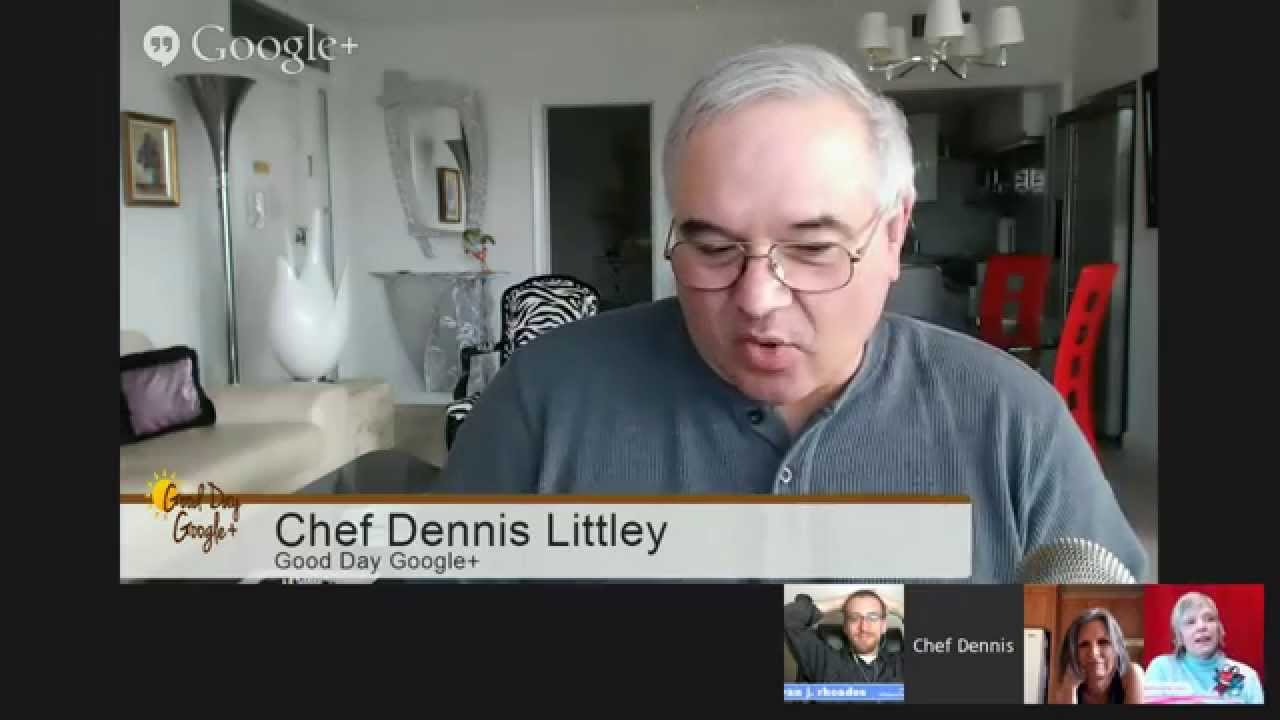
Chef Dennis Littley hosts three guests from Fort Lauderdale: Andrea Fabry cooks on a Himalayan salt block, Ryan Rhoades explains his design process, and Heidi from Italy shares puntarelle salad and discusses cold-pressed olive oil production.
Chapters
Hey everyone, I'm Chef Dennis Littley and welcome to Good Day Google+. Let me tell you, it's a good day for me because I am in Fort Lauderdale and I'm at a place called the Manhattan Tower Apartment Hotel. It's called an apartment hotel because all of the rooms are apartments. As you can see behind me, I'll move out of the way, this has a nice little kitchen in it, a dining area. This is a 2-bedroom.. I'm just gonna— there's the bedroom in there, one of them, and the other one straight back. And this is not the room I'm staying in. They gave me this for the show because it's got a wired internet connection. That's pretty cool because the Wi-Fi was just a little weak. And in fact, this is not quite as strong as I'm used to, but hopefully it'll stay well for tonight. And this is a really Amazing hotel. It's very eclectic. It's very avant-garde, and it's right on the Intracoastal Waterway. I am staring out at this beautiful water, palm trees and houses, and the boats are just magnificent. There's yachts that go by, and they have a water taxi, so we're going to take that later and go into town. So it's really, really cool to be here coming to you live. It's not an On the Road with Chef Dennis. It's still Good Day Google+. But I'm on the road. Maggie Onsueta can't be with us today because they're evidently having a massive rainstorm in Coronado, so her power went out. She won't be joining us, but we still have 3 wonderful guests with us and we're going to be doing some really cool demos. We've got a good show for you. Let's say hi to everybody right now. To my left, I have Ryan Rhoades, who is my logo designer, and he's going to be showing us how we do the process. How you doing, Ryan?
Doing good, sir. How are you? Thanks for watching, everybody.
Very nice to see you here today, and you're enjoying a nice chilly rainy day in Oregon, huh?
Yeah, my body is still rejecting the weather after several years in the Bay Area.
I could see how that could go. I feel for you, my brother, as I'm looking out at the palm trees.
Yeah, your life is so hard, sir.
It's a rough life, I know. I tweeted that before when I was here. I said it's a rough life, but somebody's got to do it.
Yeah, well, if you ever need help with that, let me know.
I certainly will. Coming to us from Arizona, Andrea Fabry. And how you doing today?
I'm good, thank you. I have a rough life too. I'm going to show you my view out the kitchen window.
Wow, that is— it looks like there's a nice breeze going on out there.
It's like 75 and sunny. It's rough.
It's 65 here. It's a little chilly. It's supposed to go up to 70, but all in all, I'll take it. It's not bad. And you're in your kitchen today because you're going to show—
I am. I'm going to talk about Himalayan salt block cooking, and I'm very excited.
I am too. I had never heard of it before today, and I kind of feel bad since I am a chef, but boy, I can't know everything. What are you gonna do? But I'm excited to see how that works. It sounds like it's a really interesting way to cook and for other food processing. So we'll get back to you. And then Heidi, and you're coming to us from Italy.
Yeah, exactly. Where it is evening, but we had a very nice day today. Cool, a really winter day. We started out at 9 o'clock with only 3°C, and then it went up a little higher. When you are directly in the sun, it's still fine, but when you're in the shade—
ooh.
And now I have a fire in my furnace, and it's nice and warm inside.
Well, you know, it is nice. It is winter. We were happy, actually, it's a little cooler here because tomorrow night I'm here for the Winterfest Christmas boat parade. So on the waterway there'll be decorated boats. So I figured it'll be nice to be a little chilly and see Christmas lights, and at least it'll feel a little bit more like Christmas. Because this morning we were sitting on the beach and it was kind of warm and they're playing Christmas music, and I'm going, this is really great, but it's different, you know. I don't want to say I was wrong, but it was different.
Doesn't feel like Christmas.
Yeah, no, it's all, you know, they get the palm trees are all lit up, they have lights going up them, and so it's too different, but I'm loving the weather, so I'll take it. But we've got a great show for us today. A lot of interesting things are going to be happening, and if you have questions or comments, please leave them for us and we'll pop them up. I want to say hi. Greta Nielsen is here. She's coming in from Ohio. Kristen Drysdale is here. She just came from the Mia Connect. Carmen Mandic is saying hi from Spain. Cheryl Deuce is loving the decor. Thanks, Cheryl. It is— I'm telling you, this place is incredible. I have to go around and take some more pictures. Dave Pipe is coming in from Sussex, so we have a full crowd. Jean Macie is here. Nice to see you there. We've got a lot of people watching, so again, if you have comments, please feel free to leave them for us and we will shout hi. So let's get this party started. I'm looking at Anthony's Coal Fired Pizza. Going by on a yacht with all these people on it. Very nice.
Okay.
I love it.
Gotta love life. I should have a camera out there. So I'm going to turn it over to Andrea and let her start us off with her Himalayan salt.
Hi, cameraman Colin. Let me explain. If you're not familiar with Himalayan salt blocks, you are basically cooking or serving or curing or freezing with food. So with a lot of the controversy surrounding, say, nonstick cookware and some of the chemicals that can emit, you can't get any safer or more natural than a salt block. So I recommend if you're a beginner, which I was, I love Mark Bitterman's book, The Salt Block Cooking Book, and it has so many pictures and recipes You'll be using salt blocks in ways that you never even knew were possible. But he also does a good job of explaining how tenuous it can be to cook with them. If you freeze or you serve, and I, over Thanksgiving, I served shrimp on a really pretty salt block and had the cocktail sauce and the little bit of flavor coming up through the shrimp. It was not only beautiful, it tasted great. But if you're just serving or just freezing or just cooling with a salt block, you don't have to worry so much about it cracking. It won't melt because salt doesn't melt till over 1400°F, so that's not an issue. The issue is cracking, but even if it cracks and it's still functional, you can use it, and when you're done, you could even eat it. So that's how natural this is. It's mined over in, um, Pakistan, there are a lot of mines there and they use a pillar and mining system where they keep pillars of salt and they move on. If it's really truly natural, they don't use chemical explosives. So you're supporting a good industry by purchasing a salt block. I do recommend getting— you kind of get what you pay for if you want to cook with this, but they're still less than $100. I paid $30 for mine. Next time I'll probably go a step up in terms of price. So first thing I did, I got these small ones, and these I'm going to keep for curing, and right now I'm curing salmon. So I took some fresh salmon from Alaska and put it between the salt blocks with some seasoning, and I'll leave it for a couple days depending on how thick it is, and I'm trusting that I'm going to know when it's done, but I'm following Mark Bitterman's book, so I'm pretty confident. I can't wait to try it. That's the first time I've tried that. What I have done with them quite frequently is cook burgers. To me, I don't have to— this is one of the best ways to use a salt block. It's a great way to cook indoors. I know if you like to grill out and it's winter, you can't. I can't say enough about the flavor of this. Hopefully you'll see, you can just see it as I cook it. I took some grass-fed beef, and Chef Dennis Littley knows I'm kind of big on grass-fed if we're going to have beef to make it. The animals are really treated well, and they have fresh access to fresh air and grass, especially for cows. I mixed in some greens from juicing, green juicing, the pulp. I put that in there. I put a little dollop with my thumb in the center because it helps it cook, and the other thing you need to know is I've been preparing this salt block for today's demonstration for about 45 minutes. So here's the downside, if you will, of cooking with a salt block. It takes time to heat it up. If you heat it up too quickly, that's the problem. Even if you're gonna cook with it in the oven, it's recommended to cook it slowly on the range, on a gas or electric stove. So, okay, so come on over. My son's gonna help. If you can show them, you see, since I have an electric stove, I have a barrier between. I'm using a tart pan. If you have a gas stove, you don't need this. The flames are just right. And as I said, I've been cooking this for about— it's slowly incrementing every 15 minutes to where it is— I can I can't get any closer than that, it's that hot. So I take my burger and so it's already sizzling as you can tell. Can you hear that?
Yeah, we can hear, I can hear it. I can see it's cooking a little already.
Yeah, yeah, it really doesn't take long. I could put some— this is ghee, I could put some fat down depending on the amount of fat in the food that I'm cooking. I find with burgers I don't need anything. I have even cooked bacon on here. You just want to be aware of moisture. If it's a moist food, it brings in a lot of salt. If it's a fatty food, you're not going to get a lot of added salt flavor, so it depends, you know. Chef Dennis, you would have so much fun with this. Before you know it, you'd be writing a book on this.
I'm excited. That really looks really interesting. Now, I think I saw some pictures in the book when you were thumbing— does he grill with it too?
Does he have it on? Yes, and grilling is the other way to heat it up slowly, a gas grill, because you can control that. And every 15 minutes you just move it up or move it to the center or whatever you do. So yeah, totally fine and should last a very long time. As long as you're careful about the heating and cooling.
Wow, I wonder how that would do for pizza.
And it's a great pizza stone. I have not tried that, and we are gluten-free in our family, but we use a lot of almond flour and sourdough type flours. So I am very excited about the pizza idea. And evidently, you heat this up and you roll out your dough, you can put it in the oven and— make your pizza. But it does not take long. See?
Wow, that looks good.
Doesn't it?
I just, you know, the salt is what is— I guess because you're not the one deciding it, it's so infused in the burger. I just can't. But it doesn't take long. Remember, this has been heating up to about 400 degrees. Over the last 45 minutes. So it doesn't—
on a grill almost outside, you know, you're getting a nice even heat on the salt block.
Yeah.
Now, will it stain? Yes. How do you clean it?
Yeah, see, this is a new one. Since I learned the hard way about quickly heating it and mine cracked, I got a new one. So this is the first time I'm using it. But even so, I got maybe 10 uses out of it before I made them. I'm confident now that I can make this last. I know the mistakes mistake I made. The other thing is about cleaning. You don't want to drench it in water. You just want to wipe it down. It will, after today, it's going to kind of have that stain to it, but that's part of the ambiance of this. You can't go back. Once you've cooked with it, I wouldn't serve shrimp on it and chill it. It's one or the other, and most people who enjoy this type of cooking have both. Depending on how you like this, if you like it rare, this is done.
When I ate beef, that was the only way to eat it. My favorite expression was from the movie The Cowboy Way, and it was, "Cut the horns off, wipe its butt, and run it across the grill." Yeah, no, see, I would eat it this way.
I like it rare. I just have this ready, and you know, for us, for me, if I didn't have any sourdough, I'd just have lettuce and whatever I want. I've got my lunch.
Excellent. Looks really good. So I guess the other question's on, have you ever tried, like, I was thinking maybe you could sand it to get rid of some of the embedded—
I haven't tried that, but from what I understand, even putting that on it is wearing it down. Down to a point. I wondered that, too, if a light sanding wouldn't be a way to clean it. He doesn't address that in the book, so that's an interesting idea. I might try it on one of these. The one I'm doing with the salmon has a lot of room to try things. I might try that.
Do you keep that out of the refrigerator, or does that go back in the refrigerator?
Again, I'm following Mark Bitterman's recipe for this, and he recommends in the refrigerator. With the salt, we infuse and cure it.
Right.
I was thinking of salt curing for some meats. I know, I guess, in the old days, they just did them out because they didn't have refrigeration.
Right.
Okay. Excellent. That's really interesting. I guess you've— have you cooked chicken on it? You've cooked just about everything on it?
Yeah. The chicken I had was already cooked, so I made a fajita type with peppers and vegetables. A lot of people wonder about fat sliding off. You can see that that's a possibility here. There's no barrier. I haven't had any problem with that unless I just use too much fat. I'm using the right amount. There was nothing that splattered or went off to the side.
I guess you could put it on a— for all intents and purposes, put it on a cookie sheet, or a small— I have a half pan.
Right.
Right on it. Then if you had any drippage, it would catch it. So excellent. Wow, I'm loving that. I'm learning so much. And you know, again, we met because of ShiftCon, and I'm really feeling the good mojo, juju, or whatever it is coming from that.
ShiftCon was amazing. Yes, it was.
Although Leah had me on her Twitter chat the other night, and I think I was entertaining them more than with knowledge because I was just cracking up over some of the different things they were saying. They were talking about CSA vegetables, and I went, "Oh, that's why mine aren't looking so good. I want CSI, not CSA." Anyway, I have really gotten a lot from that. I'm gluten-free. I've been gluten-free now for, let's see, October, November, a little over 2 months.
How's it going?
It's going pretty good.
Do you notice a difference?
I notice a big difference in how I feel overall. I feel better. I noticed it after about a week, really, that my head was clearer, that I wasn't needing as much sleep, that I had more energy most of the time. The big thing I noticed was I did not crave sweets anymore.
Wow, that's interesting.
Yeah, when I stopped eating it, I mean, and my wife was away, and I was looking at cakes and things and going, "Well, I can't eat that anymore. I want that." I went, "No, I don't." I really don't want that.
What have you substituted mainly?
Salty has been my thing. I like chips or nuts, or I've got dried fruit in the house in case I get something sweet. I've tended to go towards salty more than sweet and substitute for it.
Interesting. That's awesome.
Yeah. Again, it's worked out well. It didn't clear my psoriasis up too much, which I was hoping., but I feel good, and I don't feel any reason to go back.
Interesting. With some of the products you said you were switching to, the greener products, that you don't get there and think, "Oh, I want to go back." I felt the same thing in my journey.
I like the soaps that I've been getting for personal care. I actually got some African black soap, and that kind of— you know, that doesn't last real long, but I really like it. It smells neat and it lathers good, so I'm feeling better about— my wife's happy because I'm spending more time in the shower now too. My showers are— it's because I'm having fun with the soap.
Yes.
Anyway, but no, it's been a really interesting journey, and I know it's just the beginning of it, and I'm going to learn more and more about everything as we go. So very cool. All right, so let me turn it over. Ryan, are you ready? I know you're having some internet problems, but How you doing?
Yeah, I think I'm good now.
Alright, well let's get you before you have any more problems then.
Okay.
And Ryan, like I said, you were kind enough to help me with— I met you on Lori Lazar's show and you were doing some design work then, logo design, and talking about it. And I had had what I had done with some of the products that are out there, which are fine for beginners and you can do a job for it, but it's not professional. It really is and it looked that way and it's not exactly who you want to present who you are. If you're doing a professional job, if you're trying to catch the attention of people, you want it to stand out. We all try to save money and this is one of the areas that you really shouldn't. If you're going to do some things on your own, that's okay but unless you're a graphic artist, you really can't do some of these. Some of the web designers out there do their best to give you really nice stuff but if they're not graphic graphic artists, it just doesn't come out the same way. It doesn't come out the way something that people are going to compliment you on, that's going to really set you apart from others because of that. Let me tell you, I was at a culinary competition yesterday handing out my business cards, getting them in return, and people are looking at mine and they're handing me theirs like, "Oh my, this is all I've got to give you." Oh yeah, turn it over, there's more on the back too. I am so proud of those cards, it's really been great.
Good, good.
I loved how we did the designs and the thing about it which I would like to share with people is how we do the designs and because to me you have really taken this a whole other level and innovated the design work and taken a lot of the pain and anguish out of doing it because you do it right in front of us. We give you input I gave you input, you asked me questions, I told you what I liked, told you what I didn't like, you sent me back some basics, and then from there we got together and worked on them. So I'll let you take it from here and you tell us how it works.
Okay, well, first of all, thank you for having me on, and nice to see all of you again. I, uh, basically the one thing that as a designer, uh, that can be really, really difficult is the fact that I essentially have to read your mind. I have to basically get inside your head and figure out the, the image that you have in your mind that you want to convey to the world, and I have to somehow bring that into reality. And so I— just a little bit of background— my name again is Ryan Rhodes. My website is reformationdesigns.com. You can follow me on Twitter @reformedesigns. I've been a freelance designer since I was 15. I turned 31 back in September, and my wife and I started our business in Silicon Valley about 3, 3.5 years ago. We now live in Salem, Oregon, and over the last several years especially, I've spent a lot more time just kind of refining my process, because whenever you're just getting started out as a freelance designer, I mean, people know that you do some business cards or do some flyers, things like that. But you don't really have the confidence to put yourself out there as much. And so that's because a lot of times nobody really is telling you how to go about doing your job. You basically have to be the one who decides the systems and the processes and things like that. And with all the entrepreneurs watching this, you're probably nodding your head and— you know, a lot of people take for granted whenever you walk into a place of business that there was somebody who had to figure out how to get the lights to stay on, how to, you know, set up the filing systems and things that we just kind of take for granted. You know, these are the things that I had to figure out. And one of the main difficult points that I ran into as a designer is figuring out how to hone that creative process with the client. And so within the last 6 months or so, I started sending a survey to especially clients who are looking for logo design, brand identity, things like that, where I ask a lot of the really typical questions that I need to ask and find out those answers from a client. Things like, one, the name of your business, you know, what's the name of your brand going to be? The colors that you like, the colors that you don't like, any fonts that you like and fonts that you don't like. If you're watching this, I will tell you, you might think you like the font Papyrus, you might think you like Comic Sans, but you really don't. You should really stop using them. Please, on behalf of designers everywhere, please just stop. It doesn't look good.
Can I ask a question? Any other font that is like that? Because I do a lot of overlays onto images. I didn't know that about Papyrus.
Yeah, the thing about Papyrus that is actually kind of funny, the guy who originally designed that font, he hates it. He hates the fact that he designed it because there are so many people who use it for— you'll see it for everything from Mexican restaurants to Asian restaurants, massage places. I mean, it's very, very widely used because it's one of few fonts that show up on everyone's computer that looks different from everything else. But the fact that everyone thinks it looks different and then they use it, I mean— That's why you see it everywhere. But no, I mean, those Comic Sans and Papyrus are pretty much the one main— or the two main fonts in the graphic design community that get the most hatred. But there's a— actually, if you guys are struggling looking for fonts, there's a really great website. It's dafont.com, so it's like duh-font.com. If you're using fonts for any kind of commercial purposes whenever you're searching, just make sure that you check the box that says 100% free. It's an amazing website because you can actually type in whatever it is, whatever phrase that you're looking for to basically preview it before you download it. So I'll put that here in the chat box or in the—
Thank you.
Yeah, absolutely. And it's organized by type and, you know, you can get calligraphy fonts or bold-looking fonts. I mean, there's so many. But anyway, the hard part is, again, kind of figuring out those kind of questions that you need to ask a client. And so in that survey that I send to people, you know, I ask things about colors, fonts, and then I ask for examples of logos that you guys like, examples of logos that you don't like, and then there's even some obscure questions in there, things like You know, if your logo was a song, what song would it be? Or if your logo was a movie, what movie would it be? And especially if people actually are able to answer that about like a music or a type of music at least that they want to, you know, the emotion that they want to convey with their brand. I'll put that kind of music on while I'm designing it to just kind of get in the zone a little bit. But I'm going to share my screen here real quick. Hopefully this works and Google doesn't fight me on it. Basically, how I start out once I have the answers to that questionnaire, I'll start out with just some very rough ideas, concept sketches, and depending on what logo package you pick up— are you guys able to see my screen okay?
Yes.
Okay, depending on what logo package you decide to go with, will determine the number of different concept ideas that I'll send over. And so Chef had told me— he didn't really give me too much in terms of the, you know, oh, I absolutely want this, this, and this. He told me the brand name was On the Road with Chef Dennis and, you know, kind of gave me the creative freedom to run with that. So I sat down and just kind of started tweaking around with some different ideas, and I wanted obviously the On the Road idea to be prevalent. So we're thinking, okay, well, look, he's on the road here. Not— you know, these are again, these are just ideas. Think of this like sketching on a napkin but with a digital format. And then we're like, okay, well, you know, we'll use highway signs, but a lot of people might not necessarily know these are highway signs. And so this was the concept idea that I was leaning towards the heaviest. So I sent these over Chef said that he liked this one the best also. And so what I then did was I refined that idea in the next set of logo ideas or concepts. And as you can see, obviously it's a lot cleaner looking, looks more professional. And I just kind of started messing around with that idea, and I sent these over to him via email. Once he picked the one that he liked the best, what I do is what I call a co-creation session where we get together on Google Hangouts and I share my screen just like I am right now and I show you guys, or I show my clients, you know, where I'm at. And this is kind of how we started out. I'm sorry?
That's nice. Yeah, very cool.
Thank you.
And so what we did was we started out with this one because he liked this particular style and this color scheme the best of the 3. And so I laid that out up here, and then we did a screen share, and we just started talking. And we, you know, Chef shared with me the things that he liked about the style I just had an idea, you know, maybe have it just say "On the Road with Chef" because everyone just calls him Chef. But obviously Chef Dennis is a big part of his brand. And so just started coming up with different random ideas. And as you can see, this is the one that we ended up finally going with, this one in the top right, these two. I just did this to show what it would look like on a black background. But the nice thing about this is, say you don't like this font, I can just go through very simply and, you know, if you're really feeling like Comic Sans, I mean, if you absolutely insist on it, I'll still fight you on it.
But hey, that looks good, we should have used that.
But the nice thing about this process that I use is It's literally instantaneous. I mean, it eliminates the need for weeks back and forth on email and playing phone tag and just all of that. I mean, that is— every designer that I talk to, they can't stand that process, and I don't know any clients who enjoy that process because what if you miss the email? What if you miss the phone call? You get busy, and I mean, there's so many things that come up. And so with this process, I mean, I can change colors, I can— and you also get to see how I work, and that's something that a lot of designers, you know, necessarily might not— or might not necessarily want to show. But my goal here is to get you as a client to have the most professional experience possible. And, you know, I didn't go to school for graphic design or anything like that, and I also didn't go to school for business. But, you know, business is all about people and all about making sure that the people that you're working with are happy with the product that you're providing. And so I just do my best to show my process and show the things that I have to offer in a way that people understand it, because I can use graphic design language all day long and you're not going to understand a lot of the things that I say. I'll just open up here real quick another client file that shows more of the— oh, sorry, I was clicking on the wrong thing here— that shows a little bit more of the changes that we've made over different logos. If you guys have any questions while I'm talking, feel free to just chime in.
No, it's really fun to see.
Well, you know, I know it was great because I'd have a picture in my mind of how it would look Ryan would make the changes to look like that and I was like, "Oh no, that was not a good idea." Or, you know, "Move it this way," or "This is what I want," and he would do it instantly and then it would be good. It would be more what I wanted. I said, "Well, that's close but it's not quite what I wanted. Round the edges," you know, or he would round the edges or put it on a different color background. Then all of a sudden it was like, "Oh, that's it!" You know, then it just clicks. So that's what's great about it.
I think this is the— Oh yeah, this is the one for Good Day Google+.
Where we started.
But yeah, the other nice thing too that I actually started doing after my meeting with Lori, whenever I first met up with her, is I also provide a style guide to go along with the final logo. Once everything's done, I end up sending over a style guide that essentially shows— let me see if I can open it here. Okay, so I send over a style guide for further branding efforts. So it shows your, you know, what your primary logo is, the color palette with all the color numbers and everything, so that if you're, you know, taking this over to a web designer, that all the colors will match up. Also the type, the font, you know, I also include the font names as well as the actual font files so that you can download them and put them on your computer for further branding efforts. And I had— I'll just show you a quick example. Some of you guys know Jason Frasca. He is an Evernote genius. And I did his logo for him, and that was basically the foundation for his website. So I did this logo for Jason, and sent over the style guide, all the color numbers and everything, and the font, and his web designer ended up making everything match with the logo as the foundation, which ultimately is the goal of your logo. A lot of people don't put much time or thought into their logos, and as a result of that, you know, they end up with just kind of a whole bunch of random fonts thrown together, a whole bunch of different things and colors. It makes a huge difference whenever you have your logo as your foundation and it carries through the rest of your brand, your colors, your fonts, all that other stuff.
I have a question.
Yeah. What do you do with someone who's— because it sounds like Chef Dennis knew what he wanted, I can tell, or you'd send something over and he'd go, "I like that." What do you do with a person like myself, I have a blog name. I have no picture in my mind at all. I don't even know if you sent me 4 ideas, I might go, "I like maybe 3," you know.
Yeah, and that's, you know, usually I just need a starting point. A lot of times it is just the name of the business, I mean, or if you're having a hard time figuring out what it is that you want to share, I can certainly help with that. I mean, I do a lot of consulting and helping people kind of hone down the message of their brand because a lot of people don't think about who's your audience, who are the people that you're trying to reach. I mean, if you're wanting to reach people in the tech sector, if you don't have a sharp design to go along with your product or your app, I mean, nobody will even pay attention to you. But if you're having a hard time kind of figuring out the, you know, even the very basics of your brand, that's what the questionnaire does. I mean, I find that that kind of helps jumpstart people. And a lot of times I will send websites that have, you know, massive amounts of other company logos, even for companies that don't exist. They're just, you know, concept logos, just to kind of get the gears turning and so that I can get in your head and understand the style that you like, the styles that you don't. And then before I start the creative process, I do a consultation where, you know, we'll talk about some of that stuff. And if you don't have really any idea, you know, that's, that's where I come in and kind of just throw out those initial concepts. And if you like them, then usually I just have the person pick the one that they like the best, and then we hone that down.
Usually they have something that stands out, they'll usually pick one.
Yeah, yeah, I mean, and there have obviously been times that people haven't liked any of the concepts, and depending on, you know, the arrangement and whatever, there's a good chance that I'll just do a few more, and because sometimes a lot of people just need to see something to kind of get their brain going a little bit.
Yeah, that's punchy.
Trying to open that.
That's what we did for Good Day Google+ because I told you I think I wanted the sun in it and based on what you thought, it came over with a chef's hat on it and sunglasses and I went, that wasn't quite it but the sun was right. And then while we were talking during the concept, you just started making changes and moving things around, change the font. So there was an element of the design that I that I wanted. So we just worked the point. It didn't really take very long. It was about an hour, I think, on that one. Round the Kitchen Table was easy because you hit that right on the nail with that, with the ladle. So that was perfect. And then it was just finding the right font for that one.
Right.
And the nice thing about going through fonts is I have a lot of different fonts that are able to be used for commercial purposes. Purposes. That's another pointer if you're kind of doing things on your own. You want to make sure, especially if you're trying to put a brand out there, make sure that the fonts that you're using, that you're legally allowed to use them because the worst thing that could happen is you get to a point where your business is doing really, really well and suddenly you get a notice from the font designer that says, "Hey, you didn't give me credit for this," or "You don't have a commercial license for this." That's one of the worst things that you could run into. Anyway—
Yeah, we actually bought the font for Around the Kitchen Table, but it wasn't that much.
Correct.
Like $20 or something, so at that point it was worth the investment to get the look the way we wanted.
Just on top of what we all talked about just now, if you're looking for help in general just kind of organizing your business and your life and you know, you feel like you're floating around and don't really have any direction right now. I actually just published my first book with Laini Sullivan, and it's called Stop Wasting Time and Burning Money. And there's a whole bunch of resources in there from, you know, design things and organizational stuff to just general life things that will really help you kind of get where you're going and want to go. So you can visit the website, it's stopwastingtime.today, and there's also a free workbook that goes along with that that you can get that you can use as a standalone. There's a bunch of worksheets in there that'll help you kind of narrow down your goals and just kind of get more stuff done. So obviously I did the COVID for that, you know, whatever. But anyway, very cool.
Well, great, thank you so much, Ryan. That was I'm really glad we got to share that so people could see how the work process goes because I was so excited about it. I mean, I'm kind of a dinosaur in technology even though I do all this stuff, but for me that was really, really a great way to do business and easy to do too. Thank you. Now we're going to go to Heidi and Heidi's got some food for us and she's going to tell us what she's doing too. Heidi, thanks for being so patient over there and I'm really happy you could join us today.
It was very interesting to listen to all of you, and with the branding thing and logo, uh-oh, I think I'm not really up to date. So helpful. Yeah, many of you, some of you know that I'm wearing many hats, and I'm Integral Practitioner, I'm a Hangout host, and I've created the Wisdom Factory where I try to get the Integral thought out End of the World Integral Practice too, and then I'm a voice coach, opera singer, and a farmer. And when I have here, we have a retreat house and a guest house, when I have groups, then I cook too. And so I like cooking, but not every day. I mean, not every day a big thing. And so today I have, I was in the market this morning, and I thought I'd show you a typical Italian and maybe also Spanish Spain coming. I think so, it might be also in Spain. This is a vegetable, a salad, which is called puntarelle. Can you see that?
Yes.
When you cook it, you take off all the green stuff, all the— not cook it, excuse me, it's a salad. You cook the green stuff. This is chicoria. Chicoria. You can cook it. Tikori, yeah. You can cook it. It's a bit bitter, but it's very good. And you see what these are? They look a little bit like asparagus, these things. You take them off, and then you cut them, and then you make little— inside it looks like that, you know? It's hollow. And you cut very little slices from them, and then you put them in water. I have here, I don't know if you see it. See that I have put them in water. But I'm not really good in it because I make these pieces, they are just too thick. They should curl around and become like— this is the only one which is a little bit curly, but they really get like, you know, in old days and maybe even in some markets today, the old market women stay there and cut them in little pieces and then they sell it already prepared because this is a real big work, and I'm not good in doing it. I just, you know what I do? I just cut them in this way, and it's good too.
What does it taste like, Heidi?
It is a little bit bitter, but it is very— you hear this? It's a little bit like this, you know, it's fresh but bitter. And you prepare that with— how are they called? Anchovies. You make a sauce of anchovies, of garlic, and of oil, and of vinegar, salt, and if you want, also pepper. And then you put it on top, and you really mix it, and it has to stay about an hour or two. And then it's really, really delicious. So that's what I wanted to show you from the Italian market. As I said, I like cooking, but for every day I do quick things. Quick things, not junk food, you know, not junk food, but vegetable and with meat. Today we had amaranth with spinach and what was it? I've forgotten. But things which don't take too long. For me, for instance, to heat stove, not a stove, what is it, the salt thing for 45 minutes would be a problem because I sit on the computer, do things, set up events, write things and so on, and then it's 1 o'clock and I think, oh, we have to eat something. And what can I do?
You can't wait an hour then. Yeah.
And also, I live in Italy. I don't eat anymore, not so much pasta anymore. I try to avoid carbohydrates altogether. And it's the same thing, Chef Dennis Littley, I don't crave sweets at all. I eat things, for instance, cappuccino without sugar. I don't like sugar. As soon as I begin to eat sweets, then this, you can really feel it in the mouth. It's coming like, I want more, I want more, I want more. So today, for instance, we were in a bar with cappuccino and there were all these wonderful sweets with cream and everything, chocolate in. And I asked myself, do I want it? I don't.
I know my memories go, you want that, you want that, and then I look at it and my mind goes, you don't really want that. So it's like a constant battle, you know, I keep remembering, but I'm not in the mood for it. Like today I went to the store and I bought some apples and I'm going, that's what I really want is I just want an apple right now, an organic apple.
Yeah, you know, I can tell you a story about that where I've really realized what what the difference is between wanting and wanting. When I did fasting about 10 years ago, really 2 weeks without eating, only drinking, and my ex-husband, he cooked a chicken and I was on the terrace and I smelled the smell and my mind said, "I want that," and my body said, "Mm-mm." So I really realized that our psychological conditioning is so strong about what we think we want. I want that, I want that, I want that. It's not true. It's not true. I think everybody should really feel into the body and into the, you know, what is really going on inside of us to realize, do I really want that? Or is it only this voice that says, yeah, yeah, this is good, this is good, yeah, yeah, yeah, you need that.
And then when you do eat it, you're feeding that voice because the voice keeps coming back that you want more. That's where the problem comes in.
Yeah, and normally it's when you do eat it and afterwards I say to myself, "But was it good?" Probably I didn't even taste it very much because the greed was so big that you eat it down and you don't even notice it. So I really sort of try to not to go into this anymore and try to eat what I eat with tasting it, you know. Even not to put too much salt and too much spices and just the vegetables in themselves. I grew my own vegetables for 20 years. I had also sheep, I had my own meat, I have had chicken, my own eggs and everything. And it was a fine time. It was a lot of work. And so now I gave it up, and now I go to the market and buy the things. They are not always organic. Also in Italy, you can by chance get organic things without knowing it, because at least the little farmers, they are often not so in the— it's beginning now that they buy the medicines. They say it's a medicine.
That's what they call it.
Ah.
You know, they unfortunately have not very much understanding. There is some green ideas more in the north of Italy. They even, for instance, nuts, they bring, export nuts to Germany. In Germany, there is a big, big, big consciousness about clean food. And actually, I often, when I go to Germany, I have the car full of things which maintain, like rice, like quinoa, like amaranth and these things. Because here it's— I have to go to Terni, which is 30 kilometers. There is a health food shop, and when you go there, the vegetable is like, "Bleh!" You know, so it's not very— if there was more distribution, more consciousness about this, more people buying it, and if it was a little cheaper, then probably we would have better quality also of the fresh things. But I prefer to have it fresh. Oh, this didn't work, it's over. And, you know, I thought I have eaten 25 years really well, really without any poison, and okay, now I ate a little bit of it. It doesn't make so much, I hope. And I have a certain age, you know. Sometime we have to die, don't we?
Eventually, eventually. You were talking about olive oil before, that you had some.
Oh yeah, I have some. I could do some screen share. We have— this year we didn't have any olives and any olive oil. And I wanted to show you a little bit, let me see, how my oil, oh, this is a party of here, the neighborhood, all the farmers, little farmers, can you see that? Mm-hmm.
Mm-hmm.
Nice. And we came together, everybody brings something, this is really nice, these are green, green, let's say cakes, I don't know how you call it, tarts, inside is vegetable. And here you see other good things, good salads.
Oh, nice.
Good stuff. In abundance, as you can see. And this is my olive oil coming out of the centrifuge. Is it called centrifuge?
Centrifuge. Mm-hmm.
And this is the way they are pressed. You see all these layers. There are metal discs, and then there are 3 or 4— how can you call them?— layers of sort of carpet, but it is passing by. And in the middle, the olive mash is spread. And 3 and 4, and then there comes another metal layer. And this is already towards the end of the press. It starts about twice as as much the height. And the olive oil is dripping into this basin here, and from there goes down into the big basin on the floor, and from there it goes in the centrifuge, which is over here. I think you won't see it.
So Heidi, is there any heat involved in that process?
Any what?
Heat?
Hot?
No. This is the traditional way of pressing. It is not hot. But you know, you must imagine that from 100 kilos— we measure in kilos— 100 kilos of olives, we got 12 kilos of oil. If you used heat, you would get much more. And the industrial production, they use even solvents. They use solvents to extract even more, and they still call it extra virgin.
Really?
Yes, don't think that extra virgin is something special. Extra virgin means exclusively that it's the first pressing. But how the first pressing has happened, doesn't say, unless they say really cold-pressed, blah blah.
So, cold press and then organic. I assume if they say organic, there were no solvents.
Yeah, but you know, the new presses, they are not called— they are continuous, they have a sort of spiral and go and go and go. They are not called hot press, but they still heat up about 240°C. So, you know, we better— we always go to this traditional place because we know this is good.
I would too. Yeah, that's awesome.
The color of that olive oil is outrageous. It looks great.
Yeah, so here I am back. You know, and the color— did you see the color? It's sort of light green. When you eat it, we normally put quite a bit on toasted bread, and it doesn't taste fatty. It tastes wonderful. The smell of freshly pressed olives, it's the first few days, you know, when you eat freshly pressed olive oil, the first few days, it's— I normally get sick because I eat too much the first days, because it's so good. And now later on, now it is clear, the oil we still have left It's now clear, more yellow, let's say. But in the beginning— and you know, we have now still 5 liters left, and we need now, after a year, we would need to change the container. Because if you leave them in the container, the container on the bottom has a sort of residue, and this will, if you leave it on the residue, this will ruin the oil. So you have to change it, and then it keeps about 3, 4 other years, even more. But every year, a little bit of the good qualities disappear. So you are invited when we have again olives to come and pick the olives.
Oh yeah, I'm there, totally. I use olive oil all the time, so I would love that.
Me too. So this is my farmer head. So yeah, I don't know if you want to know anything more about me. I can tell for hours. I did so many things in my life, so I'm now sort of collecting everything and trying to get it together and to bring it out, the wisdom I have gained, bring it out to Well, I'm interested in your opera life.
What kind of operas did you sing? What did you do?
Actually, I sang in Germany, I sang Bach and Mozart and Lieder, and I sang all the classical things, oratorios in the church and concerts. And I wanted to sing opera, and that's why I came to Italy about 30 years ago. And I studied opera, and still after 3 or 4 years I studied, I thought, "Ugh, that's not," and I gave up. And then I came here into the country, and you know, when you don't have a neighbor who is always banging with a stick because he is annoyed about your sounds, you know, not all practice sounds well, especially when you try to get high notes with sound well. There are between the beginning, between hundreds, there are 90 which are not so perfect, you know. So when I came here in the country, I just could do whatever sound I wanted, you know, without anybody complaining. There was a farmer who said, "Oh, I thought somebody was calling help," when I did a big scream, you know. But anyway, nobody ever complained, and I could really try out what I wanted to try out. And I found myself how the voice works, how it works in your body. It is a consciousness training, and this is part of what I'm continuously doing. It's consciousness. And I didn't know it then, but I found out that my, how do you say, my gift is going deeper in consciousness and teach people consciousness. With the singing is the consciousness of your body, of your mind, of your images you have. For instance, when you fear to sing high notes, you won't get them, you know, because immediately everything goes there. So it is a psychological thing to calm yourself down and to get confidence and to hear once your voice really being wonderful. And this happens with what I'm doing quite in the beginning. It comes out a voice and people say, "Oh, that's me, that's me." I say, "Yeah, that's you." But they don't have it yet available, and so then the work begins to have this wonderful, open-sounding voice at their availability, you know. So this was 20, almost 20 years of my life that I taught voice and voice therapy. People who, "Ah, voice is like this, you know. I help them to get a clear voice and to even sing. Even people who say, oh, I cannot sing, I'm not music, have no musical gift. It's normally because they have learned when they were 8 or 9, they have learned, oh, you better don't sing because it's wrong. And it's not. It's only because when you are 8 or 9 You don't care if what you sing is the same thing as others do. You know, you begin with 12, 13 to want to be conformed with the group, but not before. And when you get the message when you are younger that you better stop singing, it is— you carry it through all life, and it's not true. It's not really true. And so many people I have met who said, "No, I cannot do it, I cannot sing." You can, you can, but they don't believe. And very few really take it on because it takes some work, because they have missed all the time to practice. The time from 8 to their age, they have missed to practice because they just don't think, you know. So, but they can. If they really want, they can, and I have examples.
That's something that I run into a lot too with, with what I do as a designer. As an artist because, you know, I would consider myself more of a graphic artist as opposed to a graphic designer because I, you know, logos and brand identity and stuff, I like to do those things, but more than that, I like to create and I like to have the freedom to, you know, use extreme colors and abstract art or, you know, any number of things like that. And I run into people all the time who they just kind of write you off. They're like, "Oh, well, you're just one of those creative types. I'm not creative. I'm not an artist." But meanwhile, just like you said, you know, every one of you was an artist when you were a kid, even if that meant, you know, drawing something on your parents' bedroom wall. And it took somebody, some authority figure telling you, "This is not who you are. This is not what you can do." to shut that down. And people think that, you know, creativity or music talent or whatever just kind of falls out of the sky. And sure, you might have a natural inclination towards a particular art or writing or music or whatever, but this is work. This takes practice. And I mean, one of my favorite musicians is Macklemore, and I love the lyrics in his song 10,000 Hours. And I have a poster of it right behind me, right over here above my desk. It says, "The greats weren't great because at birth they could paint. The greats were great because they paint a lot." And that's something that, you know, I can just show it to you here real quick.
Yeah, I love that.
So, you know, I made this on my iPad and then blew it up as a big poster just to be a constant reminder to me that, you know, creativity and art of any kind is it's something that you cultivate. It's not something that you're inherently born with. And if you can get over that in your mind and, you know, start applying yourself to some creative endeavor, whether that's cooking or, you know, speech therapy, music, or graphic design or painting, I mean, you will see yourself grow as you look back over the course of your career. Turning something that maybe used to be a hobby when you were a kid into something that you can actually make a living off of. So I'm glad you brought that up.
Absolutely. Absolutely. And I think the main thing when we teach this is, for me at least, the psychological part, you know, to work with the people in their minds.
Right.
What I'm doing now is relationship work, but it's the same thing. It's actually the same thing. It's here. Yeah, when we free that up, everything is possible.
Yeah, I think a lot of it gets to being at the right time in the right place for many of us. As I know, just in some of the journeys I've had, if you had told me that I would do this when I was 30, I wasn't ready to do it. So my mind wasn't ready to accept it, and no one was there to help guide me to get it ready. So, you know, a lot of times I think We would like to do a lot of things, but we just don't feel ready to do them because we don't have those tools or we don't have someone guiding us.
I fully agree because, for instance, what I'm doing now to show up in Hangouts, doing my own Hangout shows and all these things, I wouldn't have done it 5 years ago because always holding back, you know, but who are you to do that? And oh, maybe somebody doesn't like you and And I really had a big score in the last 5 years, and I overcome that, and now I feel being in my power, you know, and I don't really care if somebody says that I'm talking shit.
I love it. I hear you. I know I was trying to explain to someone why I do what I do, and I said, well, that's what I like to do. I'm having fun, and as long as I'm having fun, I'm happy. So, it's good.
If you're not having fun while you're working, what are you doing? Get in line.
I hear you. Well, you know, that's what left me cooking for as long as I did, was because I had fun doing it. And it wasn't even so much the cooking that was the fun. I mean, it was, but the greatest joy for me was watching people eat. And that is what I really— that's why I cooked, so I could see people and how much they enjoyed the food and how it was making them feel and how it It changed the moment they were in. Like, it was so funny, even with the girls, it felt like when I was at the high school the last 8 years, and I didn't think I'd really enjoy that at all, but they were still young enough where you could affect their whole day with a cookie.
Ah!
With a cookie. I mean, they were having the worst day of their lives, and I'd see them over there, and I'd walk up to them with a cookie cookie, and give it to them, and their whole mood would change. Parents would call me, email me, and say, "Thank you so much for providing a place where she can go, and she can be happy again." If we think about that, we can still have that. Our lives can change. Our moods can change, not just with food, but through experiences. We just have gotten to a to the point where we don't have time to let them do that for us. But enough for that today. So Good Day Google+ is coming to a close, and I see this beautiful Intracoastal Waterway calling me. I see taxis go by. So I'm going to go find my wife, and we'll probably get on one and head on into Fort Lauderdale and do some exploring. But thank you so much for being on today. We had a wonderful show. We had a lot of great stuff. Ryan, thank you so much, not just for all the work you've done with me, but for coming on the show and being there anytime I needed you to. I'm really glad we met, and it's been a great partnership between us.
Thank you.
Very happy to have you. Andrea, it was a joy meeting you at ChefCon.
Yep.
I could talk Himalayan salt blocks forever, so thank you.
Well, I'm sure there's other topics you can enlighten us on, and we'll be happy to have you on again to talk more about food and the properties and everything surrounding healthy living. And Heidi, I'm so glad we got to meet today and do this Hangout. It was a long time in coming, and now we know each other, we can just ping each other and say hi whenever we have time.
Yeah, I invite you to New Year's Eve. We have a— how do you say— a party. Potty at 10 AM Pacific.
Well, I may be able to. Actually, we're going to Disney New Year's Eve to stay there. My wife made reservations, so we'll be in the parks this year for New Year's Eve because she didn't want to stay alone or stay at home. Actually, this is the first New Year's and Christmas we don't have a dog in the house. So we're both feeling a little sad about that, so she said, well, let's go do something different. Anyway, but thank you. You never know, I may be able to pop on that on mobile or something.
And you all are invited to come in.
Great, and I'll be coming to see you sometime too in Italy hopefully too. So that would be wonderful. Well, thank you all for coming. It's been a great day on Google+ and enjoy the rest of your day, enjoy your weekend, and if you have time tomorrow night, 7 o'clock, I'll be here on the Intracoastal Waterway in Fort Fort Lauderdale at the Manhattan Tower Apartment Hotel to watch the Winterfest Christmas boat parade. Actually, it's the Hard Rock, I think the Hard Rock Casino, they have a casino out here. You'll understand that with casinos in Florida, but they'll be sponsoring it and it'll be going right down the waterway here with all the boats decked out for Christmas, and we'll be talking to the owners of the hotel and hopefully some of their guests because they're throwing a party tomorrow night too, so it'll be fun. So thanks again, and I will see you all soon. Bye-bye.
Bye.
Thanks for watching.









