Good Day Google+ (Episode 1)
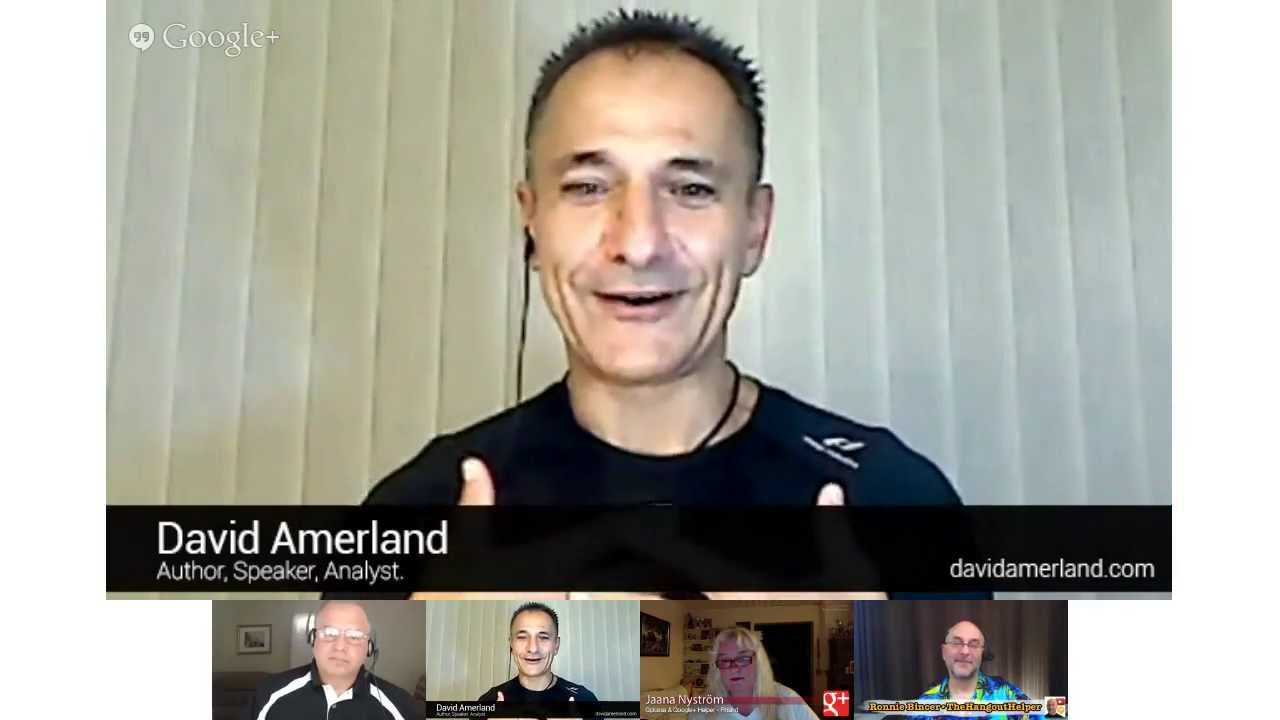
In the inaugural Good Day Google+ live Hangout, host Chef Dennis Littley brings together author David Amerland, Google+ helper Jaana Nyström, and Hangout specialist Ronnie Binser. The conversation opens with an overview of Google’s Hummingbird algorithm and the shift to semantic search, explaining how Google now maps concepts to words, builds knowledge graphs, and evaluates author authority (Author Rank) and trust (Trust Rank). The panel discusses practical implications for content creators, emphasizing the importance of authentic engagement, consistent branding, and the nuanced use of hashtags. Ronnie explains Hangout‑on‑Air mechanics, comment tracking, and best practices for asking questions and using Hangouts for teaching. Jaana shares how she structures her Google+ Helper community, uses private circles, and curates content categories. The group addresses audience questions about +1s, link dropping, spam, and the future role of SEO agencies, highlighting the balance between authority, trust, and spam avoidance. Throughout, the tone remains conversational and enthusiastic, with a focus on actionable advice for Google+ users and marketers.
Chapters
closely, so I will just talk a little bit till it does say it is good, and we're on. So hey there everyone, this is the first day of Good Day Google+ and it has been one great day so far, and things that can happen will happen and they've been happening so far. So we're gonna get on with the show, we're live, and I'm very happy to be here as your host today. I'm Chef Dennis Littley, if you don't know, and my guests today going across are David Amerland, and he is the author of Semantic Search, We have Jaana Nyström and Jaana is coming to us from Finland. Thank you so much for taking some time. She is the Google helper, Google+ helper. Of course we have the hangout helper himself, Ronnie Benser.
Great to be here.
Thank you so much. I'm so excited to do this. I have so many great friends across this community and I do love Google+ and I thought what better way to get them together, talk a little about what they do and just have some fun while we're on the air. The format is still. We're still playing with it to see how it'll go, but I hope everybody else enjoys the show. If you have questions, please leave them in the comments underneath our broadcast, and we'll do our best to get to them. Alright, so David, I'm gonna let you start the show and talk a little bit about semantic search, because, you know, this is— I got your book. I'll admit I haven't read very much of it yet, and I'm going to, but I need to learn a little bit more about it, where it's going.
Okay, I think this is perhaps more timely than ever. Because only just yesterday, Google announced that they've launched Google Hummingbird, which is the largest, biggest— the biggest algorithm change in Google's history since 2009. Wow. This shows it's going to affect over 90% of global searches. So we are all going to feel the impact of this. And I think it's really timely to actually discuss again what semantic search is, because the terminology tends to be a bit dense. The moment you say semantic search, you think semantic what? And the blinkers come down, which is understandable. If you're working on the web in any kind of fashion at all, it's going to affect you. It's going to affect you if you're not working on the web, funnily enough. And the reason it's going to affect you if you're not working on the web is because Part of the semantic search syndrome, if we can give it that label, is that online and offline are beginning to converge. It's going to be one space. It's only going to be differentiated by bandwidth and capability. So for instance, what we now consider to be online is going to have better bandwidth and perhaps better capability or better functionality because you'll have access to better apps, your laptop. Greater computing power. And when you are what we now call offline, it's still going to be online, but you'll have restricted bandwidth because you'll be on the go, you'll be on a mobile device, whether it's your future Android or, um, Apple wristwatch, or your, um, mobile phone, or your Google Glass, or any kind of wearable computer which we're going to have in the very near future. And there you will have also restricted functionality. And that'll be the main difference. Apart from that, a lot of what we take for granted now in terms of being able to look up things, find information, all those things are going to be there. And this is exactly where semantic search is actually heading. This is why it's not really— although it is a little bit geeky in terms of how search works, its impact affects every single person on the planet, because it affects the flow of information, how we access it, what we do with it, and then how that impacts on our future prospects, whether those prospects are purely reputational, or a mix of reputational and work-oriented kind of effect. So let's explain a little bit of how semantic search is different to everything else we had before, because it is really different. Now, if we think that in the past, getting any kind of search was really a case of guesswork on our part, getting any kind of search result, we used to have to you input a search query, as the web progressed up to about 2011, we had got quite close or quite good at basically guessing fairly closely the keywords that content providers would use. And if we weren't close, we had become adept at basically thinking that way. In their turn, any content provider or any kind of webmaster had also become very good at trying to guess how much we didn't know about a subject or any kind of product we were looking for. And they would give us the keywords we were likely to use. Sometimes these things fitted perfectly. We thought, hey, search is really cool. Sometimes it didn't, and we had to search again and again and again. And sometimes it didn't work at all. And we thought, OK, search is broken. This kind of imprecision allowed a lot of spammers to come into the mix. Because basically it ran on technicalities. Those technicalities were very easy to analyze, which meant they were also very easy to implement. And the moment you understand a technicality, you then become very adept at creating shortcuts which give you a fairly good payoff in terms of your time and effort, hence spamming. What has changed? Well, the web still runs on technicalities, but now Search understands what we say in terms of the words themselves rather than the code behind the words. So it understands them the way we do. And I put a post up this morning on Google+ to actually explain this. Because the moment I say that Search understands words like we do, everybody thinks that Search understands a particular language. The answer to that is yes and no. But really, when we understand a word, we don't understand the word itself. We understand the concept behind it. And associated with that concept are a whole lot of things. So the moment you say you're a chef, immediately in my head, for instance, I have a picture of somebody in a top white hat, wearing an apron, working in a restaurant, really busy, very skilled at producing dishes, working, producing food, working under pressure, perhaps running a very complex team, and chefs today also, we know, have to be really good business people because they run a restaurant which is on the cutting edge of in terms of cost and margins and wastage. And all this has to be managed.
So they're not like the Swedish chef from Sesame Street, the Ruby Dresser?
Well, they could be, but I don't think there's a long life, longevity to that one, unless you're in Sesame Street.
OK.
So this is sort of my idea of a chef. And the moment you say chef, this is what comes to my mind. So if we think all the things I know about a chef, they're part of the knowledge graph in my head, and chef is the word, then it becomes an entity, which is what essentially Google is doing with words, and it gets associated in my head with that. The moment I find out that chef— the moment I learn another language, the moment I understand the word chef in a different language, it unlocks all that value again in my head. Even though perhaps I can't express it in that language, the value is still there. The knowledge is still there. And all that happened is I map one word onto another, which then locks into all the knowledge I have. And that's how semantic search works, really. So essentially what Google is doing, it's creating an independent machine learning code of concepts, which then can be mapped onto words in different languages in the way we understand them. Radically different, because now when we actually go into search and put something there, It doesn't just see a string of words which will have— excuse me a sec. It doesn't just see a piece of words which have a probabilistic kind of value, but it actually understands those words the way we do, and then tries to understand the intent behind our search query so that we basically get the results we're looking for. Never happened before. This is what's happening now. And it's happening in an ever-increasing basis. It's accelerating at a phenomenal rate. I couldn't believe yesterday that we got to this stage so quickly. I expected us to be at this stage perhaps around Christmas time or a little bit before. This shows that Google is accelerating its accumulation of data at a tremendous rate. It is able to validate all the data really, really quickly.. And the thing with data validation is that the moment an entity has been verified, it produces credible data itself. It accelerates the process even more. So there you go, in a nutshell.
So this is a good thing then. I mean, I understood most of what you said. As a food blogger, you know, I am the chef, so I'm wearing that white hat a little too tight some days probably. As a food blogger, then it's gonna understand more when people say chocolate cake, and I've made a chocolate cake, or if they put another word in, it's gonna understand more, and it's gonna be a good thing for us rather than those spammers out there.
Absolutely. Well, this is it. It's getting to the stage now that because it understands what you say when you write it or say it or comment across the web, then it can understand the value behind of the person who said it and surface content from credible sources. So for instance, if I go online, or if Ronnie goes online— and Ronnie is very well known for Hangouts— and he talks about chocolate cake, well, Google will say, OK, Ronnie may be talking about that, but he really doesn't know anything about chocolate cake because—
Yum, I like chocolate cake.
In his 2 years of history, all he's ever said is, I like chocolate cake, which is not really a very deep comment. Now, he can say it a million times. It still won't make him an authority on chocolate cake. Although, if we take it in the past, if he did say something a million times, it made it true and it made him an authority.
Well, what if we learned how to make a chocolate cake inside of a Hangout? We'd use Hangouts to teach you how to make chocolate cake.
Yeah, that'd be really cool. But it'd still be Chef Dennis who'd get all the credit for it, because he's the authority. We're just the neophytes here.
Oh, I like that then. OK. We did have a question in here, Ronnie. I saw you put it up.
Let me put it back up here. You can blue box that.
Yeah, Lawrence— there we go.
Oh, how do we ask questions? Lawrence Eckert. Yeah.
How do you ask questions in the Hangout? And he also said, what is the best way to use Hangouts? I've been doing my best at hashtagging all my posts. What is the best way? So Ronnie, would you like to answer that?
Well, the quick one for how do we ask questions is in the comment area. We're trying to track the comments. So right where you asked the question is perfect. That's where you ask the questions., and then we're gonna bring them into the show using special techniques that I am helping with, which is called the comment tracker. And the other question about what's the best way to do Hangouts, that's a good one. Find me and I'll tell you. There's just so many, so many ways to do it. Chef Dennis has done a great job. We're doing just a conversation, but he's also doing things where he teaches people how to cook inside of a Hangout. There's so many different ways to do it.
There's a lot of great uses for Hangouts, you know, and everybody should try them, even if you just try them with your friends to see how they go at first. Get over that initial fear of being on the camera. I mean, it's not that difficult. Ronnie looks like he posted another question here. Scott Soulcroft: How has the world changed today because Google implemented Hummingbird yesterday? Was it a surprise?
Okay, well, here's what happened. Semantic Search has actually deepened, and it's done 3 things. It's added 3 different distinct layers. It added complexity— and they're all related, and I will explain how— it added comparison, and it added prediction. And here's how it did it. It all starts with complexity. Because we're using more natural language queries now, both on mobile devices where we talk and also on desktop where we actually type more complex search queries. Google has changed the algorithm to better understand those queries. The moment it does that, two things happen. First of all, it can understand better how to serve the content, because now it has more clues of what we're looking for. But also, it can understand better our own intention behind the search, because a long query gives it more contextual clues. Let me explain this. If I say, for instance— let's say I put the word "paint." paint on Google, it has no idea what I'm looking for. Am I looking to learn how to paint? Am I looking for paint for my house? Am I going to start an art class? Nothing, because there's very little contextuality in a one-word phrase. But if I say something like painting classes within a 5-mile radius of my house, that begins to give it the contextual clues it needs in order to understand what I'm looking for, and then it begins to match up to the information. The moment you get to this kind of complexity analysis, then it becomes a lot easier to link up the query with the content, which means that you have to be better at analyzing the content in depth. And if you can do that, then you're also better at comparing things. Now in the past, if we need to compare two pieces of information, this is what we did: went on Google, we searched for something, we found it, and we kept it. We went to another Google search, we searched for something else, we found that, opened it up, found it, and kept it. Then we brought both of those up side by side, and we looked at them and tried to compare them. We did all the hard work. Now Google, because it understands the content of pages so well, it can basically bring up a graphic representation of those pages with the main points of the content. So you can have, for example—
Yeah? David, yesterday we were on a Hangout together, and we're on again today. And I heard you say this, which was rather amazing to me, and I think this might help clarify. You were doing a search on paint.
Yes.
And you didn't type anything else, you just typed in paint. But if prior to that you were searching for painting classes and you were searching for where do I learn about how to paint, and then your third query was just the word paint, Google Now is able to take your prior searches, figure out that now you're interested in painting classes even though you've just searched on paint. Isn't that one of the new things that's now happening?
It is. Absolutely. This is— I'm very glad you brought that up, actually, because this is exactly the kind of relational linking that goes with complexity. In the past, we were able to put in a search query, Google would give us an answer, then we'd put another one, it would forget about the previous one and give us something else. Now it actually looks at what we do in sequence. So yes, if I put in painting classes within a 5-mile radius of my house, and then I put in Impressionists, and then I put in palettes, and then I put paint, then it knows that that single word, which is contextually poor, is now related to all the previous things. And to make life easier for me, it doesn't really require me to go and put something more complex because it has a clear picture of what I'm trying to achieve.
Now, is that tied to that particular computer you searched on, or could you—
No, no, it doesn't. It links to your profile. So if you are signed into Google+, all these are associated with it. So basically, you could go and research museums in your area, impressionists, paint, and then on your mobile, you go and say nearest museum or nearest paint shop or paint shop, and you will actually get that on different devices. You will get a continuity like you're always there. It doesn't matter where you are. This is the amazing thing about it.
It'll show a Van Gogh or a Monet because it knows you were looking for impressionism.
Yeah, so I mean, it's amazing in how it actually follows you through in your journey. I mean, Google thinks of this as a journey, and it tries to make it as seamless as possible. So as you go from one device to another, which essentially is a transitionary phase in where you are— so if you have your desktop, you're at home. You're on the move, you're on your mobile phone, on your tablet. Tomorrow you'll be on some sort of wearable device and Google Glass. You will get essentially all the kind of information following you through. And Google will know each time where you are, and this is the beauty of it, what you're doing in relation to what you want to find out. So—
In one sense, Big Brother.
Well, this is— Can I jump in? This is going way too semantic now for me, for a blonde. Lawrence Eckert has posted about he meant to say hashtags, not Hangouts. Sorry. So I guess that falls for me, the hashtags on Google. Google+. The way you use it— Google has started, like everybody, almost everybody knows, they have started adding hashtags to posts depending on the topic. For instance, we remember the Eiffel Tower picture where Google automatically hashtagged it as #Paris. But creating your own hashtags is way better because then you can make sure that you get those hashes that you want. For instance, if you post about sports, let's say you post about golf or you post about scuba diving, use those hashtags and create your own. Try to keep the hashtags under 20 characters because I have noticed that in the long run the longer hashtags sort of stop working. It has taken, for instance, Some hashtags I used last year, 12 months ago, they have stopped working, so they don't display the blue link anymore. They still come up in the search, but they are not clickable. So try to keep the hashtags under 20 characters and always just one row at the bottom. Don't fill your post with hashtags because that really discourages people from reading the posts. Many photographers have this problem that they start with this, this day theme by this, this, this, this person, and then at the bottom, after a long list, it says where the photo was taken. And everybody's like, what the heck? We are not interested in all this. Hide the hashtags. You can use enter to make a white space and then use the hashtags because then they still work in the search. One row of hashtags, maybe 3 to 6 hashtags at the bottom, that is good. And that way your posts will be found better. And now especially, Google is rolling out— it's now only for the google.com and google.ca search, but when you search for a hashtag, let's say you search for Google+ or +help, hashtag +help, then you actually, you can see on the right-hand side of the regular results, you can see Google+ posts from which have been using this hashtag, and they are quite recent. So for companies, for businesses, for small business people, for artists, for photographers, authors, whatever, start using hashtags now.
Yeah, Jana, you know what, I see a lot of people asking, they say, well, what are the standard hashtags I should use? And I think they're confused about the idea because I believe there is no standard. You just make up what you want. But if you stay consistent with what you do, like I do HOA tips because they're for Hangout on Air tips. I do that consistently, that becomes a branding thing for me as well. So you can pretty much make up your own, just use them consistently.
Exactly. And I use #plushelp and then I use #janatipp, and those have become like my own. And you can use the trending hashtags, of course, but don't use hashes that have nothing to do with the post. That is just not a good way to, to do it.
Well, you could, but you're going to get burned.
If there are a million people using the same hashtag, I don't think your post will sort of rise up in the search very high. So make your own, use your imagination with the hashtags, create your own branding hashtags.
So Jana, you just want to be consistent then when you're using them, you don't want to keep making new ones with every post because it'll be harder to find.
Exactly. So use one or two of your own regular ones, and then depending on the topic, of course, if I post about camping, I use #camping, outdoors, trekking, something like this. So people, when they search for trekking or camping, they find a post. But I also use my own branded hashtags.
I'm gonna be a translator and tie the two things together. Jana's talking about hashtags because the question came up, which is a very valid question, but that's more like the old way. Of search engine optimization, and the new way is this semantic search where Google's trying to understand more of what you're saying without having to use the hashtags. Is that right? I mean, they're both going on at the same time right now.
Yeah, OK. Google will always try to understand content which you have put in Google+, and it auto-generates hashtags most of the time. It is still very imprecise. Definitely help it along by using your own hashtags, as Janne has quite correctly suggested. You can expand it a little bit and make it your own in terms of branding yourself, which is again perfectly within your prerogative to do so. And here's where semantic search comes in. If you attempted now to do something which is a little bit wrong— suppose, for instance, I start posting content and I use #janneTip. Because I know Jana has put in that. And I start doing it. OK, this is in Google+. This is an entirely transparent activity which Google can basically understand. It can see where I'm trying to subvert the system. And there will be— and this is my guess— a penalty applied to the authority of the profile that does that. And that's it.
And that's because it's a branded one that Jana did. If it was a generic one that Jan didn't necessarily own, but like #HOATips, I don't own that, but I use it a lot. You could still use that. Wouldn't that be OK?
Well, I could. But then, well, here's the thing. Let's say I did, but I posted nothing about HOA tips. I just used the hashtag in my post.
Right. So it was a non-related hashtag just for there.
Again, this is spamming. Yeah, this is spamming. Because essentially what I'm trying to do is surface my content which has nothing to do with HOA, when searches go on for you. And Google can again see that. So essentially what will happen, whatever authority and credibility I have built up in my profile is going to evaporate. So my effectiveness in terms of hashtags is going to drop and drop and drop until I'm completely ineffectual, in which case whatever I do, it doesn't really matter. I will have burnt out my profile. And to gain back that credibility will probably take me another 2 years, by which time things will have moved on. So it's very much a reflection of the real world. If I go into Chef Dennis's restaurant, and he's advertised fantastic 10-course meals for $10, and they're actually 2-course meals for $100, then I'm going to tell my friends, hey, food was not that great. The prices were rotten, and he got us there by trick. So for him to basically then— and he may be a great chef, but he didn't deliver what he actually meant. So then for him to build up his reputation again, it's going to be a struggle, because he will have burnt it by doing that kind of behavior, which is why we normally don't do it in the real world. But on the internet in the past, because it was anonymous, because it was a little bit of the Wild West, we thought we could do anything and get away with it. If we got burned, we came back under a different name. No more. Now we're tracked. So Big Brother may be watching us, but it's also making us play nice, which I think is pretty cool.
That's a good thing. Great. Jana, let's— before we move on anymore, let's talk to Jana. Jana, I want you to tell me more about your Google Help Community because it has been invaluable for me, and I really like to touch on that a little, if you don't mind.
Do you mean the official Google+ Help or my unfortunately named Google+ Helper, which actually existed long before the official one?
I'm talking about yours because yours is the one. I use them both, but I use yours more.
Okay, yeah, I'm trying to— what I'm trying to do with the Google+ Helper is I have set two categories for the public, so to say. There is one which is general discussion about Google+ and another one which is questions to the community. And all the other categories— and there are quite a lot— they are meant for people posting about those topics, like about community tips, about beginners advice, something like this. So what I'm actually trying to do is I'm trying to create a Google+ helpful library sort of thingy so that when people go to the community and they are new, they just click on to the advice for newcomers or basics for beginners and they start reading and they get all the posts which are meant for them. If somebody is in problem with Hangouts or, or needs to read more about Hangouts, they can check the Hangouts category, which is full of Ronnie Bincer's posts. Because he gives such good advice. And then there's another one for the Google tools, and there's a lot of stuff about Google+ YouTube integration. And because the search also works inside the community, so when you go to any community and you just type under the profile picture, you type a search word or even search sentence, search for sentence, so you will get those posts. And you can use also hashtag search. Hashtags don't work in the comments, by the way. They only work on the body of the post.
The key is to point out that Jana has a community she's built, and this community is the place to go, and then you look around within the community and find all this help.
Yep.
Yep, and you've done a great job with that. I mean, I get answers there all the time when I'm stuck on something, so thank you very much.
Great to hear.
Absolutely.
Here to help.
Yes, you are. It's good to know. And all right, Ronnie, let's move on to you for a minute. Let's talk about all that you do with Hangouts, you know, if someone has been living under a rock and doesn't know you.
I'll do a transitionary thing. Jana has a great place for help, the Google Plus— what's the name of the community on? I'm getting confused with the names now.
Google Plus Helper.
Helper, right. OK. Google Plus Helper community. Now there's another more official community called Google Plus Help. And today at 1:30 Mountain Time or 3:30 Eastern Time, I'm actually going to be in a Hangout representing Google Plus Help to help people within that community. But that's not normally what I do on a regular basis. I usually do this on my own, out in my own world, um, and I'm called the Hangout Helper. And so I try to help people learn how to use Hangouts well and do an efficient job with it. And I've relatively recently opened up another place, which I'm gonna turn on right here, which is called Hangout Mastery. And Hangout Mastery is a member-only environment because this stuff changes all the time. For example, today is different than yesterday. Yesterday, the comment trackers that we use to show comments inside from events worked because the tool called the Hangout Toolbox was at version 1 or version 2. Today, it's now version 2, and you have no choice. And one of the things that they've made a change with is it doesn't work any longer with the comments from the event. Now I've talked to the people that made the tool, they may be adding it, they may not be. I think their goal is, but it's not there yet. So I found a workaround, a trick, and that's what we're doing today right now to be able to do stuff like this. I can turn on this comment and we can say it's like Google invented Star Trek's computer before it was invented. And that's a great comment, we bring it right from the event and it's possible only if you know all the proper tricks. Now, right before we did this starting of this show, I posted a public post telling everybody how to do these steps, but some of the steps honestly are a little bit missing. In case you don't know all the fine details, you come into the membership place right there, you can sign up, and that's how you will get all the details. And we do training inside that environment and things like that. So I have a dual purpose. I publicly help people, but I also need to do this for a living because there's no way I can afford to be online as long as I am and not get paid. So I also have created this membership place, so I do both. And for those that really want to keep up with everything with Hangouts, then come on into the community, and otherwise you should be able to see me almost everywhere online about Hangouts.
Absolutely, you are everywhere, Ronnie, and you provide an invaluable service. I can attest to that. As I was panicking earlier when I couldn't get it to start, you were there to help and calm my nerves a little bit. It was a great tool. We've got a couple other questions in here. I do want to try and take a few questions. Lawrence Eckert had asked about +1s. If anybody would like to share their thoughts on +1s, what do you think? Are there functions? Are there any meaning behind them? Are they going anywhere with this?
I'll give a quick one and then let the other guys say something. The +1s have changed recently.— well, recent, I mean, some of us watch this every single day. Other people are like every week, others are once a month. So recent is relative. Within the last month, I think, maybe it's been 2 months by now, the +1 has a different meaning in a richer way. It means I truly endorse somebody's post if I +1 it. And that means potentially my action of hitting a +1 on their post is going to become a recommendation in someone else's home stream. So when they're just looking along and they see things moving around, it'll say, "Ronnie Binzer recommended this post." And that is new and more powerful than it ever was before. In the past, just +1ing, many of us did it sort of as an acknowledgement. "Yeah, I see your post, great, +1." And we would throw them out like candy, you know, just here you go, here you go, here you go. Nowadays—
Way over 100,000 given plus ones.
Yeah.
Oh, wow.
And so nowadays, some of us—
You're such a generous person.
Yeah. Some of us nowadays are a little bit more careful about how we do that. And I think that's partly why they made the change. I'm not sure. But so I'm more careful now. I don't just go plus one everything. I might plus a comment, because plus oneing a comment doesn't have the same effect. As +1ing the post. So I'll leave it now to the other guys to follow up with that. Anything?
Any other thoughts?
Yeah, about the +1s, when let's say you share your blog post or you share an article from Chef Dennis Littley's blog and you share it as a link, and then when people give +1s to this post of yours, so all the Google+ 1 juice goodness whatever goes to Chef Dennis's blog, and if he has been so clever that he has connected his blog to his business page on Google+, then all those +1s also go to his Google+ page. So for instance, my Google+— no, sorry, nowadays G+ Helper, because I had to change the name, my G+ Helper page has some, what, I don't know, 20,000-something followers or people who have it in their circles, but it has way over 60,000 +1s, and those extra 40,000 +1s have come via my blog and via people giving +1 to the page and via Google+1ing the blog posts, my blog posts. And you don't just have to share the blog post as a link because nowadays Google+ doesn't even show the rich snippets or the text. They just show the link and then a tiny thumbnail picture. But if you really want to make your posts shine, use an image. If you use one link in the body of the post, then— and the picture— even then your blog post or the article you're sharing gets the +1 juice.
So it is worth doing.
In a nutshell. It would take much longer to explain too, but—
And you've got helpful documents explaining how to do that in your—
Yeah, I've been blogging about this to. So Google+ Helper is my blog. There's lots of good stuff. You can go and take a look. There are no ads, nothing. I'm not selling anything, so it's just pure information.
Jana, would that be connecting using the publisher equals URL thing when you said connect your blog to—
Yes, yes, you do. So I've also blogged about that one, so how you should do, and Mark Traphagen specializes on that. I'm sure David knows and Ronnie knows too. I don't know so well, I'm blonde. But what I understand about it is you connect your blog URL to your Google+ profile, and then you connect your profile to the blog. And there are lots of tools you get the HTML thingy stuff, whatever. I use Blogger because it's simple and even I can use it. So I did all this myself. If I had been using something else, I don't think I could have done it. But Blogger is good. Blogger is for blondes.
A lot of us start with Blogger. OK, looks like Ronnie's got another question here. He says, Jesse, David, been reading your book on semantic search. I'm loving it. Can you talk about the difference between Trust Rank and Author Rank?
And I brought that up primarily because Janna just mentioned authorship, and that ties into this Author Rank idea.
That's right.
OK. Now, Author Rank— and Trust Rank is part of Author Rank in many ways. But let's begin with Author Rank in itself. Author Rank is a term which has been loosely used by Google, especially Matt Cutts. A number of times to indicate a large and unspecified number of signals which Google is using in order to ascertain the authority of a particular profile on a specific subject.
And David, one second. Some people might not know who Matt Cutts is. So just give a—
Yes, absolutely. You're quite right. Now, Matt Cutts is the head of the Web Spam Team at Google. And he's also, by default, the public face of the company. Google uses him every time it wants to communicate with the SEO community at large, which makes Matt's pronouncements extremely diplomatic, because obviously everything he says has to represent Google's official stance, the official guidelines, and give as little leverage for abuse as possible. So he's extremely careful, and he walks a tightrope, but he does it exceedingly well. And as it happens, he has come under fire for it. But— excuse me. So essentially, there's a number of signals, and those signals accumulate on a profile. And let's take, for example here, Ronnie, who does a large number of posts on a daily basis. On Google+ Hangouts in terms of the technicalities. He demystifies how they work, and he explains how you can get better at them using all the mechanics around them. And he gets a lot of interaction around that. He gets a lot of reshares. People comment on that. His posts are reshared. His posts are +1'd. All this activity together begins to accumulate a certain authority that Ronnie has gathered on that particular subject. So we should call that authority author rank, for instance. Where does trust rank come in? Trust rank comes in now if Ronnie behaves in a certain way. If, for instance, now his profile, which let's say on a scale from 1 to 10 is perhaps at a 9, begins to promote specific SEO activities or SEO posts which are related to what he does. And that is perfectly fine. But suppose at the same time that Ronnie also starts promoting a chain of restaurants owned by Chef Dennis. He's never done it before. And that chain of restaurants, because he promotes them, begins to rise in search and comes onto the first page of Google. Many people see them, and Chef Dennis becomes incredibly rich. And Google looks at what Ronnie has done and says, wait a minute, Ronnie has never done that before in the past. So his trust trunk essentially begins to drop, and if his trust trunk drops, it means that although he may still be an authority on a subject, he begins to have less and less influence even upon that subject because he's no longer trustworthy. So there's always an authority in terms of knowledge and the acknowledgement of others that you know these things, and then trust trunk in terms of the veracity of your conduct in a virtually transparent world. So these two things go hand in hand, which if you think about it in many ways mirrors the way we operate offline. We are known for specific things professionally, we are known for other things in our social lives, and even though we have perhaps slightly different personalities in those two environments, we still act within certain parameters, which is why when we go away from home and nobody knows us, we can go a little bit wild because nobody knows us. And we can get away with a lot of things that you wouldn't normally do.
I have a question.
Yeah.
If I— because I do Hangouts and I tell people how to technically do Hangouts— if I start telling everybody, if you want to do Hangouts with cooking shows and you want to learn how to do them properly as a chef, and we're gonna bring in Chef Dennis to help us learn the process of doing Hangouts. Isn't it feasible that at some point I could build up and continue my level of authority or trust while including Chef Dennis and then eventually start promoting some of the things that Chef Dennis is doing without becoming no longer trusted?
Yes, certainly it is. I mean, this is, this is perfectly normal, and I'm very glad you brought this question up now because It shows the nuance that algorithmic assessment of what we do has actually achieved. It's no longer black and white. The algorithm allows for this kind of what we call perfectly normal slippage inactivity. Look at you.
You did the air quote thing.
I did.
I did.
Yeah.
I'm learning from you. It allows for that. And then it examines it. And it takes a lot of time to incrementally build up trust. So what you're saying is perfectly normal. Google would look at it. But it wouldn't expect you to— rather, it would be unreasonable to expect Google to allow you to push Chef Dennis's restaurants within a month simply because he is such a highly respected Hangout authority. But over the course of a year, then yes, you can do that. And it's incremental. And you can then verify that what you're doing is very much within the remit of what you're doing and just simply expanding your activities. Same thing for Jana. I mean, Jana can— she does so many things as a G+ helper. She very many times gets slipped into a lot of other activities. And she has the potential to build up there and do something else. So it's wrong to think that we should get on Google+ and just put on our blinkers, and do one thing only. That's unnatural. And if we do that, what we normally signal is the equivalent of a website that's over-optimized. It means something is wrong. It means that we are probably spammers intent on artificially building up a profile, which is why we're only doing one thing, in order to adversely— or in order to game search and affect something. And Google will again probably penalize us for that. They will not give us the credibility we expect to have.
Okay, so I don't feel so bad next time when I post my flower pictures and my scuba diving pictures and—
I love those. Absolutely love those.
I'm so bored posting nonsense stuff.
But that's perfectly fine because See, we say, I mean we often said before about being authentic, and you think, you know, what does that even mean? You know, here we are in geographically diverse places looking at a screen and essentially interacting with a laptop, and yet because we do those things, Janne, because you know when you're bored you post those pictures, absolutely love, you know, you posted the one about your garden covered in snow, which I was astounded by because you were sitting outside. These are the things which make us human, you know, allows us to connect at a human level. And here's the thing, if you didn't do that, if I didn't do that, if we weren't willing to be open and transparent, people wouldn't in turn interact with us, which means that then because we don't get the kind of interaction and engagement which we get now, our profiles wouldn't actually have the credibility and authority and trust that they build up, because this comes through the interaction. Google mines interactions, it looks at sentiment in comments, it looks at who we engage with and at what depth and level, and it begins to build up that picture of authority that it gives us eventually.
Exactly, and David answered quite well already. There was a question for tips about using Google+.— and you got some tips. And I think in a nutshell, it's be yourself. Do what you want. Do what you like. Share your interests. I remember earlier in the beginning, people used to complain to me because I was posting about this and that, and then I was posting about Google+ tips, and there were people who only wanted to have Google+ tips and they didn't want to have my cat pictures or they didn't want to look at a video of me diving in the Red Sea. But they had to take it all. And nowadays Google+ has evolved so much that now we have pages. This is why I created the G+ Helper page, so there I can concentrate on Google+. I only post about Google+ and well, the technical stuff that a blonde can understand and things like that. So it's, it's a very good site, ladies. I, I never write anything too complicated because I'm still learning myself. And then I have my own profile, which is a mishmash of absolutely everything, and I do a lot of reshares from other people. And then I have the Google+ Helper community and I have another community which is in Finnish, and I have hidden all the community posts from my profile because this way I can post to my Finnish community without annoying people on the other side of the pond, perhaps, or something with the Finnish language, which is gibberish. And I can also share stuff to Google+ Helper community. I can share posts to some other communities without spamming my profile with those posts. So, and one good tip which I have found out that helps very much in keeping everything under control is you could create your own private community with only you and perhaps your pages as managers and owners. And this way, when you find something nice or interesting, it doesn't matter if you are in the interwebs, if you are in— as your page, if you are functioning as your page, you can save everything to your own private community. I have created 20 different categories. There is about my blogs, there is drafts, there is 'Okay, take a look at this later,' 'read later.' So you can also use it as a bookmarking community. And this is, this is one idea I had which I have loved ever since I created it, because I have to say, before I used to recommend sharing to empty circles, but since two great updates this spring I only have 6 posts left in one of them and 12 in another, so everything I have saved just disappeared. So I recommend a private community and saving posts there. Thank you.
Really good tips. And those— this is, you know, what Jana just detailed, which is extremely detailed. I'm really grateful you said all that. Essentially is the digital equivalent of the nuanced way that we become ourselves from real life to a digital environment. So yeah, follow all those.
Chef Dennis, are you OK? I'm going to throw up a couple comments real fast and just put them up here from the stream.
Please do. Thank you, Ronnie.
One was— whoa, where'd it go? This is a nice one, so I'll just put it there for me. Saying, from Hangout mystery to Hangout mastery.
Yes.
Great.
I like it though, it's really good.
And then John is saying that there's no Hangout on Air is a quality promotion without air quotes.
We've got that covered, I'm so glad.
And then Irene here is asking a question that's for David. In essence, she's asking about where can we buy this book about TrustRank and AuthorRank, and I think that's your semantic—
I put a I put a link up in the events page for her, so I've just done it now. Okay.
So one of the things that I love about Hangouts is the ability to try to bring people that are not necessarily in this area in the video part, the film strip, but outside and let you interact with us. And that's what I was trying to do by bringing your comments right here into the show and bring that part of it. And that to me is one of the most valuable parts of this whole tool this Hangout On Air tool. Just awesome. So, and then another one was right here. Does the group think there will still be a place for firms or agencies that help businesses with their SEO?
Yes.
David, I see you smiling.
Yeah, this is a question that comes up again and again, and I must say, to date, I get about 20 or 30 emails every day that pretty much say, we can't wait for semantic search to do away with SEO agencies. And you know, this is wrong. There's no golden solution that will ever do away with the need for a professional to help you do something.
Why?
Because the professional understands it to a higher level than you. The professional spends a lot of time analyzing what works, and then the professional can basically link up what you do and help you do it better. And this is a true professional I'm actually describing. I'll give an example to this. Suppose you are— my favorite example usually is a bakery, so suppose, let's take that, suppose you are a baker. You're not a publisher, you're not a Hangout expert, you're not a photographer, and you're certainly not a writer. Now the choices are you can spend time, which essentially is money and effort, to become all those things, but in order to reach a competent level it will take quite a little bit of time. Or you can spend money in getting the expertise in. What I will never advise is to do it blindly. Never say, oh, I need an SEO agency. Let's open up a book and put a pin in it. Because if you do that, if you open up a directory and put a pin in it and pick an SEO agency like that, then the guarantee is that you're going to be ripped off and you're going to be disappointed. Every time you get a professional, it is up to you to be able to communicate adequately to them what you expect. It is up to you to be able to ask in plain English, "What am I going to get for my money and how can we verify it?" And then it's up to you to be able to work with them as a business partner to help you promote your business. And that's what you should be doing. So yes to the question, there will always be a need for professional firms. To help business people do things faster and better. But if you— there will never now be a need for professional firms which simply have a label over their door saying Professional SEO Services or Professional Whatever. You need to be able to educate your customer. You need to be able to understand exactly what they need. You need to be able to jump over the traditional divide between you and them and actually work with them as a business partner. And in many ways, and Ronnie is a classic example here, you're working to do away with yourself. So you're not keeping back any secrets, you're educating them all the way. And here you're going to ask, quite rightly, if I do that, at some point they won't need me. Maybe, but if you have done your job really well, they become a huge marketing amplification point for you to bring you other people because they are so satisfied. If you have done your job really well, they haven't remained static, they have grown and expanded, and as they grow and expand, they need more and more services from you because the service you provide isn't static either. So here's the answer to the question of why should I give away my hard-earned secrets? Well, because that will keep you in business. Keeping them to yourself, which is the old 20th century mentality where you got somebody who blinded you with science, took your money, gave you who knows what, and if it didn't work, they said to you, oh, gobble it, gobble it, this is what it is. OK, this in the 21st century environment has no place whatsoever. It's a brand new world. So yeah, this is what the new profession is like.
That goes along with everything too, before we get to your question there Ronnie. In the old days of being a chef, you guarded your recipes. You never told anybody what was in them. Nowadays, you want to tell everybody exactly what's in them so they can try and make them at home. They're never going to quite be as good as what you're making, so you want to give them that knowledge and then it adds to your trust factor too. Ronnie, go ahead.
This was a question from before saying, what are some of the group's favorite recommendations on using Google+? I'm going to give you a simple one, and this is sort of revelatory for many people when they first come into Google+. Instead of looking for who, you should look for what. Okay, you should start out in Google+ by looking for what you're interested in or what you have knowledge in, then find the who, the people that are talking about that. You'll find them whether you like the way they interact with people or not. And then you become connected with them by commenting on their things, resharing their posts, and then all of a sudden you now are not seeing any of this ghost town junk, which isn't even real, but you are so involved it's an amazing place and you wonder why you never knew about it. You start out by looking for what you're interested in, then you will connect with the who, whereas other places, say for example Facebook, you might start out with who you know and then try to connect out from there. This place is best done by looking for what you know or what you're interested as your starting point. That would be my biggest tip.
And I think, if I can add something, one big thing I always tell my food bloggers is to get out of your niche once you're here. Alright, you might wanna, like you said, you wanna look for what. Once you find that what, there's a lot of other whats that you wanna know about or that you care about. Start diving into those other whats. Don't just stay in one area because then you don't get to meet people like we have today on my panel here, you know, David, Jana, and Ronnie. If I just stayed with chefs, I'd have never met any of them. So you know, you want to get out and you want to, you want to, you know, learn from other people and see other people. My tip on that. So we are coming close to the end of this. If anybody has anything else they'd like to or, you know, it's been a great hour right now so far. I think we've learned a lot. I do have one last question though before we go, is link dropping. David, can you talk a little bit about link dropping?
Yes. Okay. The one hands-down flat advantage that Google+ gives you, and it doesn't matter who you are, is that the moment you drop a link in the stream, it gets indexed within about 6 seconds to 6 minutes. It's incredible. This gives an advantage to anybody who does any kind of marketing of any kind to actually drop their content in the stream. And the temptation is to think, okay, this is so easy and so cool, I'm going to automate the process, start dropping links there every day. The moment I write something, boom, there it goes. Okay, if you do that, you will get the indexing. It doesn't mean necessarily that the moment your content is indexed it will also rank. These are two different processes. Yes, it'll be in the Google index, but in order for it to rank high in search, you need to be able to have engagement, which means that if you just drop a link, you're not going to get it, and you're only wasting your time. Not only are you wasting your time, but you're also beginning to probably accumulate on your profile some kind of negative authority where you'll have to work really hard to show that changed. So if you want to drop links in, and there are extensive posts on how links work, and I think Jana in her community does have— has written quite extensive—
I just posted one. I just posted a link to— I just dumped a link to the comments section.
There you go. So please go to Jana's community. She has incredible amount of information about this, and just check out how She advises you to form posts. What you should never do is just drop in a link and go away, or automatically just drop your content in.
Some of us call that link bombing, right? And it actually seems very offensive, meaning I stick in a link and I disappear. There's no context. I don't say why I should be interested in it. I don't tell you any details at all. It's just, here's a link, boom. And that's Twitter-esque. It works for Twitter, but it does not work here in Google+.
It doesn't even work in Twitter anymore.
Well, but there's no room, right? You don't have any space to write it.
That's very true. But that's why it partially works in Twitter. But in Google+, I mean, Google+ is a conversation. If you post a link, it's not enough for people to see it. You have to be able to tell them why it's important, why they should spend time and go and visit it. If you can't do that, then they can't get a sense of who you are, which means that you're only doing it for SEO purposes, which means that either you're a spammer or you're a marketer who simply doesn't get Google+, which might conceivably make you almost as good as a spammer. So—
Ooh, that's a good one.
Talking about spammers now too, the one thing I've been trying to convince some people of too is they'll go into— they'll be in 10 communities and they will drop the same link link in all 10 communities. I know. Janne, you want to talk about that?
Yeah. Being a community owner and community manager and also a top contributor, or TC, on the official Google+ Help Community, I see people who share the same link or same post in several different communities.. And if they do that for a while, the community owners, managers, they start banning them from the communities. And if they get banned from enough communities, Google will start paying more attention to these profiles. And sooner than they notice, they might be— their profiles might be deleted, they might be banned. They might lose all their Google account, YouTube, everything they have built. Bam! It's gone because of spamming. So be very, very careful.
Be careful, but it is not— how would you say— it's not like the given rule. In other words, I have 3 Hangout communities that either I own or I manage. I'm an administrator and manager, or moderator I guess is the right word. I can't remember the right words anymore. I am official. I think it's a moderator. That's what it is. So I'm an owner or a moderator at 3 different communities that talk about Hangouts. It's feasible and acceptable for me to take that same post and put it into all 3 of those places. That is legitimate. But to take a post that's unrelated to the community and just start putting it in there and putting it here and here and here and here and here, that's where the problems come in. So I want to just help people understand it is feasible if the content is legitimately— it should be in those different communities to potentially put it in these different places without worrying about the negative consequences. But if you're simply being—
I've had discussions about this, what is spam? Some people say that it's not spam to post about something which doesn't belong to the community, but to me that is spam. That is spamming the community with something that is not on topic, something that doesn't belong to the community.
Like when people do that in my communities, I'll ask them, how does this relate to Hangouts? Please stop. And if they continue to do it, then I ban them eventually from the community.
Ban and report.
Yeah.
Oh, wow.
Exactly. Yeah.
Because there's patterns. We see these things.
Yeah, yeah, no, I saw it from me.
Yeah.
Like, yes, like Google— like Janna said, Google does figure it out. And then those posts, when they come into the community, are automatically tagged with a little red mark that only us moderators see that said, this is potentially spam. What do you want to do with it? And it's not even visible. So Google eventually picks up on that.
Can I just come in on this, Ronnie? Because there's a question in the stream about how you get negative authority. If you link bomb. And I think you pretty much covered this. This is what happens. Suppose you do have one link of something which you want to promote, and you go to all these different communities, regardless of what they are. You think Community A has 10,000 members and Community B has 5,000 members. And by the time you get to the 10th community, you're thinking inside your head, I'm reaching half a million people. This is really cool. And you dump the same link without explanation into its community. By the time you get to community number 3, Google has already tagged that with a red tag which says this is potentially spam. This is machine-generated, which means that Google looks at your activity, looks at the content you're posting, sees that there's no change in the content in terms of context. So it's figuring out that all you're doing is spamming the community, and the spamming signature is attached to your profile. If you keep on doing this, not only will community owners and moderators ban you anyway, but also Google will start thinking that you are simply a spammer. If you then try to build up your profile normally by engaging in normal activity, it will take you that much longer before you get anywhere. And because you have to make up for all the bad karma you generated in the past. It's coming back again.
We have quite a good example about spam posts that doesn't belong in the event.
So someone's not watching the show, but they decided to test the theory, possibly?
Very good, yeah.
Welcome to Benaluk's YouTube community with a Facebook link.
Excellent.
Anyways, this is not a community, but it's actually an event. And so it just sort of came in.
I'm going to say Q-E-D, quod erat demonstratum.
Very good.
So this is an example of spam. So everybody can see it out there. There it is.
Oh, I wasn't listening.
You want to put it on screen? Here you go. There's an example of the spam. OK, that's good enough.
Facebook links are a big no-no.
Generally.
Okay.
So Chef Dennis, just, you know, time-wise, we're at about the hour mark.
Well, we're gonna pull the plug on it then at this. We've had a really good time here. And you know, guys, you were great.
It did.
And that was why, you know, at first I thought maybe a half an hour, thinking there's no way I'm ever going to just be able to do a half an hour show. So thank you so much, David. It was great having you here.
I had a great time. Thank you for inviting me.
Oh, my pleasure. Jana, it was so nice finally meeting you in person here on on the tube.
Thank you for stretching it to 1 hour because I'm Finnish, so when I speak, I don't— I can't speak as fast as you guys, so it takes a bit longer for me to explain what I mean.
Well, I am from the South.
It has nothing to do with the thing that I'm blonde.
No, I am from the South, so I understand talking slower, you know. I just— it's built into me. So, and Ronnie, thank you again for being here. You are always invaluable in your help, and I appreciate that.
Thank you, my pleasure.
Great. So guys, thanks for coming to my first Good Day Google Plus, and it was a lot of fun for me. And stay tuned for next week's show, will be Friday, and they look like they're going to be Fridays at 1 PM for now. So I hope you join us again. So have a great day and Good Day Google Plus.
Take care. Bye!
Bye-bye, everybody.









