Good Day Google+ (Episode 11)
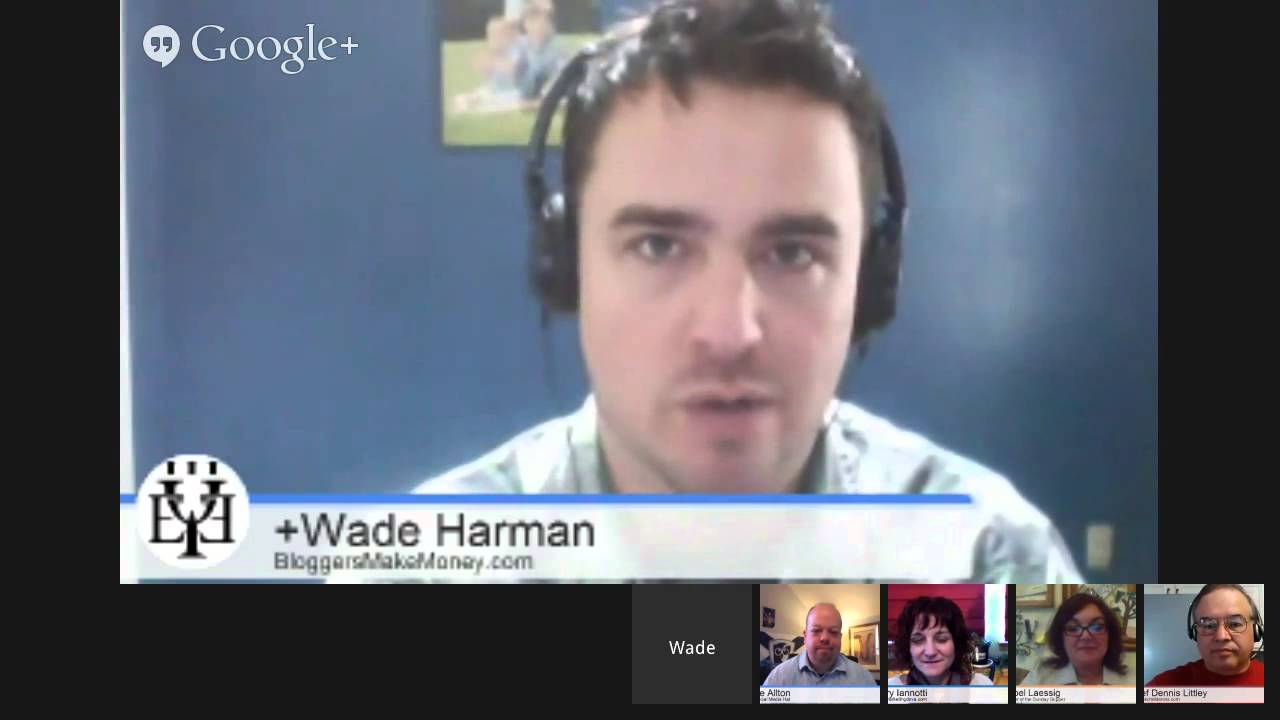
Chef Dennis Littley hosts Isabel Lacyk, Mary Ayanadi, Mike Alton, and Wade Harmon on Google+ to discuss building an online presence. They cover circles, communities, and scheduling tools, plus how to monetize and handle spam without losing authenticity.
Chapters
Hi everyone, it's Good Day Google+ and I'm Chef Dennis Littley. Thanks for joining us today for another version of Good Day Google+, another edition I should say. I have some great guests for you today. We're going to start and I will introduce everyone and then we'll get down to it. Today I have Isabelle Laysig, is it Isabelle? I wasn't sure about your last name.
Laysig.
Laysig, and she is from Sunday Supper Movement., and she's one of my food blogging friends. Okay, and we have Mary Ayanadi.
Hi.
Hi, Mary, thanks for stopping by. Mike Alton.
Hey, guys.
And Wade Harmon.
Hey, thanks for having me on the show, Dennis.
My pleasure. We have a great, great group today, a lot of information. And excuse me for one minute.
I'm really looking forward to outing Mike as the blogging group today.
You know, that was the funniest thing, like when I first started doing this, and I think I tell it almost every time, is when I started, I only thought of food bloggers, and then all of a sudden I'm meeting all these people and they're going, they blog, they blog. You have a blog? Really? You know, I just was like, I couldn't fathom that there were so many different topics for blogs. You know, it shows you where my head was as a chef. You know, I burned off too much oxygen oxygen over the stoves. My brain was affected a little.
You'll have to watch Mike, he'll be writing an article while he's doing the Hangout.
Cool, as long as the Hangout's mentioned.
Never do that.
I was just playing with you, Mike.
We're here for a nice relaxing day of just having a good time and all of my friends talking about what they do on Google+, what they do in life, or anything special that's going on with them right now. So we're going to start and For all the viewers watching, just ask your questions in the comment bar and we will get to them as soon as possible. So let's get started and have a good Friday on Good Day Google+. I'm going to turn it over to Isabel. There you go, Isabel.
Thank you so much. Thank you for having me, Dennis. This is wonderful and it's so nice to meet everyone else. I'm Isabel Lacyk. I am a blogger at Family Foodie. I'm the founder of the Sunday Supper Movement and I also hold an annual conference which Dennis attended this past year, and it's the Food and Wine Conference in Orlando, Florida. So thanks again for having me. I'm really looking forward to getting to know everyone on today's panel.
Isabel, you want to tell us a little about your Sunday Supper movement and how it got started and what it's about?
Absolutely. I actually started as a food blogger and really never thought that I would make a business out of it. I started blogging the day after my oldest left for college and I have 4 children, and I asked her, "What are you going to miss most about home when you leave?" And her answer to me had such a profound effect that after 18 years of raising your children, to actually hear her words that what meant the most to me meant the most to her, and her response was actually, "I'm going to miss the time we spend in the kitchen cooking together, uh, conversing together," and she said, "I can't imagine not being home." for Sunday dinner. And that's really where my journey started. I did my first blog post the day after she left for college, and it was my pancake recipe because we do pancakes for every celebration at our house. And I sent her off to college with a baggie of pancakes, and really that's where it started. I thought it would just be more of a memoir to my family.
Well, it's really taken off, and you've got national recognition because of it. And, you know, I see you really— a lot of people jumping on the bandwagon now. It was like a really aha moment for a lot of people.
Yes, absolutely. So what started happening, I had never blogged before and I started to get very excited and you know us food bloggers, we think it's all about the food blogs, right? Like you said earlier, you only thought about inviting food bloggers, so I thought of course everyone wants to read my recipes. What you realize as a food blogger, I'm assuming most likely as any new blogger, that you put things out there and maybe your friends and family take a look and your kids, and then you realize, wow, this is really lonely. How do I get people to my blog? I have no idea how I'm going to get eyes on this blog. But what I did notice was that every Sunday as I was cooking, I was taking pictures and I would do #SundaySupper, and I had a great response. And it was almost— we really started on Twitter and more people were joining every week. And then it got to the point that on Sunday morning we would all just pop in and 'Hey, what are you making this week for Sunday supper? What have you shopped for?' And it was really just done very organically. So after a couple of months of this and seeing that there was such an interest on what people were cooking on Sunday, I actually started reaching out to a couple of other food bloggers, and I thought, you know, I think I'm on to something. I would love to start a movement. It had such a profound effect on my family, and if we could get other families to at least dedicate one day a week to shopping and cooking and planning their meal, I think they would see the benefits and, you know, want to do it more often. So I reached out to 8 food bloggers that had become friends online, we had never met, and in January of that year, so it was January of 2012, we did our first Sunday Supper and it was a progressive dinner. And like I said, there was 8 of us, somebody took the appetizer, somebody took the salad, the main dish, the dessert, What we noticed was, one, we had so much fun planning a joint progressive dinner. Two, our audience— we reached a much larger audience because instead of it being one person, now there was 8 of us all promoting each other's recipes and conversing with each other's followers. That was really my first taste of, oh wow, if you bring a community together and you bring people together, look at the results and the response. After that month, we decided this was so much fun, let's continue to do it. We started off as 8 and just continued to grow and grow and grow. We are now reaching a weekly audience of 2 to 3 million followers, which is so hard for me to believe. Every week. We have a large community of food bloggers now. It's not just the 8 of us. We did the Food and Wine Conference because we wanted— so many of us were breaking bread virtually every week online. Wanted to meet in person and continue to grow our blogs and really turn those blogs into a business. So that's, that was my story of where it all started, and boy, has it been a great journey. Certainly has exceeded any expectations I could have had for it.
Well, you've really done an outstanding job with that, Isabella. And as being a speaker at your conference, lucky enough to do that, and attending it, I have to say it was probably the best conference I've ever been at. And for the first year running it, I mean, you, you just blew me away with And the people, I'll have to say, the people that were there that were your sponsors absolutely loved you.
Oh, thank you.
Thank you. Thank you. It was really a lot of fun. I'm looking forward— now that I live here, I'm looking forward to being more help to you on the next one.
Oh, thank you. We're already planning it.
I saw.
All right, let's turn it over to Mary now. Mary, let's talk to you for a little bit.
Oh, hi. Well, first of all, I want to say thanks, Chef Dennis, for having me on the show. I love your show, and it's really fun to be to be part of it, and to meet everybody on the panel and engage with all of you. So I live in fabulous Boulder, Colorado, and I help marketers and businesses create digital marketing and website strategies that improve business goals, find prospects, and retain customers. And I've had experience as a marketing manager for technology and healthcare organizations. Recently I completed a graduate degree in Internet marketing. And now I help companies specifically in digital marketing to create strategies, content, social, and search strategies to work in unison with their websites to improve business goals. And this fall I've actually gone on the road locally, gone out and I've done several local presentations about Google+. And I've had a great ROI on that time. And I just, I think I'd like to tell digital marketers and everybody in the Google+ community that you should take your knowledge out on the road locally and share it with people. Because we are in it every day and we understand the value of this platform and how it works with search, and how important it really is to get on it.. But many people don't. And they are really overwhelmed and confused about what to do with this new platform. So I think you can really help your businesses grow by just going out and talking to the community, and sharing your successes, and walking people through Google+ so it doesn't seem so overwhelming. And you can take your influencers with you, which is what I did, because I was a little nervous at first. But I actually got feedback from Jeff Dennis, from Stefan Haunainen, and Martin Shervington. And I just asked all of them to give me some feedback on how to build relationships with social influencers. And I shared that with my local community, and they absolutely loved it. They were completely blown away by it. And they were excited to get onto Google+. And I know that they understand the value of Google+ and how important it is to be on the platform. But they are also overwhelmed with how do I get started? How much time will this take? And I think as digital marketers, I think if we really want to help businesses be successful with their online presence, we have to help them get over that first step. You can actually see the fear and anxiety in their face when you start talking about, oh no, another social platform. What am I going to do? So I want to ask the people on the panel, what can you share with me that I can actually go back to my local community to help them take that first step, and to sort of time manage themselves and their businesses to get social media into their mix?
Good question. Mike, you want to tackle that first?
Sure.
One of the things that I love to talk about and teach business owners and really just other people in general is how much personal value you can get out of Google+. Once you start to circle the right people and you're putting them in the right circles, and we can talk about that in more detail, but once you get to that point, every morning, every day when you open up Google+, it's like a university. All these free articles and tips and posts and great graphics from people. If you're following the right people— it's amazing. I mean, at least that's how I feel every morning, and I know that's how a lot of my peers and colleagues feel. So I try to get my clients to that point where they're following influencers in their industry, people who are passionate about the topics that they're interested in, because that's the key, is to get whoever you're talking to, you know, Business Owner Joe, get him to the point where he likes using Google+. Once you get him to the point where he likes using Google+, it's going to be so much easier for him to use it as a tool to promote himself and his business.
Absolutely.
Great.
Wade, you want to talk about that a little and we'll go back to Mike for his segment?
Yeah, I would probably tell him to— probably the best thing that anybody could do, whether you're a Google page or just your own personal account, is to focus on the relationships. And not only, you know, everybody talks about building relationships with, with the influential people that are above them, but you not only have to build relationships with those people, but you have to build relationships with the people that consider you an influencer as well, because these are the people coming up behind you. And one of the ways that you can do that, I feel, that is Be consistent in your engagement, just like Mike said. Google+ makes you want to engage. Even the Google+ business pages, as me and Mark Traphagen discussed last night, they give you so much opportunity to be a real person on this platform. If you're not taking advantage of that, then you're really missing out on the whole point of Google+.
You know, Wade, I really like your comment. I know I love focusing on social influencers because I learn a lot, and I like building relationships, and it can really help you. But I also think we have to create engagement around our own communities. So I really like your idea. I also have a circle of people that aren't influencers, but I try to engage with as much as possible. Just for that reason, to build me as a Google+ authority, but also just to create some engagement around my stream. So I think that's a great point.
Very good. All right, let's turn it over to Mike. Go ahead, Isabel. Sure, absolutely.
I come from a little bit of a different perspective, but I think that you might enjoy what I'm about to share. I recently just finished a 3-month campaign with an insurance company. Most people think, now what would an insurance company want to do anything around a food blogging community? But I think it was so important because they are American Family Insurance and they are property and casualty. So we partnered together and did a campaign for their policyholders and for their employees, and it was about bringing families back to the dinner table. And the only reason really that they partnered with me and came to me was they wanted to reach a larger audience. So even as a business, it's really important for businesses to understand that if they partner with the right influencers, social media influencers, they could get great results. So we did a live Google+ Hangout while I was out there. I went out to their headquarters and It really reached out to their audience and what they were looking for. And at the end of the campaign, we're doing an e-cookbook just as an added value for their policyholders. So I would say, when you're speaking to your customers, get creative. You know, think out of the box because there's so many different ways for us to engage through social channels now.
Absolutely, absolutely. Alright, Mike, it's your turn now. Let's talk about what you do with Social Media Hat and go from there.
Sure, sure.
I'm Mike Alden with the Social Media Hat, and I am a full-time blogger, social media consultant. I've been doing this full-time for over a year. Before that, I was mostly doing website development. I've been doing websites since the early '90s and found that I really enjoy to write I enjoy teaching, but mostly I enjoy writing and teaching about blogging and about social media. And those topics, honestly, they weren't really helping my website business very much, so I kind of changed my strategy last year, launched the Social Media Hat, and have been going full bore with that ever since. One thing though that I'll point out is that I'm actually kind of a closet food blogger. I have a blog post on my site from last year that I'm about ready to reshare. It's my grandmother's secret eggnog recipe for the holiday season. Jesse has been begging me to share my super secret minestrone recipe that I brag about on Twitter, but I've never shared with anybody. So maybe one of these days I'll add some more food blogging posts to my site.
There you go. Well, if you ever want to cross-post, I'd be happy to let you share one on my blog.
Ah, there you go. Guest blogging.
Alright, sounds good. Alright, let's turn it over to Wade now.
Thanks, Jeff Dennis, for having me on. My name is Wade Harmon. I am a full-time blogger at BloggersMakeMoney.com. I'm a social media writer and I do have a degree in psychology, so about 8 months ago I started to research some ideas on how social media and psychology are mixed in with each other and how you could use psychology in a social media update. I come into this, I come into Google+ with no followers, nobody following me, zero. Of course we all came in like that, I understand that. Some people brought people over from Twitter or Facebook. I didn't have any followers at all. And so what I started doing was I started taking some test posts and doing some theories on psychology in the social media update realm, if you will. And one thing that I found out is that everybody has something called reticular formation, and our attention spans are, you know, 8 seconds or less. And so when we can take that reticular formation and jerk people out of their normal way of living, or normal way— see, let me break it down for you. 86% of people that get on social media, the first thing they do is check their notifications, and then after that they'll go and look for people that are familiar to them. And if you're not, you know, if you're not familiar with them, if you're not engaging with them, then they're not really going to notice you right off the bat. You have to engage with that person, break them out of that particular formation. And, you know, and that's basically the way I've been building a following and just getting engagements and interaction on the post. I really have fun with it, and I like helping people Also with blogging too.
Well, I love the title of your blog. I mean, I think that's something that almost every blogger in the world would want to do is make money with their blog. What are some quick tips you can give us for that?
Well, I guess the first tip I could give you, whenever I first started writing for Bloggers Make Money, I had no idea. I'm an ex-coal miner. So I had no idea about the internet or anything. It's amazing that I figured out how to write HTML code. But the first thing that I did when I got that domain, again, I didn't know I should have started WadeHorman.com, but I didn't. I just knew I wanted to be a blogger and I wanted to make money, so I just rammed them all together and put a .com behind it. But one thing that I can tell people if you're first starting out, and everybody wants to make money. I mean, we're all here for a business and some kind of monetary thing behind it. Even though I enjoy the engagement interactions on Google+, I still got to feed my family. So when I first started blogging, I was writing about how much money I was making online, and I wasn't making a dime. And so I did the Mia Show, Christina Mia Show this weekend. One of the things that I had to do was really change my mindset of how I posted and then how I promoted on social media. It wasn't until I started telling the truth and being my real self was when money started coming in for me. People want to be helped. People don't want to be lied to. Right out of the gate, you need to be honest. Because that builds trust, which in turn can mean cash in your pocket later down the road.
Absolutely, that's a very good point because people want to see you as a person and want to know they can trust you. And that's one of the best things about Google Authorship is, you know, with them using this and wanting to connect with people rather than just a brand too, is they want that trust factor. And I mean, at first, when I first started blogging as a chef, we never shared recipes. And that day everything was a closely guarded secret. You didn't want anybody else making it as good as you. And then when I started blogging, I went, you know, every recipe has to be exact because I want everyone to be able to make it as good as I do at home because, you know, I'm not in a restaurant situation now and I don't want them to say, oh, his recipes suck. So it's that thing about trust, just like you said, you can't lie to people. And if I screwed something up, I would tell them. I'd say, oh boy, it came out terrible, but I figured out what to do to fix it. So if you tell them that and show them your occasional vulnerability, I think people tend to see you as a more reliable source. That's an excellent point.
In a sense, I was the exact same way you were. I didn't want to share my stuff or other people's stuff because I saw them as competitors. And so therefore I became on social media, Facebook, Twitter, I became a link dumper. And it wasn't because I just wanted to spam my links, I didn't really understand what I was doing at the time. But it's not about sharing your own stuff. I mean, I think I watched last week's show here, Good Day Google+, and 80/20 to me now is a bit much. I try to go out and find, you know, it's more like probably 90/10. You know, I think the more you can promote other people, the more that you can help the people in your stream, the more trust and reliability you're going to build your brand.
That's the absolute truth. It's not— the one thing you always have to remember is good content is good content. It doesn't have to be your content. If you can provide good content, you're providing a service. People are going to follow you because you're reliable and you show good content. So when you do post yours, they go— to borrow a phrase from my friend Mia— they go bat crap crazy when you post something of your own. And it really gains a lot of attention. That's definitely the way to go. Real quick, I want to acknowledge a couple people. Stephen— Stephane, I'm sorry. Stephane of Mannion is in and he said, playing off Mary Ionati's point about connecting with the more experienced users, I'm avoiding the influencers on purpose. Here's a tip: anybody taking their Google+ show on the road should have a go-to circle they can introduce people to afterwards. After their event, and that's an excellent idea. That's something, you know, you should say, you should follow these 10 or 20 people. Get somebody started with that. That's a very good tip.
Pin that.
And then also, there's one from Mick Sharp, we also need to bring on anyone new to the Plus as well, and that is again an excellent point. We need to drag them. I've been doing that with food bloggers for a while, is dragging them kicking and screaming.
Take 2.
I was one of those that you were dragging.
You know, it's been difficult, let me tell you. And one of the things when we were talking about sharing was food bloggers were also very closely guarded, their secrets to success. And then as they started coming on, I started meeting more that were willing to share how they got to that point, to point A. They still won't tell you very much what they're making, because that's a big secret. But they'll start to at least share with you how they got the process done. So it's starting to loosen up a bit because, you know, that's a big blogosphere, and there's a lot of it for everybody here. Alright, it sounds good. So what else are we going to talk about? Did anybody else have any questions for each other? Guys, if you have any questions out there too, and the viewers, please put them in the comment bar and we'll get to them. Go ahead, Mary.
I'd like to add something about blogging and sharing. I think it's really important to share because we're all co-creators now. There's not one It's just so much stronger when we all add to something what the end result will be. And that to me is what blogging and social media is really turning into. So for example, let's take food. I actually got a recipe that Chef Dennis shared for this butternut squash sauce for pasta. And I did it, and it was pretty good, but I felt like this is a better soup than a pasta sauce. So that was something that I could have like put out in social media and shared it and just made that recipe I felt like that much better. And that we can all do that now because that's what we're doing is co-creating. And we shouldn't be afraid of that because everybody who responds and shares is just going to make that better.
I think one of the best things you can do is acknowledge someone when you find something of theirs. Even if it's something they shared. You know, everybody is using that hat #ht to mention them. You know, what is better than mentioning someone, a friend, or giving them some exposure? You know, again, you're helping each other out.
I agree. One of the easiest things for me of the week is maybe do— I have a top Google+ post of the week that I share, and I'm taking the the people that I have found. And like this week was Martin Shervington was in there, Mark Traphagen was in there, and I just compile them all up into one Google+ update and show my followers what they might have missed so they can get it all there. And then like you said, I've mentioned everybody, gave them all credit for the writing.
Absolutely. Here's a little comment from Stefan. He wanted to plug— can I shamelessly plug the Closing the Google+ Gap community that Peg Fitzpatrick and Rebecca Raddatz run? Okay, if you guys don't follow Rebecca or Peg, you're missing out. Let me tell you something, they are great and they're a lot of fun to be around. So definitely thanks for plugging that shamelessly, Stephan. I appreciate that. Also we have Jeff Say, I hope I pronounced that right, share the minestrone recipe, Mike Alton, it might help boost your low followers numbers.
I think that's—
whatever it takes.
Whatever it takes, hey, everybody loves minestrone. Craig Fifield, local meetups are a great place to introduce people to Google+. I think anytime you can get out there and preach the gospel of Google to your friends— my wife just walks away now because she's heard it so many times. I'll stop anybody in the street and talk to them long enough about it. Mike, what have you found to be the best feature of Google+ for you with your social media background?
Wow, the best feature. Probably the ability to write really compelling content right on the platform. And now when I say that, I want to be careful because I'm not a big fan of blogging on Google+. I'm always telling my clients that you want to own your own content. If you're posting your entire blog post to Google+, you don't own it. But that said, Being able to introduce your own posts, or we've been talking about finding other people's posts, be able to create that commentary in a way that's far more compelling than any other platform. Because you can write an intro on Facebook and you can write an intro on LinkedIn, but you can't make a bold title, you can't do a lot of the paragraph breaks, you can't insert multiple links and do all the things that can make it an enjoyable read for somebody else and create that opportunity for discussion and engagement. Just the other day I had a guest blogger on my site who wrote about kids and being safe online, this idea of cybersecurity. And I shared the post to Google+ and I shared it to Facebook like I do every single post. And on Google+ there were, I don't know, 20-30-50 comments? I mean there was a lot of discussion about it— what were parents doing, did they think it was okay to spy on their kids, you know all these concepts going on. And on Facebook nothing.
Clicks, perfect!
That's all that I got. One of my friends on Facebook who I knew from high school he shared it to his stream on Facebook and he got the same response and he had written this really long extensive introduction. He honestly commented on his own post, "Man, I was hoping to get more input and comments from parents." I said, "You're not going to get that on Facebook. Why don't you head over to my Google+ profile. Here's the link to the post and there's a few more comments over there." That's what I'm really enjoying about Google+.
Facebook keeps shooting themselves in the foot too, every step of the way. They're making it harder and harder to be on there. Share and to use it and to really enjoy it. Google+ is changing the game so much, it's a whole different game here.
Yeah, absolutely.
Talking about— Mary had mentioned about doing local stuff. Do you do anything with local businesses in your area?
Do I?
Yes.
Yeah, absolutely. In fact, I started a Google+ community for St. Louis networking and I'm not really huge huge in the communities. I just don't have the time because I'm writing and teaching, but I need to do more. But I've been using that to help St. Louis businesses connect with each other, both me and them and each other, because there really wasn't a lot online in terms of St. Louis. That's obviously where I'm at right now. So I use LinkedIn quite often, in fact, to create that initial connection with people in my area. We'll set up a face-to-face meeting and inevitably I'm talking about Google+ the whole time that we're face-to-face and telling them how they need to be on Google+.
I think that's an opportunity that a lot of us could gain some exposure with and help us if we started looking more towards local businesses because they're going to eventually need to be on and they need somebody to really lead them on. So as a type of influencer on the platform, who's better than to lead them? You get some marketing companies out there, I see people selling Google+ and they have no background on Google+ or writing posts on it and you go and they have no, they don't post themselves, they don't do anything on the platform but yet they're trying to sell it as they are the quote expert. I think it's an opportunity for all of us to really look a little bit local and trying and bring more people on board too. It's a good way.
Mike, what is your typical customer or your typical client, I should say?
I typically work with small to medium business owners. Kind of my ideal client would be somebody who wants to learn and they want to be involved themselves. My preference is to teach them how to use these tools, how to speak with their own voice, you know, as Dr. Covey would say. So, you know, I can blog for a client, I can, you know, do their Facebook posts and their Google+ posts for them, but my real preference is to kind of lead them by the hand and teach them how to use these tools.
And do you find that most of your clients are doing any social media and you start them from the very beginning all the way through?
Yeah, most of them, you know, they're online, they may be on one or two networks, but typically if they have any presence at all or any activity at all, it's poor. You know, I had a client where they were on Twitter and they were tweeting maybe once or twice a week, and they kind of had the reverse wrong impression. They weren't saying anything about themselves. They were only tweeting other articles and links to other sites and businesses, so there was no value there at all for themselves. So Wade mentioned that 90/10 ratio. You still have to have that 10%, or there's going to be no ROI at all, and therefore you won't do it.
I always tell food bloggers too, and I guess it would go for business to some degree, if they've created posts before, everything on Google+ is new again. If you have all these posts, you can start recirculating them. What you want to do is you want to have some consistency, whether it's 1 out of every 10 or 2 out of every 10 or 3 out of every 10. You want to have some consistency so people know what to expect of you. I think at first maybe the ratio should be a little bit higher so you do get more exposure on yourself. Then as you grow and you gain followers, that's when the exposure can drop down to that 1 out of 10 or 1 out of 20 even.. But you do have to sell yourself at first and get aligned with some people that are going to do you some good. I like what Jenny Field here said about Facebook. Her island is shrinking at an alarming rate. Thank goodness for the international airport on Google+. That's a great one. Here's one from David Kuchner, Mike Alton, don't make Google+ your blog platform, drive people from social media to a site and platform that you control under your brand. That's a good point. Anybody else have anything they'd like to ask right now? Here's one from Craig again. The easiest way to find a true expert is to read their bio, they'll tell you right there.
There you go.
One way to find an expert is to have them tell you. So Mary, you're still fairly new to Google+ too though, aren't you? How long have you been on?
I've been on Google+ for about a year and a half.
Okay, well for me you're a newbie.
I am, I'm a newbie. It took me, before I was working in my own business I was working for other businesses and I got on Google+ and I didn't have as much time to devote to it, which is why there is a lag. I feel like I'm starting to catch up now since I can set my own priorities. So I've actually moved social media to be a much a much higher priority, which is a joke because I was working for companies where they wanted social media to be a high priority, and they told me that as a marketing manager, but there was always the lack of resources and the technology hurdles really. So for example, I worked for a hospital, and I was managing a Facebook page, but I couldn't get to the Facebook page because of their technology. So there is that issue when you are working with those mid-sized companies and those larger companies is you've got to help them get away from their own infrastructure, so to speak. So it wasn't until I started working on my own that I could really do justice with social media. And I just started spending more and more time on it and getting to know Google+.
It does take a lot of time, but there's a really good return on investment. Wade, how much time do you think you spend a day on Google+?
Dennis Littley.
Oh my goodness, never mind.
That's why I didn't want to offer.
I live on this platform, man. I love it here. I love it. I mean, it's just like I said before, it just pushes you to engage with people, and with engagements comes relationships, and relationships breeds opportunities, you know, just like you and me right now, you know. When you can get people to get close to you and build that relationship, then it makes them more responsive to your content. Google+ is driving you to build relationships. I love it here. I'm here all the time.
I think so. Me too. Mike, how about you?
Clients ask me that and I say, you don't want to know.
What do you tell them though?
They're asking the question because they need to know, they want to know how much time they have to time spent on social media before they get back to their real business. I totally understand that. Obviously, they need to recognize that this is my passion, this is my interest, this is my business, being on Google+ and other social networks. I'm on social media all day, every day. Some of it's for personal stuff. Anyone who knows me knows that I love Star Wars and Star Trek, so I'm in a sci-fi community. I'm watching for that kind of stuff and the latest movies and everything as much as the latest post from Martin Shermington. I mean, I want to know both those things. But from a client perspective, yeah, we want to make their daily commitment as minimal as possible because they do have the rest of their business to run and that needs to be their focus. So we try to come up with processes and workflows that they can follow. They're going to get up every morning and they're going to check these sources. Again, that's why I love having your circles set up so well in Google+ because you can just hop in your home stream or hop into a specific circle and see the stuff that people are posting and talking about that are going to be interesting to you and they're going to be interesting to your target audience. So it's easy stuff to reshare. And you can use a plugin for Chrome called DoShare so that you hop in in the morning and you find 3 or 4 articles that other people have been talking about and use DoShare to schedule those out through the day. Or you use Hootsuite to schedule your Google+ page and your Twitter and your Facebook page and your LinkedIn all at once and get that done. Then the rest of your day you're focusing on your business and you just have your ear to comments and mentions and replies and those kinds of things that can crop up during the day so that you can be active and participatory.
I know, this is— Stephane just said something, and that's what I was going to go with too, was you can do Google in 30 minutes a day, true story, but the more time you invest productively, the bigger your return. And that's usually what I like to tell people when they ask me How much time do I have to spend? And I say spend 15 minutes in the morning, 15 minutes in the afternoon, because you got to get them to enjoy it and you got to get them to really start to love it. And then after that, it's like us, we spend way too much time. Forget about it. Once you get hooked, you're hooked. But if you tell them that in the beginning, you're going to scare the bejesus out of them and they're not going to want to go on. So, can I have a question?
Can, can we also explain I try to explain that— because back to Mike's point where the businesses are saying, how much time do I have to spend on Google+ or on social media and then I can get back to my business? But I think the more time you start spending on social media, the more you realize this is your business and this moves your business. So that's the other thing I try to educate them. You know, you start with small chunks, but you'll You'll see that over time, back to Stephan's comment, the more you invest, the more you see that your business starts to become more on the platform.
Mary, I agree with you. I think so much of social media is really understanding human behavior and what makes people tick. And Wei, you probably have something to add to this coming from a psychology background.. For example, one of the things that we learned early on is, you know, in the beginning with having a community and wanting to get recipes out there and drive traffic to the blog, you know, we would be out there all day long just like pushing recipes. And I started really monitoring my followers' behavior, and we— a lot of our audience are moms, and what we found is the most important time that they're thinking about what to cook for their family for dinner is between 6 and 8 in the morning. They're getting on before they get the kids up and off to school. And then again in late afternoon, early evening, they're thinking about it again. And once we learned their behavior and what really makes them tick, it was so much easier to put out there what they're looking for at the right times instead of, oh, I have to spend all day long just pushing out information which, you know, at least for me in the beginning, that's what I thought. So I think depending on whatever niche of the business it is, it's really understanding what are their followers looking for and what time should we give them that information.
That's a really huge tip, Isabel, and that's why I talk to my clients about using tools like DoShare and Buffer and Hootsuite, not because we want to automatons on social media because it's so important to reach that target audience at the right time. And that may not be the time that you're sitting actually in front of your computer, you know. So if you're early at your computer but your audience is late morning, early afternoon, you don't want to leave that to chance. So yeah, that's, that's, that's a great observation. But you know, figure out where your audience is going to be. And publish them and test and monitor, as Stephan would say, and then change it and test some more.
Excellent advice. I think the one difference with Google+ as opposed to some of the other social media is good quality content gets reshared a lot more on Google+. It seems to anyway. So if you have a really good post, whether it's about Soup or whether it's about SEO and it's a good quality post, people are gonna pick it up and reshare it. So it's gonna be seen throughout the day. Now, like I find with Ripples, when I go in there to check who has reshared it and I thank them, I always try to stagger it a little so that I have the— because the post is gonna reappear again when I thank them in their post, so it appears more times at different times too. But, you know, good quality content seems to keep resurfacing on Google+ even over the course of days as opposed to just hours where like on Twitter people retweeting you or Facebook if you're lucky enough to get some shares nowadays. Here's a comment from my friend the Shan Man, Shannon Hernandez, I like to compare Google to the underground in rock music. This network is where all the cool stuff happens before it becomes mainstream. I'm not even sure I want to Google+ to go mainstream, I know that could be the downfall, but I think that's still years away from that happening. Jessica Duell, oops, Stefan Hovhannian says, "Investment directly relates to return." That's absolutely true. Here's my friend Mia Voss, she's going to be playing it again. Good to see you here, Mia, thanks for stopping by. But they were, they were talking about, about personalization a little bit with Mia being here. And people— and I had made a comment in her show on the comments about people do business with people because they like them. Of course they need the product they're getting from them, but honestly, we could find that same product a lot of different places, or we could get that same information from a lot of different places. But it's that personalization that really gets us out there and gets other people to do business with us. Have you seen that in your workings, Mike, in how you advise businesses? Do they know that?
Yeah, I've seen it with myself and I try to share that with my clients. That's partly why it's important when you're on social media to have some personality. Don't just, you know, brute force share the facts and the information or whatever it is that you're talking about. Have some personality in your writing, have some personality in your other shares. There's a line there, obviously, and no one's really sure where it is, but you can get too personal, of course. But having that level of personality allows people able to kind of see behind the curtain a little bit, get to know you. I'm an old-time business networking guy, and getting people to know, like, and trust you is that key tenet to being successful in business. They're not going to get to know you, they're not going to get to trust you if all you are is hawking your wares. Definitely be personal.
Yeah, you don't want to become that snake oil salesman. Wade, you know, you said when you started you were doing a lot of link dropping just because you didn't know any better. How have you found since you've changed your ways, have you picked anything up on the other social networks? Have you adapted over there as well, or have you pretty much just washed them away?
I've pretty much washed Facebook off. I like Eli Fennell, he said a quote the other day that I loved, I laughed. He said Facebook was something that MySpace puked up on its deathbed. And so I thought that was a funny quote. And that's the way I feel about Facebook right now. I don't go on Facebook anymore. Twitter, I do. I'm on Twitter a little, but Google+ is where I live right now. As far as the link dumping, it's not that I didn't know any better. I did know what I was doing, but I didn't know how how it was going to work out. Mark Trepagan said last night in our Hangout, he said he was getting a lot of spam in his community, and so he went to this lady and he asked her, he said, you wouldn't go into the middle of a party and stand up on a chair and scream, hey, this is my product, come and buy this. And you have to be consistent. Consistently engaging with people. Going back to the point that you just made, in order for them to know, like, and trust you, you have to be consistent with engaging them. Let them remember who you are. Plus one, reshare, comment on their posts. Get that consistent, that memory factor going. And then when you share, like today when I did the top pics on Google+, I've got some people in there that will remember me for that. And so it makes— it just builds trust and builds rapport with your clients. And that's what I had to understand. It wasn't all about me, and I had to learn that quick. It's about everybody else but me.
Here's a good point. Jenny Field just said, nobody really knows where the line is, but everyone knows when you cross it.
Isn't that the truth?
Yeah, we can't find it until it's too late, that's the problem. Yeah, you really need to be personal and get that trust out there. There's a lot of things people do and I think it's they don't know any better. People coming onto Google+ thinking it's like everything else and they're, especially I see it a lot in food bloggers. Because that's the major part of my community that I engage with. And they'll just be dropping links. You know, I get people requesting to come into the community, and I look at everybody that wants to come in, and if they have dropped links in more than 2 communities and that's all they do, I just get rid of them. I don't even consider them. And thankfully now Google is registering those links as spam. Which is good for us, bad for them, because if you're a blogger and you're dropping links and they start getting registered as spam, you get enough of those, Google just says bye-bye, that's the end. Time to start a whole new brand. Oh, because yeah, you're not gonna get anywhere that way. Okay, Isabel, we were talking about trust and how we started and everything. It must have been hard for you— I know it was for me as a blogger, but you just seemed to explode with what you did. Trust had to be a big part of being authentic and being yourself when you started blogging.
Absolutely. I could remember just last February I spoke at the Cookbook Conference, and as you could imagine with something like cookbooks and authors, it was very divided. So you had the old school that was "this is how we've always done it, it's print, we don't need to go social media." And then of course you have the new school who was saying, "It's all about the social media, we have to do both, every author should have a blog, etc." So it was really interesting to be at a conference like that. I was on a panel, one of the questions that they said is, "I don't understand what you're doing." And I said, "Well, what do you mean?" And they said, "Aren't you promoting your competitors? This makes no sense." Sense to me. And I think that's the hardest thing for people to figure out, that when you're doing a community, it's about sharing, bringing attention to everyone, not just one person. But until you're out there doing it, and I'm sure that's a challenge with some of your businesses, people don't realize that. You know, no, I never felt that way, to be honest with you. So really, I think a learning curve for most people starting in social media.
That's a good point. I know talking about your competitors has got to be one of the hardest things to do, but again, if you can make that competitor a friend by engaging with them and getting to know them a little better, you know, it can work out beneficial for everyone because there is enough business out there. And unless you've got some extreme product, you know, that—
you know, and as our community has grown, Dennis Littley, we are working with more and more big brands. And honestly, I'm the first to say it, if it was just me by myself as a blogger, those brands wouldn't be coming to me. They're coming to us because now we have a large community of influencers that we have grown. So there is so much benefit in bringing people together and to work together. So it's just, it's a little bit different than I think traditional business was for a long time.
Excellent point. Very good. Well guys, it's been a great show so far. Anybody else have any questions for each other or anything you'd like to talk about?
I actually have a question for Isabel. Oh, go ahead, Wade. You can go.
No, no, go ahead. I'm sorry.
So Isabel, I was wondering if you could share anything since Christmas is coming up. Can you share any sort of recipe tips or cooking tips or something around the holidays?
Absolutely. Absolutely, I would love to. So I'm Portuguese, I was actually born in Portugal, came over when I was 6, and you know, one of the things with the Portuguese is we're really into tradition. And the biggest tip that I say to everyone, yes, it's about the food, but it's so much about that time and those memories created in those traditions that you create with your families. So for us, you know, we always have our bolo rei, which is the Portuguese King's Cake. And inside the Portuguese King's Cake, you always have to have a coin and a fava bean. And so whoever finds the coin while they're eating, that means that they're going to have a very wealthy year the following year. And whoever finds the fava bean, they have to bake the Portuguese King's Cake the next year.
Nice, nice.
Excellent. Wade, you had a question?
Yeah, I actually had one for Isabel as well. Isabel, whenever I share a post of mine, maybe 2 to 3 times a week on Google+, I have certain call to actions that I put inside the update. For the people to perform on Google+. Now how is that different from a food blogger? I mean, do you update, how are you getting people to come to your site or to perform some kind of action on your update?
I will tell you that's one of the advantages that we have as a food blogger. Everyone loves to talk about food, everyone loves to eat, right? New recipes. So I would say that's probably the biggest advantage of being a food blogger is people are really interested in recipes and clicking through to see if it's a recipe that they will try. The other thing that we do is at the beginning of every week, and I think this is a little bit more of what you were asking, you know, we do a lot So let me back up a little bit. I feel a little bit differently than some of you may. To me, the social media solution is about bringing everything together. So I tell everyone it's almost like a Ferris wheel. So you have Facebook and Twitter and email marketing and Pinterest and Instagram. So my campaigns and how I work is we bring them all together to work really well together. And one of the things that we we do is we announce at the beginning of every week what's going to come up. So for Weekday Supper, we know these are going to be the recipes, and our audience has learned to almost watch a little bit for it and to be excited about it because we don't reveal them all that day, right? We tell them this is what's coming on Monday, this is what's coming on Tuesday. So that's one of the ways that we do it. At the same time as we're cooking that recipe, we're Instagramming, again creating a a little bit of excitement so that they know that that post is going to come up. Instagram, I recommend that everyone have it hooked up to Facebook and Twitter. And so we're reaching like 3 different audiences and we continue that excitement and then also back it up with email marketing. That has worked really well for us.
Okay, so kind of like a sense of urgency in your updating.
Yeah, I think people like to be excited about things and if you give them those little bits of information while of course engaging with them. You know, don't just put it out there, but you know, with a certain season coming up, we might talk about, you know, what's your favorite gingerbread recipes? What's your— you know, like Mary asked, you know, what are some of your holiday traditions? We ask a lot of questions also to engage our audience, because what we found in our case is our audience likes to be a part of that community. So our community involves the bloggers, but it also extends to outside the bloggers. We have audience that feel like they're part of the community, and that's what we want.
Thank you.
You're welcome. Here's a question from Cheryl Erickson, and it says, if Google is marking links to posts as spam, how do you get individuals to your site if you should not make them Google your blog? Cheryl, it's not that you don't make them— you don't put your stuff on Google. What we're saying is those that are going into communities, and some people will go into, you know, 5, 10 communities and drop the same link in every community and then run. They don't do any engagement, they don't do anything else. So after you do that in 2 communities, usually the 3rd community, it goes into— you get a notification as a community as you, the person who runs the community or moderator, that this post has been flagged as spam. And then you have the option at that point of saying, yeah, it is spam, get rid of it. And just, you know, if they're not following your guidelines of your community, so Google is starting to flag them as spam. And then if I say, yeah, it is spam, and turn it in, and enough community moderators do that, after they get enough complaints on you for link dropping— that's where they take action on you. But if you're just posting your, your blog link on Google, that's fine. It's just when it starts getting into too many communities, that's where they're having the issue with it. So I wanted to clear that up for you. You guys have anything on that? You run communities, you do anything in your communities where people just link drop and stuff?
Yeah, in fact, I was having a conversation on LinkedIn yesterday about the differences between LinkedIn groups and Google+ communities and how I feel like Google+ is headed in the right direction in terms of helping moderators combat spam and making communities a great place. LinkedIn is headed in the wrong direction. On LinkedIn, they've got groups just like communities and you can put your links in there and do whatever you want. On LinkedIn, if a moderator marks you as a spammer just once, for any reason. That means that now automatically on LinkedIn, if you submit a link to a group, it's going to get shuffled into their promotions bucket, which is kind of the spam bucket, and you miss out. So there's a far greater chance for you to be flagged inappropriately on LinkedIn. Whereas on Google+, you know, if you share a link, one link to a community, and a moderator doesn't like it "Well, that kind of sucks." But there's no long-term ramification there. It's only if you're a true spammer, if you're putting that link into 2, 3, or 4 more communities at the same time, same link, then you're going to get flagged appropriately.
Do you find the groups on LinkedIn really have any—
really work?
Because I'm in LinkedIn and I don't really use it a whole I think they create those groups and then just leave.
Forget about it.
I agree with Wade. I think that the difference between Google+ and LinkedIn is the moderators on Google+ engage in their communities. They actually comment on people's posts, they spark the conversation if it's it's not naturally happening. And in LinkedIn, no one does that. It's like the moderators on Google+ got some training or something and the LinkedIn moderators didn't get any training. So they're not sparking their communities to come alive.
I think the community moderators and the owners have, feel an ownership to communities on Google+. It's like it's our baby, we're building it, we want it to be what we want it to be and we want it to share what we wanted to share and become. So maybe that's the difference where LinkedIn, you just set it up, you know, and I belong to other communities where it was kind of like that too. You would just set up a topic in a community post and then people would just leave stuff and I never went back to check because there was really no engagement. It was people just dropping links and making a comment and that was the end of it. You never really got to talk to them that quickly. Like, I'll make a comment here on Google+ and within seconds there's a response. Yeah, it's just weird.
I've actually created a relationship marketing community this week that I'm not trying to focus on people dropping links as much as conversation and engagement. This is not, you know, I've made it clear this is not a community to come and link drop. But it's more of a community to come and build relationships. I think that if we can discourage these people from dropping links, then I think hopefully they will stop spamming all these communities. Eventually they're going to get kicked anyway.
Absolutely. Absolutely. It is about being engaging and really being yourself and enjoying what you're doing. Because if you think of it as a duty rather than something you enjoy, you're not going to do well at it. You know, I have friends that are just so upset because they can't— they want to schedule something because they don't have time to come on. Well, don't bother then because it's not really going to gain you anything. Do what you have time to do. You know, if you can't find time, don't do something poorly just to do it. If you're going to do something, you should do it well.
Yeah, I agree.
I know, but I have made some enemies with those statements too.
It's funny.
Well, guys, we're coming close to the end of the hour on this. If anyone has any last thoughts they'd like to share for the day, now's a good time. If not, we're going to sign off. Isabel, anything you'd like to say in closing?
Thank you so much for having me. This was great. It was wonderful to be be here with everyone and I really enjoyed learning about your business and learning more about Google+ because I'm still a baby.
Now that we're relatively close together, we have to make an in-person connection again and do some work live.
I would love that, absolutely.
Mary, it's good to see you again. Any last thoughts?
I just want to say thanks and this is a really special HOA for me because I think you just make it a very casual environment, Chef, and people can just start talking. And I feel like connections among the hosts really blossom with that type of environment that you create. So I just want to give you kudos for this weekly show.
Thank you, Mary. Mike, it was very nice to see you live and in person here, and thanks for coming by. Anything you'd like to share with us?
Yeah, in fact Yeah, you didn't mention earlier, but for everybody watching, this is the first time Chef and I have ever talked.
Oh yeah?
That's what I love about these Google+ Hangouts. I don't do them enough, and I really appreciate you having me on here. We were able to talk for the last hour or so like we've been old friends.
Absolutely.
That's fabulous. This is a great time.
Thank you. That's one of the best features of Google+ Hangouts. Wade, very nice for you to be here and meet you in person, sort of, you know, virtually.
Yeah, yeah, thanks so much for having me, Chef Dennis. It's been my pleasure to come on. And if it's okay, I'd like to plug my Hangout. It's on Thursday nights called Relationship Marketing at 8 PM Eastern. And next week, next week I'm going to have Mike Alton with me and another special guest. So we're going to drag Mike on another one of these things.
Absolutely, anytime you want me, I'd love to come on with you too.
You're on the schedule.
Yes, sir. Good. And like I said earlier in the green room, I said the best part of these shows for me is introducing all my friends to each other so we can make more connections and have a broader range of community of people on Google+ that we follow. So it's a really good thing. I have a great time doing this, and that's why we don't follow any specific rules of what we're going to talk about. Let it go where it goes and see what happens. Alright guys, thank you very much for coming today. It's been another great day on Google+. So thanks for coming by Good Day Google+ and we'll see you again real soon.
Thank you.
Thanks.









