Good Day Google+ - Finding Zoe
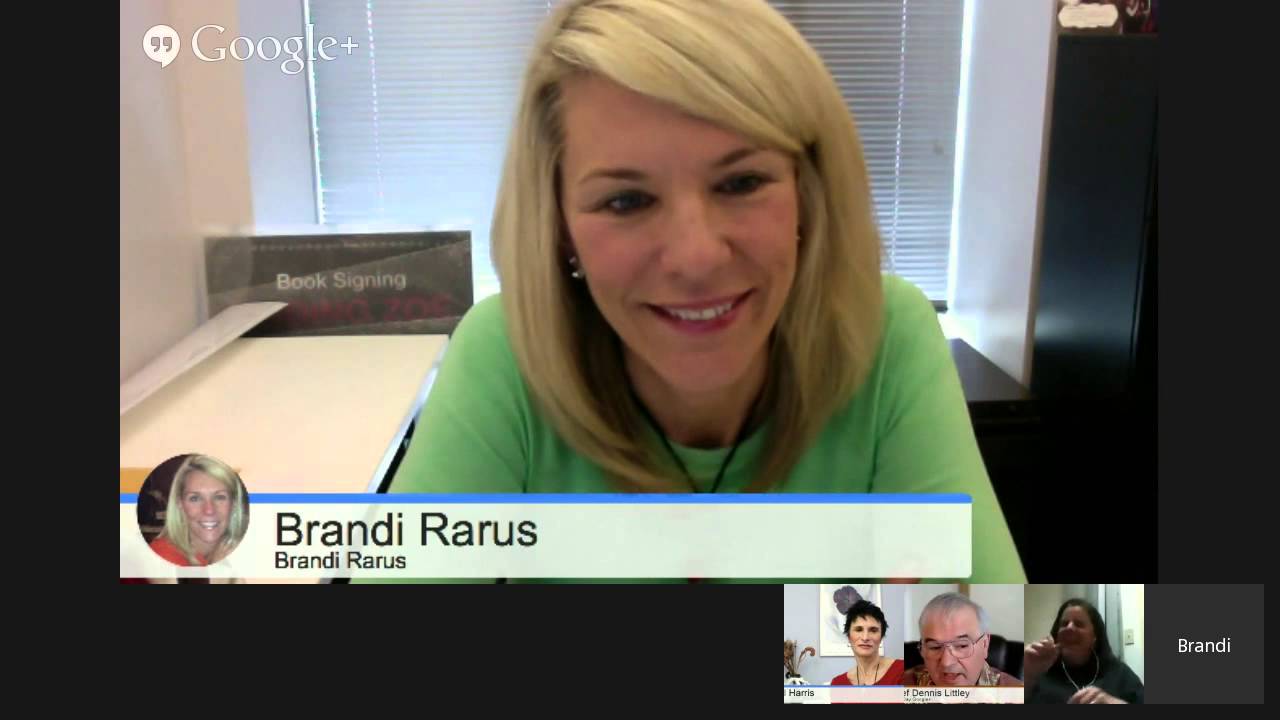
In this live interview hosted by Chef Dennis Littley, co‑author Gail Harris and memoir subject Brandy discuss their memoir "Finding Zoe," which intertwines Brandy’s personal journey from a hearing child to a deaf adult, the historic Gallaudet University uprising, and the adoption of Zoe—a deaf baby who had been placed in four homes before Brandy and her husband Tim adopted her. The conversation covers Brandy’s loss of hearing at age eight, her transformative experience at a deaf summer camp, the spiritual lens that guided the book’s creation, the extensive two‑year research and interviewing process undertaken by Gail, and the challenges and triumphs of raising a deaf child in a mixed hearing‑deaf family. They also touch on the importance of deaf education, the limited number of deaf‑focused colleges, and Zoe’s future aspirations. Throughout, the hosts and participants emphasize advocacy, cultural identity, and the power of storytelling to raise awareness for the deaf community.
Chapters
Gail? Yeah? Can you hear me?
Uh-huh.
I feel—
Hey everyone. Yeah, we're going live now. Hey everyone, I'm Chef Dennis Littley and welcome to Good Day Google+. We were having some technical difficulties, so it looks like we may not be able to have Brandy and Naomi join us, but we're going to talk to Gail Harris. In the meantime while they try and fix the connection and see if we can get it going. And I will start the show off with that. So thank you for coming. If you have any questions, please feel free to ask, and we'll get moving with the show. So let me jump right over to Gail. And Gail, how you doing today?
Oh, I'm doing great. We've been trying to get this working for the last hour, folks, so we're not giving up. But considering the circumstances I'm doing great. I just wish Brandy was here with me.
I know, I know. We had hoped, and you know, everything was working good, but you know, sometimes the things just don't work out as we planned, and the show must go on. And we're gonna have a good talk, and there's still a chance they'll join, hopefully. But if not, we will continue, and maybe at a later time we can get this rectified and come back.
Right.
All right, you and me, Cal.
There you go, you and me, Mom. So let me say hi to a few people in the audience. And Coach Moore is in the house. Hey, Coach, how you doing? Thanks for stopping by. Ron Sneeberger is here from Jupiter, Florida. Dave Pipe is in the house, and he is here from England. Lynn Sanders made it. Whoa, yeah, thanks for stopping, Lynn. I'm glad you made it in time. Marcus Dieterle is in. Hey, Marcus, good to have you here with us. Carmen Mandich is coming in. Great to see you, and it has been a little while. Yay! And Jane Anderson is here, and she's looking forward to it. We got a lot of people in the house watching, so I'm really happy about that. And so let's just get started talking while they're fixing things. Things are looking a little brighter on their end, so hopefully they will come through. So why don't you tell me a little bit about yourself and what you do, Gail? They fix this.
Well, I am a mom, I'm a writer, I'm an author, and the reason why I was looking so forward to this show is because this book that I wrote with Brandy, it's her memoir, her life story, is really just an incredibly amazing story.
I am—
it's the first book I have ever written for another person, actually. And it's the first time I've ever really worked with a deaf person. And, you know, just what I found out from this experience of working with Brandy has really been just absolutely life-changing. It just— I never knew what deaf people had gone through. I mean, they really were just not treated as human beings. They were unable to own property, unable to vote, unable to drive cars. Once I heard Brandy's story, I just felt so compelled. I just really was on a mission to get this book out there. It was just amazing. And another reason why it was so incredible for me is because I'm getting back to your original question. So my passion as a writer and author is really about connecting in with the benefits of spirituality in everyday life. And my first book was actually a self-help that teaches you how to trust your intuition and connect into it. And so this next book that I wrote with Brandy really, in a sense, was a culmination of all my writing to date. It really took all of my writing to the next level, being able to express my spiritual views and perspectives through telling Brandy's story. It's just been an incredible experience, and it keeps going, you know, just even like this with getting— deaf people have to go through so much just to, like, just going to the doctor, just getting things to work, like here today. They just have so much up against them. So it's really been a mission of mine to get this story out there and get it sold.
Well, you know, I can see that for a fact from what we're going through here. And like you said, the hootch to jump through just to do what we normally without thinking about. It's sad that it's at this level. Bringing it to light, I really enjoyed the book. I did read it. It was a great read, a lot of information, a lot of things that I sat and went, "I had no idea." So much of it that I had no idea that things like that were happening. It was really an eye-opener for me. I'm glad that I met you through here so I could go through that book and learn because we're never too old to learn something. It's never too— we're never one person. People say, "Well, I can't make a difference." Well, yeah, one person can if enough one persons keep saying things. It's up to us to try and do something about this and help wherever we can. I'm happy to have this show, and I'm happy to have Brandi and Aimee. Wanted to show people what we're going through to get the show up and running. So it's pretty good.
I know. It's amazing. I mean, I just have to say that hearing Brandy's story just about what it's like being deaf— and of course, I think a lot of people know that Brandy was actually Miss Deaf America in 1988 during a very critical time in deaf history. I just— when I heard her story, it just— I was just like on this mission. You know, like this book just became my mission to get the story out there. Randi is an advocate for deaf people, and during this critical time in deaf history, she really led the way with her husband during the Gallaudet uprising. I don't know if people realize this, but Gallaudet University is the only university in the United States that's specifically for deaf people, and it's chartered by Congress, by the government. And in 1988— they always had a hearing president of 125 years. From its inception, they always had a hearing president. And in 1988, the students closed down the school in protest because they just felt like, my God, it's time. You know, it's time we have a deaf president. And Brandy's husband Tim— this is all part— this is chapter 3, which is really one of my favorite chapters in the book. But so the students closed down the school in protest, and they won, and they finally got their deaf president. The Gallaudet uprising was actually on the 6 o'clock news for an entire week. I mean, it was a big deal. And Brandy's husband, Tim Rarus, was one of the 4 student leaders of the Gallaudet uprising. And so when this— when they got their deaf president, this became an inspiration for the Americans with Disabilities Act. And Brandy became Miss Deaf America right around that time. And so what was so incredible for me as a writer and a storyteller is one, well, just to hear about what deaf people went through generally speaking. I never knew a deaf person before, so I had no idea about deaf history. But when I read up on deaf history, just the story itself, forgetting about the major role that Branzee played in it and also her husband as well, but just Deaf history in general, you just would not believe. I mean, they had a real, in a way, a sick twist to their history. I mean, and things completely changed because of the Gallaudet uprising. But so to learn about Deaf history just from the storybook, you know, just from the history books was amazing. But then to understand the critical role, as I said, that Brandy and Tim played in it, and to bring them into the story and tell their story tell the deaf story from their personal perspective, it was just like this amazing experience for me because there are actually books out there, academic books that talk about the Balaadet Uprising, but none of them talk about it from the personal perspective of the leader, one of the leaders of the Balaadet Uprising, and also from this America during that time. So it was just an incredible experience for me. Writing this book on so many different levels.
I can understand that. I mean, it really is quite something. And one thing that I did have to laugh when I read was nothing— the action didn't take place until Congress threatened to withhold funding for the school since it was chartered.
Right.
And I went, oh, good, good. You know, there is some justice in America.
Right.
They got it. They got it.
But, uh, yeah, it was quite a compelling story, you know, going through the first parts of it that you wrote, laid the groundwork for what was to happen and all the things that were necessary for this to happen. And you have to believe in fate or some kind of higher power at this point because it was one of those things where everything had to be aligned just so for this to happen, for Zoe to become to go find the home that she was meant to have.
Right. Actually, I'll just add this part now because I don't think that we've said this yet, but the thrust of the story itself of Finding Zoe is Brandy's— how she found the daughter that was waiting for her and was meant to be with her for her entire life. Brandy had always yearned to have a daughter, and this is the story she actually came to me originally when we first started working together She didn't want this to be— she didn't even want to be in the book. She just really wanted to tell this incredible adoption story because Zoe, she was actually in 4 different homes by the time she was 8 months old when Brandy and Tim took her home. And that was— and it was an incredible story. I mean, this little baby was rejected 4 times from 4 different parents. And, you know, there could be so much judgment and blame about this, but The story that Brandy wanted to tell and the story that I wanted to tell was a completely different story. It was one really of perfection and how rather than focusing on the terrible things that people did, really just focus on how Zoe was guided from one home to the next and loved so completely until the timing was right when Brandy and Tim were able to take her home. So it truly was an incredible story, and that's the story that Brandy wanted to tell. And I remember when we first started working together, you know, she said to me, she said that she didn't want to be in the book at all, you know, as little as she could, and that the fact that she was deaf and Zoe were deaf had nothing to do with the story. So I'm like, well, okay, I'm open here. Let's see how it goes. And then, of course, when I began interviewing Brandy and also her husband Tim, and I realized the incredible role that they played in deaf history, I just— I said— I went back to Brandy and I said, I know that you didn't want this book to be about you, but I'm sorry, it has to be. This has to be your memoir. This story, it just— it has to get told, you know. Those of you who read the book understand that, you know, know that there are so many different levels to the story. You know, there is this incredible adoption story, this like divine— like you said the word fate, Dennis Littley— but just how everything had to happen exactly as it did in just the right time, as you said before, for Zoe to find where she truly belonged. And then there was Brandy's story, the whole deaf piece of her story, but growing up deaf in America and, you know, How do you, or how did I, you know, how do you merge those two? And from Brandy and I working together, she actually really came to see that her entire life she was being groomed to be Zoe's mother, you know, and that really became the thread that went through the whole story. And Brandy understood, she's a very good marketing person, very smart, and she realized that The book was so much— the story and the book itself became so much bigger once we shifted stories to make it her memoir and the adoption story a part of that. So it's been quite a— it's been a real journey.
You can tell there's a lot of passion with you about talking about this and how much it meant to you. And it's not just like someone who came in and ghostwrote a few things and fixed things. You were a big part of this story yourself. And you know, you put a lot of yourself into this, a lot of love into this, so you could share this amazing story. So I'm very grateful for that. I want to ask Brandi a few questions if we can. And Brandi, why did you finally decide to write this?
Hi, everybody. Well, I knew it was a great story when I brought Zoe home and realized that she had already been through 4 homes. And we were kind of led to believe that the reason why she was given up was because she was deaf. And I felt like it was a great story because, you know, she still needed to be in the right home and You know, we just, you know, I just felt like her process and her coming to us was a story that needed to be shared. You know, I feel like she was waiting to be adopted by us, someone who really understood the needs of a deaf child, that this would be a perfect family for her. I contacted Gail, and I wasn't exactly really sure how this story would turn out. So, you know, I wanted to share how important it was that deaf children find families if they're stuck in foster care and lost in the system. And, you know, I felt like Gail and I, back and forth in our journey together, we figured out how to tell the story, my life, my husband's life, the story of how our family came together. And how then eventually we adopted and brought this, you know, little person into our home and into our family. And so we felt like it was a really good, strong, passionate story that needed to be told.
Well, it is, and it's an amazing, exceptional story, and I'm glad you did. I wanted to ask another question. Now you have 3 hearing children as well, 3 boys, correct?
Yes, 3 boys.
And how did they react?
3 very active boys.
3 very active boys usually are.
How—
yeah, definitely.
They could already sign when you brought Zoe home? How did they react to her?
Well, all 3 of them were wonderful, really. They all obviously signed because both of their parents are deaf. So they signed with Zoe right away, communicated very well with her. And, you know, we always joke with each other as a family. That, you know, there are 3 deaf people in the family and 3 hearing people in the family. You know, so if we add the dog and the cat, then we have 5 hearing people and only 3 deaf people. But my boys sign, and, you know, communication in ASL is very flawless, and really it works well for our family.
That's great. I guess they helped in her development by being there to sign with her and helped her progress at an even faster rate.
Oh yeah, I would definitely say that for sure. Yep. And you know, all of the communication with all of the family members, obviously it helped And the other thing too that helps Zoe a lot is that she's around a lot of deaf adults that serve as role models for her. Because her father and I socialize with a lot of deaf people. You know, we're with colleagues and friends. My husband's entire family is all deaf people. So she has grandparents and aunts and uncles and cousins who all sign. So she does definitely have that interaction regularly.
I think what a lot of hearing people don't understand is that it's really important for deaf people to learn at a deaf school and to associate with many deaf people as well, because it— to me, it would seem like it helps enrich their lives and helps make them stronger people rather than try to adapt to just hearing. A hearing world.
Yes, yes, definitely. When we moved from Florida back to Texas, the reason for that was to get Zoe— to get Zoe into Texas School for the Deaf. So right now, unfortunately, the school and the county are going through a process where the school is becoming much smaller. There are only 5 large deaf schools left in the country and Texas is one of them. And so we have deaf families, many deaf families and hearing families as well whose kids go to the Texas School for the Deaf. And so, you know, we are, we really love the fact that she's in this environment every day with all this great stimulation where ASL is the language that is on the campus everywhere, prevalent. And also, I definitely want her to, I guess I would say, learn to be able to transition smoothly in between both worlds, you know, the hearing and the deaf world. Because, you know, to me, to be able to integrate into a hearing world is very important. She had a situation a couple of weeks ago where she hurt her eye really badly. We had to take her to the hospital. They had to put stitches in. And because she, you know, had an interpreter there, she could talk directly with the doctor through an interpreter without me, you know. And so we felt like that was very empowering for her to be able to communicate in situations on her own. And that particular situation was the perfect example of her being able to do that.
Very good. So, now, Brandy, you weren't originally deaf. You had hearing when you were born. At what age did you lose your hearing, and how did that happen?
Okay. I became deaf at age 8 as a result of spinal meningitis. It just happened. It was over a slow period of about 2 weeks. I was very ill. I do have some memory of it. I do remember being very sick, being in the hospital. I remember waking up and my first memory was really of my father trying to tell me all of the people who were thinking of me, who had visited me, who wanted to say hello to me. And I just remember when he was saying different names, I wasn't understanding him. And it was just silence. It was only silence. But I realized that, you know, kids are very resilient, and they just kind of keep going, adapt to whatever the situation is, and just kind of keep going. So I was that child. You know, I learned how to do it. I sort of moved on. I tried to, you know, I wanted to get my life back, go back to school, be with my friends. I wasn't worried about my hearing loss at all at that point. I just wanted to get back to life as normal, as I knew it. And I do remember shortly after that, I went to a program at school where there were some kids Hold on one second. The interpreter's asking for a little bit of clarification. So when I did start to learn to sign, then it was then that the ability to try to get myself back and forth into both worlds, that was the part of the journey that was beginning at that point.
Okay.
Well— Dennis Littley?
Yes?
I'm sorry to interrupt. This is Naomi, the interpreter. I'm wondering if you can help me again with making Brandy's picture larger on my screen again? I'm sorry to interrupt, but Brandy's really small and it would be easier for me to be able to interpret with her.
Can you click on her picture and put a white box around it?
Yeah, there she is. Okay, perfect. Thank you. Great. Okay, good.
My next question would be then, from, from your book, I understood that you tried to stay in the hearing world for some time almost pretending you could hear?
You know, I would say yes. I think growing up, I always struggled with my identity, you know, because I was born hearing, and that was the world I was in for 6 years. That was a big part of my life. My whole family is hearing. My language is not ASL. My first language was English as a hearing person. So that was a struggle, yes, sort of transitioning between both worlds and trying to figure out where I belonged and where I fit, you know. And so that really took a long time. It was a journey and a process. And I realized that, you know, the deaf world— eventually I realized that the deaf world was my home and where I belong.
What was the turning point that made you realize the deaf world was where you belonged?
Well, you know, I would have to say my defining moment, I guess, was when I was— when I was a sophomore in high school. I went to a camp that's called Camp Mark Seven. It's in New York. Please know, too, that when I was growing up, I did have some interaction with deaf adults, but not a lot. There were some— the teachers in my school were mostly hearing. So when I went to Camp Mark Seven, it was run by a deaf Catholic priest, and I went for 2 weeks went to this camp, it was the first time in my life that I was surrounded every day by only deaf people. The cooks were deaf, the counselors were deaf, the people that cleaned up after us, the maintenance people, they were all deaf. And for me, that was like, wow, a fully immersed world where I was. The deaf priest that ran this camp was a gentleman by the name of Father Tom One time while we were at camp, he asked us all, "How many of you are proud of being deaf?" And I remember sitting there and thinking, "I can't believe this man asked that question. Crazy." And he said, "You know, when God made people, it was a very difficult job for God because every person, each individual is so different. Everybody has their own personality, their own appearance, their own body shape. Everybody's different." So, to make it easier for God, he created one recipe. And with deaf people, he added one ingredient to make deaf people a special group of people. So being deaf is a gift to you from God. And that was a wow defining moment for me, that one simple phrase. And not really because he said being deaf is a gift, not that, but because it was the first time someone had actually ever said, you know what, being deaf is okay. You know, that was all that he said was something good, that it's okay to be the way you are. And at that moment, I realized I had two choices. I could continue to try to make myself a hearing person, which I never would be because I knew that I would never get my hearing back, or my second choice was to become the best deaf person I could possibly be. And so I obviously decided to choose the latter, and that was my aha moment, to answer your question.
Very good, thank you. And that's quite an aha moment, and thank goodness for Father Tom then, and for showing you that it was okay to be deaf, that you were still, you know, a special person.
Father Tom, I just wanted to add that Father Tom actually married Brandy and Tim. Those of you who read the book know that.
Yep, that's wild. Alright, so your search for Zoe. You had 3 boys, you wanted a girl. God wasn't cooperating at that moment because he had other plans for you. Which we never quite— I always remember hearing once, if you want to make God laugh, tell him your plans.
Right, right, right.
So God had other plans for you and for finding Zoe. How did you decide to adopt and to find Zoe?
Okay, well, it wasn't until after my third son was born that my husband said, "You know what, let's go to China." And at that time, there were so many baby girls waiting for homes. And really, my point was at that point, I just wanted a girl. The deaf part of it wasn't so much of something I was looking for. But in the process of adopting through China, we did a study. And it just so happened that the agency that did that home study was the same agency that Zoe's birth— that Zoe's birth mother went to. So when she became available, they contacted me and said, hey, we have this deaf baby girl, 6 months old. Are you interested? And I was like, oh my God, yes, of course I'm interested. So we went ahead through the process, and I want to say she came home with us 2 months later.
Yeah, there was quite a process in between that, what I read in the book, and a lot went on before you finally did bring her home. So, you know, it did end up with a happy ending, but there was a lot of hardship and heartbreak along the way.
Mostly for other people.
Yeah.
Oh, definitely, yes. For sure. And the interesting thing that I don't think I realized at the time, I truly didn't realize this because I was so focused on bringing Zoe home, that I didn't really think about how everyone else felt. You know, I didn't consider it at all. After we brought Zoe home, and we had her home for 6 months, I started to think about her birth mother and her birth father, and people that had adopted her and then eventually gave her up. And I have to say, I thought Gail did a really great job of representing their story. And her ability to share their voices, I thought, was very profound in the story as well. To Gail Garrett.
She did an exceptional job, and I know when I first read it and I read about the family that first adopted Zoe and the thought that they would give her up because she was deaf, I went, oh my God, how could someone do that? But then you have to think about how difficult that decision was for them to make, and if they hadn't made that decision, she wouldn't have wound up in a better place. So we can't think ill of people without thinking of the whole story.
Absolutely, yes. And I was the same as you, Dennis, because the mother of the first adopted family, she was a speech therapist. So I was really disappointed. A speech therapist who knew some sign language would give up a deaf baby Only because she's deaf? But then I realized, oh, she was so— I was so happy that she ended up in this particular home at that time, because then she could allow herself to be her true self, therefore allowing Zoe to be her true self, and then leading her eventually to the right home.
Do you still talk to the birth mother and birth father?
Oh gosh, yes. Both of them are wonderful. And Zoe was actually in her birth mother's wedding. I want to say it was just last month. About a year and a half ago. It was wonderful. She was a bridesmaid in her birth mother's wedding. And her birth mother had the baby on her— she now has a baby on her own. And her daughter's name is Adeline, or Adeline, and her middle name is Zoe. And so it does continue on, and yes, Gail and I both will see her in about 2 weeks. Gail and I are going to be flying out to Minnesota to help with a fundraising event at the pregnancy center that helped Jess, Zoe's birth mother, help her with her journey of adoption. We're in touch all the time, and we also keep in touch with Zoe's birth father and his family. And I have to say, he's a really exceptional young man, and all of these people are just really wonderful people.
That's great. How has Zoe— has Zoe thought anything about her adoption? As she— I know she went into an incredibly loving family with parents that wanted her and brothers that loved her, but has she ever thought about her birth mother and why she gave her up, or was anything like that ever come out?
Yeah, I think she understands a little bit of it. You know, one time she asked me, um, and her father, just recently actually, just 2 days ago, and she said, "Hey, I'm wondering if I was a boy and I was deaf, would you have adopted me?" So I thought, wow. Tim and I both were like, "Oh no, we wouldn't have adopted you because we already had boys. We wanted a girl." So, but It wasn't supposed to work out that way. It was supposed to work out exactly the way it was supposed to and exactly the way it did. So I think as she grows and gets older, questions will pop up, but she certainly does ask those. You know, I feel like she is really culturally deaf now and that the bond that we have with her will go way beyond the bond of hearing parents. Also, because it's a cultural thing. Very much a very strong cultural thing. And Zoe knows it. It's already a part of her. And I think that that is a bond she'll never be able to share with her birth parents because her birth parents are not deaf. And so it's a very unique bond that we have because of that. And it's all good for all of us.
I can see that. And, and, you know, I've seen pictures of the two of you, and she looks like your natural-born daughter. There is— I mean, I would not ever think she was adopted. You're like two peas in a pod, both blonde and beautiful. Gail, do you have anything at this point you'd like to bring up or ask or talk about? Well, about the journey, I mean, about writing the book. I mean, you were the co-author. How did you— when this was brought to you, what did you think? And how did you— did you think you were going to fall in love with this?
Well, of course I had no idea what I was going to embark upon, a 6-year journey. And just because beginning now a new phase of it. But when I had originally responded to an ad, actually, that Brandy—
Do you hear me reverberating?
No.
Oh, OK.
I just hear myself. So the reason why I was drawn to work with Brandy was because she wanted to tell this adoption story. And I, too, I'm an adoptive mother. So I was very drawn to the story. I, once I heard what that story was truly about, you know, really just the process of co-authoring this book, you know, Brandy actually didn't give me any written material at first. Everything we had worked on was just back and forth emails and on VRS, which is on the telephone. We didn't do much of what we're doing now. Now Brandy and I mostly when we meet we do GoToMeeting, so we see each other's faces and hopefully we get Naomi. Usually we hear her better than we can hear her today. But I didn't have the material really. I had to really go out and get— figure out what is this story, what does it really need to be. I knew that there was this adoption story I knew that the more I started talking to Brandy, I realized that, gee, the deaf component is really important here. So through the interviewing, I had to gather all the information. I had to do research on deaf history. And then I really had to figure out— it's such a complex story. You know, how do I tell this? There are so many different layers to the story. And once I got all the material there, I did my interviewing. I did 2 years of interviewing, and what I found out blew me away. After every interview, I would get off the phone with people, and I would just think, like, I can't believe what this person just told me. Like, the story, as a writer, as an author, the story just kept getting better and better and better. It was really amazing. So after 2 years of interviewing, now I had to write this darn thing, right? I had nothing on paper. So what do I do now? So I realized that the first thing I needed to do was get something down on paper, like a first draft. And so I interviewed everybody. I interviewed Jess, Zoe's birth mother, BJ, Zoe's birth father, their parents. The first adoptive family, Stephon and Sandy. I interviewed Brandy's parents. I interviewed Tim's mother, and of course, tons of, you know, many, many interviews with Tim. I mean, I have like 75 interviews, probably each of them are on an average more than an hour long. So it took me 2 years to get all this information before I even put a word down on a page. So then it was like, okay, well, now what do I do? I got this, all this information, how do I write it? And so I realized that the way I saw the story itself, there were like 3 different levels to the story. There was this incredible adoption story, which was really the stories of 5 people and how their lives became intertwined and became intertwined with Brandy's. Because of the love of this little girl. Then there was Brandy's incredible coming-of-age story and being deaf in a hearing world. And I thought of that as the story behind the story. And then there was this incredible force that kept moving the story forward, you know, what I call the lens of perfection, you know, how everything had to happen exactly as it did in just the right time for it to all work perfectly. Like, for example, at one point, Tim changed his mind. He was all on board to go to China, and then he realized, I can't do this. We have 3 kids. We never see them as it is. And he changed his mind. And of course, that was devastating for Brandy, and she went through her little deal there to try and get him to change his mind. But you know what? If he hadn't said no when he did, and then changed his mind and said yes, this never would have happened. I mean, the timing of it was so amazing. So that's what I mean. It's like this force. And I call that the story behind the story behind the story. So I had these 3 different pieces. And how do I get this all together? And frankly, at that point, I had my first draft. At this point, I was holed up in my office for 3 years working on this alone, and I had this first draft, and I knew I needed to consult with somebody at that point. So I brought in an incredible editor, John Nelson. He helped me to figure out how to tell the story, and I think it ended up working really well. But part 1 was setting it up with Randy's struggle being deaf. In a hearing world and fitting into neither, and setting that up for this amazing adoption story. And that became part 2. Part 1 was Brandy's story. Part 2 was the other people's story. And then part 3, it's actually titled The Roads Converge, and this is how everybody's lives came together, and so— and Brandy were brought together. And then the epilogue actually explains that story behind the story behind the story. I call it the lens of perfection, kind of like stepping back and seeing the miracle of the whole thing. You know, like, God created this. It couldn't have been created more beautifully. And the epilogue just sums it all up. I think it works pretty well the way it came out. But that was a big fight. How do I do this?
Did you ever imagine that it was going to take that that long in your life to write this story, though?
No, no idea. And it's funny because I remember, like I said, I was interviewing for 2 years. And my husband, sometimes he would think, like, well, get on with it already.
You know, like, get on with it.
Aren't you going to start writing? And I was like, no, I have to do this the right way. I have to really— there's so much depth to everybody's story. I just had to let it unfold and really trust the process, and I'm glad I did. And we're still continuing on now. Who knows what's going to happen.
Well, you know, another author may have taken the short and easy route and just put down everything like Brandy wanted, not told this whole complete incredible journey that was taken. So, yeah, it's like you said, everything happens for a reason. You can't question things, why they happen. You just have to kind of trust in your inner feeling and go with it and know that things are going to turn out all right because of your trust.
And you know what? That's the story. That's the lens behind the story through which we tell the story. You have to trust God. And in a way, that's why this book was so meaningful for me to actually write it because You know, my professional life and my personal life are very intricately entwined. I write about spirituality in everyday life, and so to be able to tell Brandy's story through that lens through which I view the world, that's what made this story so meaningful to me. You know, it just— so it didn't matter how long it took or anything like that. I just I just trusted the process, and I still am. It's just how I live my life.
I had a Chinese karate instructor that once told me— I asked him how long it would take to do this, and it was, "It takes as long as it takes." That's how you have to face a lot of things in life. Some things are easier to do than others, but it doesn't make them any less worthwhile or any more worthwhile. It just takes as long as it takes to do what you need to do.
Yeah, it's been the greatest experience of my life. You know, one of them, just worth writing this book. Very profound, very rich.
Well, good. And I hope to see more, and who knows what will come from this. And it would be, you know, I'd like to see it on the big screen, but that's just my personal wish. You know, I would—
we're working on that.
Well, good. Whether, you know, whether it happens, but it would be an amazing story that I think people would really love to see and would benefit the deaf community and me as a hearing person to know what's really going on because, like, you know, I— we have no idea. And it's not because we don't want to know, it's just we— well, maybe we don't because we don't try and find out more about it, but we need to bring it to the forefront. Well, this has been an incredible show. I am just thrilled to death with how this has gone. Naomi, you are the bomb. You are really amazing, and I have loved having you on. And Brandy, what a story, and I'm so looking forward to seeing more from you and hearing more from you. Pardon that use of words, poor choice of words, hearing more from you. But when now as Zoe gets older and she's adapting— how old is Zoe right now? Oh, wait a minute. It would probably help if I had you muted. I'm sorry.
Oh, okay. You hear me now?
Yeah, I can hear you. How old is Zoe?
Zoe? How old is she now, you're asking?
Yes.
She's— we adopted her when she was 8 months old, and now she's 11.
She's 11, okay. So she's getting closer to high school age, then she'll be thinking about college and where she'll want to go. Now, Tim went to Gallaudet, but you went to the school in New York.
Right, I did not go to Gallaudet, I went to National Technical Institute for the Deaf.
There you go.
So far, Zoe has been saying she wants to go to Gallaudet. She's very much her father's daughter in that regard.
Well, are there— have any more schools opened up since then, or is there more focus on the deaf community?
In terms of education, you mean? I'm sorry, can you say the question again, Dennis Littley?
Have any more deaf universities opened?— the focus with the influence as Gallaudet or—
No, not at all. But I do think that more colleges and universities are offering deaf support services, meaning they're offering interpreters, note takers, you know, CART or, you know, live captioning support for students. In mainstream universities. We're seeing more of that for sure, but there are only two deaf colleges in the United States at this point, and they are Gallaudet University and National Technical Institute for the Deaf. There is a third one in California that's called CSUN, but the thing and the point is that there are choices in that. So—
Is it better to attend an all deaf university university or to try and go mainstream with a hearing population?
You know, wow. You know, I think it really— there are many different factors to be considered. It depends on what you want to study. I think that deaf people today have a world of opportunity. They really can go to any college or any university as long as they have the right support services. You know, doors are open everywhere. I do think that an experience like NTID or Gallaudet in terms of a cultural experience is— there's nowhere else that can offer that. You know, it's the best, the best. I would not have wanted to go anywhere else because there's that cultural experience of bonding with other deaf people who are like you, and there is a value to that that's very hard to put a price tag on. At the same time, what I think is really wonderful and what's the best part about it is that there's choices for people to make choices that are better for them.
So things have improved. Things are getting better.
Yes, I would say so, for sure. You know, um, every day we continue to work to advocate for better access and more rights. It's an ongoing thing, and I think that as a result of that, Zoe will have many, many more choices as an adult than I did, you know, 30, 35 years ago, for sure.
Does she have any aspirations to become Miss Deaf America or Miss America?
Oh no, oh no. She is a complete 100% tomboy. Really, I did not get my real kind of girly girl with her. What she wants is to play football at PSD in the fall, at the school for the deaf where she goes. And I think I'm going to go ahead and sign her up too because she's really good. She's a good football player. So she wants to become a pediatrician, a pediatric nurse. Right now, that's where her interest lies, so we'll see what she, you know, decides to do as we move forward.
Great.
Well, what a great story, and thank you so much for coming on today and sharing it with us.
Yes, it was my pleasure.
Oh, and Naomi— Naomi, thank you so much for being here to sign and for helping us get through this, through all the trouble that we did have too. You're a trooper. Gail, thank you. It's been a pleasure getting to know you, and I'm so glad we had this time together to talk about it. And I, I'm so glad you answered that little ad I had about having people on Good Day Google+. So guys, thanks so much for watching. It's been a great day on Google+, and I hope you learned something today, and I hope you think about things just a little bit differently. Remember, we're all in this world together and we need to survive together. So think about your neighbor, think about the people next to you, and let's have a great day. See you all soon.









