How to be a Better Food Blogger
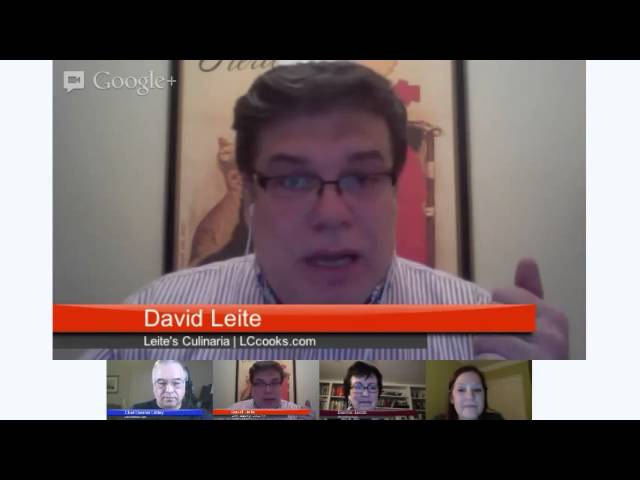
In this 2013 Google+ Hangout, Chef Dennis Littley moderates a round‑table with food writers David Leite, Diane Jacob, and Holly Hughes (with occasional input from Sarah Kate Gillingham‑Ryan) on how to improve food blogging. David outlines his "12 Steps" for stronger food writing, covering voice, specificity, ethical use of recipes, strong verbs, narrative arcs, character development, and the importance of copyright and Google Authorship. Diane focuses on headline crafting, lead writing, structuring posts, knowing your audience, using links, and maintaining a consistent voice and persona. Holly emphasizes copy‑editing, the need for posts that can stand alone, balancing personality with branding, and the role of humor and authenticity. The conversation also explores social‑media platforms (Facebook, Twitter, Google+, Instagram, Pinterest), engagement tactics (comments, polls, community interaction), posting frequency, dealing with writer’s block, oversharing, and how to generate ideas when working from home. Additional topics include definitions and best practices for vlogging and video blogging, the future role of Google Hangouts, the potential of e‑books, apps, and interactive digital cookbooks, strategies for pricing and marketing digital products, crafting effective About pages, and handling controversial subjects or personal beliefs on a food blog. Throughout, the panel shares practical, experience‑based advice, anecdotes, and real‑world examples to help both new and seasoned food bloggers create compelling, ethical, and audience‑focused content.
Chapters
Hi everyone, I'm Chef Dennis Littley, and tonight we're going to teach you how to be a better blogger with your food writing. And our guests tonight are David Leite, Diane Jacob, and we're also going to be expecting Holly Hughes and Sarah Kate Gillingham-Ryan. So right now I'm going to turn it over to David Leite and have fun.
Thanks, Chef Dennis. Hi everyone, this is my first time. I want to let you know this is your witnessing the deflowering of me on Google Plus, so be gentle with me. What I want to talk about is a couple of you probably have already heard this if you've been to one particular food conference, but a lot of people have been asking me if I would do it again, and these are the David Leite 12 Steps on How to Be a Bigger, Better, More Badass Food Writer, Food Blogger. And so there are 12 steps, and I think that we kind of touch upon some of the things that Diane is going to touch upon and some of the things that Holly and also Sarah will touch upon. And we also can talk about it more in depth. Each of us are going to talk for about maybe 5 to 8 minutes, which Dennis is going to keep the clock going, and then we'll have the last half hour, 45 minutes for questions. If you want to have questions, you can actually put them in the event stream and Dennis will keep track of that. So here we are, 12 steps. Number 1, Donna Summers and Barbra Streisand were absolutely wrong. Enough is not enough. And what I mean by this is that when you write blogs, you're writing a blog post, you you're writing first person, and I was told by an editor, one of my editors at Bon Appétit, that the reason why so many people fail at first person writing is they're not something enough. You gotta be bitchy enough, you gotta be funny enough, silly enough, witty enough, mean enough, kind enough. You have to be something enough that attracts people to what you're doing. If you're writing very beige prose, no one's really gonna wanna read it because you're not something enough. Like, we all go to Ruth Bourdain because she's really bitchy, or he's really bitchy, and we get something something from him. Or we go to Ruth Reichl because we like the lyrical quality of what she does. Or there are other writers that we follow because we like what they do. So it's important to be something enough. Now, step number 2: navels are meant to be— are meant for picking, not for gazing. And so ask yourself, am I writing about my life, or am I engaging in self— excessive self Introspection. And what I mean by this is that you should always write about your life, but sometimes don't use your, your blog as therapy. We really don't want to see you going through therapy. We want to see you struggling, but we want to see it distanced. We don't want to be so close. It's a little bit like someone giving birth and being right there in the, in the hospital room. We don't want to be that close to the birth, but we want to see the baby. So talk about yourself, but definitely don't get too self-engaged. Step number 3 is draw a line in the flour, not in the sand. And what I mean by this is that you need to make a decision of how much of your life and your world you want to share. And once you decide what that's going to be, stick with it. Don't start changing. Don't start suddenly introducing other people when you've decided to keep very close and keep, and keep your cards very close to your chest and to your vest. Don't suddenly blow open the doors, or don't suddenly have everybody in your life, in your blog, and suddenly just want to shut it all down to just you. Because your readers are going to get very confused. Now Diane has an interesting blog post on her blog today about— actually she interviewed me and The One talking about how much do you actually expose of your life and how much do you want other people to know and what that boundary is. So it's actually a very interesting post. Now step number 4 is it's not all about me, myself, and I. Now this is different than step 1. As tempting as it is to write all about yourself, don't. Because the best blogs are ostensibly about food, but really, when you think about it, they're about things like loss and regret, love, joy, patience, bigotry, hatred, forgiveness, whatever it is. I wrote a blog post, you know, it was a blog post, um, God, a long time ago, uh, when it was 9/11. And for me, it was— I had recipes in there, but it was about healing, trying to deal with what happened with 9/11 and trying for all of us who had just escaped New York to get together and heal each other. Some of them actually were down there and had seen what happened. So, you know, there are recipes in it, but who cares about that? Really, underneath, it was about something greater. Now, this is the most important step for me. This is what I do, and I actually have all these steps with me whenever I write, but number 5 is the most important for me, and that is think fiction Write nonfiction. What I mean by that is sometimes when we're writing a blog post, you just kind of going along and saying what's coming to your mind, that stream of consciousness. But some of the most successful and the most interesting blog posts and blogs for me are those that actually have the elements of fiction like plot, setting, character, conflict, symbolism, point of view, theme. When you bring all of those things together in a very conscious of them, you can start shaping your blog post one post after another after another, and each blog post can have a little bit of a narrative arc. But when you step back, you realize, gosh, I've been dealing with composting— I don't know, I'm using that as an idea— over the course of like 5 or 6 months, and there's actually an arc. Or the fact that you and your spouse are arguing because one of you wants to eat vegan and one of you doesn't, and you realize that there's all these small arcs and there's a larger arc through the whole whole situation. So think fiction while you're writing nonfiction. That doesn't mean you can make things up. I'm telling you right now, do not make things up. It's taking the facts and dealing— using the facts as if you were writing fiction. And then number 6 ties into that, which is called Characters Are Welcome. Building upon the thinking fiction idea, write nonfiction but populate your posts with these wonderful characters. Think of the people in your life— your spouse, your boss, your mean next-door neighbor, your kid anyone, think of them as characters, because I find when I think of the people in my life and in my blog post as characters, I'm much more likely, believe it or not, to give them more life. I tend to flatten out the people in my life when I write about them factually in the sense of just these are the people. When I think of them as characters, I give them more dimension. It's just, it's something that happens to me. Maybe it won't happen to you, but I found by giving more dimension to these people they actually become more who they are, but I kind of went through the back door to get where they actually are. Step number 7, if you all were raised on The Brady Bunch, as I will— I was— you will understand this. Here's a story of a lovely lady. We all love stories, so please tell stories in your blog posts. We've been telling stories since the beginning of time, since the beginning, since, since man could sit around fire and talk. The Greeks were telling stories, and we still read those stories. There's a reason why, is because we, I think, are just built for stories. And the more you can tell a story with character, with plot, with conflict, and then you're not talking too much about yourself and you're thinking fiction, I think it's going to be so much more enriching for you in your blog posts. And then number 8, step 8, is strong language welcomed here. And I do not mean blue language or cursing, although many And if you do use blue language, God love you. I chose not to. Now, I curse like a sailor. Ask Diane Jacob. I curse like a sailor in my real life. But what I mean by use strong language is use strong verbs. Verbs are sort of like the muscle of a sentence, and they can catapult a sentence to something higher. Don't rely so much on adjectives and adverbs. They're kind of like decoration. You know, they're like really kind of like a bad outfit on someone in the gym. You know, you want to be— you want to have sentences that really use verbs in a very powerful way. Now, Diane and I have been arguing about this about 3 years now. Diane, I think when I was saying this, she's like, yeah, it's not that important. It is important. For instance, when I wrote my cookbook, I decided to create a vocabulary list of what I thought all of the different foods do when I'm cooking them. So for instance, I listened to beans being poured into a bowl, and to me they clattered. So from that point on, I said, clatter the beans into a bowl. I took potatoes and I chopped them up and I threw them into a bowl or a pan or stockpot. I said, what do those sound like? And I thought, they plop. Potatoes plop, beans clatter. And I like to use very strong verbs because I think it makes it interesting, and it's just— it really is— it's, it's that nice meat of a sentence. And then so number 9, which is really a very unusual thing— people don't really realize this— the more specific, the more universal. And what I mean by that is the more specific you get, the more universal your piece will be, the more people will like it. And so for instance, I talk about my relationship with the one, you know, we're two— we're two— like I told Diane, two old gay men. We live in New York, we live in Connecticut. Who the hell is going to relate to that? But the thing is, when I get very specific about the arguments that we have, the places that we go right now, what 'One of our cats is very, very, very sick. What's going on with that cat?' People relate. So the more specific you can be— this doesn't mean that you're revealing so much more of your personal life, it just means you're being specific. People will, I think, relate more to that because we all, you know, nothing is really new to any of us, but we will relate more. Now, um, these are some more general things. Be a dummy, please. And what I mean by that is please go and buy yourself a copy of Grammar for Dummies. I have read so many bad— so many blog posts with such bad grammar and such bad structure and dangling modifiers and misplaced modifiers and split infinitives, and you go, this doesn't really read well. It doesn't mean you're going to lose your voice, it doesn't mean you're going to lose who you are, it just means you're going to be a little cleaned-up version of yourself so people can actually read it and enjoy it. And then step number 11 is when it comes to your work, copy, copy, copy. And I'm not saying copy other people. Put your— find a friend who's a copy editor and get it copy edited. Bring it to an editor and have an editor look at it to be able to get it to really work well. Diana is a great editor. She's edited some of my stuff and looked at my work, and she's very good at getting to the meat of what's going on. Um, also there's something called free— now talking about copyright itself Always copyright your work. Now, on the bottom of all of our posts on Leeds Culinary and also the David Blog, which is my personal blog on my site Leeds Culinary, everything is copyrighted on the bottom. But you can also go to something called myfreecopyright.com. So it's myfreecopyright.com, all one word. You sign up for an account, and then every time you have a blog post, you will get a message the next day maybe even that same day, saying that that has been copyrighted. That has been— that's the first time it's actually appeared online. And if I'm not mistaken, Dennis Littley can talk more about this, but Google authorship— all of you should get your verified authorship. There's talk that Google will use that. So when you put out a blog post for the first time and you're a verified author and someone else decides to copy your copy and take what you've done, they're gonna get dinged because they have proof that you were the first verified author of that particular material. And then the last one, step 12, is Bette Midler was right: God is watching us. All of you need to be ethical in your work. It's not ethical to just take a recipe from someone else, put it on your blog, do a couple of lines above the recipe, and then write the person who you took the recipe from and say, hey, guess what, I'm promoting your work. That's not promoting your work. You've ripped them off. You've taken the work and you're using it for your own purpose. Ask permission, or even better, take the recipe, have your experience with it, write a beautiful blog post about your experience with that person's recipe, rewrite all the directions in your voice. I would be thrilled if you did that with my work and then acknowledged me, but then made it your own. And that doesn't mean like changing a few words, that means completely rewriting it. Most people don't do it. It's a lot of work. Those people who do are gems, and those are the people I know that Google+ will be looking for as time goes on because they're looking for the best possible content. When they see duplicate content too much, they will ding. So those are the 12 steps. It's much easier than AA and AA or CE, CODA, Codependents Anonymous, not that I've been to them. So I'm going to pass this now on to Diane, who's going to take this these 12 steps and her experience and go deeper.
Thanks, David. That was great. That was really great. I am a big fan of Power Verbs. I think you and I are having an argument about something else. You're going to have to remind me what it is, but I love Power Verbs, and I think you're really good at them. So let me see, I've got my own list here. So David was talking about writing in general, and my topic is how to make Good writing work on a blog. I know you've— a lot of you are not beginning bloggers and you've heard some of this stuff before, but sometimes you need to hear it again. I know I do, and I've heard David talk a million times and I still am always entranced by what he's saying and aspire to be as good of a writer as he is. So the first thing is to look at your headline. It It's always really shocking to me when I look at my stats, how long people have spent on my blog. I know that a lot of them don't get past the headline. It's such a huge challenge to figure out what are you going to say that's going to get them to keep reading. I learned this as a newspaper reporter. Your job— first you've got to get them past the headline to the lead. Then you have to get them past the lead to the next paragraph, and then you have to figure out how to keep them going down to the end. And it's, it's a huge challenge. So the biggest thing is to just get them started by not clicking away. And you know, because your time is valuable, you've looked at a million headlines and you never get any further than that. So the best thing you can do is to cause some kind of a reaction in people. You know, David was talking about emotions. If you can get people to feel a sense of joy, anger, surprise, envy, indignation— otherwise you've got to intrigue them. You've got to entertain people. If you're funny and you can make people laugh by reading the headline, there's a huge chance they're going to continue because they're going to like you. You can ask them a question that they're interested in knowing, they're interested in exploring for themselves, what they know the answer to. If it's a recipe, you need to make people salivate, and you need to also make it specific. So, you know, cake is not specific. Cookies is not specific. I was looking at some of David's headlines on his, on Leeds Culinaria. Braised chicken with tomatillos is very specific. First of all, braised is one of those words that gets your salivary glands going. And plus tomatillos is a very specific word. It's not spicy braised chicken. It's braised chicken with tomatillos. So you know exactly what you're getting into if you read that. And you're intrigued because you don't see a lot of that kind of recipe. Chocolate thumbprint cookies. Again, there's a million recipes for thumbprint cookies, so chocolate, just a little twist that makes it more specific. So that's one of the things you have to aspire to as well, is get to the essence quickly of what your post is about and what's different and what's intriguing about it. Um, if you're the type of person who writes how-tos sometimes, you have to make sure that the reader knows right away that you're an expert on the subject. And you're gonna hold their hand. So if you say, "4 no-fail ways to melt chocolate," first of all, 4, they know that it's fast. No-fail means it's worth their while to read this because you're not gonna steer them wrong. So your job is to be reassuring and to be an expert at the same time. So now, okay, let's say they like the headline, they're gonna try it, they're gonna get to the lead. There's an expression in journalism that says that you have to tell people what you're going to tell them, and then tell them, and then tell them what you just told them. So in the headline, you told people what you're going to tell them, and now in the lead you're gonna tell them again. And it seems, sometimes it seems counterintuitive to be kind of repeating yourself like this, but people need reassurance that they're going down the right path. You have to make sure that your lead definitely reinforces the title. You're not going to start with, "I've had a cold for the past couple weeks. I haven't been blogging much lately." Wow, it was a It was the Christmas season, I really didn't get around to posting. You know, nobody wants to read that. Um, I've been wondering what to write about next, I thought I'd try this. All that is called throat clearing. Um, if you're an edit— if you edit your copy, you'll recognize it and you'll get rid of it. Um, so you have to capture the essence of the story right away in your lead., and so that readers can know where they're going. And, um, and like David says, it's got to reflect your voice. If— are you silly? I mean, a lot of the time Pioneer Woman is kind of goofy, and I love that about her. I love how she makes fun of herself. She talks about her terrible manicures, um, and I always expect that. I can I can read a paragraph of her writing in a class that I'm teaching and somebody will know who it is. And that's not so true of a lot of blogs. So whoever you are, you've got to be that person from the first paragraph all the way through. And so don't, you know, if you're writing your draft, don't worry about making the first paragraph perfect because you can always come back to it and work on it. I work on my— I probably change my lead 6 or 7 times in a blog post until I've got it where I want it. Even then I probably want to go back and change it some more. Sometimes you have to say enough is enough. When you get to the body of the post, blogging is fast so you can't make a million points. You're just going to make a couple of points. There's got to be one main point. David was talking about storytelling, which is a little different than what I do most of the time. I'm reporting on something. I'm making a list. I'm doing a how-to. I'm interviewing someone. But there still has to be a main point. You have to know what it is. I find sometimes when I read blogs that people don't really know where they're going. Meander around, they get to it and then they back up and they go forward and then they go in reverse. So just try and figure out what the main thing is, some subpoints, and then get in and get out. Blogging is not about everything, and one of the hard things when you're writing a post, sometimes you don't really know where you're going in a post, and that's okay. You just write down everything, but then you go back and shape it. Into whatever the main point is. So the other thing is you need to know who you are writing for. I think sometimes bloggers are writing for other bloggers. I had this conversation with a client where, um, you know, it's true that a lot of the people who are going to respond to your post are bloggers because they're a lot more comfortable than the average reader who's just looking for a recipe. But writing to other bloggers is different than writing to a home cook, and you need to decide who it is that you're writing to. So you could be writing to your girlfriends. It's another thing I like about— I was using Pioneer Woman as an example. She tends to write to you as though you're her inside friend, and you know her husband, you know her kids, you know that she goes to church, you know that her fingernail polish is chipped. So that's her way. You might be writing to people who love to travel or who have kids or have food allergies. Whatever it is, you need to know what it is they want from your post, because they— the more you know about your reader the more you can write to them and have them respond to you. I've got just two more points to make. One is about links. I like, I try to put a lot of links in my posts because there's so much more that I want to say, but I can't squish it all in there. And what I find is that sometimes somebody else has already said it. I like to link, I like to embed a link. If you're writing a post about food safety and you're writing about how to cut up a chicken properly, there's got to be a million posts about food safety. You can Google cutting up poultry safely, which is the same post that you're writing, and there might be a government website that talks about it in a way that's different from how you're talking about it. And you can link to it instead of repeating the same information that you can find a million times on the web. So add value by, you know, it makes, it seems to make your post a lot longer if you can add value that way. But you're not repeating information that's already out there. The last thing is, one of the hard things to do about writing a post is what I think is hard for a lot of people in general is writing a conclusion. It's easy, you know, leads are hard and conclusions are hard. I'm sorry, I'm using a journalism term for the beginning of your post, the first couple paragraphs is lead. And you'll see it's spelled L-E-A-D and L-E-D-E. So leads are hard and conclusions are hard, but one of the ways to get around it is to have them be related to each other so that your lead reinforces your conclusion. So is that you, Holly?
Yeah, I'm here.
Okay, you need to mute your mic. Do you know how to do that? Okay. You know, I'm so clueless about all this stuff. I really don't know. This is my second Hangout. It's David's first, it's my second. So we're all just trying to figure this out. I'm sure you're all going to be doing them also, or maybe you've already started, I don't know. But I hope you'll bear with us. Anyway, you don't want to leave your readers hanging and just have your, your blog post trail off. And one of the easiest ways to close is to somehow get back around to the beginning of your post and reinforce whatever you started talking about there. Otherwise, you know, you end up summing up and then you end up repeating yourself. It's kind of a challenge. So those are most of my tips. I'm sure we'll have more comments in the Hangout where you can write in things. Otherwise, I'll go back to Chef Dennis Littley. Thanks, Chef.
Thank you, Diane. That was great. All right, we're, we're doing pretty good on time here. Now we're gonna hand it over to Holly Hughes. Holly, you unmute and it's all yours.
Hi, thanks a lot.
Um, my—
when I'm looking for blog posts that I'm going to feature in the Best Food Writing Anthology, some of my— what I'm looking for is a little different from what makes a good blog, but a lot of the things really are just sort of general things that you want to do for your readers regardless of whether you're trying to appeal to that audience. One of the things that really struck me is that a lot of blogs have great photographs, they have great design, but the writing is still absolutely essential. For my purposes, when I reproduce things in The Best Food Writing, I'm not getting to use the photos, I'm not getting to use the designs. The writing really has to hold up. So I think everything that has been talked about so far here keeps pointing back to you've absolutely got to have things really well written. Remember that when I'm looking at things, I'm comparing them not to other blogs, but to things that have been published in books and magazines. —those have all been copy edited by somebody else. So it's absolutely essential that you copy edit yourself. And if you're not a good copy editor, find somebody else who can read it, who can say, "Oh, you know, did you realize you misspelled this word?" or "Did you check this fact?" because that's what you're up against.
Looks like we lost Holly.
We did lose Holly briefly. While we're waiting for Holly to come back, David, I did have a question. You talked about narrative arcs. Could you talk about that a little bit?
Sure. If everyone remembers their 9th grade English class, that basically stories have— oh, Holly's back. And I will talk about narrative arc later.
Holly, turn it back to you.
Am I back? Yes, you are.
Go ahead. Yeah?
Okay. I don't even know when I went out, so I'll just go back and finish that point, which is copy edit yourself and make sure, because you're being compared to other published things that have been—
Dennis? Yes, yes, David. What should we do here? This might be a little difficult. I feel like we're talking to somebody on the moon or something.
I can't tell.
We can hear you now.
Then my next point is that I will use a blog post that can stand alone. And at first you think, well, you know, I write a blog and so it doesn't really matter, but it's also important because you never know which of your blog posts is going to be the first one that a reader finds. So each one should be able to stand on its own, to have a story, as Diane was saying, a beginning, a middle, and a strong conclusion. You've got to get some of your personality into it. You don't assume that everybody knows the name of your significant other or, you know, what other things you've been— If someone had never read my blog before, what would this post tell them about me? Does it have your personality in it? You can't just assume that persona that you've developed for the blog is so important. It's got to be something a little different, but it's got to be you. It's got to be authentic so that every time you post you can write with that same personality and make it really come through. There's another thing. We talk about voice, and the persona is one part of it, but another part of it is simply that voice. How casual are you going to be? How gushy are you going to be? You need to be consistent blog after blog so that you're developing a brand. I don't blog about food. I blog about music. I know that when I sit down to the blog, there's a specific voice that I use just for my blog that's different from when I'm writing articles or books.. It's a voice that is a conversation with the reader. It establishes familiarity. It invites people in, and that's one of the great things about blogging is that kind of intimacy that it develops with your readers. You can't abuse that. You can't assume that everybody's reading your stuff all the time, that they know all the little secrets of your life. So every time you write a blog post, you gotta think, how am I going to invite people in establish that sense of familiarity. So when I am picking just a single blog post to include in the anthology, it still has that intimacy, that familiarity, that sense of a conversation, which is something you can get in a blog that you can't get in a magazine article. On a large form, it does actually work in a cookbook, but to be able to establish that post after post is a really important thing about not just attracting readers but holding readers and building a following, which is one of the most important things in the success of a blog. So those are the main points that I'm looking for. Besides, I like humor. I find humor is a great way to have that, you know, create that friendship circle sense that the readers of a blog will have. Not everyone can do it though, so if it's not something that comes naturally to you, don't strain for it. And you have to think, what are your strengths as a food writer? Is your strength technique? Some people love a blog that will hand-walk you through some difficult culinary techniques that they don't know, and that's a great thing. Are you talking about cooking or are you talking about dining out and enjoying food? Are you talking about what you do Do you go to the market, and what are you doing with the stuff that you bought at the market? You're not going to hit this the first time you start blogging. It's something that's going to grow. I think you've got to give yourself 3 or 4 months, up to a year, to start realizing what it is that your readers are responding to the most and to sort of groove your voice, your persona, and your subject. You don't necessarily know it right off the bat. Anyway, that's about all I have to say right now.
Thanks, Holly. That was really good. And thanks for hanging in there. You were a real trooper on that. We kept fading in and out. That's one of the things about these Hangouts is that you never know what's going to happen or when it's going to happen, and you just got to kind of plug along with it. But you did a great job with it, and that's some great information there. David, can we go back while we see if Sarah does make it back in? If not, let's go back to the question we had about narrative arcs for you.
Absolutely. I did hear from Sarah, and she said that she has tried everything she as she possibly can on several different computers, and it simply is not working, so she's going to kind of opt out. So basically, talking about narrative arc, as I was saying, in 9th grade English class, you learn about that sort of— that mountain about a story. There's the setting that starts, or the— I'm also thinking about theater too. There's the homeostasis. Then there's always some sort of inciting incident. An inciting incident could be, um, I'm trying to think of a story that we all know. Oh my gosh, um, a story in which someone, a stranger, comes into town and it starts the ball rolling. That's the inciting incident. And from there, that's where we start following the action. As the action starts going up, it starts going up, and there's these little conflicts that go up and go up and go up until there's finally a major climax in which The inevitable has to happen. There has to be some face-off, some showdown, some problem that has to be dealt with. And then once it's dealt with, once that release happens, there's that very fast dénouement, and there's a conclusion. I wrote a blog post last year where I almost set my house on fire because I was reducing— actually, I think Holly, you put that in Best Food Writing— I was reducing maple syrup to put into a a pecan pie. So homeostasis, me cooking, music on, cats all over, tripping over them. What's the inciting incident? Is all of a sudden the pan catching on fire and all this black billowing smoke. And as it goes up, there's the alarm company calling and me not being able to remember the passwords and the codes. And then suddenly the alarm for the fire department happens and there's the showdown where the fire department is there with all their gear on, and I'm trying to explain to them that, no, it's just— I really screwed up just a pie. And then the one came back with a friend of ours, and he starts chastising me. And then there's the dénouement that comes all the way down. And the reason why I screwed up is because I think that's that piece where I was taking pictures for Twitter and for Instagram. And so it ends up with a dénouement of— because I wasn't paying attention— that I actually took a photograph of what I end up making in the end. So that's kind of a mini arc. Sorry, it's a story that I know, just something I throw out, but that's, that's a narrative arc. And I like storytelling. I do. I think Holly said a very important thing. It's very good when a blog post can stand on its own because you want to be able to take it out from that entire strand. It's like basically, if you think about Downton Abbey, you take one episode of Downton Abbey out The one saw it yesterday, Sunday, for the first time. He's never seen it. He says, "I understand all the relationships." There was enough clues that were put in there that you understood the relationship, but it stood on its own. And so that's enough of me.
Great. Thanks, David. We have a question here for the group. It was from Jenny Fields, and she wanted to know what your thoughts were on beautiful photography, beautiful writing, but where the ingredients list starts with box cake mix, candy coating, pie filling, things like that. What do you think about that?
I'm not an elitist. If it works for their reader, you know, that's fine with me, as long as I know exactly which cake mix they're talking about. Cake Mix Bible has sold thousands, millions of copies and has had many add-ons, so it depends who your reader is. If your reader likes that, then that's fine. If you don't like it, then you're not going to be attracted to her blog.
Good answer.
Okay, we had another question was, how do you find a balance with what your readers want and with what you're getting good traffic on?
You want to tackle that, David?
Yeah, I think that's a very interesting question. What I do is I actually take polls. I poll some of my readers and say, you know, what is it that you have liked, what is it that you haven't liked. But I look at posts that get a lot of comments, and I wrote a post recently about— the one had a big birthday party, and I told our relationship in 13 cookies that Gail Dosik created. We had a lot, a lot, a lot of comments on that. Then I wrote something else that I thought was quite good. I got a couple of comments. So apparently people didn't like that. But at the same time, I want to balance what they like, and I want to balance traffic, but I also want to balance the stories that I'm telling. And so I think if you're true to yourself and true to your own personal narrative, your own personal story of your life, the characters in your life, and you're telling it consistently and constantly like Holly was saying, I think you're going to get those people who will attach onto your life and they will like what you're doing. And whether you're going on a great phenomenal vacation or you're in the backyard doing a barbecue, they're going to want to be with you. And I think that will get the page views that you want. Page views are really important, but I think we really should think about the content that drives the page views.
Great. I can sort of add one other thing to that. I know that in my music blog, you know, as an analogous thing, for a while I was doing things like, oh, I'll do a post on Bruce Springsteen because people will Google that and come, or the Grateful Dead. Oh, there's a lot of people who love the Grateful Dead, they're going to come. They came once. You know, I don't care for people coming once. I have a few people who check out every posts that I write and have a dialogue with me. And those are more valuable to me as readers. So I've stopped trying to chase, you know, the people who just Google you once.
I have something to say about that too. I was reviewing my book today for inspiration, and I interviewed David Leibovitz about what to write that he thinks would work would go to search traffic versus what he wants to write. And he said if he wrote about chocolate, every single time that would make millions of readers very happy, but he's not interested in doing that, so he doesn't care.
Good point. Okay, we had another question. We have another question here from Cassandra. The more personality you give to your blog, the more comments you will receive. How do you get more comments?
Ask a question.
Okay. I think also Cassandra, you answered your question in your question. I think that the more personality you give your blogs, the more consistent you are with your blog, the more comments you're going to get. For instance, we have a— my site is divided into the site and the blog. Now the blog is just me, that's it, and the site is the people who work with me. But we have a policy which is no comment left behind. Every comment is commented on, even if it's like, if they say, "Oh, I love this recipe, I'm gonna try it someday," we will write, "We hope you do, and when you do, make sure you come back and you give us a picture so we can see it." That's what we do. Not everyone does that. It's very time-consuming, I have to admit, but we have just got more and more readers who go, "You always answer. I feel part of—" and the word that we hear a lot, "part of the family." which is exactly what I'm going for.
I would like to add to that that a lot of writing is passive for the reader, which means, you know, you've experienced this as a reader. You go to somebody's blog and they say, well, today I did this, and then I did that, and then I did na na na, and I went to the French Riviera and you didn't, and I'm having a wonderful time and you're not. There's nothing for you to do. You're not involved at all. And the more that you can get the reader to get involved in your writing, you know, if your post about your grandmother's spoon, which the one wrote on David's blog, reminded people of their grandparents, then something active happened in the telling of the story. It's not just about reading what someone else did, and it's kind of hard to explain how to get other people that interactive in your writing, but it can't just— you can't just be writing about your own experience and then people read about you, you, you all the time. It was one of the points David made, actually.
Very good. Okay, we just had a question. I had a—
can I just answer a little bit? Go ahead. Sorry about that. I realized I was speaking to the group. I was muted. Cassandra, one of the things that Diane said is about asking questions, and I think that's a very good thing. I remember that Juan and I went to London this summer, and we had never been, so we were asking our readers where to go. And so they're saying, "Go here, go that, talk to this person." Now, Sadly, because I was so overwhelmed, I never wrote a blog post about London. It's still coming, I'm sure. I almost got hit by a bus, and he almost got hit by a bus. But it was so fun for people to send us somewhere. We went to a bakery called Outsider Tart, which was way outside of the extremes of London, on a reader's recommendation. And we have become friendly with the owners. So that's, I think, a very nice way to engage them. So as you're interactive. As you are writing the blog post, you take in what they do. It's like on Broadway there's a show called Edwin Drood where you vote on the ending because it was Charles Dickens and he died before the ending was done, so the audience gets to vote on what the ending could be.
That's a good idea. Okay, I just had another question. Someone asked, how important for the success of your blog is social media? That being said, which social medias do you think are the most useful? No takers on that one.
I have an opinion, I just don't want to hog the screen. Give it. Probably half of my traffic comes from me putting on Facebook and Twitter that I have a new blog post. I'm still figuring out how to include Google+ in that. I have to accumulate people and all that sort of thing.
I think that what's important when you're doing social media is not just, "Hey, I have a new blog post, come read it." I think very much like our No Comment Left Behind, you have to have relationships with those people. I don't follow as many people as follow me because I try to be able to understand what's going on. Married with Dinner, we have a bit of a relationship. I don't even know her first name, I can't remember it right now. Anita. Anita. We have this relationship that goes back and forth, and she was talking about her pork pies, and we shared that. And there are other people that we just go back and forth, and I really have met very few of them, but I engage in them. So when something comes out, they're much more likely to come visit, and I'm much more likely to go visit visit them. I think you have to invest the time and choose the social media that is right for you and your personality. Twitter is basically gone. You do it, it's gone. It doesn't stay there. Facebook takes a longer time to scroll off and you can scroll up and see it and there's more engagement there, deeper engagement, and G+ also has deeper engagement too. And I also do Flickr, I do Instagram, I do Tumblr, but I think that you have to choose the one that works for you. For me, they are— it's moving more toward G+ away from Facebook, and Twitter are really the big, big ones for me, and Instagram too. I use Instagram as a way of sort of in-between blog posts to keep people interested in what's going on in my life, to see that I actually am eating and I actually am cooking. That's what I do too.
Plus people share your blog post on Facebook and RT it on Twitter, which gives you an expanded reach, and on Google+ for that matter.
One thing I found though is when I do a Facebook post, people comment on Facebook and they don't get their comments on the site. They do. Which is a little bit frustrating. Sometimes I'll have 7 or 8 comments on Facebook and no one's commented on the blog, but sometimes I say, "Do it." It's still a relationship, and I just have some people who don't want to put it up on the site, and that's okay. They're still reading. Still getting views.
Sometimes I'll ask people, "Do you want to put that on the site? I think it's going to also help readers over there," and they do. A lot of them will do that.
Any thoughts on Pinterest?
Oh, God, Pinterest, yeah. Pinterest is amazing for driving food blog traffic.
Oh, it's huge for me. Driving food traffic. Actually, their food vertical, from what I understand, is one of their largest verticals, which is why they bought Punchfork. And then the gentleman, Jeff Miller, who created Punchfork, is now going over to Pinterest to be able to expand that and really work with what's going on at Pinterest. And I think we're going to see some very exciting things with Pinterest. I love Pinterest because it's— in advertising, we used to have what was called mood boards. Where you put up all this imagery when you're trying to create a brand. It's all about your brand. It's all about you as a person. If you go through all over Pinterest and you're pinning these things, people can really kind of read into your psyche by that. I think that's really kind of cool.
Yeah, I have a blog post on, you know, maximizing Pinterest for food bloggers. I don't think that's the exact title, but if you put Pinterest into my search box, you'll find it. It was written by a guest blogger who's done very well with it.
I'm afraid that we're missing some questions. I saw some earlier.
I just saw one again on Pinterest. It said, do you think that the traffic we get from Pinterest, though, is really people that are going to interact with us and come back, or do you think it's fleeting? I see David laughing.
No, I'm laughing because Adam Holland Wrote a very funny question. It has nothing to do with what we're doing, but it's very funny. It's about my glasses. A very nice line though, he says they're cool like the other side of the pillow. That's a very nice line, by the way. Congratulations. Cool like the other side of the pillow.
Hey, how come I'm not seeing that?
I don't know. Where is that? It just happened to be on the feed. I think Pinterest is here to stay unless there's some massive legal issues that happen. They're too strong and they're too powerful. Unless a major conglomerate like Facebook buys them or Google buys them. I think they're here to stay, and a lot of people are trying to copy their success, but I think that it's a very— I think it's a great place to be in my mind. And food— I watch the food vertical. I don't know anything personally. It's just a gut feeling I have that something is really going to be changing.
Stuff can go viral on Pinterest and suddenly 12,000 people have repinned your photograph of a stuffed mushroom. Then you try and figure out, well, what was it about the stuffed mushroom and how can I recreate that? You don't really know why, but because it's visually based, it's so perfect for food bloggers who are great photographers.
I just happened to see something from Laura Rucker. She says, "Nothing wrong with quick and easy recipes. Few people have time to make the fancy stuff. Just my opinion." I absolutely agree. I do quick and easy. One of the posts that I did in the very beginning of last year was a stew that I think that took all of 25 minutes. I like fast and easy too, and I think that if you honor it and not just— a lot of people just slough it off. It's like, "Oh, it's easy and it's fast." and their blog post reads easy fast. I think that's the mistake. You can have a very beautiful blog post about a very easy quick recipe.
Good point. We also had a couple comments about how to get over writer's block. Writer's block.
David and I have suffered with this, haven't we, David?
Yeah, and there's only one answer.
I don't know if you have too, Holly. There's only one answer, it's write.
It's that simple. I don't know about you guys. Plant your ass in the chair and write.
That's what someone once said. Well, you have to silence the critic, too. Somebody once made me write "I'm a crappy writer," I don't know, like 300 times because it was all I wanted to say to myself. I just— I wrote it longhand in a book in a class one time, just forever. And she's like, "Okay, did you get that out of your system now?" I mean, you do have to deal with your critic who's telling you that and manage your critic who is being extremely unhelpful.
And Holly, what do you do?
Well, I think that what I— when I talked about being your own copy editor, that is an entirely— I mean, you really have to, like, you know, part your hair on the other side to become that other person. You can't be the copy editor sitting down at the beginning. And I do, I have a lot of things sort of sitting on my blog in draft form.
Yeah, me too.
But I sometimes publish them and then say, you know what, I think I can do better. And that's one of the lovely things about blogging is that, you know, you can actually, sometimes somebody gives me a comment that's intriguing, I think I do actually have something to say about it. Instead of putting in the comments, let me put that up in the body of the piece. But as I said, Putting things in draft really helps a lot, and then go to bed and wake up tomorrow and say, "Oh, now I get what I was trying to say." And that's—
I think it's from Jennifer Farley who asked this. And Jennifer, some of the techniques actually that I do use besides— I was not really joking when I said plant your ass in the chair and write— is I take a shower sometimes when I have writer's block. I'm the cleanest person I know because something happens in the shower. I just just get ideas. Sometimes I'll walk the street with— now with an iPhone, but it used to be those little mini tape recorders— and just not think, just go and let it just happen. And sometimes a word or two or a sentence or a phrase like, "Cool, like the other side of a pillow," which I think is a great line, can start something. It can start all the tumblers tumbling. Sometimes what I've done is— do you know on Google+ when you see the ripples and it shows you in the middle and things go out like that. I will write, I don't know, birthday party, and then I'll write all the things that relate to birthday party that I can think of. Then I start circling those things that are more important to me, and then I start trying to do arrows and seeing if something comes up from that that might be able to help me just get a bit of a structure. And if that doesn't work, sometimes I just sit down and I do write, and I know that the first 4 or 5 paragraphs are gonna just suck. Just suck. It's the shitty first draft that Anne Lamott talks about. And then somewhere there's gonna be that one line and you go, that's where I start. It's the throat clearing that Diane says.
Well, it's funny, it's kind of contradictory because on one hand you have to allow yourself to be a crappy writer so you can get something down. Yeah. But on the other hand, you don't want to focus on thinking that you're a crappy writer so that you can't write anything. So it's kind of a mixed bag. But I have to say, when I was a journalist, I always looked down on people who had writer's block because I always had a deadline. I would have gotten fired if I had writer's block. I had to produce. I never really understood it until I became self-employed, and then I could either write or not write, and it was my choice. And I could just put it off and put it off and put it off as long as I want.
I have one correction. Gail Dosik, I'm terribly, terribly sorry, my darling. Gail Dosik did not do the illustrations on the post about the cookies. Gail Dosik created 13 original custom cookies for me. Just wanted to clear that up. Dennis, there's a really great question from Mimi Johnson. Did you see that?
No, I didn't. I missed that one. I have one here from Lauren King. I will find that though. She wants to know about how often you should post to get more followers. She's trying to increase —her following on her blog and Facebook and wants to know if you have any thoughts on that.
I worked with somebody who posts twice a day and she has astonishing blog numbers. Wow. I don't know how she does it. I think she doesn't sleep.
Who has that much to say in a day? She does it. That's wonderful. I really admire that. My last blog post which is not before Christmas, took me 2 to 3 weeks to write. Yeah, that's just how I write.
So I think one thing that actually has worked for me is to have like certain days of the week when people expect to see things, you know, and you give it a name, you know, this is your Wednesday, you know, I did a Wednesday roundup of 10 songs or something. And so people sort of, it becomes part of that day of the week for them to check in.. And that keeps you from that frenetic, you know, I have to post every day, which I think you drive yourself crazy with. And I'll do that maybe for a month sometimes if I have a special project.
Wow, that's great. I mean, one of the things that we have—
but I think having that one day so that they think Friday is associated with checking in to see what you're cooking for the weekend or something.
I mean, one of the things we have, and I'm lucky that we have it, is on the site we have on Fridays or Thursdays we do weekend projects. And then we also have Weeknight Winners on a Tuesday. And we basically publish a recipe because we have a different format. We work with editors of cookbooks and writers of cookbooks. So that's, that's an easier thing. But my blog post, I, I try very hard. My— when I did one of my polls, they said they wanted to hear from me 2 to 3 times a week. My life is not that exciting. I work at my desk for 15 hours a day, I don't have that much to say, so it's harder for me.
We did have a question earlier too. You talked about finding an editor to help you with your work to make sure that it's, it's the way it should be. Well, where do you find an editor? Where can you find help?
Wow. There are a lot of freelance editors, but you have to pay them. Sometimes bloggers, if you're friends with other writers, you can do a trade where you read each other's work, but then not everybody is good at editing.
Finding them is hard. I know that there are some writer communities online. I know that Renee Shetler Rossi, who was our editor-in-chief, belongs to one, and and she's an editor. And there— don't use her, she's my editor, she has too much work to do. But there are other editors on there, a lot of unemployed editors, of course, because— and copy editors— because the business is so bad.
You want a copy editor, right, David? It depends.
It depends if you really want to have a line edit where you really want to get down to the bones and the structure of what's going on, or if you feel it's in great shape, get a copy editor. I know, just something to pass on, when I began writing for publications, for newspapers and magazines— newspapers, forgive me, not magazines— that my first 6 or 7 articles, I hired someone for $35 an hour, and she took sometimes 4 hours, 5 hours, 10 hours to edit my stuff. I learned more with those edits than I did in all of high school, because suddenly language became alive for me. And I encourage you, if you can afford it, even just 1 or 2 pieces by a professional editor, you will learn a tremendous amount about your writing and about where your weaknesses and strengths are.
I have edited blog posts for people. One guy, after he posted, I would go in and clean it up. But the problem was, I mean, if there was a serious— I could only copy edit because if there was something seriously wrong or if I thought his lead was in the third paragraph, it was too late by then. I wasn't doing that kind of change. So, I mean, I do edit as a living, but typically I'm working on somebody's work before it's posted, or a book.
Okay, we did have that question from Mimi Johnson. It was, when writing a blog, do you use proper writing formats such as paragraphs, or should blogs be less formatted, less formal?
Well, I feel like paragraphs are essential because even more so, I tend to go for shorter paragraphs when I'm working on a blog in a blog format because the constant stream of copy can, you know, a solid block of copy is very daunting. I tend to break them up a lot more and to have even like, you know, one-line paragraphs. And sometimes my first draft, I'll go back and break it up into even more paragraphs just because it's easier on the eye on the screen to read something that's broken up a little bit more. I think where the informality comes is in throwing in little colloquial phrases, but I think you still have to have an organization and I think you still want— you don't have to have a topic sentence for every paragraph, but you have to have good segues from one topic to another. And I think there's— it's an art in itself. It feels more informal, but it definitely still has clarity and structure.
You know, I think, Mimi, I agree with— for my personal taste, I happen to agree with Holly, but I think it's really up to you. But if it's something that you want to do more stream of consciousness, more E.E. Cummings, I think you can never stray from that. I think suddenly if you start interjecting paragraphs and topic sentences, you're going to lose an entire audience. I think if you write that way, you have a tremendous, tremendous challenge because you have to let the eye move along those lines in such a way that they're capturing what's being said and what's being understood, as well as some beauty on the page as far as the language and the lines are broken up. So it's a challenging thing, but God love you if you can do it.
Great answer. Oh, can I add to that, please? Sure. And please be extremely judicious in your use of exclamation points and all caps. Oh, please. And italics. Italics, ellipses.
Yeah, you know, one of the things I used to tell my writing students is writing a blog or writing as if it's spoken word You just don't sit down and start dictating, because that's not what it is. To make it sound like you're actually just speaking and writing takes a tremendous amount of work, and it's actually very deceptive because you're writing and you're constructing sentences. It's like, it's like pearls, you're stringing pearls on a necklace. It's like words that make up sentences and sentences that make up paragraphs, and it sounds like you're talking. It sounds like there's just this voice coming out, but it's actually not how you speak., but it sounds like how you speak. And so I think it's one of those things that are hard to capture when you do it. It's really wonderful. Dennis, I sent you a question from, I think, Cassandra.
Yes, I did. I saw it, and it was a follow-up to the question about social media. And the question was, how important are the comments in judging the success of your blog versus the social media sharing, page views, and other metrics?
I think some of this is just what you want out of it. I mean, I want to have a dialogue with readers who are of like-minded tastes, and I would rather have intelligent comments that bring up new topics that start a conversation than have a lot of page views.
I mean, look, I, I like big numbers. 'Give me 550 shares and give me 2,000 Pinterest views,' and I love that, but in the end, the comments is where the relationship happens. They're not happening in the press of a button. You know, I like— if I like something, I like to try and like it and then write something because I want someone to know why I liked it. So I think that you should never judge the success of a blog by how many comments you got or how much social sharing you got. I think you should judge the success of a blog about the relationships you're creating and those very dedicated readers that come back and want to know more. Because if they come back and want to know more, there are other people like them who want to know more also. And you're building your brand and you're building your story. Again, that personal narrative. And to me, that's the most important thing.
Yeah, I, I've been looking at this question because I realize that On my blog, I have a list of most popular posts, and I realized that I defined most popular by how many comments I got, and that's not necessarily the right way. You could define it by how many people viewed it, right? Or how many times it was retweeted. But that's what I chose because that's what I like. I like having conversation. And I think people do get really caught up in whether they're succeeding, you know, whatever that means. And you can drive yourself crazy with that. And the bottom line for me still is, are you enjoying it?
You know what's interesting? I'm thinking about one of the blog posts that got, I think, the most comments, like 100-something comments. I wrote about my mother, and my mother gets on to start thanking people, and then people are talking to my mother, and my mother basically just pushed me aside, which she does in real life, just pushed me aside and started talking to my readers about me, which I thought was very funny, but it's say that's a great object lesson. It's about relationship and about character. She's a great character, and it's about relationship, and that will always get them, always get your readers.
Great answer. Okay, well, we had a couple questions, one from Nicole Pierce and then another one sounded in on it too. They work from home. Where do they find interesting things to write about?
That's a great question. Oh boy.
Who are the people Nicole and Who's the second person, Dennis?
It was Jennifer Farley. It was Nicole Pierce and Jennifer Farley.
Jennifer and Nicole, this is important and it's something that I've only started in the new— well, in December. I work Monday— well, Monday, Wednesday, Friday, Saturday, Sunday doing all the caca stuff on the blog, all the stuff you have to do, all that stuff. I reserve 2 Tuesdays and Thursdays for myself— oh God, oh, Tuesdays and Thursdays, I thought I was being muted. Tuesdays and Thursdays for me, and it's not like a spa day, but it's a day for me to write, it's a day for me to go to the farmer's market, it's a day for me to go out in the backyard and take a picture of a mouse, which I did and actually wrote a blog post about it. But I think you need to live, and I think you need to balance living with what you do. Because if you have no life, you have no blog. You have no blog, you have no followers. You have no followers, you have no money. And if you have no money, you can't have a life. So it really is very cyclical. So I think that you need to carve out that time to have a life. I think you need to do something, even if it's just meeting friends every Thursday for lunch and getting great gossip, and maybe that gossip's gonna trigger an idea. But you have to live a life. Of course, I'm saying this, and in the other room is the one basically snickering because he knows I don't have as much of a life as I should.
But so the question was also about how you get new ideas if you're working from home, and I think that you can get a little stale and isolated when you're working, working at home. My answer is get a dog and you'll be out in the park walking the dog. Exactly. And have some contact with people. It's brief contact, but they're going to have something on their mind and it'll jog loose a lot of the staleness that comes from being alone at your desk all day. Or going to the grocery store is another thing where, you know, you get out. You're still thinking about the kinds of things that you're working on, but you know, you're out having some contact with people in the community.
Grace, living a life, that's where the ideas come from.
Oh, I had something to say about that too. I think sometimes you have to think in terms of a storyteller. If you think every day, oh, the craziest thing happened to me, and try to fill in the sentence I saw the funniest thing today. It might be something that your kid did. Maybe you looked out the window, maybe you're on the bus and someone was doing something nutty. You know, try and fill in what happened. And a lot of the time we just take these things for granted. And this happens to me all the time where I'll read a story— like, I read a story about— I read a story in the New York Times last week about a guy who still keeps his old-fashioned datebooks. And I was so mad. I thought, I've kept my old-fashioned datebooks for years and it never occurred to me to write a story about that because I just took it for granted and he didn't. So, you know, he thought about it and he's just sitting at his desk working every day and he was looking at his old-fashioned datebook and he thought, you know, my husband keeps telling me I should I could start using my calendar, but I don't. I like this and I'm going to defend it. A very normal day-to-day thing, but it got him a piece in the New York Times.
Yeah. And also, someone once said to me, I was in a conversation and someone said, how can you be, not me personally, but you general, be at a table for 25, 30 years across the table from the same person every morning? You'll have nothing to say after like 2 years. And see, I think that's not true because you're not living lives. You're not going out there having separate experiences and bringing them back and sharing them. And think of that other person across the table as your reader. Go out there, have experiences, even if it's in the other room while you're vacuuming, vacuum the cat's tail, and then come back and tell that reader or that person across the table that story. But you can't be chained at your desk, and I am very guilty of that. You cannot be chained to your desk.
Another thing that I sometimes— I'm a great believer still in sitting down in the morning with a cup of coffee and taking time with the newspaper. Maybe you're not just picking up items, but they'll jog your thinking about something else. I still feel like it's not— the temptation is if you're reading this stuff on the computer skim through things, but you have to turn the pages. Makes you slow down, makes you think a little bit more. You look at the pictures a little bit longer, and that takes you out of where you are because you're reading news from all around the country. You know, I don't really follow sports, but if there's a good human interest story on the sports page, I'll start to pay attention to that. It takes me away from the things that I'm working on for just long enough to sort of let a little, little air into things, and that's where new ideas start to come in.
I've been scrolling this, I know that you have been too Dennis, there's a lot of questions and I'm afraid that I'm missing some and oh gosh.
It seems like it's just they're having fun talking to each other too so. Which is great. A lot of our comments, they seem to be enjoying this Hangout, amen.
I know there was one or two that I thought were really great and I thought I'll get back to them and I didn't copy and paste you.
Here's Kate McDermott just wrote, does a food blog Does a blog lose impact if a recipe is not always included? Or is it okay to blog about things that are not food-related, or should we always tie it back to food somehow?
Oh, Kate, I wrote a post for you. I think it was called something like, Sick of Writing Recipes? Try All These Other Formats. I got so many comments because writing a recipe is really time-consuming, and then you gotta photograph it and pick which photo. Then what if you have step-by-step photos? There are lots of other things that you can do. They're just as valuable. Why not? Then the subject of do you always have to write about food? Michael Ruhlman tried that in October. He wrote a post about how he was endorsing Barack Obama. He said, "This is my soapbox. I don't feel like talking about food. I feel like talking about this." and should he— he asked, is it appropriate for him to talk about this? And he got a huge response to that post. So, I mean, he had nothing to lose. He thought he should try it.
Yeah, I don't feel you have to stick with a recipe. I don't. A lot of times I do not have recipes, and I don't think you have to stick with food. I like to keep it somewhat tangentially related because I don't think if I suddenly came out with a sports blog post, I think people would fall over laughing. But I think that, you know, something that may be about travel or maybe about a pet— people I was noticing say they've written about their pets. I've written about Devil Cat, one of our cats, many times. And so I think that you can write about your life because you're not one-dimensional. Remember I said about the idea of looking at the people in your life as characters? Characters. Look at yourself as a character too. You're not one-dimensional. You just don't eat. You do other things. And I think that if it's related and it's character consistent, if you want to use that word, I think people will go along the ride with you. If it's not character consistent, meaning that it just doesn't seem like it's part of you and it's kind of forced, I think you'll lose them. But they'll go along for the ride.
I think you can get away from food occasionally if you have something really strong. I've heard some wonderful blog posts where a grandparent died and suddenly you wanted to write about that. Tangentially, you mentioned their favorite kind of food, but it's really about the other thing. I think if you do it too much and you're all over the place, you will lose your branding. People will stop feeling as connected to you or feeling that I come to you for X. I think it has to be really a strong thing if you're going to get away from food.. But I don't think people need to feel tied to always having a recipe at all. You know, I think there's a lot of other things you can write about food. If you are, you know, you can write occasionally about going out to eat somebody else's food. Why is somebody else's food always taste so delicious? You can talk about, you know, buying ingredients. There's so many other takes on food that aren't necessarily about the recipe.
Kate McDermott said, so you're saying to be authentic? Yeah, that's true. Really what it is, it's being who you are.
Kate, you're obsessed with food in so many other ways besides baking or cooking, are you not? So that's all fodder. She can't respond to you, by the way.
She can't talk. Sorry. Okay, question from Kimberly Beaulieu. Beaulieu, I love that. Question: How do you know if you are oversharing? Do you go with your gut? Diane, this is up your alley.
Oh boy. If you are writing about your little boy in every single post and you think everything that he does is really cute and what he ate every day, that is oversharing. I really don't care that much. I mean, it might be a good story. I just don't want to read about your little kid every single day. Sometimes there is stuff that's embarrassing. I have, I have written things many times and erased it that I thought I wanted to tell people, and then the next day I'm like, what are you thinking? No, you're not telling them that. There are just things that I don't want people to know about me. I mean, David is a little more David appears to be ruthless in self-deprecation, but that's not true. He has chosen which self-deprecating things, right? I mean, there's a limit.
There was a blog post that I wrote and I worked on very, very hard for a very long time. And when I told The One that I was going to do this, he's like, "Absolutely not. You cannot do that. You cannot open that part of your life because suddenly you're just going to hijack your blog. It's going to go somewhere else." And I said, No, no, they need to know who I am. And he pushed the delete button. He said, you cannot do that. You cannot post that. And I was very angry thinking, you know what? But now I'm so grateful that I did not share that. Not that I wouldn't share it sometime in my life. I'm sure that I will. I may even write a book about it, but right now it's the wrong time and it's the wrong venue.
I think also it's helpful to think of you having a persona. And I find this, you know, because in the, you know, as food writing, I have one persona. In my music blog, I have another persona. And in my mind, those are two very different, and I now have this sense when I sit down to write about one or the other that I know what I've shared about that one person, you know, the kinds of experiences that one person would be writing about. And neither one is all of who I am, but you establish that persona for that blog.
You know, Jeffrey Steingarten, I don't know if many of you or any of you or all of you know who Jeffrey Steingarten is. He, uh, does he still write for Vogue, uh, Holly?
You know, I don't read Vogue except to— Was it Vogue?
Which I thought was the most funniest thing. He's writing about food and horse fat and French fries in a magazine about women who don't even eat. I thought was the funniest thing, the most ironic But he said to me when I was interviewing one time, he says, you know, you create a persona. He says, mine is sort of like a little bit of the dolt, the village dolt, that I don't know something and I go out on a quest to find it. He says, I know the answer before I go out on that quest. But the thing is, I want to take someone along with me, so I go on that quest. He doesn't always know the full answer, but he's much more knowledgeable than than I think his persona. And all of us have sort of an online persona, and I think that's kind of that line in the flour that I was talking about. You make that decision how far that persona goes. It was very good that Kali mentioned that word persona. I love that word persona. And you have to make that decision what it is.
Okay, I have one more— two questions on basically the same subject. Laura Rucker wanted to know what your thoughts on vlogging were. And John the Chef also asked basically the same thing about Hangouts and what do you think their effect on the future is going to be. Are we going to be using them more? Are more people going to be using them? And that's basically a type of blogging, so on a different level.
This is for you, David.
Me? I think that— I think vlogging is great. The thing about vlogging to me is It's so in your face that you're right there, you're saying your thoughts, what's going on, and it's so extemporaneous, which is great. I'm not the best extemporaneous speaker. I like to be able to put my words together. I like the sound of words. I like the patter of words. I like the rhythm of words. I like to see how they clang together sometimes when I want them to clang together. I just like the look of words. And so I like to see it in print, but I do think that vlogging— well, you know, people have been vlogging for a long time, but they really haven't taken off very much. Although I do think Google+— Google Hangouts, I think, are going to change how we communicate about food. I don't think blogs are going to go away, but I think Diane can have a Hangout once a month or once a week about different elements of food writing. You know, I think we're going to communicate differently about food. I don't know if the medium is going to become what we do. I think it's— for me, I think it's going to be how we communicate.
Well, video blogging is a huge topic, right? I mean, it's not just us being talking heads right now. I mean, look at Chef John. He has a very successful blog, Food Wishes, if you haven't seen it, that was acquired by Allrecipes. DennisLittleyRecipes.com, where he posted recipes on YouTube like he had a little TV show. But do you consider that vlogging? Well, I don't know. What is your definition of vlogging then? Is it just what we're doing now?
Yeah, it would be like me sitting there and saying, guess what, I got up this morning and I didn't have any coffee, so suddenly I went out to Starbucks. There's this really cute guy there. Oh my God, you know, so I bought a croissant, he smiled at me. That's what vlogging is to— in my mind is that someone just talking to a camera as if they were just putting down their thoughts on paper. Oh, and then maybe something entirely different to other people. So to me, that kind of vlogging, that sort of extemporaneous talking to a camera, doesn't interest me. Now, what Chef John does, there's education that goes on. Those are, those are recipes that are there, and then you can use— to me, that's video inserting that enhance. It's multimedia in my mind. It makes a blog post multimedia.
Well, Laura was asking about how-to videos. She just clarified that, so that was her question on that.
That's your thing, isn't it, Chef Dennis?
Yeah. I've been doing Hangouts now for, I guess, close to a year, and it's something I never thought I would do, but Yeah, I think it's the future, and I think it's a great way to get information out to other people, and it's a great way to pull people into the community and into a hangout like this. Like, normally my hangouts would be open for a lot of things, and people can come and go, and that's a good and bad thing, but you get a lot of different feedback and you get a lot of different voices in that type of hangout.
I'd like to ask the group a question, and we can read these later. What is everyone's definition of vlogging because perhaps I'm living in the 1990s or the 2000s. I would love to know what people think is vlogging so perhaps I can then amend what I said at some point.
And we have another question here from Arlene Mobley and it's a pretty good one. It's about ebooks. What are your thoughts on ebooks and should we be giving them away to people or should we be charging them for them?
Diane. I thought a lot about that subject for my own business, let alone for advising other people. Sometimes if you want something from someone, if you want them to sign up for your newsletter, for example, some— a lot of people give away a small ebook as a reward for someone signing up for newsletter, something like that. On the subject of ebooks, it seems to me that you need to be a marketer. If you're gonna put an ebook on your website, how are you gonna get people to buy it? You need to be a relentless marketer, because otherwise you put all this work into something and you sell you know, 30 copies of it and that's it. So I don't think it's that different from being a published author in a lot of ways. I'm not talking about formats, but I'm just saying to get sales you need to be pushing it, you need to be giving it away, you need to be bringing it up, you need to be speaking on it, you need to have all these different methods of promoting. What do you two think?
Well, you know, it's interesting about ebooks. I kind of like jump over ebooks, and Holly, I would love to hear your thoughts on them. Although I don't really buy printed book anymore, I buy all electronic books, so I do read them. I don't read cookbooks, but to me, I think in the cookbook world or the food world, especially the cookbook world, I'm much more interested in apps. I don't know if anyone has seen Michael Ruhlman's Schmaltz. It's beautiful. It's a smaller book, but it's an ebook and an app. And I'm thinking that's where a lot of cookbooks are going to go. If we ever did anything, we would do something like that where it's interactive and you can download it, you can amend it, you can add something else to it. Food52 is doing something like that. The idea of giving away an ebook on your site is great. But it's a little added extra value. But, you know, what are they going to do with it if you want to sell it like Diane says? I mean, you write it once, which is great, and there's no overhead and you can sell it. But I don't know, it's one of those questions— that's a very good question— and I kind of stutter when I'm asked it because I just don't know where it fits into the whole scheme of things.
I did speak with someone who has written 4 e-cookbooks, and in a good month she makes $4,000 a month selling them. That's pretty cool because it's passive in that she's already written it. All somebody has to do is download it. It's not like she has to, you know, wrap it up and go to the mail— go to the post office and mail it or anything. So, but she must have a huge following to sell enough copies to come to that kind of money.
Diane, how much are the copies, do you know?
No, I don't remember. I want to get back to her and interview her about the subject for my blog.
Because to make someone turn over $2, $3, $4, $5 when they've been coming to your site for free, there's a block, I think. There's a wall you have to help them get over of why should I suddenly I'm going to pay for something when I've gotten so much from you for free.
Yeah, I think price point is important as well. You know, you don't want to charge too much, you don't want to charge too little, or they don't think it's worthwhile having. One good thing is that with ebooks, people don't trade them with their other friends. So if you have a low enough price point, you just tell your friend, oh, this is really great, you should download that, it's only $3 or whatever. I can't imagine, as David said, I think apps that are, you know, the interactivity is going to be much more important, especially in the food world. You just, you know, I think that the ebook is a little small stage, like a little blip, like a beta.
That's very good.
Depends what it is, you know, for my kind of writing, which is how-to, I could probably write Amazon has ebooks that are a maximum of 5,000 words. For me, that's a small chapter. It depends what it is. It doesn't have to be interactive.
Great. One of the problems with ebooks is being able to jump around in them. If you have something that has to be written— As soon as you require people to go back and check that last stage or that last— If you have to keep going back to your ingredient list It just becomes really clumsy.
I don't know if anyone has seen Donna Hayes' magazine, electronic magazine. I just get lost in it. It's just truly splendiferous and so is Martha Stewart's too. I love the interactivity. I love the animation. I love the video that goes into it but it's so easy to move things around because you're able to go through step by step by step and as you do it, it either highlights or is grayed out so you know you've done on it. And I think that really is the future. To me, that gets me very excited. But that's cookbooks, of course, but it gets me very, very excited.
My agent noticed that few of my sales— when I get the royalty statement, she noticed that few of my sales are electronic, and she asked me why. And I said, I think it's because people really like to mark up Will Write for Food and put little sticky things and turn pages over. And it's so much harder to do that in an ebook. I mean, you can't— apparently you can highlight things, and I wrote a post about that too, but it's not tactile in the same way where you can just turn to something you've marked up. Turned a page down.
I know with my cookbook they have the electronic version available, and of course I was the first person, I think, to download it. I was so disappointed because it just wasn't friendly. It didn't have that app feeling like Michael Ruhlmann's Schmaltz does. And of course this was 5 years ago or something like that, so they didn't have the technology then. And I never use it. That's the one book I always pull out and use. Not because it's mine but because I want to cook from it and I don't like the electronic version of it. All these questions coming in, my gosh.
There's still a lot of them are talking. We did have a question earlier from Laura Rucker again and it was about an About page and she wanted to know what should your About page say about you?
I wrote a post about that. You've covered everything. It got people so riled up. It's called "Are You Making These 3 Mistakes on Your About Page?" I wrote a rant about how upset I get when I discover a blog I like. I go to the About page and I don't know who this person is. I don't know where they live. I don't know anything about them. Their About page says, "I like balsamic vinegar and unicorns." It's just infuriating. I can't hear them say it in that voice. There's no photo. I don't know their name. I don't know how to contact them. It just makes me crazy. And so, there was a— the comments are really interesting because some people violently disagreed with me. Some people agreed. Some people said they didn't want to say their real name and why. And got quite a conversation going. But I just think at a minimum, please, put your picture and your name and your contact information.
Well, that's where, you know, the persona thing comes back in, because I want people to know, for example, that I come from the Midwest. That's a big part of who I am. That's a big part of my bedrock value. I'm not going to tell you the name of my grade school. I might not even tell you where I went to college, but I think that's kind of something about where I— the persona that I'm trying to do and how what generation I grew up in because that influences something about the way I approach music when I write about it. If you're writing gluten-free recipes, well then you kind of got to talk a little bit about why it's important to you to be doing gluten-free stuff. So I think you don't tell the whole story, but I absolutely agree with Diane. You need— you're trying to forge a connection with people. You're trying to bring them into your circle of friends. You've got to give some clues, otherwise they're going to think you're working for the CIA.
I mean, my About page, it's actually everybody on the masthead, that's what our About page is. You know, I did mine very much like a CV, something that you would read in prose form. And I did it because— now don't forget, my blog is almost 14 years old, I think. I did it back then because there was no respect at all online., and I wanted people to know that I'd written for Bon Appétit, Gourmet, Food Wine, and the New York Times, and all these other publications, because I was insecure about the fact that they're not going to value what I do. Now if I were to do it, I probably would get— well, actually, we did rewrite them a little bit. I probably would be a lot looser, but I would let people in. I'd let them know about the one. I'd let them know that fried clams are the greatest things that God ever created. I would let them know that through the things that I chose to speak about, they would see deeper into who I was without me being so blatant about it.
Very good. We have one last question here, and I think we're going to wrap it up because it's getting a little late. But, uh, Freda Hale asks, should we avoid controversial subjects on our blog? Should we share our beliefs, our personal beliefs, as opposed to what we're writing when we're doing recipes or posts? And this is following through on social media too. Where do we draw the line, or where do we stop sharing?
I think the idea about controversial subjects, Freda, is that if you are ready to handle the shitstorm that may come your way, Do it. If you feel that you can't, and I'm not sure that I have thick enough skin, I would personally, I would avoid it. You have to have very thick skin because we've seen what's happened to many of the bloggers out there, the bigger bloggers, what's happened to them. You have to be able to weather that storm.
Well, plus it depends what you mean by controversial. I mean, I really enjoy stirring stuff up on my blog, and I have managed to offend some of my closest friends even. No names. She's talking about me.
She offended me. I did.
And I just enjoy having a conversation. I always want to be polite. I'm not scared of topics. It's been very rare that people have come after me personally. I'm just not big enough. I mean, there are There are very big bloggers, as David was saying, who have trolls. That's a whole other subject. But you just have to decide what's appropriate for you. I mean, if you need to say that you've accepted Christ as your Savior on a blog post about making kale chips, you know, people are going to respond to that. But that's your personal belief, yes, but I don't know what it's doing in there unless there's some story attached to it that's going to go with it. So you just have to figure out what you're okay with. And like David says, if you can handle it. I find it really fun to stir things up because I like to be a troublemaker.
But I think there are some controversial subjects that people will never come back to your blog. And I think you just have to, like David says, you have to be willing to say, this is really important, this is who I am. And I, you know, a stand on abortion or a stand on gun control or something like that, you're going to know that there will be some people who will believe the diametric opposite and they won't come back. And, you know, whether or not that's worth it to you is your question.
Exactly. I know, for instance, with the Newtown massacre, which is a couple of towns over from where We have a house in Connecticut. I drive by Newtown all the time, drive by that school, and all the towns were so devastated, and I wanted to write something about wanting to nurture these families, wanted to give food, wanted to do something, and, and a rant on gun control. And I thought, you know what, this is not the place. This is not what I should be talking about. I can have an opinion about it, but I don't think this is the proper platform for me to talk about it. And so I just remained silent. My silence wasn't ignoring it. It was just mourning privately.
But there were other bloggers who did write rants about it. Absolutely. And then there were bloggers who said it, who started a post saying, wow, it seems so trite to be writing about cranberry muffins today after this news. So everybody dealt with it in their own way.
Excellent advice, and it was really a great panel tonight. I think we covered a lot of good subjects, and you guys were wonderful. I can't wait for you all to read the comments in the sidebar. You're going to love them. Get a cup of coffee and go back to the event page and just start scrolling through them, and there are literally hundreds of them.
Well, Dennis Littley, thank you. You were a great moderator, taking care of all the technology. Everybody, thank you for being so gentle with me on my first time. Thanks for tuning in.
Good night, thanks everybody.
Thank you everybody. Good night, thanks Dennis Littley.
Thank you, thank you very much. Good night all. Good night.









